- From farmland to quantum computing
- Nine solar sites, four shared with agriculture
- Why a virtual power agreement is not a private power line
- The tougher test of additionality
- A fifteen-year carbon-removal agreement with Tokyo Gas
- Understanding net-zero equivalent, not zero physical emissions
- Why the three emission scopes matter
- Three decades of environmental commitments
- A growing electricity question for advanced computing
- The data that should follow the promises
From farmland to quantum computing
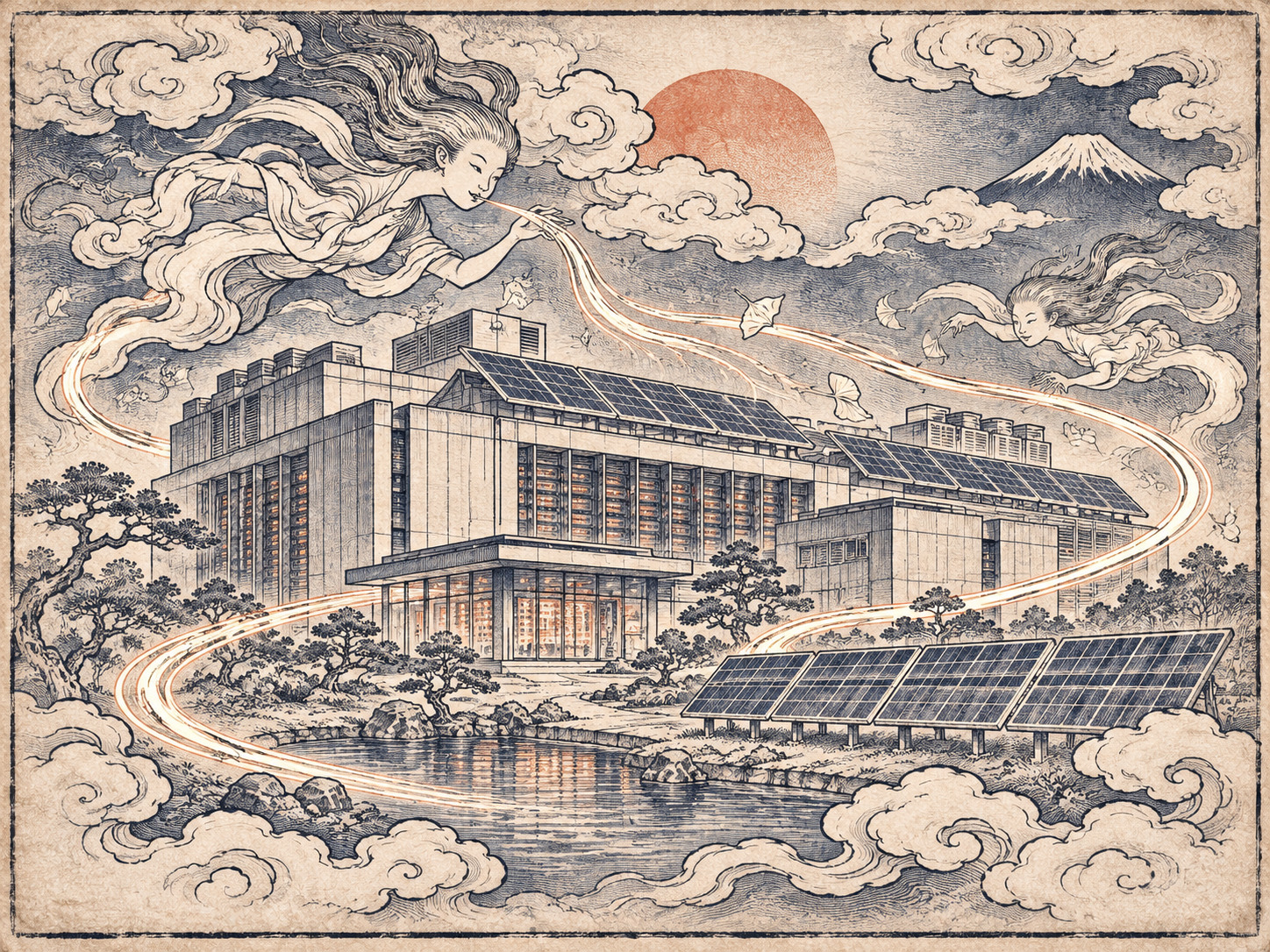
Solar farms in northern Kanto sit at the center of an unusual commitment associated with quantum research in Kawasaki. Fujitsu announced two long-term agreements on November 16: a 20-year virtual power purchase agreement with energy provider UPDATER and a 15-year agreement to procure carbon-removal credits through Tokyo Gas. They address different emissions sources. Neither can be understood simply as electricity flowing directly from the countryside to a computing laboratory, or as proof that Fujitsu’s physical emissions have reached zero. The significance of the arrangements lies in the increasingly demanding question facing technology companies: can their climate procurement help create new electricity supply and address residual emissions while their computing requirements grow?
Nine solar sites, four shared with agriculture
UPDATER says the contract was signed on September 18, 2026, and covers nine solar facilities in Ibaraki and Tochigi prefectures developed and operated by ENEGLOBAL. Four sites use agrivoltaics and five are conventional ground-mounted arrays. The agricultural activities include growing soybeans, potatoes, pumpkins and ginger beneath or alongside solar equipment. Such arrangements could help support rural incomes and use agricultural land for two activities, but coexistence is not guaranteed merely by placing panels above a field. Crop yields, sunlight conditions, machinery access, maintenance and local consent are part of the economic and environmental equation. The reviewed statements do not establish a verified aggregate annual generation volume, site-level capacities or the actual value of the contract.
Why a virtual power agreement is not a private power line
A virtual PPA separates renewable-electricity attributes from the physical delivery of grid electricity. The buyer can acquire eligible environmental attributes through a long-term contract while continuing to use an existing grid supply arrangement. Fujitsu intends to link the acquired attributes to research at a proposed Quantum Building at Fujitsu Technology Park. That does not mean electricity from the nine solar plants will flow over a dedicated wire to a quantum computer in Kawasaki. Physical electricity and the right to make a renewable-energy claim are different things. Traceable issuance, transfer and retirement of the relevant attributes, together with safeguards against double counting, are essential. Fujitsu’s own procurement principles identify those safeguards as basic requirements.
The tougher test of additionality
Corporate renewable procurement is increasingly judged by additionality: did the buyer help bring additional clean generating capacity into existence, rather than merely purchase a certificate associated with electricity already being produced? A two-decade commercial commitment can make revenues more predictable and could help renewable developers obtain financing. UPDATER says this arrangement supports new renewable capacity; Fujitsu has likewise made additionality part of its procurement strategy. But an asserted intention is not the same as a demonstrated counterfactual. To assess precisely what the contract enabled, independent reporting would need project commissioning histories, financing records and information showing whether the facilities would otherwise have proceeded. Those details are not established by the reviewed announcement.
A fifteen-year carbon-removal agreement with Tokyo Gas
In November 2026 Fujitsu signed an agreement with Tokyo Gas to procure nature-based carbon-removal credits from 2026 through 2040. The intended use is to address difficult-to-abate direct emissions from fuel-consuming equipment, including heating and on-site power-generation systems. Fujitsu says it will continue evaluating efficiency upgrades, electrification and lower-carbon fuels as these technologies become practical. Buying a removal credit is not the same as eliminating combustion at a facility. Nature-based removals also carry difficult questions: carbon storage can be reversed by wildfire or land-use change, measurement is uncertain and claimed removal must be verified and accounted for only once. The announcements reviewed do not identify the underlying projects, contracted quantities, prices or registry records sufficiently to assess their quality independently.
Understanding net-zero equivalent, not zero physical emissions
Fujitsu reports that its Japanese data centers and main Fujitsu Technology Park site already use 100% renewable electricity under its accounting methodology. It plans to apply removal credits to residual Scope 1 emissions after its fiscal-2026 inventory is finalized and thereby report net-zero-equivalent operational emissions at those sites. That is a future accounting outcome, not evidence that every piece of equipment will physically stop emitting greenhouse gases. Nor does it describe the whole group. Fujitsu reports a 67.5% renewable-electricity share across the group in fiscal 2025. The data-center and group-wide figures have different reporting boundaries. The ambition to source 100% of the electricity used in operations from renewables by fiscal 2030 remains a target rather than a completed transition.
Why the three emission scopes matter
Scope 1 covers direct emissions, such as fuel burned in company-owned equipment. Scope 2 concerns indirect emissions from purchased electricity, heat and steam. Scope 3 encompasses other value-chain emissions, including suppliers, logistics and the use of products sold. The Tokyo Gas arrangement primarily concerns Scope 1; the UPDATER VPPA addresses Scope 2 accounting. Fujitsu’s fiscal-2030 operational target covers Scopes 1 and 2 at business sites. Its fiscal-2040 net-zero goal is broader and includes Scope 3, alongside a stated aim to reduce the relevant emissions by at least 90% from fiscal-2020 levels. Physical reductions, contractual electricity attributes and carbon removals perform different functions. Combining them into a single undifferentiated claim makes meaningful scrutiny harder.
Three decades of environmental commitments
Fujitsu’s formal environmental action planning dates to 1993, an era when corporate environmental management often concentrated on factory emissions, chemicals and waste. As the information-technology sector expanded, attention turned to the electricity consumed by digital infrastructure and the emissions embedded in the supply chain. Fujitsu joined the RE100 renewable-electricity initiative in 2018. In 2023 its net-zero target received validation from the Science Based Targets initiative. The company’s twelfth environmental action plan, covering fiscal 2026 through fiscal 2030, places the environmental impact of customers and society alongside its own operations and supply chain. A long history of commitments provides context; it does not itself establish current performance. Progress still depends on comparable absolute-emissions data, credible procurement records and reporting boundaries that readers can understand.
A growing electricity question for advanced computing
Quantum research requires reliable electricity for control systems, cooling, laboratory instruments and related computing. Rapid expansion in advanced AI computing adds another layer of demand for power and thermal management. Fujitsu intends to associate renewable attributes from the new VPPA with its proposed Quantum Building, but the reviewed disclosures do not substantiate the facility’s eventual electricity use, commissioning date or an hourly match between research demand and solar production. Annual renewable-energy accounting and continuous carbon-free supply are not identical. The question is not whether the quantum computer will physically run on sunlight delivered from farmland. It is whether the procurement contract supports additional renewable generation while the company also reduces the amount of energy needed per unit of useful computing work.
The data that should follow the promises
The commitments span 20 years of renewable attributes and 15 years of planned carbon-removal procurement. Long contracts can help suppliers make investment decisions, but duration alone is not an outcome. Future verification should examine when each solar project was commissioned, how much it generated, how the environmental attributes were retired, how much direct fuel use Fujitsu actually eliminated, and which removal projects supply the credits. Continued agricultural production under the panels is another relevant measure of local value. Pricing and economic savings cannot be inferred from the reviewed disclosures. If corporate procurement is to become more than a change in the language of annual emissions reporting, those measurable results must eventually be available to researchers, investors, local communities and the public.
Sources and reporting limitations
Independent analysis based on materials released through November 16, 2026. No direct interviews or visits were undertaken. Contract values, annual attribute volumes and individual carbon-removal projects could not be verified.