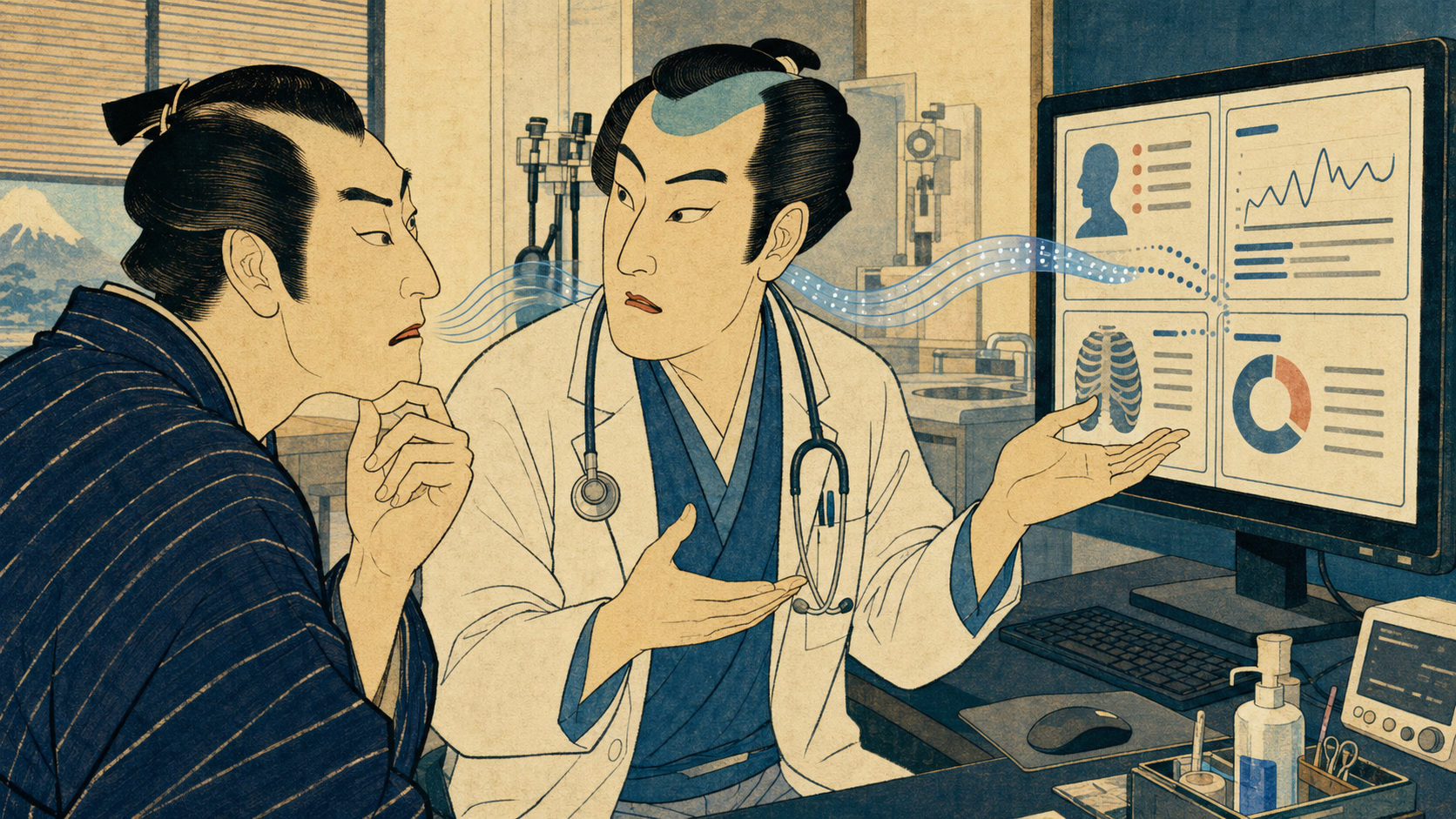
The scarcest thing in an examination room is not only time. It is attention. When a patient says, “I have felt a little dizzy in the mornings since my medicine changed,” a physician is watching complexion, pauses, posture and the expression of the family member in the next chair. At the same moment, the physician may be checking an old prescription, searching a laboratory result and trying to turn a human story into a compact medical record.
Fujitsu Japan’s latest product announcement proposes a new division of that work. A generative-AI voice-input option for the company’s HOPE LifeMark-TX Simple type cloud record system will capture a physician-patient conversation, transcribe it and transform the text into SOAP format: Subjective, Objective, Assessment and Plan. Fujitsu announced the sale on July 23, says service will begin August 31, and aims to win 100 users by the end of March 2028.
The company’s release is concise. It does not disclose the price, foundation-model provider, speech-recognition accuracy, processing latency, clinical-validation results, audio-retention policy, patient-consent workflow, performance by specialty, dialect or language, or how the software detects dangerous errors. It describes the central function and the intended result: less electronic-record entry and more physician attention for the patient.
Behind that short announcement are three much longer stories. One began in the 1960s, when Lawrence L. Weed tried to turn the medical record into an instrument of disciplined thought. One followed the migration from paper charts to computers, which brought search and sharing but also a vast new clerical load. The third is unfolding now, as microphones, automatic speech recognition and large language models combine to make a nearly finished draft from an ordinary conversation.
SOAP began as a sequence of reasoning, not a writing template
SOAP was not invented merely to make a chief complaint look tidy. In the 1950s, Weed—an American physician and teacher—became dissatisfied with records organized around the source of information: one pile for laboratory reports, another for physicians’ notes, another for nursing. The structure made it difficult to follow each problem a patient actually had. In a 1964 paper and a landmark two-part 1968 article in the New England Journal of Medicine, he described the problem-oriented medical record, or POMR.
The proposal was radical in its clarity. Do not mix hypertension, cough, family conflict and unexplained anemia into one undifferentiated chronology. Build a problem list. For each problem, separate what the patient reports, what clinicians observe or measure, what the clinician thinks it means, and what happens next. These became the four letters of SOAP. By 1973, according to a later medical-informatics review, 73 percent of U.S. medical schools taught some form of the problem-oriented record.
| Section | Its intended work | What conversation alone may miss |
|---|---|---|
| S — Subjective | Symptoms, chronology, effect on life, concerns and medication use as reported by the patient or family | Symptoms never voiced, matters too sensitive to say, and the clinical meaning of hesitation or silence |
| O — Objective | Examination findings, vital signs, tests, images and medication history observed or measured | A silent physical examination, laboratory values on another screen, a pill bottle or photograph shown but not described |
| A — Assessment | Differential diagnosis, severity, causal judgment and the relationship among problems | Possibilities weighed privately by the physician, probabilities and dangerous alternatives that must not be missed |
| P — Plan | Tests, treatment, explanation, referral, follow-up and instructions for deterioration | Orders chosen after the conversation, contraindication checks, formal prescriptions and scheduling actions |
This is the most important boundary for a generative system. Much of S—and some O explicitly stated aloud—is a task of extraction and organization. A and P contain professional judgment. If a patient says “my chest feels a little heavy” and the model writes “suspected acid reflux” under Assessment, it has done more than summarize. It has narrowed a differential diagnosis. If it supplies a plan the physician did not voice, a polished draft has become a false record.
SOAP has never been beyond criticism. A 1992 article titled “Why SOAP Is Bad for the Medical Record” challenged the supposedly clean divide between subjective and objective information and warned against forcing complex clinical stories into rigid boxes. Orderly appearance does not guarantee good reasoning. Generative AI can magnify that old weakness: filling four sections quickly is not the same thing as identifying the right problem, linking it to evidence and preserving uncertainty.
From paper to cloud: the record became more useful—and more work
A paper chart existed in one place, could not be read by several departments at once and was sometimes defeated by illegible handwriting. Electronic records made medications, test results, images and referral letters searchable and shareable. They connected documentation to ordering, billing and continuity of care. Fujitsu’s HOPE family expanded through this transformation. Japan permitted electronic storage of medical records in 1999; the product portfolio broadened through the 2000s; and Fujitsu introduced HOPE Cloud Chart for smaller and midsize hospitals in 2014.
Moving paper to a screen did not eliminate entry. It gathered many competing purposes into one note: care communication, reimbursement, compliance, quality measurement, legal evidence, patient access and research. Templates and copy-forward tools improved speed while creating duplicated, swollen records. Conventional voice dictation reduced typing but still required the doctor to compose record-ready sentences before speaking them.
A 2016 time-and-motion study of 57 U.S. ambulatory physicians found that during office hours they spent nearly two hours on electronic records and desk work for every hour of direct clinical face time, followed by another one to two hours of work at night. Japanese payment rules and workflows are different, but the underlying conflict travels: the record is essential, yet making it can consume the attention that gives the record meaning.
Ambient AI differs from dictation because the clinician does not have to speak in “chart language.” The system listens to the visit itself and constructs the draft. A simplified pipeline runs from audio capture to noise reduction, speaker identification, speech-to-text, normalization of medical terms, clinical extraction, SOAP generation, display in the record and clinician review, correction and signature. Every stage can fail independently, and an early error can be polished and propagated by every stage that follows.
Fujitsu is targeting the clinics that have not digitized
HOPE LifeMark-TX Simple type began in July 2024 for new practices and clinics adopting an electronic record for the first time. Fujitsu described it as a cloud service integrating clinical records and medical accounting, with support for online insurance-eligibility checks, electronic prescriptions and the HL7 FHIR data-exchange standard. “Simple” is not just a product label; it is the strategy for lowering the barriers faced by small providers.
Japan’s Ministry of Health, Labour and Welfare reported that electronic records were used by about 55 percent of medical clinics and 65 percent of general hospitals in 2023. Among bedless medical clinics, 57,662 had adopted a system while 47,232 had not. The national goal is for nearly all medical institutions to have records capable of sharing necessary patient information no later than 2030. Policy is moving toward lower-cost, cloud-native systems with multitenant software, standard APIs and data portability.
Voice AI can become a powerful argument to the large group that remains outside. It reframes an electronic record from “a machine that makes me learn to type” to “a tool that drafts as I talk.” Integration matters: if the same system carries information from reception to consultation, e-prescribing, billing and national data-sharing services, it can deliver more value than a stand-alone transcription app. Fujitsu’s advantage may be less the novelty of the language model than its position inside the clinic’s core record.
The goal of 100 users by March 2028 is modest beside Japan’s more than 100,000 bedless medical clinics. It looks like a scale for building early operational evidence and trust, not mass adoption. Nor is Fujitsu first to the idea. By 2026, Japan already had systems creating SOAP notes from home-nursing conversations, summarizing health-guidance interviews and connecting generative AI to hospital records. Fujitsu is entering an active field as a large incumbent, not unveiling ambient documentation to Japan for the first time.
The benefits are beginning to appear. The evidence is still young
Early international research suggests that ambient scribes can improve clinicians’ working experience. A 2025 JAMA Network Open study followed 263 ambulatory clinicians across six U.S. health systems using one platform for 30 days. In the primary adjusted analysis, self-reported burnout fell from 51.9 percent to 38.8 percent. Participants also reported less note-related cognitive load and after-hours documentation, and a greater ability to give patients undivided attention.
Another pre-post study of 46 clinicians found a 20.4 percent fall in time spent in notes per appointment, from 10.3 to 8.2 minutes, and a decline in after-hours work from 50.6 to 35.4 minutes per workday. Yet these were not randomized trials. Early adopters volunteered, observation periods were short, several outcomes were self-reported and each deployment used particular tools and workflows. Less documentation time is not automatically safer care or a better patient outcome.
A Veterans Health Administration simulation published in January 2026 supplies a useful counterweight. Sixteen specialists in cardiology, gastroenterology, hematology-oncology and neurology tested two ambient products during difficult standardized encounters involving interpreters, relatives and intrusive noise. Average note quality was a moderate 36.2 out of 50. Mean scores ranged from 42.2 in neurology to 32.0 in cardiology. Specialists also observed that findings from a physical examination often are not spoken to the patient at all, leaving an audio-only system with nothing to capture.
In a separate 2025 evaluation of 97 encounters, AI-generated notes were more thorough and better organized than comparison notes, but slightly worse in accuracy, succinctness and internal consistency. Reviewers detected hallucinated content in 31 percent of ambient notes and 20 percent of the comparison notes. Those figures belong to one product and one method; they do not measure Fujitsu’s system. They do show why “well written” and “said, observed and clinically judged” cannot be treated as synonyms.
| Potential benefit | Paired risk | Necessary safeguard |
|---|---|---|
| More physician attention for the patient | Patients disclose less because a system is recording | Advance explanation, affirmative permission, an easy pause and an equal opt-out path |
| Less work from a blank page | Automation bias toward fluent errors | Clinician review, correction and signature; prominent display of high-risk fields |
| More consistent and detailed notes | Note bloat, flattened priorities and irrelevant personal detail | Problem-oriented summaries, data minimization and audits for length and relevance |
| A gentler path into digital records | Outages, vendor dependence and new verification work | Manual fallback, portable data and measurement of total workflow time |
| Information ready for sharing and reuse | An error propagates into prescribing, referrals, billing and future visits | Separation of draft from final record, audit trails and double-checks for critical data |
More dangerous than mishearing: changing the meaning
A medical speech-recognition error is not merely a typo. Drop a negation and “no chest pain” becomes “chest pain.” Turn 0.5 milligrams into 5 milligrams, exchange right for left or substitute a similar-sounding medicine, and documentation can become a safety event. Masks, quiet older voices, overlapping speakers, waiting-room noise, abbreviations, regional speech and mixed-language encounters all change the recognition problem.
Generative AI then makes an imperfect transcript readable. That creates the second hazard: it may fill gaps instead of preserving them. A patient’s guess can migrate into the physician’s Assessment. A relative’s symptom can be assigned to the patient. A drug mentioned in a question can become an active medication. Edema observed silently during an examination disappears; a finding merely discussed can be written as present.
A safe interface should not treat every word equally. Medicine and dose, frequency, allergy, pregnancy, negation, laterality, dates, laboratory values and return precautions are high-risk elements. The Assessment and Plan should distinguish the physician’s explicit language from any model-generated organization or suggestion. Source-linked text or short audio could make verification faster—but storing source audio increases privacy risk and the damage of a breach. Accuracy and minimization have to be designed together.
What it means to record an examination room
A medical note contains highly sensitive personal information. The conversation before the note can contain even more: jokes the physician would never document, the names of relatives, employment, violence, sex, pregnancy, addiction, immigration status and financial hardship. Putting a microphone in the room is not simply a new keyboard. It creates a new data layer—the whole conversation—upstream of the clinician’s traditional act of selecting what belongs in the chart.
Japan’s Personal Information Protection Commission and health ministry require medical and care providers to specify and communicate purposes of use, maintain security, supervise contractors, establish responsibility and provide channels for questions. In June 2026, the ministry published version 7.0 of its safety-management guidelines for medical information systems and asked institutions to comply. A clinic adopting ambient AI must convert those principles into precise answers: who can access audio and text, where processing occurs, how long material is retained, whether it trains future models, when it is deleted, and what happens after an outage or breach.
A small sign at reception is not a sufficient patient experience. People should be told, in brief comprehensible language, that the encounter is being captured, that the purpose is a draft clinical note, whether audio is kept and for how long, whether outside processors are involved, that refusal does not change the terms of care, and that listening can be stopped during the visit. A 2025 consent study found that patients and clinicians emphasized trust, technical understanding and flexible consent. In a preimplementation survey of roughly 1,900 patients, 48 percent were favorable, 33 percent neutral and 19 percent unfavorable toward an AI scribe; comments frequently raised accuracy and privacy, and respondents considered advance education and permission important.
Domestic violence, sexual and reproductive health, mental health, genetic counseling, substance use, minors, interpreters and impaired cognition demand special care. “Always on” should not be the default. A patient must be able to pause the device by topic as well as reject it by visit, without receiving less attention, a longer wait or inferior care.
The questions missing from the announcement
Fujitsu Japan’s July 23 release establishes a direction, but it does not provide enough information for a clinic to assess safety or return on investment. That does not prove a defect; it is an early product announcement before service begins. It does mean buyers should require answers and contractual commitments, not rely on the fluency of a demonstration.
- Accuracy: How was transcription and each SOAP section evaluated in real Japanese consultations? Are results stratified by specialty, age, sex, dialect, second language and noise?
- Clinical validation: Were physician ratings, controls, sample size, exclusions, serious errors and editing time reported?
- Responsibility: Is output always marked as a draft, unable to become a final record or order until reviewed and signed?
- Evidence: Can medicines, negations, assessments and plans be traced to the source conversation? Does the system flag uncertainty?
- Audio: Is original audio stored? Where, encrypted how, for how long, deleted when, and recoverable by whom?
- Model training: Is patient information reused to improve models? If so, is there separate consent, meaningful de-identification and an opt-out?
- Subprocessors: Who supplies speech recognition, the generative model and cloud service? Is there overseas transfer or further subcontracting?
- Access control: How are staff and vendor privileges, logs, audits and termination of access managed?
- Consent: Are scripts, documentation, withdrawal, pausing, minors, proxies and interpreters built into the workflow?
- Downtime: Can care continue during a network or service failure without losing the record?
- Total labor: Does time really fall after initiation, consent, review and correction—not merely generation—are counted?
- Price and exit: Are setup, subscription, usage and audio-processing charges clear, along with export and deletion when the contract ends?
Evaluation should continue after purchase. In the first months, a clinic should track correction rates, serious errors, note-closing time, after-hours work, patient refusal and complaints, downtime and differences among specialties. Privacy-preserving samples should be audited. Are records longer than before? Are Assessment and Plan filling with generic prose? Is an error being copied forward into the next visit?
“100 users” is not a sufficient definition of success. Did eye contact increase? Could the physician confirm the plan with the patient before the visit ended? Did staff stop finishing charts at night? Did patients feel that the note represented their words? Did the rate of consequential errors approach zero? The product’s real value will be attention and safety recovered, not seats licensed.
From an AI that records to medicine that listens
In 1968, Weed wrote that a more organized record, rational use of allied personnel and a positive approach to computers would become obligatory parts of a physician’s environment. He was not asking for a machine that produced more prose. He wanted records that defined problems, separated data from judgment and allowed the next clinician to follow the reasoning.
Generative AI can move toward that ideal or away from it. If it faithfully captures the patient’s words, preserves uncertainty and asks the physician to verify what matters, SOAP can again become a tool for thought. If the system prizes filled sections, silently repairs missing information and substitutes length for accuracy, the chart becomes orderly noise.
Fujitsu Japan’s option is not a spectacular diagnostic machine. It is designed to take on clerical work behind the consultation. That modesty contains its promise. When nearly half of Japan’s clinics still lack electronic records, a natural conversation could become the bridge into digital medicine—and “medical DX” could come to mean recovering human time rather than installing more equipment.
But the center of the examination room is neither the microphone nor the model. It is the relationship between patient and physician. Software can listen, but it cannot respect hesitation, accept responsibility or sign a clinical judgment. In the best implementation, the patient knows the system is present and can say no; the doctor remains skeptical of the draft; and the vendor makes performance and data flows visible. When the visit ends, the screen holds a short, accurate record. What the patient remembers is that the doctor was looking at them.
Sources and references
This report cross-checked Fujitsu Japan’s announcement against Japanese government material, the history of SOAP and electronic records, and peer-reviewed studies of ambient clinical AI. It does not infer undisclosed details of Fujitsu’s price, model, accuracy, storage or consent design. Results from other products do not establish the performance of Fujitsu’s system.
- Fujitsu Japan: generative-AI voice option for HOPE LifeMark-TX Simple type (July 23, 2026)
- Fujitsu Japan: official announcement PDF
- HOPE LifeMark-TX Simple type launch overview (2024)
- Ministry of Health, Labour and Welfare: electronic prescription and medical-record targets (July 1, 2025)
- MHLW: Guidelines for Safety Management of Medical Information Systems, version 7.0 (June 2026)
- Personal Information Protection Commission and MHLW: guidance for medical and care providers (revised April 2026)
- Lawrence L. Weed: “Medical Records That Guide and Teach,” part one (NEJM, 1968)
- Lawrence L. Weed: “Medical Records That Guide and Teach,” part two (NEJM, 1968)
- JAMIA: oral history with Lawrence Weed, inventor of the problem-oriented record (2014)
- JAMIA Open: history and modern implementation of problem-oriented documentation (2023)
- Donnelly and Brauner: “Why SOAP Is Bad for the Medical Record” (1992)
- Sinsky et al.: allocation of physician time in ambulatory practice (Annals of Internal Medicine, 2016)
- JAMA Network Open: ambient AI, administrative burden and burnout across six systems (2025)
- JAMA Network Open: documentation time and burden among 46 outpatient clinicians (2025)
- JAMA Network Open: physician perspectives on ambient AI scribes (2025)
- JAMA Network Open: ambient scribing in simulated encounters across four specialties (2026)
- Journal of Clinical and Translational Science: quality and hallucination assessment of AI-generated notes (2025)
- npj Digital Medicine: multiperspective study of an ambient scribe in Dutch general practice (2026)
- npj Digital Medicine: barriers and opportunities in scaling ambient clinical scribes (2026)
- JAMA Network Open: informed consent for ambient generative-AI documentation (2025)
- Journal of Medical Internet Research: patient attitudes toward ambient voice technology (2025)
- NEJM: the value and retention dilemma of AI-generated visit transcripts (2026)
- Fujitsu: HOPE/EGMAIN-LX for midsize hospitals (2011)
- Fujitsu Technology and Service Vision: HOPE Cloud Chart and cloud records (2015)