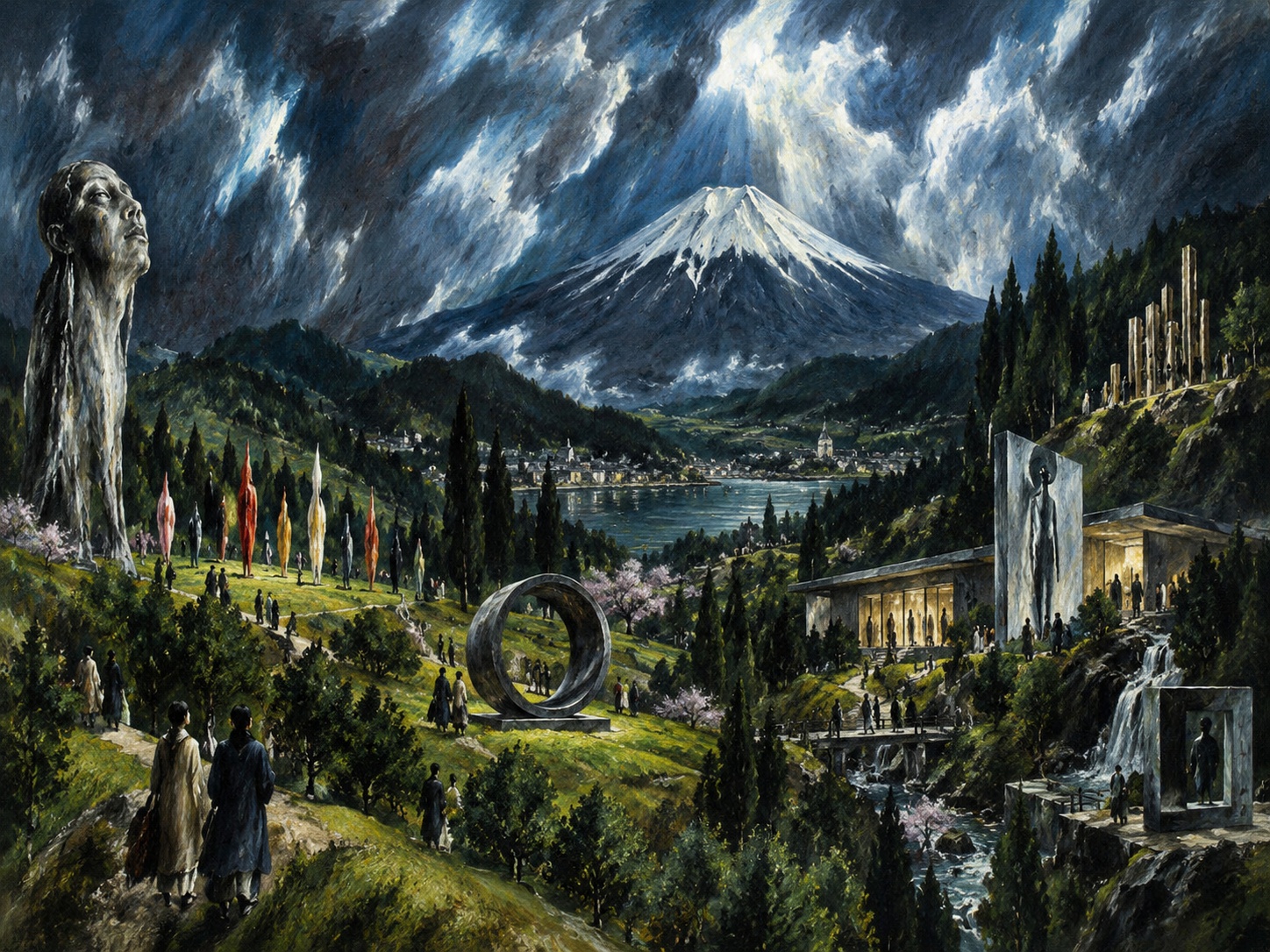
A conventional museum asks the outside world to recede. Temperature, lighting and wall color are controlled so that the object can hold the viewer’s attention.
Fuji Art Festival 2026 is built around the opposite proposition. A temple hall, a Meiji-era merchant residence, the childhood home of a Nobel laureate, a former sake brewery, a workshop and a museum all carry histories that cannot be neutralized. The journey between them matters too.
From October 17 through November 15, Fuji Art Festival 2026 will connect 17 venues across Yamanashi Prefecture. The first edition in 2022 operated at roughly 10 sites; the 2026 version expands across Kofu, Chuo, Yamanashi, Nirasaki, Hokuto and the southern and Fuji Five Lakes areas. The official site calls it a wide-area circulating art festival that links cultural resources not as isolated “points” but as “lines and surfaces.”[1][2][3]
A September 14 announcement uses an even more ambitious phrase: “all of Yamanashi becomes a museum.”[1] It is a promotional metaphor, but a useful one. The event is asking visitors to treat the prefecture between the galleries as part of the exhibition.
Seventeen venues do not all open for the entire month
The overall festival runs October 17-November 15, but the individual sites have different exhibition periods and closing days.[4]
Three Nirasaki sites — the Emperor Meiji Maruno Rest Stop, Satoshi Omura’s childhood home Keisetsuryo and the Nirasaki merchant storehouse residence — are scheduled for October 17-25. The Hirayama Ikuo Silk Road Museum and Paul Rusch Memorial Museum in Hokuto use the same festival window. By contrast, the Kondo Koichiro Memorial Nanbu Town Museum of Art is scheduled across the full October 17-November 15 period. ART SPACE Yume in Kofu opens only October 31-November 8; the former Futabaya sake brewery in Ichikawamisato is scheduled for November 7-15.[4]
This is not a festival designed for ticking all 17 boxes in one day. The week a visitor chooses changes the exhibition that exists.
| Item | Published plan |
|---|---|
| Overall dates | October 17-November 15, 2026 |
| Venues | 17 sites across Yamanashi |
| Municipalities | 10: Kofu, Chuo, Yamanashi, Nirasaki, Hokuto, Ichikawamisato, Fujikawa, Minobu, Nanbu and Fujikawaguchiko |
| Artists | Official site describes roughly 40 participating artists |
| Format | Wide-area art festival using temples, historic buildings, museums, a former brewery, workshops and memorial sites |
| Cycle | Once every four years; next planned edition 2030 |
| Previous edition | First festival in 2022, approximately 10 venues |
The official theme is broad; the deeper concept is the “living place”
The festival’s formal theme line is “Emotion! Experience! Discovery! A month to encounter Yamanashi’s great figures and traditional crafts through art.” The official site also uses a conceptual phrase that is more revealing: recover the feeling of being alive in “living places.”[2][3]
The September 14 ticketing release additionally describes the 2026 theme as “living.”[1] Because the official Overview page uses the longer “Emotion! Experience! Discovery!” phrase in its Theme field, Japan.co.jp treats “living” as part of the curatorial and promotional concept rather than the only formal title.
The distinction matters. A regional art festival can easily blur curatorial ideas, marketing language and economic-development goals. Fuji Art Festival is openly carrying several ambitions at once: contemporary art, heritage protection, traditional craft, tourism, food, regional identity and local economic circulation.
Mount Fuji entered UNESCO as culture — faith and artistic inspiration — not simply scenery
The festival is not using Mount Fuji only because it is Japan’s tallest and most recognizable mountain.
UNESCO inscribed Fujisan in 2013 as a cultural World Heritage property under the title Fujisan, sacred place and source of artistic inspiration. Its 25 component sites collectively represent centuries of mountain worship and artistic representation.[6][7]
By the twelfth century, the mountain had become a center for ascetic practice. In the Edo period, Fuji-ko pilgrimage groups expanded popular worship. Summit sites, routes, Sengen shrines, oshi lodging houses, lakes, springs, waterfalls and lava formations are understood as parts of one cultural system rather than isolated monuments.[6][7]
The artistic side is equally central. Representations of Fuji date back at least to the eleventh century. Nineteenth-century woodblock series by Katsushika Hokusai and Utagawa Hiroshige spread the mountain’s image internationally and influenced Western art — a relationship UNESCO explicitly includes in the site’s Outstanding Universal Value.[6][8]
Connecting Fuji and art is therefore not a contemporary branding invention. The 2026 festival is entering a visual history nearly a millennium old.
Hokusai changed the viewpoint; this festival changes the viewer’s location
One reason Hokusai’s Thirty-Six Views of Mount Fuji remains so powerful is that Fuji is never merely one fixed frontal image. The mountain appears behind labor, bridges, waves, streets and journeys, changing according to where ordinary people stand.
The structure of a 17-site festival creates a related experience, even though the curators do not claim a direct Hokusai model. Instead of looking at Fuji from one observation deck, a visitor moves through the Kofu Basin, Yatsugatake foothills, southern Yamanashi and the Fuji Five Lakes area.
Not every venue has a Fuji view, and not every artist is depicting Fuji. The festival’s subject is broader: the cultural territory that has developed around and beyond the mountain.
A temple cannot behave like a white cube
Kai Zenkoji in Kofu was established by warlord Takeda Shingen in 1558 when sacred images and treasures were moved from Shinano Zenkoji out of concern that warfare could destroy them. Its main hall and gate are nationally designated Important Cultural Properties, and the main hall is among eastern Japan’s largest wooden structures.[9]
Kaizenji in Chuo City is another festival site. Executive Committee chair Taido Ishida is both a contemporary artist and the temple’s resident priest; the festival schedule also includes a large-brush calligraphy performance there on November 3.[10]
Contemporary art installed in a temple acquires things a museum can usually suppress: ritual use, scent, acoustics, old wood, religious symbolism and accumulated memory.
The problem becomes more interesting than “does the work look good?” The work can resist the place, disappear into it or reveal something already present.
A Meiji merchant house turns modern art into an introduction to local economic history
The Nirasaki merchant storehouse residence is a city-designated cultural property dating to the early Meiji era. It survives from the Ono family residence, a merchant household that operated a sake business on the Koshu Kaido. The interior retains a formal shoin-style room with alcove, staggered shelves and attached desk; the building was later relocated to its present site.[11]
The family home is also associated with Kinroku Ono, founder of the Fuji-Minobu Railway Company.[11]
Three contemporary artists — Ryoji Kato, Aketoshi Tada and Kazuhito Watanabe — are scheduled to exhibit there in 2026.[4]
A person who comes for the art can leave knowing something about merchant life, the old highway and the modernization of transportation in Yamanashi. The artwork becomes a reason to enter local history.
The childhood home of a Nobel laureate becomes an art venue
Keisetsuryo in Nirasaki Omura Memorial Park was the childhood home of Satoshi Omura, winner of the 2015 Nobel Prize in Physiology or Medicine. The main house dates to around 1907 and the storehouse to around 1916; their value as a representative sericulture-farming residence led to registration as a national Tangible Cultural Property.[12]
There is an unusual layering here. Omura is a scientist, but also a major art collector, and the same park includes the Nirasaki Omura Museum of Art.
Ayaka Kobayashi, Miko Niikawa, Yuka Hiroshima and Rena are scheduled to exhibit at Keisetsuryo during the festival.[4][12]
The site makes the festival’s phrase “places associated with great figures” concrete: modern art is not being placed in a generic heritage house but in a building already carrying a story about science, rural upbringing, collecting and regional memory.
At Yatsugatake, a museum about cultural movement complicates the idea of “local identity”
The Hirayama Ikuo Silk Road Museum in Hokuto collects Hirayama’s paintings and cultural material connected with the Silk Road. It began in 1999 as the Yatsugatake Silk Road Museum and took its current name in 2004.[13]
Hirayama traveled widely from the 1960s through Turkey, Afghanistan, China, Central Asia and West Asia. He described the Silk Road as a route through which Buddhism and many parts of what became Japanese culture arrived from elsewhere.[14]
That creates a useful tension inside a festival emphasizing Yamanashi’s distinctive heritage. Local culture is not produced by isolation. It is also the outcome of travel, borrowed forms, imported ideas and adaptation.
Hokuto’s other festival venues — the Paul Rusch Memorial Museum and the Kudo Teruhi Museum of Art — add still more distinct local narratives to the Yatsugatake section.
Southern Yamanashi connects contemporary art to paper, ink and production
The southern cluster includes the former Futabaya sake brewery in Ichikawamisato, Sunanta Workshop in Fujikawa, Nakatomi Annex in Minobu and the Kondo Koichiro Memorial Nanbu Town Museum of Art.[4]
This is also a region deeply connected to paper and ink culture. Yamanashi Prefecture traces Ichikawa Daimon hand-made washi to ancient origins, with protection as paper supplied to the Takeda family and later the Tokugawa government. Nishijima washi and the roughly 300-year history of Amehata inkstones form part of the same southern craft landscape.[15]
The festival’s own concept foregrounds Koshu inden lacquered deerskin, Koshu crystal and gemstone carving, Ichikawa paper and Gunnai textiles as local traditions to be reinterpreted through contemporary art.[2]
That changes the meaning of “heritage.” Instead of preserving a craft only as a finished object behind glass, the festival imagines artists entering the material process and making something that could not have existed in an earlier generation.
Yamanashi craft begins in geology, water and climate
Many of the prefecture’s crafts make little sense detached from geography.
Koshu crystal carving grew from the long history of quartz found around the Mitake-Shosenkyo area; polishing and carving developed into a specialized industry through the Edo and Meiji periods. Koshu inden has used lacquer patterns on deerskin for more than 400 years. Gunnai weaving has more than a millennium of history in communities at the foot of Mount Fuji.[15][16]
If an art festival wants to work seriously with craft, showing a finished object in a Tokyo gallery loses some of the story. The mountain from which stone came, the water needed for paper, the factories, the old trading towns and the people maintaining specialized tools all matter.
A distributed festival can make that background visible simply by forcing the visitor to travel through it.
From 10 venues in 2022 to 17 in 2026
The first Fuji Art Festival ran from October 22 to November 27, 2022, connecting 10 venues including a sake brewery, old houses, temple grounds, a former school and museums. Its organizers described the aim as drawing attention to nature, culture, everyday life and local industry around Fuji through art and workshops.[17]
For 2026, the organizers have formalized a four-year cycle: three years of “cultivation” followed by a major festival year. The off-years are supposed to include artist residencies, technical research with craftspeople, smaller exhibitions and workshops. The next major edition is planned for 2030.[2][3]
That model is an attempt to address one of the recurring weaknesses of regional art festivals: relationships and funding can disappear as soon as the visitors do.
If the three-year cultivation period actually remains active, the process before the festival becomes part of the cultural output rather than invisible preparation.
“Not a one-off event” is the hardest promise to keep
The executive committee says it wants the festival to function as a cultural platform crossing tourism, regional industry and educational experience, generating a population of people with continuing relationships to Yamanashi while supporting cultural succession and the regional economy.[18]
That ambition is much harder than running a successful month of exhibitions.
A tourist taking a photograph does not train the next craftsperson. A temporary installation can bring attention to a heritage building without paying for its maintenance after November. More visitors can create spending, but they can also create parking and traffic burdens for small communities.
A true “platform” therefore has to be evaluated after the event has ended.
Dispersion is the festival’s strength — and its largest access problem
Yamanashi is not one compact city. Kofu, Hokuto, Nanbu and Fujikawaguchiko are far apart, and the 17 sites have radically different transportation conditions.
The festival has announced official bus tours, and its ticket material explicitly says that travel time and encounters with local people are intended to be part of the experience.[19]
But calling travel part of the artwork does not eliminate the logistical problem. People who do not drive, international visitors, older people, disabled visitors and travelers with limited time can experience dispersion as exclusion rather than enrichment.
If “all of Yamanashi is a museum” is to function as more than a slogan, transport, multilingual information, accessibility and accommodation have to be treated as parts of exhibition design.
The 17 sites are not standardized galleries
A museum curator can normally control lighting, humidity, wall color and the distance between works. The Fuji Art Festival cannot — and that is precisely the point.
Kofu Kameyaza is a modern municipal historical-cultural exchange facility modeled conceptually on the Kameyaza theater that existed in the Edo period, designed to reconnect people with Kofu’s “Little Edo” entertainment culture.[20]
The Kondo Koichiro Memorial Nanbu Town Museum of Art, by contrast, is a municipal art museum devoted in part to Koichiro Kondo, a Nanbu-born artist associated with the development of modern ink painting. Masatsugu Ito is scheduled to be the festival artist there.[21][4]
Calling both an “art venue” hides the most interesting fact: they are fundamentally different cultural machines.
The exhibition has to respond to that difference, or there is little reason to be distributed at all.
Roughly 40 artists inherit the stories of particular places
The official site describes roughly 40 participating artists. Executive Committee chair Taido Ishida, vice chairs Yataro Amemiya and Masatsugu Ito, adviser Ryoji Kato and artists including Yoshihiro Suda, Tokuro Sakamoto, Kyoko Kumai, Junko Maruyama and Katsutomo Wakabayashi appear across the venue lists.[2][4]
The September 14 announcement illustrates the festival with works including Kumai’s Nayuta, Sakamoto’s Fuji, Maruyama’s Alles Lebt, Ito’s Requiem and Ishida’s Forest of Flowers.[1]
Those promotional examples should not automatically be read as a final installation list or as proof that each work is a newly commissioned site-specific piece. The organizers say artists are continuing to develop work in relation to their sites and themes, and final displays remain subject to venue information.[5]
Food is part of the festival because time in the region matters economically
The official concept gives equal billing to “Art & Spirit,” “Gastronomy” and “Nature & Heritage,” naming wine, whisky, grapes and peaches as part of the Yamanashi experience.[2]
That is not merely lifestyle packaging.
The economic effect of a dispersed festival is rarely concentrated in ticket revenue. It comes through transport, meals, lodging, shopping and longer stays. A 17-site itinerary takes time. If that time becomes a reason to eat and sleep locally rather than an inconvenience to minimize, cultural tourism can circulate money beyond the exhibition organizer.
The opposite is also possible: visitors can drive from artwork to artwork, take photographs and leave. A festival making economic claims should therefore measure length of stay and local spending, not just door counts.
Mount Fuji must be more than a photographic backdrop
Any project using Fuji faces an easy temptation: put the mountain on the poster and regional identity appears instantly.
UNESCO’s cultural definition is more demanding. Fuji’s significance lies in the long relationship between landscape and people — pilgrimage, religious practice, springs and lakes, shrines, lodging houses, poetry and visual art.[6][7]
A serious contemporary festival therefore has to go beyond producing more images of the cone. Water, stone, paper, weaving, worship, highways, farming, tourism and the ways daily life changes with geography can all be part of the story.
The decision to extend the festival beyond the Fuji Five Lakes into Kofu, Yatsugatake and southern Yamanashi suggests that the organizers understand Fuji as a cultural center of gravity rather than a literal view from every venue.
Judge the festival by whether the “lines” remain after November
Japan.co.jp’s analysis is that the strongest measurement of 2026 will not be the number of works installed or images posted to social media.
- Circulation: how many venues and municipalities did the average visitor enter?
- Length of stay: did the festival produce overnight and multi-night travel?
- Local spending: did restaurants, transport, craft shops and local producers share in visitor expenditure?
- Local participation: how deeply were residents, craftspeople, students and venue staff involved in making work?
- Continuity: do collaborations continue during the three “cultivation” years?
- Access: could visitors without private cars realistically experience multiple sites?
- Return visits: do people come back to these places when there is no festival?
The official phrase “connect points into lines and surfaces” becomes meaningful only if some of those lines survive after the installations come down.
What does it really mean for all of Yamanashi to become a museum?
A museum does more than display objects. It conserves, researches, interprets and creates conditions in which the public can encounter cultural material responsibly.
If the metaphor of Yamanashi as a museum is taken seriously, old buildings need maintenance. Craft skills need successors. Local figures need interpretation that makes sense to new generations. Visitors need routes that do not overwhelm communities. Those are museum tasks on a regional scale.
Fuji Art Festival began with 10 venues in 2022. In 2026 it grows to 17.
Expansion does not prove success. It increases the difficulty of tying art, heritage, transport, community participation and economic benefit into one coherent experience.
But that difficulty is also the argument for the festival. Instead of constructing one new giant cultural building and asking Yamanashi to come to it, the organizers are turning things that already exist — temples, homes, workshops, museums, a scientist’s childhood house and old commercial spaces — into reasons to travel.
For centuries, Mount Fuji has been viewed from afar, climbed, worshiped and drawn. In 2026, the mountain becomes the center of another kind of movement: an invitation to move sideways through the prefecture and notice what usually sits outside the famous view.
If visitors leave remembering not only the artworks but also “I did not know this town had this place,” then the phrase “all of Yamanashi becomes a museum” will have become something more durable than a one-month slogan.
Sources & Reference Material
- The Chain Museum, Fuji Art Festival 2026 — 17 venues across Yamanashi, Sept. 14, 2026
- Fuji Art Festival 2026 official homepage
- Fuji Art Festival 2026 official overview
- Fuji Art Festival 2026 official venue guide — 17 sites, schedules and artists
- Fuji Art Festival 2026, kickoff gathering and site-based production program, July 2026
- UNESCO World Heritage Centre, Fujisan, sacred place and source of artistic inspiration
- Yamanashi Prefecture, component sites of the Fujisan World Cultural Heritage property
- Yamanashi Prefecture, Fujisan — object of faith and source of art
- Kofu City, Kai Zenkoji
- Fuji Art Festival 2026 official event program
- Nirasaki City, Nirasaki merchant storehouse residence
- Official Yamanashi tourism network, Nirasaki Omura Memorial Park and Keisetsuryo, Jan. 13, 2026
- Hirayama Ikuo Silk Road Museum, museum history
- Hirayama Ikuo Silk Road Museum, Ikuo Hirayama biography and Silk Road work
- Yamanashi Prefecture, traditional crafts including crystal carving, inden, washi and inkstones
- Yamanashi Prefecture, Gunnai textiles and the thousand-year weaving tradition at the foot of Fuji
- ART JAPAN Wa Society, Fuji Art Festival 2022 archive
- Fuji Art Festival 2026 planning document — 17-site map and cultural-platform concept
- Fuji Art Festival 2026 official ticket announcement, July 15, 2026
- Kofu City, Kofu Kameyaza historical-cultural exchange facility
- Nanbu Town, Kondo Koichiro Memorial Nanbu Town Museum of Art
Sources checked through September 14, 2026. The official English name is Fuji Art Festival 2026. Venue schedules vary; not all 17 sites are open continuously from Oct. 17 through Nov. 15. The artist count uses the official site's wording of 'roughly 40.' Works illustrated in Sept. 14 promotional material are treated as representative examples, not as proof that every illustrated work is a new commission or final installation. The official site's Theme field uses the 'Emotion! Experience! Discovery!' wording; references to 'living' are treated as part of the broader curatorial concept. Attendance and economic-impact figures for 2026 do not yet exist because the festival has not opened. Analysis is by Japan.co.jp.