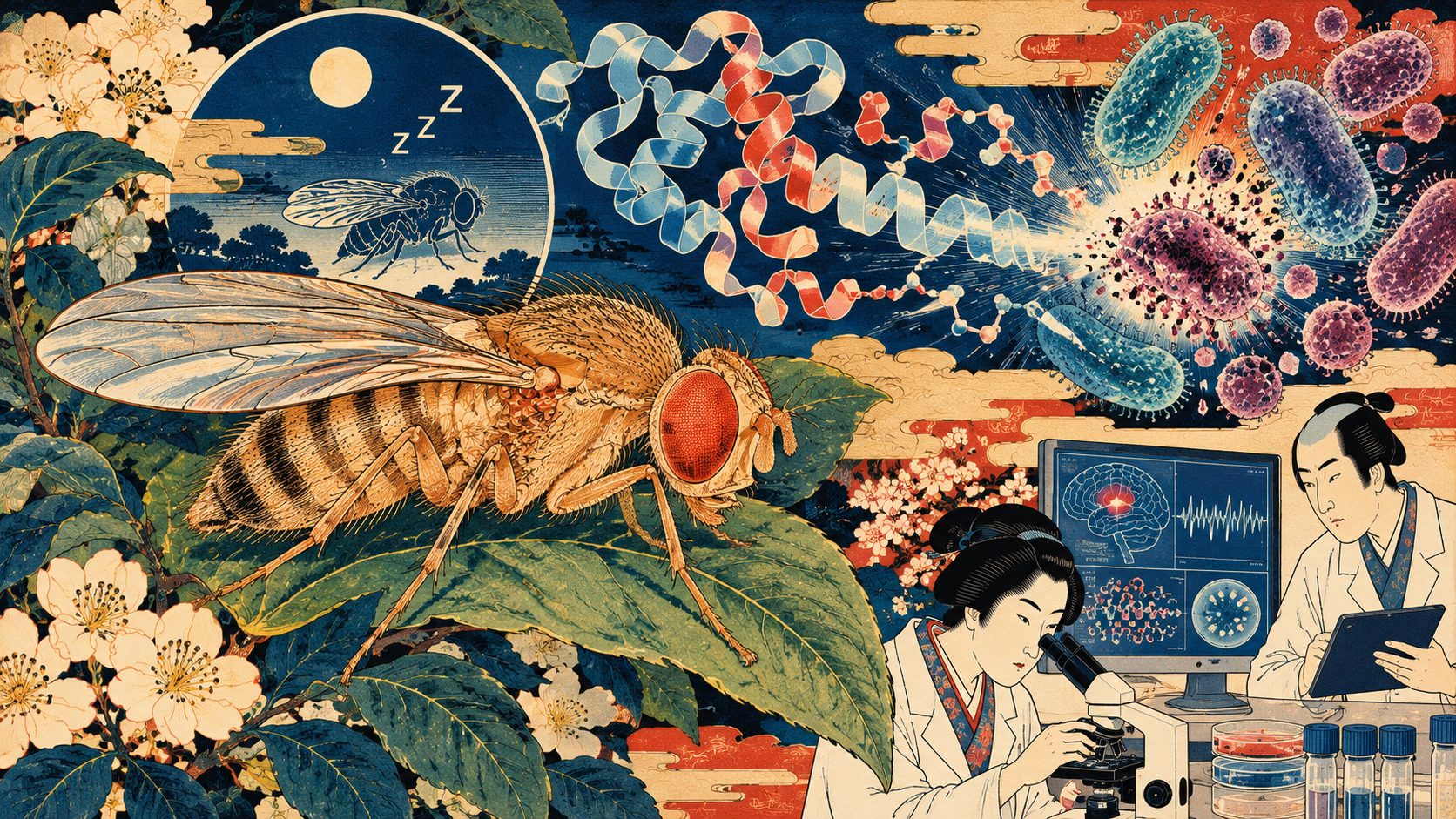
A sleeping fly, a stalled bacterial factory
One of the most intriguing ideas in antimicrobial research now begins with a tiny animal going to sleep. Researchers in Japan have characterized peptides derived from Nemuri, a fruit-fly protein associated with sleep, that can stop bacterial growth by interfering with the molecular machinery of protein production. Their study appeared in Nature Communications on October 29, 2026; Hokkaido University highlighted it the following day. It is an imaginative finding backed by laboratory evidence, but it is not an approved treatment or evidence of a cure for resistant infections.
The Japanese name at the center of the discovery
Nemuri takes its name from the Japanese word for sleep. Rather than testing the intact sleep-related protein as a medicine, the researchers identified several shorter antimicrobial peptides generated from it. A collaboration involving Hirofumi Toda at the University of Tsukuba’s International Institute for Integrative Sleep Medicine and Professor Nobuo Noda at Hokkaido University’s Institute for Genetic Medicine investigated what these fragments do to microbes. The work should be credited to the joint team, not attributed solely to Hokkaido University.
The story reaches back to 2019
The link between sleep and host defense did not begin in October. Earlier work reported in 2019 established Nemuri as a sleep-promoting factor in fruit flies and connected it with the response to infection. Toda’s laboratory describes how fruit-fly genetic screening was used to discover pathways associated with sleep behavior. Such experiments can illuminate conserved biological principles, but findings in Drosophila cannot automatically be transferred to human sleep or immunity. The importance of the 2026 study is that it investigates a detailed antimicrobial mechanism rather than stopping at the behavioral observation.
A route into bacteria without obvious membrane destruction
Antimicrobial peptides often attract attention because some can disrupt the envelopes that protect microbial cells. The Nemuri-derived fragments described in the new study behaved differently in the experiments. They entered bacterial cells without the overt membrane damage researchers would expect from a primarily membrane-rupturing mechanism. The peptides accumulated in regions rich in RNA and ribosomes. This distinction matters because it directs attention away from the bacterial surface and toward physical organization inside the cell. It does not prove that membranes play no role in every context.
How to disable a cell’s protein-making machinery
Ribosomes translate genetic instructions into proteins. Many antibiotics interfere with that process by binding to defined sites on a ribosome. Here, the authors describe a different type of interference: the Nemuri fragments make multiple contacts with RNA and ribosomal surfaces and remodel ribosome-rich regions into condensed assemblies with reduced mobility. Protein production then falls. In accessible terms, the peptides appear to interfere with how the bacterial protein-making machinery is arranged and moves, not simply with one molecular switch on that machinery. The researchers describe this as ribosomal condensation.
What was actually tested
The universities reported growth inhibition across a range of microorganisms, including drug-resistant pathogens. In tests involving Escherichia coli and Staphylococcus aureus, they also reported bactericidal activity at comparable concentrations to those that blocked growth. The announcements do not provide a complete strain-by-strain efficacy table. Any comparison with specific prescription antibiotics or claim of effectiveness against all resistant bacteria requires scrutiny of the paper’s assay conditions, concentrations and controls. In vitro activity is an important observation, not a clinical outcome.
Low toxicity is promising, not a safety certificate
The team reported low cytotoxicity in cultured insect and mammalian cells. That finding is encouraging for a potential drug-development program because a substance that harms host cells as readily as microbes would be difficult to use. But cell culture cannot resolve whole-body questions: stability in blood, distribution to infected tissues, immune responses, clearance, dose requirements and adverse effects. Nor do the findings show that these peptides have already treated infections in animals or humans. The researchers explicitly identify animal infection-model testing as a future step.
Why a new mechanism matters for drug resistance
Antimicrobial resistance is a global challenge in part because microbes can evade agents that act through familiar pathways. The Nemuri work suggests that the spatial arrangement and dynamics of bacterial ribosomes might be exploited as a therapeutic vulnerability. That is conceptually different from targeting a single conventional ribosomal binding pocket. Nevertheless, a different target is not a guarantee that resistance cannot emerge. Repeated exposure, evolutionary adaptation, differences between bacterial species and interactions with the normal microbiome remain substantial questions.
A broader shift in how scientists think about cells
The study also speaks to a newer language in molecular biology: biomolecular condensates. Researchers increasingly examine how RNA and proteins form dynamically organized groups that help control cell processes. Their physical behaviors matter alongside the chemical identity of individual molecules. The Nemuri experiments use that framework to investigate bacterial protein synthesis. This does not mean a bacterium has a human-style organelle or that all condensates are harmful; the striking point is that changing intracellular organization can itself have antimicrobial consequences.
The long road from an elegant experiment to a medicine
The study’s next hurdles include tests in infected animals, deeper toxicology, pharmacokinetics, stability, manufacturing practicality, immune reactions and the possibility that bacteria evolve resistance. Peptide medicines face delivery and degradation challenges that are not captured by a dish of bacterial cells. The researchers have not supplied a verified timeline for clinical trials or commercialization in the primary announcements. Headlines implying that a new antibiotic is ready for patients would therefore seriously overstate the work.
An unexpected intersection worth watching
The discovery is worth attention because it crosses disciplinary boundaries in a surprising but testable way. A molecule known through fruit-fly sleep research yielded peptides that interfere with the organization of bacterial ribosomes. Whether that insight ever becomes a practical antimicrobial medicine remains uncertain. For now, it provides a new question for chemists, microbiologists and drug developers: can the physical dynamics of a microbe’s protein factory become a useful target for future therapies?
Sources and reporting method
Based on primary university and JST announcements, the publicly available original-paper abstract and researcher profiles. Full-paper access was restricted during production; details requiring its complete experimental tables are not asserted. No independent experiments or researcher interviews were performed.