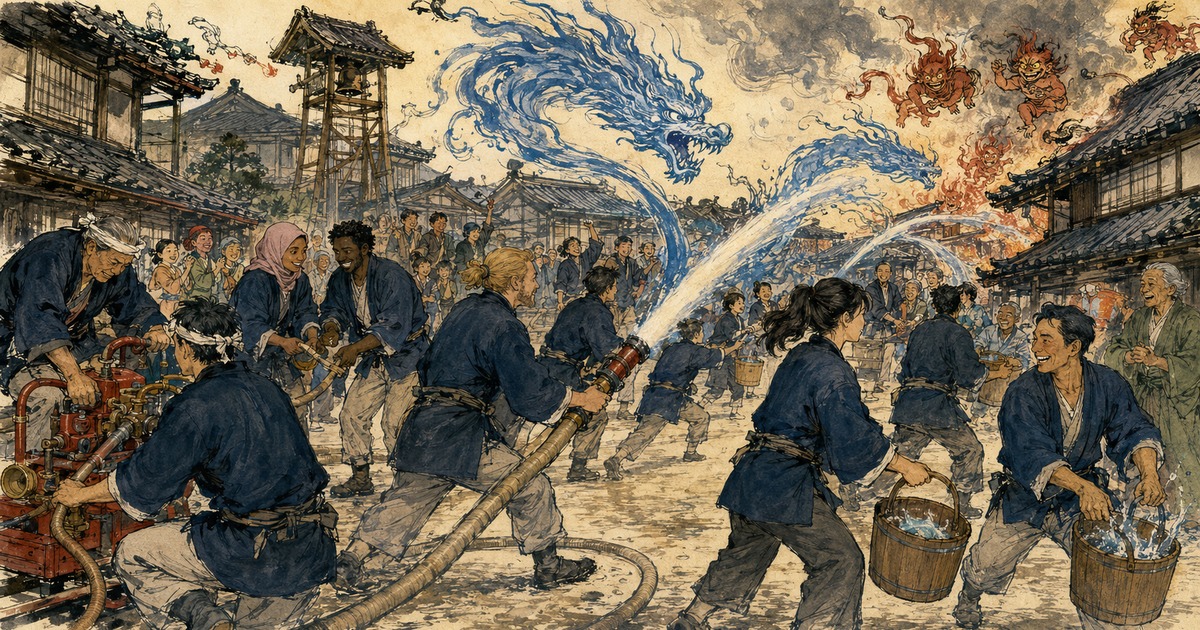
On a summer flood-training ground in Kiyosu, Aichi Prefecture, Mauricio Ojeda stood among nearly 200 people learning how to hold back the Shonai River. The work was deliberately unglamorous: move earth, fill sacks, close gaps, repeat. In a flood, the useful person is not necessarily the loudest or the strongest. It is the one who has practiced the sequence, knows the streets and can make the person beside him understand what comes next.
That matters in Kiyosu. The city lies on low ground threaded by rivers, and the Tokai Heavy Rain of September 2000 remains part of its civic memory. A record downpour flooded broad areas of Aichi and overwhelmed normal assumptions about where water would go. Annual drills are therefore not pageantry. They rehearse the moment when a professional response may be stretched and the first people available are neighbors.
Ojeda’s presence also expressed a second reality. “Neighbor” in Japan no longer reliably means a person born nearby, bearing a familiar family name and expecting to remain in the same association for life. It can mean an engineer from Brazil, a technical intern from Indonesia, a Vietnamese caregiver, an international student, or a child translating a warning for parents. At the end of 2025, Japan had 4,125,395 foreign residents—a record and the first total above four million.
The volunteer fire corps, or shōbōdan, must decide whether that changing population is outside the institution, a special audience to be helped, or part of the institution itself. An increasing number of municipalities are choosing the third answer. It is a modest movement measured in people, but a revealing one measured in what it asks Japan to change.
Not a Hobby Club, Not the Professional Fire Department
The English word “volunteer” can mislead. Fire-corps members normally have another occupation, and they do not work the daily shifts of municipal fire departments. Yet they are not informal helpers who simply appear when they feel like it. A member is appointed as a special part-time local public employee. The corps is a municipal non-standing fire agency, maintained in every municipality and trained to operate within a command structure.
When a house burns, professional firefighters lead the technical response. Corps members may establish water supply, move hoses and equipment, manage traffic and crowds, conduct patrols, support evacuation and remain after outside units have left. During typhoons, floods, earthquakes and landslides, their local knowledge becomes operational intelligence: which lane ends at a locked gate, which elderly resident lives alone, where a culvert overflows, which shelter entrance can take a wheelchair.
The distinction is also financial. Municipal ordinances provide annual and dispatch compensation, not a normal salary. The Fire and Disaster Management Agency’s standard is ¥36,500 a year for a basic member and ¥8,000 for a day of disaster dispatch, though actual rules vary. Members are covered for injury in public duty, receive clothing and equipment, and may qualify for a retirement reward based on service. Calling the corps “free labor” is inaccurate; pretending this compensation fully prices the time, risk and family disruption would be equally inaccurate.
Scale explains why the system matters. Japan had 169,730 professional firefighters in the latest national summary, against 732,223 corps members—more than four times as many people available through the local network. A career department can send expertise and machinery. It cannot permanently station a crew in every mountain hamlet, island settlement or shrinking neighborhood.
The Long Emptying of the Ranks
The corps counted about 1.94 million members in 1954. It fell below one million around 1990 and stood at 732,223 on April 1, 2025. In just the preceding year, 52,215 people left and 37,757 joined, producing a net loss of 14,458. The average member was 44.5 years old. Only about a third were in their thirties or younger.
Demography is the obvious force: fewer young adults, especially in rural areas, means fewer potential recruits. But population decline is not a complete explanation. The social machine that once produced members has also broken down. Self-employed shopkeepers and farmers could answer a siren from near home; today 73.3% of members are salaried employees, often commuting across municipal lines. Workplaces, families and individuals are less willing to accept open-ended claims on nights and weekends.
Official and prefectural reviews have acknowledged other barriers: too many ceremonial events, long practice for pump-operation competitions, rigid seniority, pressure to attend social or drinking occasions, unclear compensation and difficulty resigning. These complaints do not describe every brigade. They do show why a recruitment poster alone cannot restore a system designed around the rhythms of another economy.
Japan has already begun to diversify the model. Women, students and “function-specific” members—people who agree to defined duties or large-disaster activation rather than the entire traditional schedule—are increasing even as the total falls. On April 1, 2025, the country had 29,478 women, 7,568 students and 40,195 function-specific members. Flexibility is not a concession at the edge of reform. It is where growth is occurring.
582 People Cannot Replace 14,458
The latest clearly reported national count by nationality was 582 foreign members on April 1, 2024, about 2.2 times the number when the tally began in 2020. That sounds like momentum until it is placed beside the whole system. Foreign nationals were about 0.08% of the 746,681 corps members recorded that year—fewer than one in a thousand. The corps then lost more than 14,000 members over the following twelve months.
Foreign recruitment is therefore not a numerical cure, and presenting it as one would burden a small group with repairing Japan’s demography. Its importance lies elsewhere. A brigade that can recruit and retain a newcomer must explain duties that older members may have learned through habit. It must make compensation legible, turn shouted command language into teachable vocabulary, consider work visas and job schedules, and separate essential training from inherited custom.
Those reforms also help the Japanese university student who returns home only on weekends, the mother who can teach first aid but not attend every nighttime event, the office worker whose company needs a clear leave policy, and the retiree with valuable local knowledge but limited mobility. Inclusion works when it changes the operating system, not when it adds a translated leaflet to the old one.
The Citizenship Line Inside the Uniform
There is a legal boundary that enthusiasm cannot erase. Corps members are public employees, and Japan’s administrative doctrine reserves exercises of public authority for Japanese nationals. A January 2025 FDMA notice clarified how that rule applies in the field. Foreign members may not perform acts that directly impose legal consequences on others—demanding information under the Fire Service Act, establishing a restricted fire zone, or taking emergency measures that affect rights, obligations or property.
The same notice makes clear that the permissible field is much wider than translation. Foreign members may carry and recover hoses, secure predesignated water sources, rescue and transport victims, treat injured people, prepare stretchers, call for and guide evacuation, search for missing people, patrol danger points, and place sandbags on public roads. In normal times they may teach first aid, conduct fire-prevention education, support schools, translate information and train colleagues in foreign languages. Municipalities must define the precise activities for local conditions.
| Normally available roles under national guidance | Roles involving public authority |
|---|---|
| Equipment and hose support; designated water supply; rescue and transport; first aid; evacuation calls and guidance; missing-person searches; patrols; sandbagging; education; interpretation and translation. | Compelling information under statutory authority; creating a legally restricted fire zone; emergency acts that directly change another person’s rights, duties or control of property. |
| Important: the boundary depends on the concrete act and local rules. Training must make it operational before an emergency, not debate it beside a burning building. | |
This is both a practical framework and an incomplete equality. A foreign member can wear the uniform, enter danger, carry a victim and warn a family, yet remain excluded from some decisions made by the person beside them. Municipal leaders should not hide that distinction behind the friendly language of multicultural exchange. They should explain it, map roles in advance and create leadership paths as far as the law allows.
They should also resist turning every foreign member into “the translator.” Language can be lifesaving, but people bring other expertise: construction, logistics, nursing, engineering, driving, radio operation and knowledge of a factory or dormitory. If a Portuguese-speaking engineer is always sent to the information table while a less experienced Japanese colleague handles equipment, inclusion has become a costume.
An Institution That Has Never Stopped Changing
The fire corps is often described as ancient tradition, and its roots do reach into the neighborhood firefighting companies of the Edo period. In a wooden city where water pressure was weak and flames crossed narrow streets, organized townspeople fought fire, created breaks and pulled structures down before the blaze could consume a district. Their standards and matoi banners made each company a source of local identity.
But the institution was never frozen. The Meiji state standardized local fire companies under the 1894 Fire Brigade Regulations. In 1939, as the country mobilized for war, firefighting and civil-defense organizations were merged into keibōdan under police authority, with air-defense duties added. After defeat, the political meaning changed again. The 1947 Fire Corps Order replaced the wartime organization with locally based, “autonomous and democratic” corps. The Fire Organization Act separated fire services from police and made them a municipal responsibility; a new 1948 order completed the shift in command.
That history matters because it challenges the claim that opening membership somehow weakens an unchanging Japanese form. The corps has repeatedly been remade when the state, technology and community changed. Today’s question is whether “local” describes ancestry or presence: the people who actually live, work, study, raise children and face the same floodwater.
March 11: Indispensable, and Exposed
The Great East Japan Earthquake showed why local corps cannot simply be replaced by a centralized service. Members closed floodgates, called residents away from the coast, fought fires, rescued survivors, supported shelters, searched for missing people and patrolled communities where normal systems had collapsed. Many acted while their own families and homes were in danger.
It also exposed the lethal cost of heroic ambiguity. As of September 2012, 254 corps members were dead or missing in Iwate, Miyagi and Fukushima; 198 were considered to have been on duty. Some remained at water gates or continued evacuation work as the tsunami approached. The lesson is not that future recruits should prove belonging through sacrifice. It is that a public institution owes every member—Japanese or foreign—clear withdrawal rules, reliable radios, protective equipment, paired work and commanders trained to stop an impossible mission.
This is especially important when language confidence differs. A member who misses one warning word or hesitates to challenge a senior can be placed in disproportionate danger. Multilingual labels and pictograms, repeated hands-on drills, competency checks and a shared emergency lexicon are safety systems, not hospitality extras.
From Kusatsu to Hasami: Five Local Experiments
Local programs reveal different answers to the same national problem. In 2015, Kusatsu City in Shiga created a function-specific unit for foreign nationals, widely described as the first of its kind. International students who might otherwise be treated only as people needing assistance became people able to provide it. The conceptual shift—from the “supported side” to the “supporting side”—was as important as the headcount.
Aikawa, Kanagawa, launched a multilingual function-specific corps in 2024 with seven members speaking English, Spanish, Portuguese, Vietnamese, Tagalog and Khmer. Their work includes evacuation and shelter support as well as ordinary outreach. In Tochigi City in 2025, five foreign-national members interpreted while the corps and professional firefighters taught foreign residents how to call 119, use an AED and operate an extinguisher. Information moved in both directions: the institution taught procedures and learned where explanations failed.
In Hasami, Nagasaki Prefecture, Deni Saputra, 26, and Ahmad Ubaidillah, 25, became the town’s first foreign corps members in May 2026. The Indonesian technical interns work for a local construction company; a colleague already in the brigade helped make the connection. The town’s authorized strength is 330, but it is short by nearly 100. The two joined a regular local division, prepared to move equipment and help call residents to evacuate.
The Hasami case shows both promise and risk. An employer can normalize participation, release workers for training and connect newcomers to a civic network that would otherwise be difficult to enter. But technical interns are also dependent on employers for income, housing and status. A request from a boss or senior colleague may not feel optional. Recruitment must be explicitly voluntary, unrelated to visa or promotion decisions, and supported by paid release time. Civic service must never become another debt a migrant worker is expected to repay.
| Place and year | What the model tests |
|---|---|
| Kusatsu, Shiga / 2015 | Function-specific membership for international residents and students. |
| Aikawa, Kanagawa / 2024 | A multilingual unit with six languages and defined evacuation and shelter roles. |
| Tochigi City / 2025 | Foreign members as interpreters and instructors in practical disaster education. |
| Hasami, Nagasaki / 2026 | Regular-division recruitment linked through a local employer—useful, but requiring safeguards for voluntariness. |
| Kiyosu, Aichi / 2026 | Participation in a large annual flood drill grounded in local river risk. |
Language Is a Network, Not a List of Translations
Japanese disaster policy has become better at producing multilingual pages, QR codes and machine translation. Those tools matter. They do not solve the trust problem. A technically accurate warning is useless if it reaches the wrong app, assumes knowledge of school gym shelters, uses a map symbol nobody has learned, or arrives from an institution residents avoid because they fear an immigration consequence.
A foreign corps member can identify the factory night shift that will miss a daytime drill, explain that “evacuate” does not mean leaving the city, tell commanders that one language label covers several communities, or recognize that an apartment intercom announcement was unintelligible. The value is not simply speaking from Japanese into another language. It is carrying information back into the command system.
That requires listening. Municipalities should exercise with the actual communities in their jurisdiction, including schools, religious groups, employers, restaurants, dormitories and language classes. Foreign residents should help design scenarios and evaluate them afterward. A photograph of diverse recruits is not an operational capability.
Rebuilding the Corps for Everyone
The most durable foreign-member program would not be a colorful auxiliary attached to an unchanged hierarchy. It would establish a plain eligibility rule in local ordinance; publish duties, schedules and compensation in accessible language; and assign roles by training and lawful authority rather than stereotype. The same protective equipment, injury coverage and safety threshold must apply to everyone.
Training should use a small standardized command vocabulary with audio, pictograms and demonstrations. Competency—not conversational fluency—should determine who can operate a pump, provide first aid or manage a shelter zone. Municipalities should maintain role cards for incidents where the citizenship boundary matters, so a commander can allocate work without improvising legal advice under pressure.
Participation must fit modern employment. Written agreements with cooperating companies should guarantee release for emergencies and essential training while stating that membership is voluntary. Compensation should be paid directly and shown clearly to the member. Function-specific and large-disaster tracks should be available without permanently trapping foreign members in a lower tier. Those who gain skill should be able to teach, mentor and lead within lawful limits.
Finally, government should publish better data: joins, departures, training completion, dispatch experience, injuries and retention, separated enough to reveal unequal treatment but protected enough to preserve privacy. A rising recruitment number can conceal people who leave after one year because meetings are incomprehensible or social pressure is exhausting. Retention is the evidence that welcome has become belonging.
- Make nationality eligibility explicit in local rules and recruitment.
- Map permitted duties and public-authority limits before an emergency.
- Teach a multilingual command lexicon through repeated, practical drills.
- Provide equal protective equipment, insurance and withdrawal rules.
- Publish schedules, obligations and direct compensation clearly.
- Guarantee voluntary participation and release time in employer agreements.
- Offer basic, function-specific and large-disaster membership tracks.
- Create mentoring and leadership routes based on competence.
- Measure retention and readiness, not just recruitment photographs.
Who Gets to Say “Our Town”?
The phrase traditionally associated with the fire corps is simple: “We protect our own town.” Its emotional force has helped sustain generations of service. It can also contain an unanswered pronoun. Who is “we”?
If it means only people with Japanese nationality and deep family roots, the institution will continue to shrink while the population it protects becomes more varied. If it means anyone available for labor, foreign residents risk being celebrated at recruitment ceremonies and burdened without real voice. The stronger answer is civic rather than ethnic: “we” are the people who share the place, learn the work, accept mutual duties and are protected by the same safety rules.
That answer will not refill 14,458 empty places in one year. Nor should foreign residents be expected to rescue a system from every demographic and cultural problem it postponed. The national figures are too small for such a claim. But small numbers can expose large design failures. A newcomer asks why a drill begins at that hour, why payment moves through that channel, why one ceremony is mandatory, why a shouted command has no written equivalent and why a skilled member cannot perform a particular legal act. An institution capable of answering becomes clearer to everyone.
On the sandbag line, belonging is practical before it is philosophical. One person holds the mouth of the bag. One fills it. Two carry it. Someone sees the water finding a seam and calls the next move in words the group understands. Japan’s volunteer fire corps were built on the proposition that safety cannot be delivered only from the center; it must also be organized among the people already there.
The people already there have changed. The proposition has not. If the corps can recognize that fact without exploiting newcomers or pretending legal differences do not exist, foreign participation will mean more than a few hundred additions to a declining roster. It will show that one of Japan’s oldest civic institutions is still capable of its essential act: assembling a community before the water rises.
Reporting notes and sources
This article uses the latest clearly comparable national totals available by July 28, 2026. The overall corps total is from April 2025; the latest clear national count of members by foreign nationality located for this report is from April 2024, so the two figures should not be treated as the same-date denominator. Local duties vary by ordinance and incident. The 2025 national notice describes examples; it does not give every foreign member identical authority in every municipality.
- Fire and Disaster Management Agency: 2025 survey of volunteer fire-corps organization and membership
- FDMA: January 2025 guidance on foreign-national members and exercises of public authority
- FDMA: history of Japan’s volunteer fire corps
- FDMA: losses suffered by volunteer fire corps in the Great East Japan Earthquake
- FDMA: compensation, public-duty injury coverage and retirement rewards
- Immigration Services Agency: foreign residents at the end of 2025
- Nippon.com: national count of foreign-national corps members and the Aikawa model
- Tochigi City: 2025 disaster seminar with foreign-national corps members
- NCC Nagasaki: Hasami appoints its first foreign-national corps members in May 2026
- The Japan Times: current reporting on foreign participation and remaining barriers