The ten goals make headlines. Eight straight clean sheets may tell the deeper story.
A decisive goal on either side of halftime
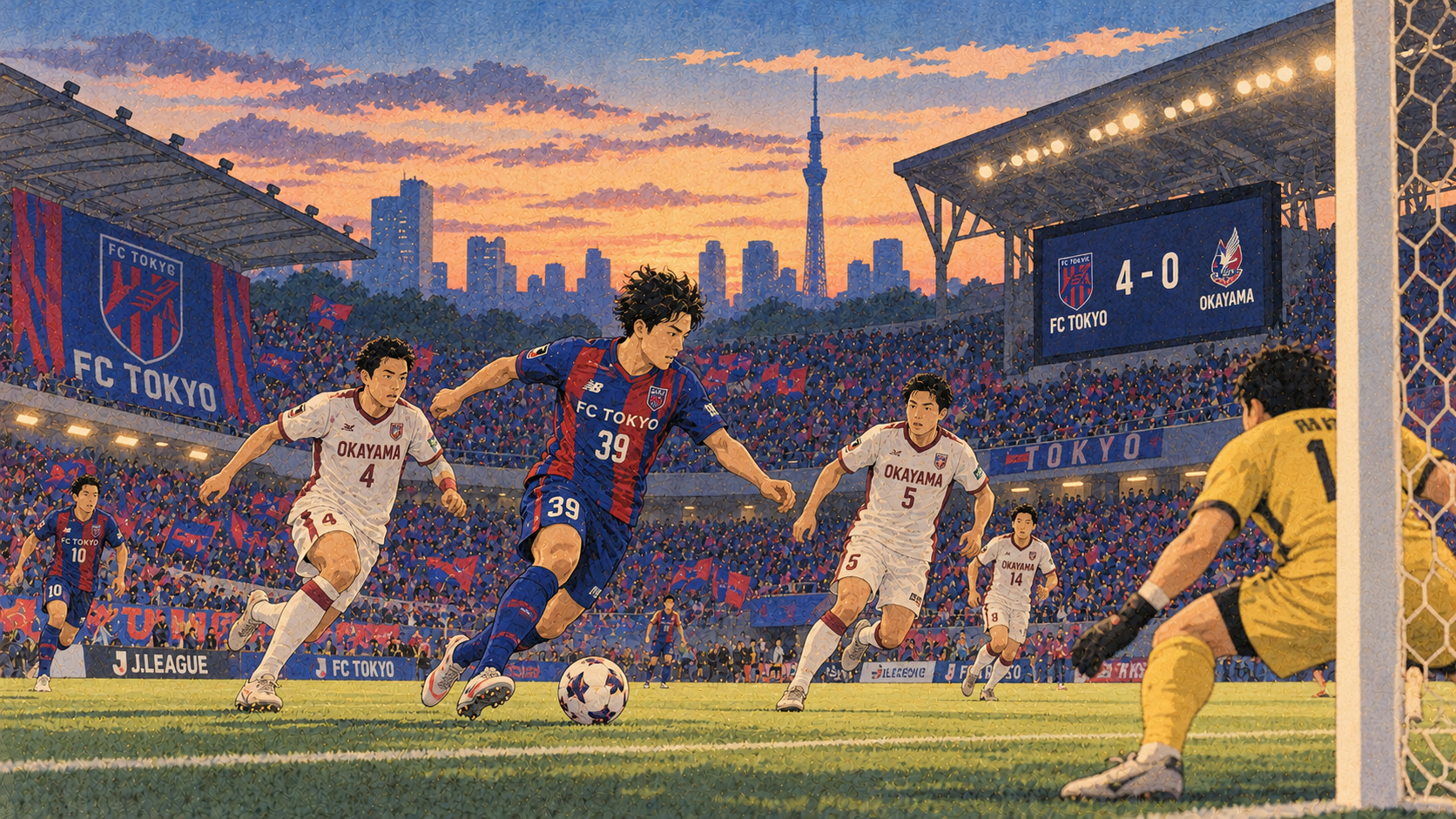
The scoreline from October 31 is emphatic: FC Tokyo 4, Fagiano Okayama 0. But the story of the match is the timing. Teruhito Nakagawa scored four minutes into first-half added time and struck again just two minutes after the restart. The combination deprived Okayama of a clean opportunity to reset. Substitute Dani Gómez then scored twice, turning a controlled away victory into a rout at JFE Hare no Kuni Stadium. That sequence matters more than any impression that the hosts were overwhelmed from the opening whistle.
Ten goals in six days—and a defensive record
On October 25, Tokyo had demolished Mito HollyHock 6–0 at Ajinomoto Stadium. Six days later came four more goals, producing ten across two league fixtures. Nakagawa registered braces in both matches; five additional scoring contributions came from Sōma Anzai, Dani Gómez, Alexander Scholz and Marcelo Ryan across the Mito match, with Gómez also scoring twice at Okayama. The club’s October 31 review reports eight consecutive league clean sheets. That second number may prove the more instructive measure of Tokyo’s form: an impressive attack is being supported by a defense that has stopped conceding.
Four goals, two double-scorers
The official timeline records Nakagawa at 45+4 and 47 minutes, followed by Gómez at 63 and 90+3. Different websites express the second-half times as either 2 and 18 minutes after the break or as full-match minutes; these are equivalent not contradictory. Nakagawa started; Gómez entered in the 58th minute and finished with a brace of his own. No goal came from a penalty, according to the published match account.
Why the substitutions mattered
FC Tokyo’s official match review describes a tactical adjustment after Okayama reshaped its attack. Nakagawa came off, Gómez came on, and the visitors continued to threaten in transition. For the third goal, Anzai carried the ball and young midfielder Shūto Nagano supplied the decisive pass. For the fourth, Kōta Tawaratsumida delivered from the right before Gómez maneuvered around the goalkeeper. Those are the club’s descriptions of the plays; they provide evidence for a tactical narrative, not proof that any single adjustment alone caused the result.
Read the shots carefully
Tokyo’s own match summary lists 15 shots to Okayama’s six, with attendance of 14,287. Some third-party data services count attempts differently and therefore publish different shot totals. Rather than fuse incompatible datasets, this article uses the club’s figures for that comparison and identifies its source. What is beyond dispute is the final margin, the four scorers’ entries in the official record, and the timing of the goals.
Okayama’s version of events
Defeated manager Takayuki Kiyama acknowledged a comprehensive loss in the club’s published postmatch remarks. He described Tokyo’s intensity and technical quality, especially the difficulty of keeping possession after winning the ball back. His comments also noted periods when Okayama had been able to push the visitors backward in the first half. Taking the losing side seriously matters: the match was not an uninterrupted highlight reel, and its decisive moments came after Okayama had attempted to compete.
Nakagawa and the importance of varied finishing
Nakagawa’s four goals against Mito and Okayama represented 40% of Tokyo’s ten-goal output across the two games. Against Mito, his opening goal came from a cross met with a header; against Okayama, his second goal followed an alert recovery when a defender failed to deal with a long delivery. His performances suggest multiple ways to finish attacks, although the evidence does not justify claiming he alone transformed Tokyo’s attack. Other starters and substitutes contributed to the scoring.
A regional club on a long climb
Fagiano Okayama began in 2003; its operating company was established in July 2006. The club won the 2024 promotion playoff to reach the top flight for the first time, and finished 13th in its inaugural J1 season in 2025. In July 2026 the company marked its twentieth anniversary. These milestones help explain the stakes for a club built around a regional mission. A 4–0 defeat is an immediate sporting setback, not a verdict on two decades of institution-building.
Tokyo’s scale does not make success inevitable
FC Tokyo operates in one of the world’s largest metropolitan markets, but population size does not supply a tactical system, a defensive structure or reliable finishing. The club’s recent matches invite questions about fitness, rotation, pressing, confidence and cohesion. They do not, on their own, allow each factor to be measured causally. The defensible conclusion is narrower: Tokyo combined a high-volume scoring week with a sustained run of clean sheets.
A new season, a new calendar
The J.League’s move from a calendar-year schedule toward an autumn-to-spring model makes this a distinctive campaign. October 31 was round 13 of the 2026–27 Meiji Yasuda J1 League, rather than the closing weeks of the old annual format. Comparisons to earlier October runs require that context. The change affects the rhythm of recruitment, preparation, and the competition’s interaction with international football calendars.
Eight shutouts deserve as much attention as ten goals
Goals travel well on social media. Clean sheets rarely do. Yet eight straight league games without conceding, as reported by Tokyo’s official review, suggests something that merits longer observation. Is the back line limiting chances consistently, or has goalkeeping been decisive? How much does the schedule explain? Only match-by-match analysis can answer. There is no need to convert a striking October statistic into a premature prediction of a title.
What the result does—and does not—tell us
Two wins by a combined 10–0 score are notable. They do not establish how Tokyo will perform over the rest of the season, and the October 31 outcome says nothing about fixtures not yet played. The more enduring question is whether a side capable of controlling difficult phases without conceding can keep finding goals from multiple players. Nakagawa and Gómez supplied the spectacle in Okayama; the next matches will test whether this apparent balance lasts.
Sources and verification
Scores, players and times derive from official J.League and club records. Third-party statistics may use different event definitions.
- FC東京 10月31日試合結果/FC Tokyo official result
- FC東京試合分析・選手インタビュー/FC Tokyo official match review
- ファジアーノ岡山 監督・選手コメント/Okayama comments
- ファジアーノ岡山試合速報/Okayama live record
- Jリーグ10月25日 FC東京-水戸公式記録/Official J.League October 25
- ファジアーノ岡山クラブ沿革/Okayama club history
- ファジアーノ岡山創立20周年/Okayama 20th anniversary
- FC東京 公式サイト/FC Tokyo official site