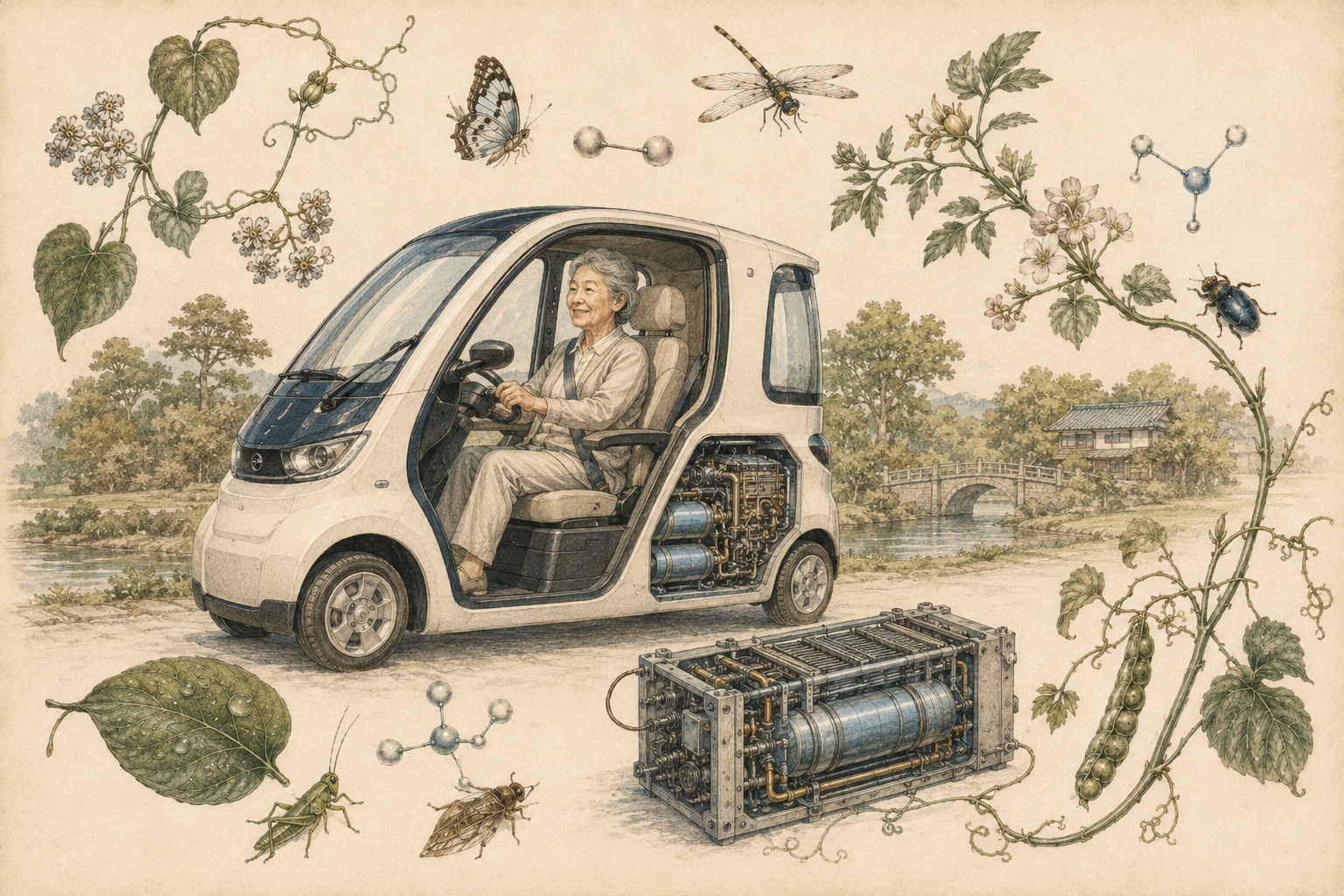
Giving up a driver’s license is not merely giving back a card. In rural Japan it can mean giving up a three-kilometer trip to the supermarket, a five-kilometer trip to the clinic and a two-kilometer trip to the post office. The bus may run only a few times a day. Adult children are at work. Taxis become expensive when they are the answer to every errand. Walking is too far; a bicycle may no longer feel safe.
Japan’s older-driver problem sits at the uncomfortable intersection of road safety and personal independence. Driving risk rises with age. But stopping driving can also reduce access to health care, shopping, friends and local activities while increasing dependence on family.
That is the social problem behind a small hydrogen project announced by Chiba-based mobility company ELEMOs and Yokohama hydrogen-drone developer Robodex.
The idea is to put a fuel-cell system into a compact four-wheel vehicle that can be driven without a conventional driver’s license. Instead of expecting the user to find a car-scale hydrogen station, the concept is to exchange a lightweight cylinder and resume travel. Robodex also wants common tank standards that could be shared among mobility devices, drones and emergency fuel-cell generators.
This is not a plan to shrink a Toyota Mirai. An older resident does not need a 500-kilometer automobile to reach the local clinic. The relevant question is whether a small vehicle can reliably cover everyday trips, replenish energy without a long wait and let the user remain independent without creating a new burden for family.
The smaller the municipality, the more older people depend on driving themselves
Japan’s Cabinet Office has repeatedly found a sharp urban-rural difference in older people’s transportation. Large cities have higher use of trains, subways and buses; as municipality size declines, the share relying on a self-driven car rises.
That matters because rural older drivers cannot be understood simply as people unwilling to give up cars. Their communities are frequently designed around private automobiles.
A Cabinet Office survey of older residents found 46.6% reporting a self-driven automobile among their means of going out. The same research found that some people continue driving even after physical function has materially declined.
The safety side is equally real. In 2024 the number of fatal crashes per 100,000 licensed drivers was 5.2 among people 75 and older and 7.2 among those 80 and older. Cognitive screening, senior-driver training, driving-skills tests and voluntary license surrender therefore have a legitimate public-safety purpose.
But “please stop driving” and “here is how you get to the doctor afterward” have to belong to the same mobility policy. Japan has designated FY2025–FY2027 as an intensive period for eliminating transportation gaps; MLIT said in 2026 that roughly 2,500 such gaps exist nationwide.
ELEMOs is not legally a “senior car”—and that distinction matters
Japan uses the word “senior car” for handlebar-type powered wheelchairs. Under traffic law, a qualifying powered wheelchair is treated as a pedestrian. Its maximum speed is 6 km/h and it operates in pedestrian space.
ELEMOs4 REBORN belongs to a different legal category: the specified small motorized bicycle, created under new traffic rules that took effect in July 2023.
A qualifying vehicle can be operated without a driver’s license, but riders under 16 are prohibited. It requires a number plate and compulsory liability insurance and generally follows vehicle traffic rules.
The statutory envelope includes rated motor output no greater than 0.6 kW, length no greater than 1.9 meters, width no greater than 0.6 meters and performance speed no greater than 20 km/h. A vehicle satisfying additional “special specified small” conditions can use an indicated 6 km/h mode on sidewalks and other areas where such travel is legally permitted.
ELEMOs itself markets its vehicles for “senior-car use” while also explaining that they are not legally powered wheelchairs. That distinction is important for the older user.
The vehicle can move substantially faster than a 6 km/h mobility scooter, but the operator must understand intersections, roadway position, signals and turning rules. No license does not mean no traffic responsibility.
| Typical senior mobility scooter / powered wheelchair | ELEMOs4 REBORN-type four-wheel mobility | |
|---|---|---|
| Traffic-law status | Pedestrian if the statutory powered-wheelchair requirements are met | Specified small motorized bicycle |
| Maximum speed | 6 km/h or less | 20 km/h or less in road mode |
| Driver’s license | Not required | Not required; under 16 prohibited |
| Plate / compulsory insurance | Generally not required | Required |
| Primary operating space | Pedestrian areas | Roadway by default; qualified 6 km/h mode can use permitted sidewalks |
| Hydrogen version | Not applicable | Under development; performance confirmation not publicly announced |
A traffic category created in 2023 created room for a small company
ELEMOs was established in October 2023, only months after Japan’s new specified-small-mobility rules took effect.
The legal change was driven heavily by the rise of electric kick scooters, but the regulation is not confined to one shape. A seated four-wheel vehicle can enter the category if it satisfies the required dimensions, motor output, speed, lighting and other safety standards.
ELEMOs entered that opening with four wheels. In 2025 its ELEMOs4 REBORN passed MLIT’s performance-confirmation testing. The company describes it as the first 20 km/h four-wheel model to pass under the newer test regime that includes motor-output verification.
In April 2026, ELEMOs’s cargo-focused Elecargo also passed the confirmation process. It has a 20-liter front basket plus 100-liter rear capacity, twin 250-watt motors and roughly 60–70 kilometers of battery range, aimed at shopping, farm tools and local deliveries.
ELEMOs is therefore not building a single-purpose welfare device. It is trying to put commuting, shopping, delivery and light agricultural use into the same low-speed vehicle category.
That broader market matters. A mobility platform used by younger people as well as seniors can spread parts, service and development cost across more units—and may avoid the stigma some users associate with visibly age-specific equipment.
“I do not want to look old” is also a product requirement
ELEMOs itself markets the idea of a stylish mobility option for older users, sometimes playfully asking whether it is a “cool and fun senior car.”
The marketing language points toward a real behavioral issue. If adopting mobility assistance feels like publicly announcing physical decline, some people may resist a device even when it would improve their life.
A person who has driven a car for fifty years may experience a sharp psychological step from an automobile to a 6 km/h medical-looking mobility scooter. Four wheels, a steering bar, cargo space and 20 km/h road capability preserve more of the feeling of choosing a destination and going there independently.
That does not eliminate risk. Greater speed demands more education and judgment. Designing something to feel youthful is not a reason to make the rules less serious.
So why hydrogen? ELEMOs battery vehicles already travel 40 to 130 kilometers
This is where the hydrogen concept deserves a skeptical test.
The ELEMOs4 REBORN development base already travels roughly 40–50 kilometers on its standard battery. The STRONG Edition reaches around 80 kilometers. The flagship ELEGRAN G-class announced in April 2026 advertises roughly 130 kilometers using a twin-battery system.
Does an older resident traveling to a supermarket and clinic actually need more than 100 kilometers?
For many people the answer may be no. If a home has a convenient electrical outlet, the vehicle can charge overnight and daily travel is ten or twenty kilometers, a battery-electric design is simpler and uses an energy network that already reaches essentially every home.
Hydrogen therefore cannot justify itself merely by saying “longer range.”
The more interesting claims in the Robodex-ELEMOs project are rapid energy replenishment and standardized reusable tanks. Instead of waiting hours for charging, a user exchanges a lightweight hydrogen cylinder. The same cylinder standard might later serve drones, other small vehicles and an emergency generator.
If that system works, hydrogen’s value is not “more than 130 kilometers.” It is “I can swap the energy module and leave again without a charger.”
Can a replaceable cylinder shrink the hydrogen-station problem?
The car-scale hydrogen economy has struggled partly because refueling stations are expensive and sparse. High-pressure equipment, compressors, storage, dispensing and safety systems require capital, and utilization stays weak when the vehicle fleet is small.
If a small mobility device requires the same national station network as a fuel-cell automobile, the economics are difficult.
Robodex instead wants to apply the small hydrogen-tank technology developed for drones and standardize tanks across multiple small products. The public concept lets users resume travel by replacing the cylinder rather than waiting for battery charging.
This creates the possibility of a cartridge-like distribution model. The end user would not compress hydrogen at home. Certified facilities could fill containers, and the customer could exchange an empty cylinder for a filled one.
Technically this is not comparable to an LPG cylinder or a can of liquid fuel; high-pressure hydrogen has its own safety and inspection requirements. But the customer experience could still become “exchange an energy container” rather than “operate a hydrogen filling station.”
Critical details remain unknown: the cylinder mass, capacity, pressure, service life, inspection schedule, deposit system, distribution cost, distance per cylinder and what the user must physically lift.
For an older customer, that last number is not a footnote. A five-kilogram object that feels “light” to an engineer may still be difficult for an 80-year-old to exchange every week.
If hydrogen is for people with limited mobility, the hydrogen may need to come to them
A rural hydrogen vehicle fails its purpose if the owner has to travel ten kilometers to find fuel.
A plausible model would therefore need local distribution: filled cylinders at supermarkets, JA cooperatives, filling stations, roadside stations, post offices, welfare facilities or municipal sites—or home delivery.
That is an inference from the exchange model, not a distribution system ELEMOs has formally announced.
The analogy is LPG. Rural LPG works because the cylinder is only one piece of the system. Dealers, delivery trucks, inspection, contracts and emergency support bring fuel close to the user.
Small-container hydrogen will likewise become a service business if it is to serve people who have transportation constraints in the first place.
Why Robodex’s drone experience translates to the ground
Robodex was founded in 2019 as a hydrogen-drone company. Putting high-pressure hydrogen into aircraft forced the company to think about compact tanks, pressure reduction, fuel cells, refueling and safety under extreme weight constraints.
In a drone, one kilogram matters enormously. Small, light hydrogen components are therefore central to the product.
A 20 km/h ground vehicle has more mass allowance than an aircraft. Technology made light enough to fly may have room to become more robust and easier for a person to handle when brought to the ground.
Robodex has also been working on hydrogen distribution itself. In 2025 it completed a mobile filling truck capable of high-pressure filling of cartridges used for its hydrogen fuel-cell drones, aimed at making subdivided hydrogen supply practical.
The mobility project can therefore be read as something larger than technology transfer from drone to vehicle. By creating several small users for the same fuel and tank architecture, Robodex can increase demand density for a small-hydrogen logistics network.
One tank standard for mobility, drones and emergency power
The most ambitious element in the February announcement is “multi-use.”
Robodex wants common hydrogen-tank standards across small mobility devices, drones and a separately developed fuel-cell generator. A container used for transport in ordinary times could potentially be moved to emergency power during a disaster.
This matters in low-density regions. Infrastructure serving only one product can be economically weak. A senior-mobility fleet alone may exchange only a handful of cylinders per day.
If agricultural drones, delivery drones, local delivery vehicles and backup generators consume the same standardized cylinders, the filling facility gets more turns per year.
Emergency fuel that simply sits for years could also be rotated through everyday uses, allowing filled containers to remain part of a managed circulation system.
Whether one pressure, connector and certification architecture can truly serve all of those different flow-rate and safety requirements has not yet been demonstrated. But the project is attacking hydrogen’s classic weakness—too little local demand—by aggregating multiple small applications rather than waiting for one giant customer.
Long-term storage creates a different emergency value than batteries
Robodex also emphasizes hydrogen’s storage behavior. Lithium-ion batteries slowly self-discharge and experience calendar aging, requiring state-of-charge management during long storage.
Hydrogen stored in a properly sealed pressure vessel does not “self-discharge” through electrochemical reactions in the way a battery does.
That does not make it maintenance-free. Pressure vessels have service-life and inspection requirements, while valves and seals require safety management.
The interesting possibility is operational: use the cylinder network every day for mobility and drones while maintaining sufficient filled inventory for emergency generators. Instead of buying disaster batteries and forgetting them in a warehouse, the community rotates the energy inventory through normal service.
For older users, “lightweight” has to be defined by older users
The partnership announcement says the goal is a lightweight cylinder-exchange system manageable even by older users with limited strength.
That requirement should become a measured human-factors specification.
Older users may have reduced grip strength, limited ability to bend, poor vision or difficulty following multi-step procedures. A good exchange system might therefore slide rather than lift, prevent incorrect insertion, lock with one obvious motion, automatically isolate a leak and display remaining energy in large, unambiguous indicators.
Those are design principles proposed here, not published final ELEMOs specifications.
“An older person can use it” should ultimately be supported by repeated user testing: required lifting force, required grip, average exchange time, error rate and performance among people in their seventies and eighties.
- Full cylinder mass: Can the intended user actually exchange it without assistance?
- Range per cylinder: Enough for a real daily loop—store, clinic and home?
- Exchange time: How quickly can an empty unit become a full one?
- Hydrogen cost: Cost per kilometer versus home-charged battery ELEMOs.
- Fuel-cell lifetime: Operating hours and calendar life before stack replacement.
- Supply density: How close is the nearest cylinder exchange point?
- Human-factors data: Error rates, grip/lift requirements and older-user testing.
- Vehicle approval: Can the hydrogen configuration separately pass performance confirmation as a specified small motorized bicycle?
Adding hydrogen does not automatically preserve the current vehicle approval
The battery ELEMOs4 REBORN has passed MLIT performance-confirmation testing. That is valuable, but the future hydrogen version does not automatically inherit the same confirmation.
Adding a stack, cylinder and piping changes weight, center of gravity, electrical architecture, structure and safety characteristics. The finished vehicle still has to satisfy the legal dimensions, power, speed, braking, lighting and speed-indicator requirements of its category.
One issue requiring careful engineering is the category’s 0.6 kW rated motor-output ceiling. Fuel-cell generation rating and propulsion-motor rated output are not the same engineering parameter, but the final drive system still has to remain within the legal vehicle definition.
As of August 2026, no performance-confirmation approval has been publicly announced for the hydrogen ELEMOs. It is therefore too early to describe it as a road-ready license-free hydrogen vehicle.
For many users, battery electric will remain the better answer
The most useful hydrogen reporting is willing to say where hydrogen may not be needed.
A resident traveling five kilometers a day, parking beside a household outlet and charging overnight has an excellent energy network already connected to the house. Battery electric is simple and efficient.
ELEMOs’s own 40–130 kilometer battery range proves that a fuel cell is not necessary merely to create useful local mobility.
Hydrogen may become more interesting for users without convenient charging, shared vehicles that operate repeatedly throughout the day, communities integrating mobility with emergency hydrogen reserves, or areas where drones and generators already create cylinder demand.
That would make the hydrogen model not a “premium replacement” for every battery ELEMOs but a different solution for different operating conditions.
Do not transfer the burden of a new fuel system to the people the product is meant to help
There is also a human-design principle at stake.
A product meant to reduce mobility dependence fails if an older person has to book scarce hydrogen, understand high-pressure regulations, search for a distant exchange point and manage complex cylinder expiration rules.
The best consumer interface would be much simpler: full or empty; exchange or drive. Professional operators handle the high-pressure system behind the scenes.
Gasoline became convenient not because every driver learned refinery engineering but because the complexity disappeared behind a service station.
Hydrogen mobility will have to perform the same trick.
No single small vehicle can solve a transportation gap
Japan’s roughly 2,500 transportation gaps are not simply a shortage of cars. They reflect driver shortages, low population density, poor route economics, consolidated hospitals and stores, dispersed homes and geography.
A one-person small vehicle will not solve snow-country travel, steep roads, long highway journeys or mobility needs for people who should not operate any vehicle independently.
Regional mobility will need combinations of community buses, demand-responsive transport, public ride-sharing, family assistance, automated vehicles and personal mobility.
The ELEMOs-type vehicle is strongest in the middle: preserving a few kilometers of self-directed travel to a bus stop, local store, clinic, community center or field.
If hydrogen expands that small zone of freedom, it has social value. If older users merely become a convenient justification for deploying hydrogen technology, the logic is backward.
Mobility is also health and social connection
Older-person mobility is not only a transportation statistic. Independent travel supports shopping, medical care, exercise, relationships and participation in local life.
Japan’s aging-policy framework explicitly treats mobility access as part of enabling older people to live safely, remain involved in society and continue daily life in their communities.
When a person cannot leave home independently, errands shift to family, taxis or delivery. Choices narrow and spontaneous social contact can disappear.
The value of a small mobility device therefore cannot be measured only by grams of CO₂ per kilometer. It can also be measured in days a person goes outside, medical appointments kept and family transportation hours avoided.
The value of a kilogram of hydrogen is not only kilometers
Hydrogen may cost more than home electricity in a small vehicle. On pure drivetrain efficiency, it may struggle to beat a battery.
But mobility has social costs outside the energy bill.
A municipality may pay for demand-responsive transport. A daughter may leave work to drive a parent to hospital. Grocery-delivery services have costs. Reduced activity can contribute to broader welfare needs.
If a replaceable-hydrogen mobility system reduces some of those costs, its economics cannot be evaluated only against the electricity required to charge an EV.
That claim would still require evidence. A serious trial should measure whether users actually go out more often, whether family driving hours fall and whether municipal support cost changes.
The most interesting part of the 2026 announcement is not hydrogen itself
Robodex partnered not only with ELEMOs but also with United Solution, which develops three-seat small mobility, and Blaze, which works on delivery EVs.
The strategic idea is not one hydrogen “senior car.” It is a common fuel-cell and tank platform spread across several low-speed mobility categories.
That is a scale strategy for a small market.
Older-user mobility alone may not provide enough units. Family mobility, delivery, drones and generators using related components could increase manufacturing volume and raise utilization of hydrogen filling infrastructure.
Large hydrogen policy tries to create a million tonnes of demand with steelworks, ports and power stations. This group of small companies is trying the opposite approach: aggregate a hundred small uses around the same hardware standard.
That is what makes the project unusually interesting.
Technology can help create a society in which giving up a license is actually possible
The simplest way to reduce crashes involving older drivers is to have unsafe drivers stop driving. Social policy has to go one step further.
After returning the license, can someone still buy bread alone? Reach a regular doctor? Meet friends? Carry tools to a small field?
The ELEMOs-Robodex hydrogen vehicle may become one answer—or it may not.
If batteries already do the job, hydrogen is unnecessary. If the cylinder is too heavy, it is not senior-friendly. If exchange points are far away, it does not solve a transportation gap. If fuel is too expensive, people will not buy it. If the modified vehicle does not pass the required confirmation, it cannot fulfill the road-use promise.
But if a lightweight cylinder can be exchanged nearby, the vehicle can cover normal local trips, drones and emergency generators create enough shared hydrogen demand, and professional operators hide high-pressure complexity from the user, a different model becomes plausible.
Japan does not have to judge the hydrogen economy only by steel plants and giant carriers.
One fair test is whether an 80-year-old who gives up a car license can still go to the supermarket alone the following week.
If technology can help answer that question, hydrogen becomes something more than energy policy. It becomes part of the infrastructure of an aging society.
2002 Japan introduces the Driving Career Certificate, helping people retain official identification after voluntary license surrender.
2010s Older-driver safety and shrinking rural public transport become increasingly linked policy problems; community buses and demand-responsive transport expand.
2020 Amendments to regional public-transport law strengthen the idea of mobilizing multiple local transportation resources.
July 1, 2023 New traffic rules for specified small motorized bicycles take effect, allowing qualifying vehicles to be operated without a driver’s license by people 16 and older.
October 2023 ELEMOs is established and enters the four-wheel specified-small-mobility market.
May 2025 ELEMOs4 REBORN passes MLIT performance-confirmation testing.
2025 ELEMOs expands battery products toward roughly 80- and 100-kilometer ranges, raising the competitive benchmark hydrogen must beat.
January 15, 2026 Robodex and ELEMOs enter their business partnership.
February 3, 2026 The companies announce development of hydrogen fuel-cell small mobility using lightweight cylinder exchange, longer range and fast energy replenishment as goals.
April 2026 ELEMOs announces ELEGRAN with roughly 130 kilometers of battery range, making hydrogen’s non-range benefits more important.
April 21, 2026 Cargo-focused Elecargo also passes MLIT performance confirmation.
FY2025–FY2027 Japan runs an intensive national program to address transportation gaps, including the mobility problems created as older residents stop driving.
Next Vehicle approval, real range, cylinder mass, exchange logistics, fuel price and older-user human-factors testing will determine whether hydrogen moves from concept art to useful rural mobility.
Reporting notes and principal sources
This article uses public information checked through August 9, 2026, 12:50 a.m. JST. For the hydrogen ELEMOs concept, the companies have not disclosed range, fuel-cell output, cylinder capacity/pressure/full mass, vehicle price, mass-production date, exchange locations or MLIT performance-confirmation approval. “Cartridge” is used here as plain language for the lightweight replaceable cylinder/tank approach described in the partnership and for Robodex’s subdivided-hydrogen work; it is not a confirmed formal product name. Performance confirmation of the existing battery ELEMOs4 REBORN does not constitute approval of a future hydrogen configuration.
- Robodex: hydrogen fuel-cell small-mobility development with ELEMOs and other partners, February 3, 2026
- ELEMOs: current specified-small four-wheel mobility lineup
- ELEMOs: ELEMOs4 REBORN specifications, 40–50 km battery range and performance confirmation
- ELEMOs: Elecargo passes MLIT performance confirmation on April 21, 2026
- ELEMOs: ELEGRAN G-class with roughly 130 km twin-battery range, April 20, 2026
- National Police Agency: traffic rules for specified small motorized bicycles
- MLIT: vehicle standards and performance-confirmation system for specified small motorized bicycles
- National Police Agency: powered-wheelchair rules, including 6 km/h limit and pedestrian treatment
- Cabinet Office: 2025 Annual Report on the Ageing Society, older-person mobility by city size and driver safety
- Cabinet Office: Survey on Housing and Living Environment of Older Persons, transportation choices
- MLIT: roughly 2,500 transportation gaps and regional public-transport reform, 2026
- MLIT: securing mobility for older residents through transport/welfare coordination
- Robodex: mobile filling truck for high-pressure filling of hydrogen fuel-cell drone cartridges, 2025