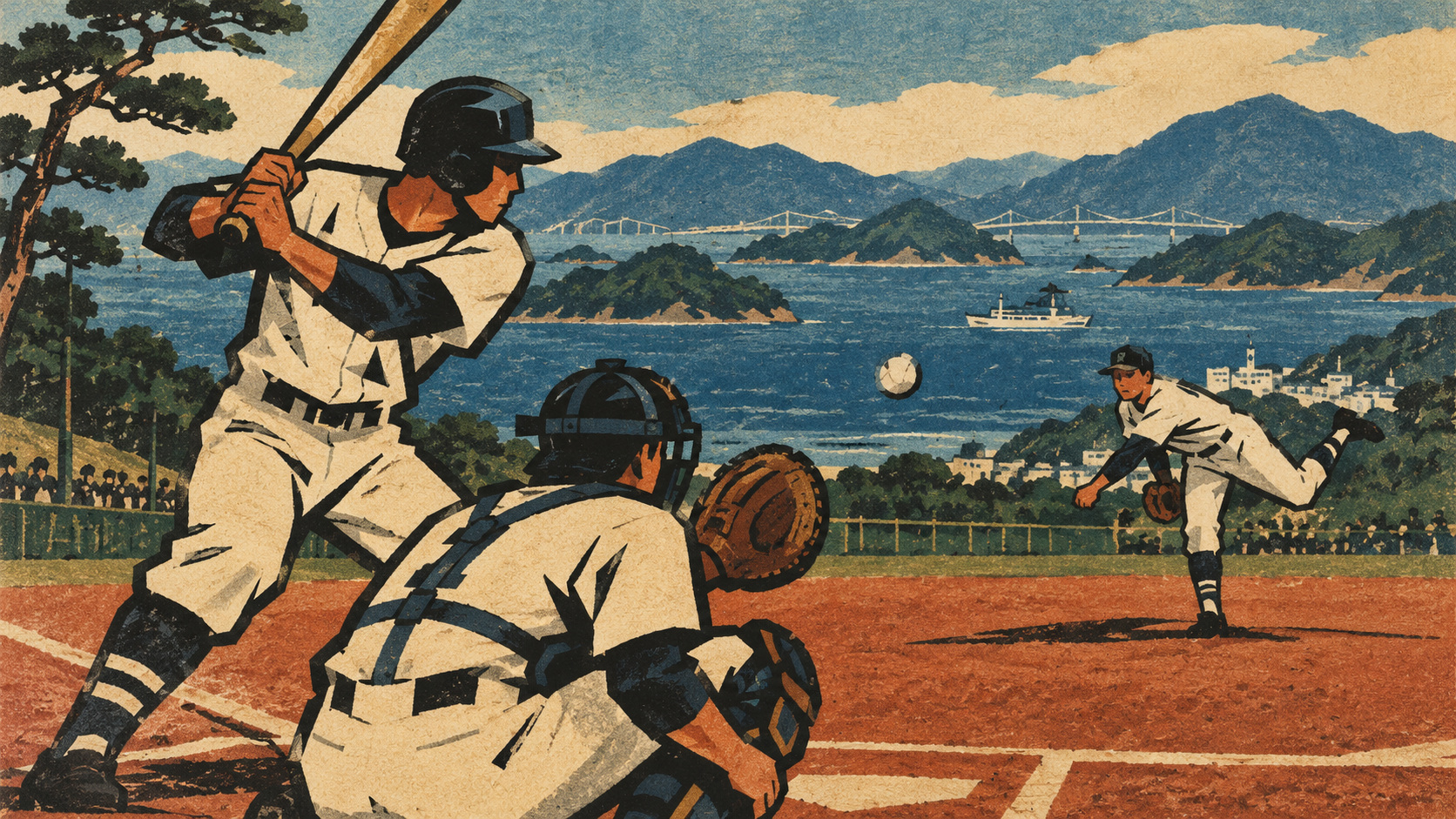
The sea between schools
The Seto Inland Sea separates prefectures and links them. Bridges, ports and trading routes connect communities that, in high-school sport, still often compete within familiar boundaries. Ehime is trying to use that geography rather than be constrained by it.
On October 10 and 11 the prefecture is hosting the inaugural Ehime High School Baseball Exchange 2026, formally called the Setouchi League, at four grounds in the industrial and maritime east of the prefecture. The idea is not simply to play more games. Organizers hope stronger competition will support participation in baseball while introducing visiting teams to Ehime’s towns and landscape.[1]
Six prefectures, four grounds and 20 scheduled games
Teams come from Ehime, Yamaguchi, Hiroshima, Okayama, Hyogo and Kagawa. The Ehime High School Baseball Federation organizes the exchange, with the prefecture and the four municipalities of Imabari, Saijo, Niihama and Shikokuchuo as co-hosts. Venues are Imabari Municipal Baseball Stadium, Toyo Sports Park Baseball Stadium, Niihama Municipal Baseball Stadium and Kawanoe Baseball Stadium.[1]
The published fixture list contains eight visiting schools—including Hiroshima Commercial, Ube Kojo, Okayama Gakugeikan, Iwakuni and Sanbonmatsu—and 16 Ehime schools. The advertised program comprises eight games Saturday and twelve Sunday. These are scheduled fixtures, not verified results.[2]
What spectators can actually see
Niihama City lists Sanbonmatsu against Matsuyama Technical at 10 a.m. Saturday, followed by Kure Municipal Kure against Niihama Higashi at 1 p.m. Sunday brings Hiroshima Commercial versus Matsuyama Seiryo at 9 a.m., Hiroshima Commercial versus Sanbonmatsu at 11:45 a.m., and Niihama Minami versus Sanbonmatsu at 2:30 p.m.[3]
Admission is free at Niihama, where a temporary parking area is identified along the Kokuryo River. Other grounds have different schedules. Anyone visiting should check the latest federation and host-city notices for changes caused by weather or operational needs.
An exchange league is not a route to Koshien
The language of a league can be misleading to international readers. This event is an exchange series, not a qualifying tournament for either Japan’s summer National High School Baseball Championship or its spring invitational championship. No Koshien berth is awarded.
The competitive benefit is potentially subtler. Facing pitchers, batting orders and fielding systems from different prefectures gives young players a wider comparison than familiar local opposition. Coaches can test practices against peers. Whether that exposure improves performance is an outcome to be demonstrated later, rather than assumed from the announcement.
A prefecture with a remarkably long baseball memory
Ehime has produced nationally significant school teams for generations. Matsuyama Commercial High School notes that it won national titles across the Taisho, Showa and Heisei eras. Its campus memorial commemorates the 1996 summer championship, remembered for the extraordinary outfield throw commonly called the “miracle back home.”[5]
That inheritance is both an asset and a challenge. A famous tradition may inspire new players; it does not by itself ensure that smaller schools can assemble squads, afford travel or provide enough varied opposition. The Setouchi League attempts to put the region’s legacy to use through actual encounters.
The parallel Nanyo exchange has a different purpose
The prefecture’s October 8 announcement contains a second event that must not be confused with the six-prefecture Setouchi League. A separate exchange is scheduled for October 10–11 in southern Ehime, with high-school games at Maruyama Park Baseball Stadium and junior-high games at Yoshida Park Baseball Stadium.[1]
Teams will come from Ehime and Oita at high-school level, and Ehime and Osaka at junior-high level. The stated aims include recovery from the July 2018 torrential-rain disaster, community vitality in a shrinking-population region and stronger ties across the Hoyo Strait. Those are distinct objectives from eastern Ehime’s competitive and tourism-oriented program.
Uwajima Higashi’s place in the southern story
Southern Ehime has its own championship history. Uwajima Higashi won the spring invitational tournament on its first appearance in 1988. The school says its baseball club dates back more than 110 years and records multiple consecutive Koshien appearances during the 1990s.[6]
The more pressing regional issue is maintaining opportunities for young people as communities shrink. For a small school, travel and a lack of nearby opponents may matter as much as talent. An exchange with Oita and Osaka can create contact, but lasting development depends on whether schools are able to keep those relationships alive.
Why the organizers mention mountains and bridges
Ehime’s official account specifically names the Shimanami Kaido and Mount Ishizuchi as regional attractions connected to the Setouchi League.[1] The intention is for visiting athletes and accompanying adults to encounter more of eastern Ehime than a diamond and a car park.
Hotels, restaurants and transport providers may benefit from travel, but no verified visitor totals, spending figures or measured economic impact have been released for the 2026 series. An exchange match should not be sold as a proven tourism windfall before anyone has measured its consequences.
A four-city model for a distributed sporting event
With fixtures spread across Imabari, Saijo, Niihama and Shikokuchuo, the program avoids concentrating everything in a single stadium. It exposes visiting schools to different communities while sharing organizational demands across municipalities.
That reach comes at a cost: coordinating pitches, volunteers, travel, lodging and safeguarding across multiple venues is more demanding than holding an event in one place. If the program becomes annual, organizers could publish information on costs and transport burdens alongside results and attendance.
Can two days help save a sport’s future?
The federation and prefecture explicitly seek stronger local baseball and more people playing it.[1] It is an ambitious objective for a two-day program. School enrollment patterns, coaching capacity, competing activities and family travel costs all influence whether a teenager stays involved.
A meaningful assessment would track whether participating schools arranged future exchanges, whether students reported improved experience, and whether younger players continued into high school. Counting games played is the easiest metric. Determining whether participation grows is considerably harder.
A small form of regional diplomacy
When a visiting school steps onto a field in Niihama or Imabari, the opponent is also a potential future training partner. Players whose home towns face one another across the Inland Sea may discover that their region is larger than their prefectural borders.
The story of this league will not be established by an unverified Sunday score. Its real test is whether new competitive relationships survive the journey home, allowing more young people in Ehime and neighboring prefectures to keep playing the game.
Sources and reporting notes
- Ehime Prefecture, Announcement of High-School Baseball Exchange, Oct. 8
- Ehime Asahi Television, Setouchi League fixtures and teams
- Niihama City, Setouchi League schedule and spectator information
- Ehime High School Baseball Federation, official site
- Matsuyama Commercial High School, 1996 championship memorial, May 2026
- Uwajima Higashi High School, baseball club history
Based on officially published information through October 8, 2026. No verified October 10–11 scores, attendance totals, economic-impact measurements or independent player interviews. The eastern Setouchi League and southern Nanyo exchange are separate events.