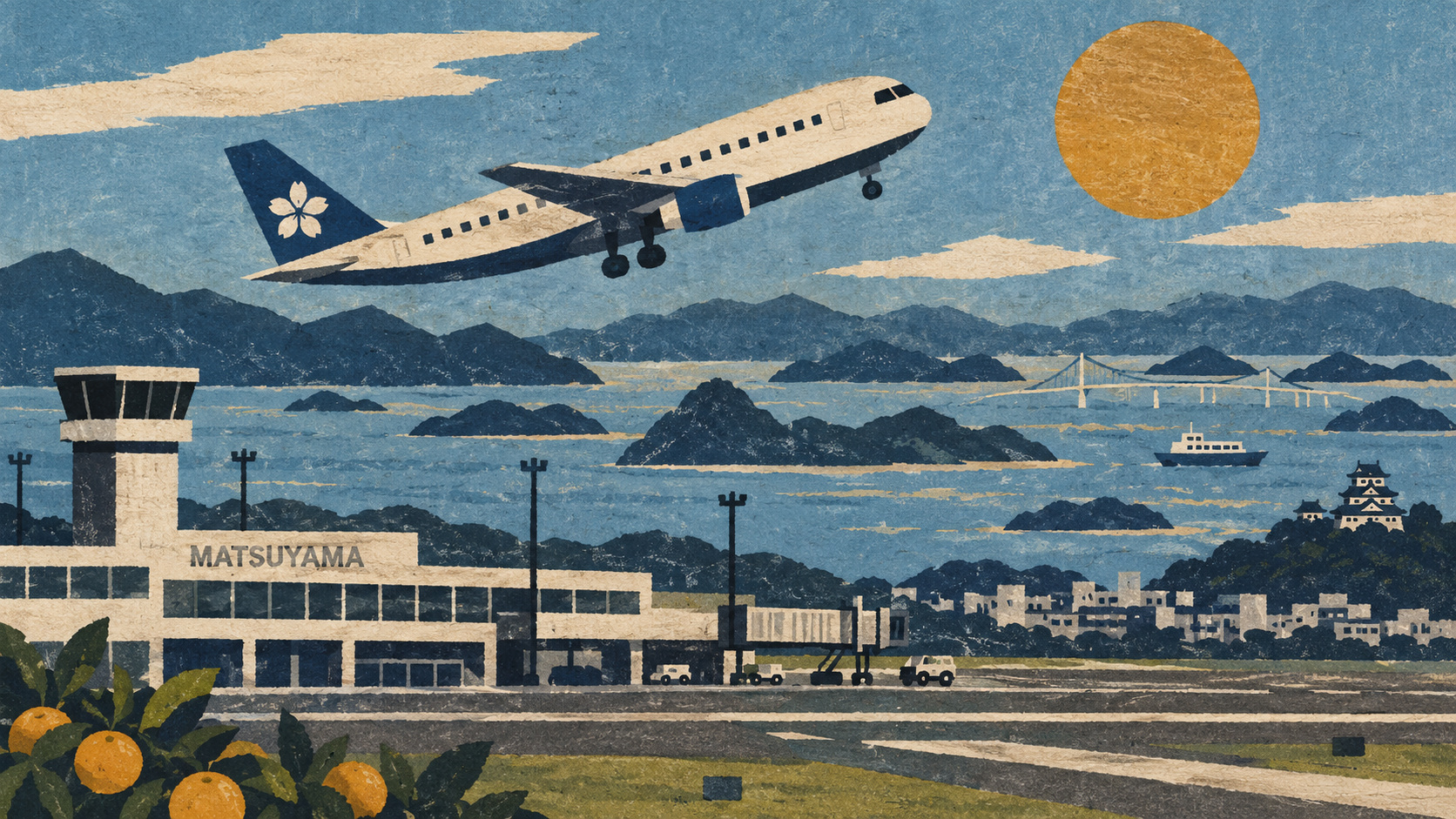
A regional runway, a larger market
Aero K, the South Korean low-cost carrier based at Cheongju, plans to start scheduled flights between central Korea and Matsuyama on January 2, 2027. Ehime Prefecture says the service is intended to operate three round trips a week, on Tuesdays, Thursdays and Saturdays. The airline has made an internal decision, but final coordination with Japanese aviation and airport authorities remains under way. The announcement is significant not because three flights will transform Ehime overnight, but because it may extend a local economy’s access to a previously underserved part of South Korea.
What has actually been announced
According to Governor Tokihiro Nakamura’s September 30 briefing, the route would raise Matsuyama’s scheduled international frequency to 27 weekly flights across Seoul, Busan, Taipei and Cheongju—its highest announced level. This would create three distinct Korean links, more than any other airport in the Chugoku-Shikoku region, the prefecture says. That is a planned network position, not evidence that 27 flights are already operating. Schedules could change ahead of the January launch.
A launch built on test flights
The route did not emerge from one meeting. In April, Ehime announced four inbound-only charter round trips planned for June 2, 4, 6 and 9. The prefecture later reported that the associated travel packages sold out. Governor Nakamura visited Aero K’s headquarters in July to argue for a scheduled connection. In September, he announced a limited service of six round trips from October 14 through 25, with Matsuyama-originating passengers also eligible. The January timetable is the next step in this phased effort to test demand before making a longer commitment.
Why Cheongju changes the map
Cheongju is in North Chungcheong Province, between Korea’s better-known air gateways of Seoul and Busan. The governor described a surrounding commercial catchment of about 5.5 million people, while the city itself has roughly 900,000 residents. The distinction matters. The market estimate is not a promise of passenger demand. Aero K’s proposition is that travelers in central Korea can use a regional hub rather than travel first to larger metropolitan airports. Ehime hopes that some of those passengers will choose Shikoku rather than the standard Tokyo–Osaka itinerary.
How Matsuyama rebuilt its international links
Matsuyama’s aviation history illustrates how fragile routes can be. Prefectural records show the Seoul connection began in 2017, was suspended in 2020 and resumed in 2023. Taipei service started in 2019 and resumed after pandemic interruption in 2024. Busan service began in November 2023. A 2026 airport notice listed 14 weekly Seoul flights, seven to Busan and three to Taipei, totaling 24. Adding Cheongju therefore extends a network that has been painstakingly restored, not one that grew without interruption.
Tourism gains, and the problem of concentration
Ehime’s governor reported that in the first half of 2026, guest-nights by domestic visitors rose 21.5% from a year earlier and those by foreign visitors rose 28.6%. These figures describe lodging demand, not revenue or the number of unique travelers. The central policy challenge is where those stays occur. Matsuyama offers Dogo Onsen, Matsuyama Castle and easy access from the airport, but the prefecture also wants spending to reach industrial and coastal Toyo in the east and rural and historic Nanyo in the south. New arrivals do little for outlying communities if most travelers never leave the airport city.
The economics require caution
The governor cited an annual economic-impact estimate of roughly ¥1.2 billion from a private think tank; local broadcaster TV Ehime reported the projection more precisely as around ¥1.29 billion. Neither number represents observed spending or a guaranteed increase in regional output. The result depends on assumptions about loads, length of stay and traveler behavior. For hotels, restaurants, transport companies and employers, subsequent operating statistics will be more informative than the headline forecast.
The empty-seat problem is two-directional
An inbound-only strategy cannot reliably sustain a scheduled route. Travelers from Ehime also need reasons to fly to central Korea. The prefecture has discussed passport assistance for younger travelers and support for educational trips by university and vocational students, alongside outreach to tour operators. Business travel, family visits, study programs and short holidays could all contribute. A viable route is a two-way market, not simply a campaign aimed at attracting Korean tourists.
Opportunities outside the tourism sector
The possible benefits extend to firms that do not sell hotel rooms. Ehime has shipbuilding-related businesses around Imabari, manufacturers in the eastern part of the prefecture and specialized food producers. A direct link may make meetings, site visits and exchanges easier, even if it does not on its own create export orders. For business readers, the question is whether chambers of commerce, universities, local banks and companies turn new transport capacity into ongoing relationships.
What success should look like after launch
The meaningful benchmarks will come after operations begin: completed flights, monthly load factors, the split between Korea- and Japan-originating traffic, guest-nights, seasonal resilience and visitor spending outside Matsuyama. Public incentives, if used, should be reported transparently and evaluated against measurable outcomes. The biggest test is not whether an aircraft lands on January 2, but whether residents and businesses on both sides of the strait continue to need the connection a year later.
Sources and reporting notes
- 愛媛県・2026年9月30日知事臨時記者会見
- 愛媛県・2026年9月1日知事会見
- 愛媛県・2026年4月27日記者会見
- 松山空港国際線・2026年夏ダイヤ
- テレビ愛媛・路線と地域経済効果
- 松山空港利用促進協議会・利用実績
Research cutoff: October 9, 2026. Service dates are planned and economic-impact figures are projections. Booking volumes and any subsidy amounts were not independently verified.