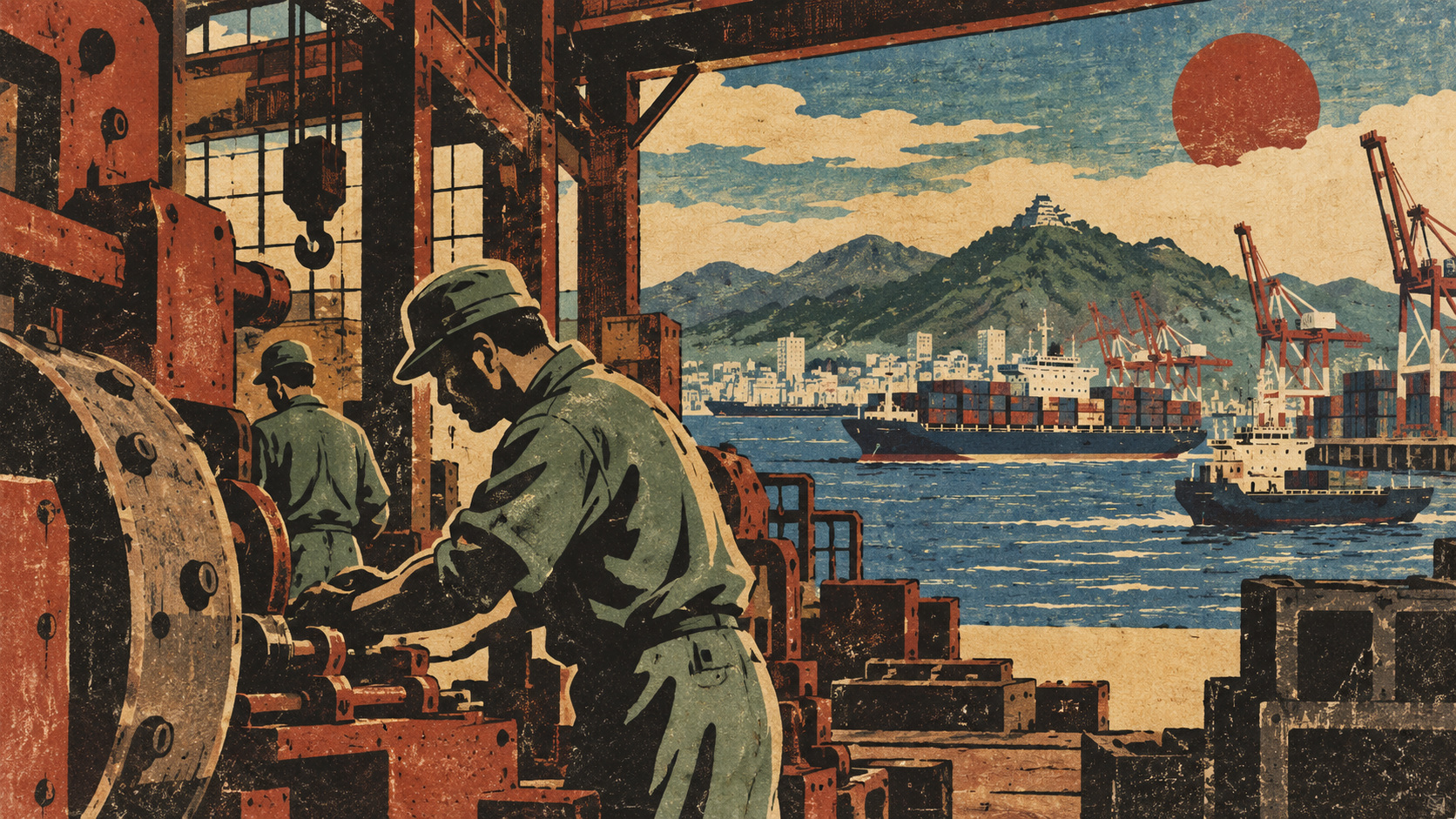
A regional factory looks beyond the home market
In Ehime, the next export story may begin not with a new port or an overseas factory, but with a carefully arranged meeting. The prefecture has opened targeted business-matching programs for manufacturers seeking customers in Vietnam and Indonesia. These efforts come as Japanese regional producers face an aging domestic population and the costly challenge of finding customers, workers and successors. Their significance lies in whether public support can turn highly specialized capabilities into repeat business without hollowing out the places where those capabilities were developed.
Small cohorts, ambitious purpose
Each 2026 program aims to recruit about four Ehime manufacturers. The publicly announced participant fee is ¥50,000, with travel expenses paid separately. Applications ran September 2–25; in-person meetings are planned for November 2026 through February 2027. Expert advisers are expected to identify suitable local prospects, arrange meetings and provide follow-up. These are concrete process commitments, not evidence of new sales: the official notices do not establish how many applicants were accepted or which contracts, if any, resulted.
Indonesia: a chamber-to-chamber bridge
In January 2026, Ehime Prefecture and the federation of local chambers of commerce concluded an economic-exchange memorandum with the Indonesian Chamber of Commerce and Industry, KADIN. The new matching initiative draws on that network. A commercial introduction can reduce the costs of locating a partner, but it cannot substitute for product certification, diligence, maintenance arrangements and the ability to collect payment. Those decisions remain with the participating companies.
An export geography shaped by the Seto Inland Sea
Ehime’s economy did not become outward-looking in 2026. The Seto Inland Sea helped create an industrial corridor where shipping and shipbuilding became central around Imabari, paper and converting products developed in Shikokuchuo, and industrial operations in Niihama trace a line back to the Besshi copper mine. Chemical, mechanical and other production grew from that foundation. This is a varied industrial landscape, not a single export cluster. Its common advantage is the accumulation of practical expertise that can be valuable to overseas buyers.
Why smaller manufacturers need a different playbook
A large multinational can maintain regional offices and teams for legal compliance, language, credit and technical service. A small factory with a distinctive component or production machine may have none of that infrastructure. Finding a buyer is only the first step. Buyers ask about standards, reliability, installation, training, spare parts, response time and payment terms. A persuasive overseas strategy must solve those questions before celebrating a first quotation.
Indonesia is not one uniform market
Ehime separately announced a commissioned market study of promising Indonesian provinces and districts, with particular attention to environmental technology and food processing. The brief calls for examination of market demand, industrial concentrations and infrastructure. Its budget ceiling is ¥1.944 million, with bids due October 9. That narrow geographic approach is important: a Japanese supplier of specialized equipment needs an addressable buyer and service network, not merely the assurance that Indonesia has a large population.
Vietnam and the value of repeated contact
The prefecture says it has already dispatched five economic exchange missions to Vietnam. Its 2026 service procurement selected GLOBAL ANGLE Pte. Ltd as the preferred contractor. This continuity points to a practical lesson: sustained representation and follow-up matter more than one trade mission. Companies need local feedback after the meeting, on pricing, specifications and rival suppliers. Whether that support converts into orders should be tested against results disclosed later.
India provides a third comparison
Ehime has also advanced an India-focused business-matching contract, naming Dooox as its preferred provider following selection. The point is not that Vietnam, Indonesia and India are interchangeable growth stories. Regulations, procurement practices and the cost of technical support differ sharply. Maintaining several pathways allows local companies to choose a customer base that fits a real product rather than follow a single official destination.
Exports do not automatically solve labor shortages
Winning customers abroad may add orders at precisely the moment when an Ehime producer struggles to recruit younger engineers and skilled shop-floor workers. Expanding abroad might safeguard specialized work at home, or it might shift tasks elsewhere. The outcome depends on company strategy, wages, investment in apprenticeships and the retention of research, design and advanced production locally. Sales development and workforce development have to be assessed together.
The hidden costs of an international order
Currency movements can change revenue, but they also change the costs of imported inputs and energy. Shipping, local agents, warranty obligations and credit terms may erase an attractive headline margin. Companies selling equipment must also be able to support it years later. Local lenders and business organizations can help with trade finance and risk controls, but no public program eliminates commercial risk.
What should count as success
The right scorecard begins with qualified meetings and proceeds to quotations, trial installations, repeat orders, gross margins and jobs retained in Ehime. A public evaluation should also state the cost of programs and what participating companies pay themselves. Announcements about memoranda and delegations are only intermediate milestones; they should not be reported as export victories.
A new route for an old industrial instinct
Ehime’s maritime and industrial history was built through connections outside the prefecture. Its present challenge is to make those links work for a different generation of businesses operating in a smaller home market. Four well-supported companies could matter more than a crowded trade fair if they gain durable customers. But the decisive moment will not be the official handshake. It will be the second order—and what the revenue makes possible back in Ehime.
Sources and reporting notes
- 愛媛県「令和8年度インドネシアにおけるビジネスマッチング支援事業」
- 愛媛県「令和8年度ベトナムにおけるビジネスマッチング支援事業」
- 愛媛県「令和8年度インドネシアにおける新市場開拓調査事業」
- 愛媛県「令和8年度ベトナム事業受託者の募集・審査結果」
- 愛媛県「令和8年度インド事業受託者の募集・審査結果」
- 愛媛県産業政策課・貿易振興と商談会
- 愛媛県産業政策課・海外企業向けの支援施策
- 株式会社フォーバル・インドネシア支援事業の受託発表
Research cutoff: October 9, 2026. Business meetings are scheduled for November 2026–February 2027. Application outcomes, export contracts and employment results were not independently verified. Industry analysis is editorial interpretation.