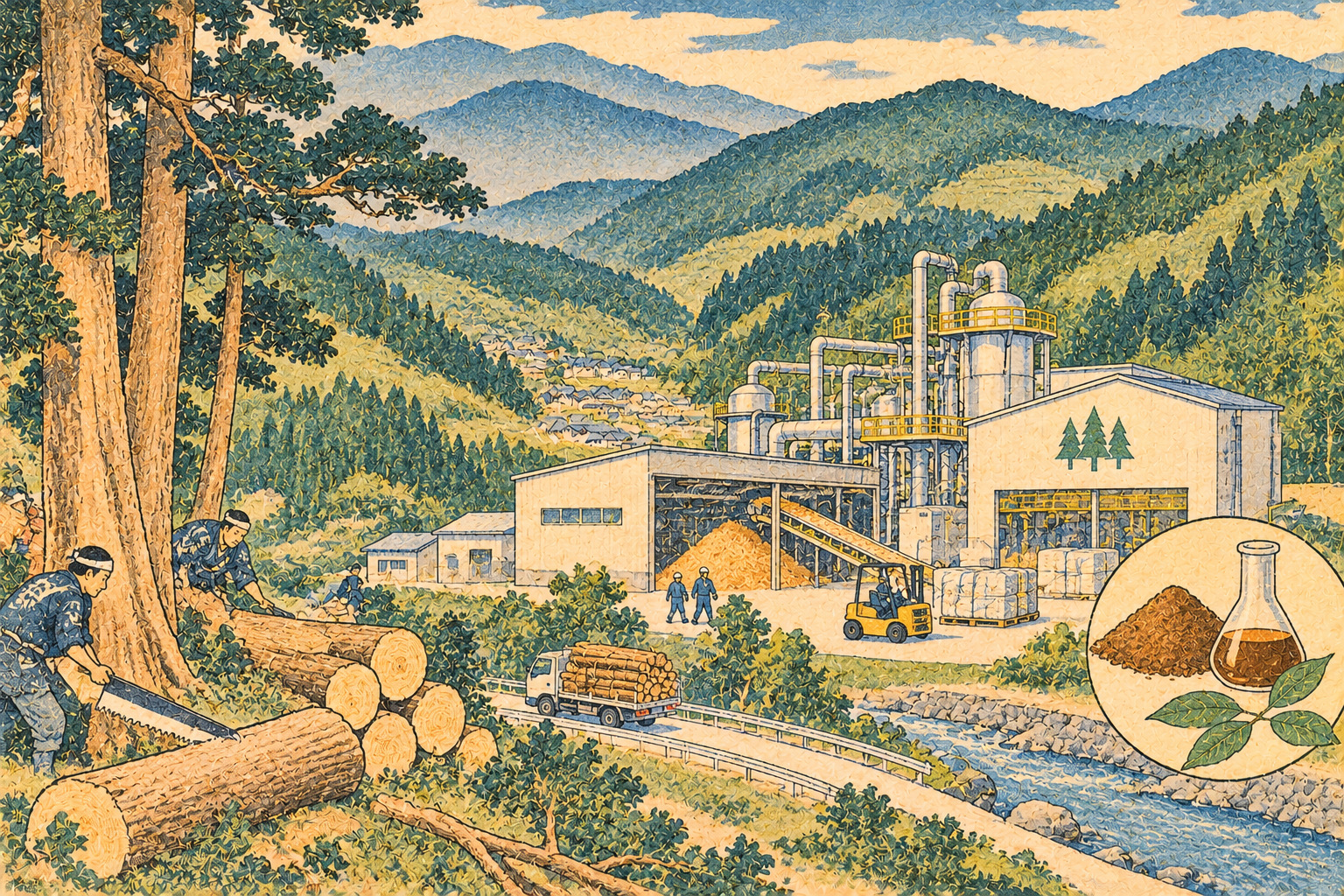
A factory at the edge of the forest
The promise of Japan's cedar forests usually begins with wood: beams for buildings, boards for interiors, chips for paper, and biomass for energy. An industrial project in Ehime Prefecture is asking whether trees can also provide the molecular ingredients for advanced engineered materials. If it succeeds, an ordinary forest product may enter supply chains that value heat resistance, manufacturing consistency and component performance far more than its appearance as timber.
The immediate news is a groundbreaking ceremony held October 19, 2026, in the town of Kihoku. TV Ehime reported an overall project cost of about ¥4.1 billion and a target for plant completion around July 2027. But the factory is not yet producing commercial material. The more important story is the attempt to scale a Japanese laboratory process into a viable business in a rural region searching for new sources of income.
Why Kihoku matters
Kihoku lies in mountainous southern Ehime, near the border with Kochi Prefecture. Local reporting says forests cover roughly four-fifths of the town. Cedar grows in the surrounding landscape, giving the project the possibility of a relatively local feedstock and a reason to involve forestry businesses rather than simply importing industrial chemicals.
The proposed location is the Naganoichi area, where project descriptions identify space for lignin processing, wood preparation, wastewater treatment and planned solar and biomass energy equipment. Rural proximity is not automatically economic efficiency: harvested wood must still be collected, graded, transported, chipped and delivered on a reliable schedule. A factory cannot run on the idea of abundant forests alone.
The molecule inside the tree
Wood is a sophisticated natural composite. Cellulose contributes tensile strength, hemicellulose helps organize the structure, and lignin reinforces plant cell walls. Lignin makes up a substantial fraction of wood, but its molecular complexity and differences between species make it difficult to turn into consistent industrial chemicals. Paper mills have long dealt with lignin as part of separating fibers, often using the resulting stream for energy rather than high-value manufactured products.
The Japanese technology being scaled here is not simply powdered sawdust in plastic. Researchers treat Japanese cedar with polyethylene glycol, or PEG, under controlled heat and chemical conditions, producing PEG-modified lignin that can be processed and blended into engineered materials. The treatment alters molecular properties and can make the product more useful in resin formulations; it also introduces real processing inputs that must be counted in any environmental assessment.
The search for consistency
The scientists chose Japanese cedar for reasons of chemistry as well as availability. Researchers at the Forestry and Forest Products Research Institute, or FFPRI, describe cedar lignin as relatively uniform in molecular structure, a valuable property when a manufacturer needs predictable viscosity, curing behavior and final material performance. Different tree species do not offer identical lignin characteristics.
Japan's extensive planted cedar forests are also a legacy of postwar timber policy. Mature plantations need management, harvesting and replanting, while aging rural communities face labor shortages. A new use for lower-value wood could contribute to forest management, but that outcome depends on fair procurement prices and sustainable cutting and regeneration—not simply on the opening of a chemical plant.
Twelve years of research before a groundbreaking
Government research records document work on lower-cost lignin modification by FFPRI scientist Tatsuhiko Yamada and colleagues in 2014. The Cabinet Office's Strategic Innovation Promotion Program later brought together a network of researchers and businesses to explore the full pathway from local feedstock collection to materials manufacturing and finished products. The work was as much about the production process as the chemical concept.
In 2018, AIST, FFPRI and partners began evaluating modified-lignin composite components installed on a Mitsuoka vehicle. That did not establish commercial approval, but it made the material tangible. Subsequent work studied the effects of wood particle size, PEG composition and processing temperatures on properties, while a 2020 study addressed a surprisingly practical bottleneck: efficient filtration of tiny lignin particles. Industrial scale depends on solving such seemingly unglamorous problems.
Automotive prototypes, electronics ambitions
In 2024, FFPRI and automotive supplier Toyoda Gosei announced a plastic material incorporating modified lignin that could substitute for part of the petroleum-derived content. The team described possible future applications in steering wheels and other automotive components. Researchers have also reported formulations combining flexibility with high heat resistance—a difficult performance pairing for many conventional materials.
Electronics represent a potentially valuable market, but a factory announcement should not be mistaken for a qualification certificate. Semiconductor and printed-circuit-board applications demand consistent dielectric behavior, thermal performance, dimensional stability, moisture resistance and reliability in manufacturing. Specific finished-product approvals or long-term procurement contracts linked to the Kihoku facility were not demonstrated in the available public materials.
The partners behind the plant
Japan's Forestry Agency identifies Mokushitsu Research Institute (株式会社木質素研究所) as the lead institution in a large-scale manufacturing demonstration, with Advantec, Manac, the Osaka Research Institute of Industrial Science and Technology, and Kihoku Town among the partners. The consortium draws on Japan's small-business innovation funding framework to bridge the gap between public research and industrial deployment.
One published project profile describes an initial production line designed for around 1,000 metric tons per year, with an ambition to reach 2,000 tons in fiscal 2028. Those are plans for capacity, not achieved annual output. The figures should also not be treated as evidence of signed orders, profitability or market share. Establishing the operating company's precise contractual role and the division of project risk would require further primary financial disclosures.
A ¥4.1 billion project—or a ¥2 billion plant?
The reported cost requires careful reading. TV Ehime's October 22 account describes an overall project budget of approximately ¥4.1 billion. A project overview published October 9 refers to around ¥2 billion for the manufacturing plant. The two numbers may describe different scopes—such as processing equipment versus site works, energy systems and related facilities—but the available material does not reconcile them definitively.
It would be misleading either to add the figures together or to silently choose one as the universally accepted construction cost. For investors and local taxpayers, the unanswered questions include the definitive capital budget, public grant share, expected operating costs and the commercial arrangement governing the plant. These financial fundamentals matter just as much as the performance of the material.
Can wood-derived plastics lower emissions?
The climate case is potentially attractive: a renewable biological input might displace some fossil-derived feedstock, and the planned facility includes renewable energy components. Government research reports have presented encouraging material and lifecycle comparisons. Yet the exact benefits depend on the process and product substituted.
Forestry machinery, trucking, PEG manufacture, extraction, heating, filtration, drying and end-of-life treatment all create environmental burdens. A rigorous life-cycle assessment needs to count these inputs and specify a like-for-like comparison with the petroleum-based alternative. A bio-based ingredient does not make an entire finished component biodegradable, carbon-neutral or automatically more sustainable.
A new industry, if value stays in the region
The largest consequence for Kihoku might not be the number of tons leaving the factory. It could be the value of wood otherwise sold cheaply, the local work created in forestry and processing, and the ability to sustain replanting and forest maintenance. In that sense the plant is being watched as a regional economic development experiment.
The risks are concrete. Market prices may not justify the cost of collecting raw material; equipment may be underutilized; qualified buyers may demand expensive testing; and chemical handling and wastewater infrastructure must meet environmental expectations. Community benefits should be measured by stable jobs, local procurement, sustainable forestry and transparent operating results, not by an attractive publicity narrative.
After the ribbon cutting comes the harder test
July 2027 is a reported construction target. Commissioning, process optimization, repeated quality tests and customer qualification can take longer than the construction schedule. An earlier project profile also mentions a proposed trial-run period, but the public timeline requires reconciliation; the scheduled opening should not be recast as a firm commercial start date.
Japan has spent years learning how to extract more value from cedar at a molecular scale. The question now is whether that knowledge can survive the everyday discipline of a manufacturing business: reliable feedstock, repeatable output, customers who return, environmental performance that stands up to scrutiny and a community that benefits over time. That is why a factory in a mountain town matters far beyond Ehime.
Sources and reporting method
Document-based research using the Japanese Forestry Agency, FFPRI, ministry research materials and local Japanese reporting. No on-site reporting or fresh company interviews. Project financial scope, schedule and commercial performance remain subject to verification.
- TV Ehime: Kihoku lignin plant groundbreaking (Oct. 22, 2026)
- Kihoku project profile: partners, site and capacity plans (Oct. 9, 2026)
- Forestry Agency: Wood-biomass materials development and consortium
- Forestry and Forest Products Research Institute: New Materials Research Center
- Agriculture, Forestry and Fisheries Research Council: Modified-lignin resin advances
- FFPRI: Modified-lignin plastic material with Toyoda Gosei (2024)
- FFPRI and AIST: Vehicle component field trial with Mitsuoka (2018)
- MAFF agricultural research archive: Low-cost lignin modification (2014)
- FFPRI: Manufacturing parameters and material properties (2018)
- FFPRI: Separation and filtration efficiency research (2020)
- Forestry Agency: FY2025 Forest and Forestry White Paper
- Kihoku Town: Public lectures on modified lignin and regional industry