What the milestone means—and what remains unknown
A family at the center of a remarkable milestone
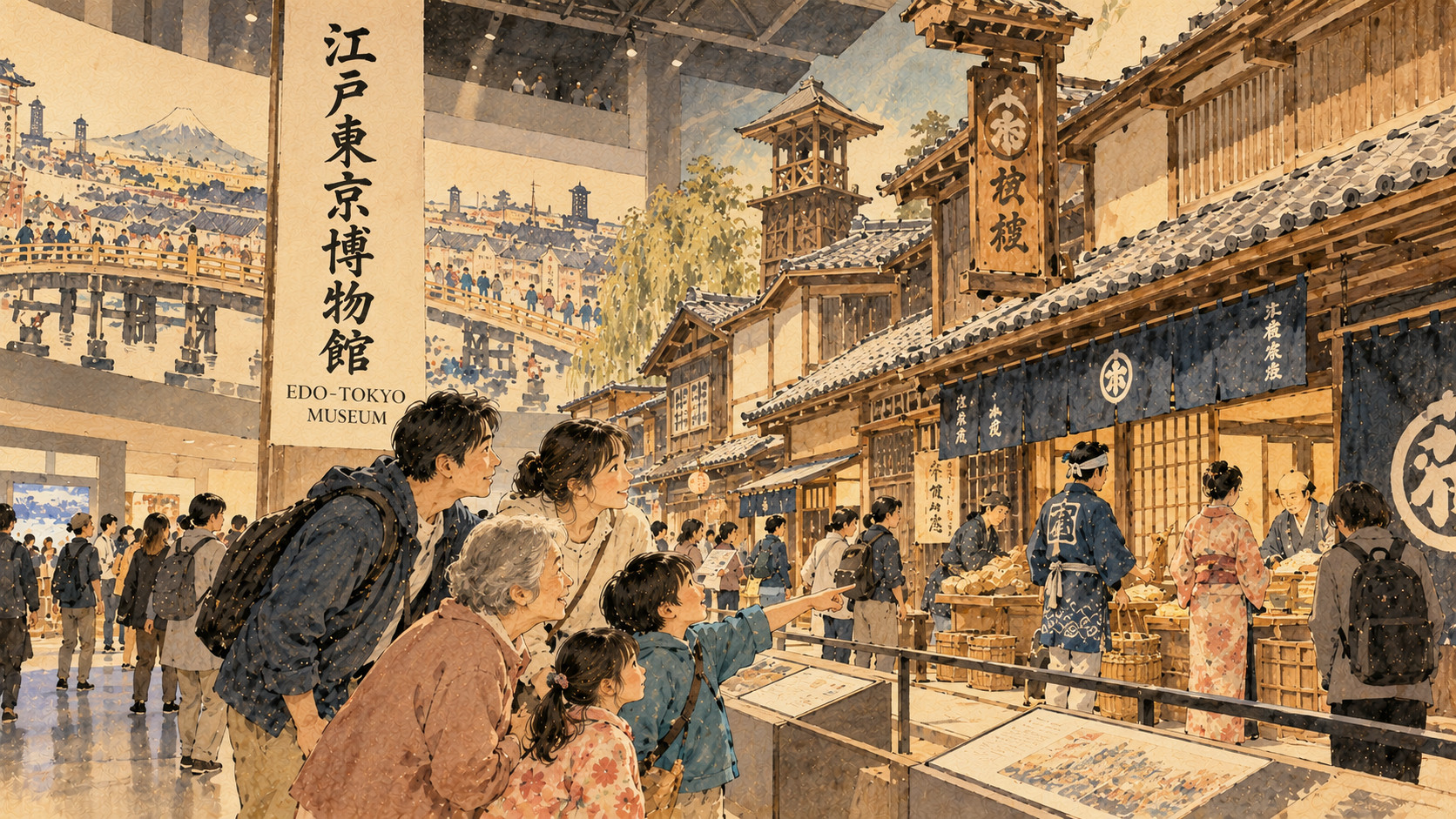
On October 14, a three-generation family visiting Tokyo from Kumamoto Prefecture became the ceremonial millionth visitor to the Edo-Tokyo Museum’s permanent exhibition since reopening. The museum’s director, Terunobu Fujimori, and mascot Gibo-chan joined the celebration. The family said a televised glimpse of the reopened museum had sparked the trip, and singled out the dramatic model displays and Nihonbashi reconstruction.
This was not a million visitors arriving on October 19, when the museum published its announcement. The milestone itself occurred October 14; the Tokyo Metropolitan Government disclosed it October 16. The count refers specifically to the permanent exhibition following the March 31 reopening. It is not a verified total for every museum program, ticket or special exhibition.
Why Tokyo built a museum about an entire city
The institution opened on March 28, 1993, with an unusually ambitious subject: the history of Edo, the shogunal capital, and of Tokyo, the modern metropolis that grew from it. Rather than narrating the city solely through rulers, wars and celebrated artworks, it uses the built environment and ordinary objects to show how people earned money, raised families, traveled, enjoyed entertainment and experienced change.
The architecture by Kiyonori Kikutake’s practice became part of that story. Rising more than 62 meters in Ryogoku, the monumental structure can resemble an improbable vessel on enormous supports. Its boldness belongs to a Japanese architectural era that thought seriously about megastructures and changing cities. Visitors arrive at a place that itself invites questions about how Tokyo should look.
The four-year closure was more than a cosmetic renovation
The museum closed April 1, 2022, for major work and returned March 31, 2026. The project addressed aging facilities, safety and the care of exhibits, but also rethought how visitors approach the building, move through its public spaces and enter its enormous galleries. Tokyo’s history foundation describes an architectural-design collaboration involving OMA and partner Shohei Shigematsu, alongside museum director Fujimori.
That matters because museums compete for attention against images instantly available on a phone. Better lighting or circulation alone cannot justify a trip; a successful renewal makes experiences possible that a screen cannot offer. The museum’s soaring interior, reconstructed streets and physical scale are potential strengths, provided that they become more accessible and intelligible rather than simply more spectacular.
Crossing Nihonbashi into the Edo city
A defining feature is the reconstructed Nihonbashi bridge, encountered in the permanent galleries spanning roughly 9,000 square meters on the fifth and sixth floors. The bridge is more than a photogenic object: it introduces a city built around movement, waterways, trade, administration and dense social life. Edo grew after Tokugawa Ieyasu established his eastern base in 1590 and the shogunate in 1603.
New and revised displays invite visitors to explore the texture of that life. An asagao flower seller and a tempura stall evoke street commerce; changes to a reconstruction of the Nakamura-za theater allow closer engagement with the world of popular performance. These choices make an argument: the everyday city deserves as much museum space as its political elite.
From a watchmaker’s shop to the apartment city
The Tokyo section treats modernization through commercial architecture, housing and material culture. One large-scale model, previously representing the Chōya Shimbun newspaper office, was revised on documentary grounds to depict Hattori’s watch shop. Such a correction may seem minor beside the anniversary headline, but it reveals something essential: historical museum reconstructions must remain open to correction as evidence improves.
A reconstruction associated with the Dojunkai Daikanyama apartments approaches the twentieth century through rooms, furnishings and urban housing. It offers visitors an alternative to the familiar skyline narrative, asking how ordinary residents adapted to new buildings, transport, risks and expectations. Tokyo was remade in kitchens and streets as surely as in government offices.
Authentic objects and immersive replicas must work together
The museum’s experience-oriented approach draws people into the past, yet accurate interpretation depends on the underlying evidence. Prints by Utagawa Hiroshige, maps, clothing and household artifacts matter not simply as decorative treasures but as surviving documents that can complicate or correct a narrative.
At reopening, organizers announced striking arrangements for armor and a special presentation of Hiroshige’s One Hundred Famous Views of Edo. Some of these presentations were explicitly limited in duration. Readers should not assume that every opening-day highlight remains on display in October; the museum’s current exhibition pages and notices govern what can be seen.
What one million visitors can—and cannot—tell us
Reaching the stated annual attendance target in approximately six and a half months is a clear sign of demand. Four years of absence, reopening publicity and school-holiday travel may all have helped, but the available announcement does not separate their contributions. Nor does one large cumulative figure reveal repeat visitation, geographic diversity, satisfaction, education outcomes or net operating costs.
The longer test is whether the museum can remain relevant after the reopening rush. Residents should have reasons to return when a section changes or a public program asks a timely question; schoolchildren should be able to see their own city’s history; overseas visitors should leave understanding more than the visual spectacle. The millionth admission is evidence of reach, not an audit of impact.
Public value and the price of admission
Adult admission to the permanent galleries rose from ¥600 to ¥800 in the renewed museum, according to Tokyo’s renovation materials. The fee for visitors aged 65 and over rose from ¥300 to ¥400; university and vocational students remained at ¥480, high-school students at ¥300, while younger students remain eligible for free admission.
This gives the milestone a policy dimension. A public museum has expenses that ticket sales alone may not cover, including preservation, scholarship, climate control and accessibility. Yet it must also remain an institution families can afford to visit repeatedly. Without detailed fiscal and demographic data, the effects of the increase on access cannot responsibly be asserted.
An autumn calendar that links Tokyo to the world
As of the museum’s October 19 listings, the NHK period-drama exhibition Brothers in Arms runs through November 8; a permanent-gallery feature on the techniques of ukiyo-e runs through October 25. Starting October 24, a new exhibition on students who traveled from late-Edo and early-Meiji Japan to Rutgers College will explore another remarkable historical connection between Japan and America.
Those displays highlight why the institution is more than a tourist stop. Tokyo’s history crosses borders and media, from woodblock printing to architecture to higher education overseas. The museum stands at 1-4-1 Yokoami, Sumida-ku, near Ryogoku station. Visitors should confirm ticket categories, hours and special-exhibition details on the museum website before traveling.
The question after the celebration
The headline number is impressive, but the most revealing detail may be the family’s fascination with a reconstructed bridge. Their reaction suggests what a museum can uniquely offer: scale, context and a physical encounter that turns a familiar place name into a human experience.
A generation after opening, and following four years of closure, the Edo-Tokyo Museum has a new chance to define the relationship between Tokyo and its past. The challenge is to keep revising its account as the city changes. A million visits mark a successful return; the deeper achievement would be a museum that gives people new reasons to ask what kind of city they inhabit—and what they want it to become.
Sources and primary documentation
Based on original announcements and records from Tokyo and the museum; no original interviews or site visit were conducted.
- Tokyo Metropolitan Government: one-million milestone, Oct. 16
- Edo-Tokyo Museum: one-millionth visitor and ceremony, Oct. 19
- Tokyo: reopening and exhibition changes
- Tokyo: renovation and admissions
- Tokyo Metropolitan Foundation: renewal architecture
- Edo-Tokyo Museum: permanent exhibition
- Edo-Tokyo Museum: building data
- Edo-Tokyo Museum: director’s message
- Edo-Tokyo Museum: current exhibitions