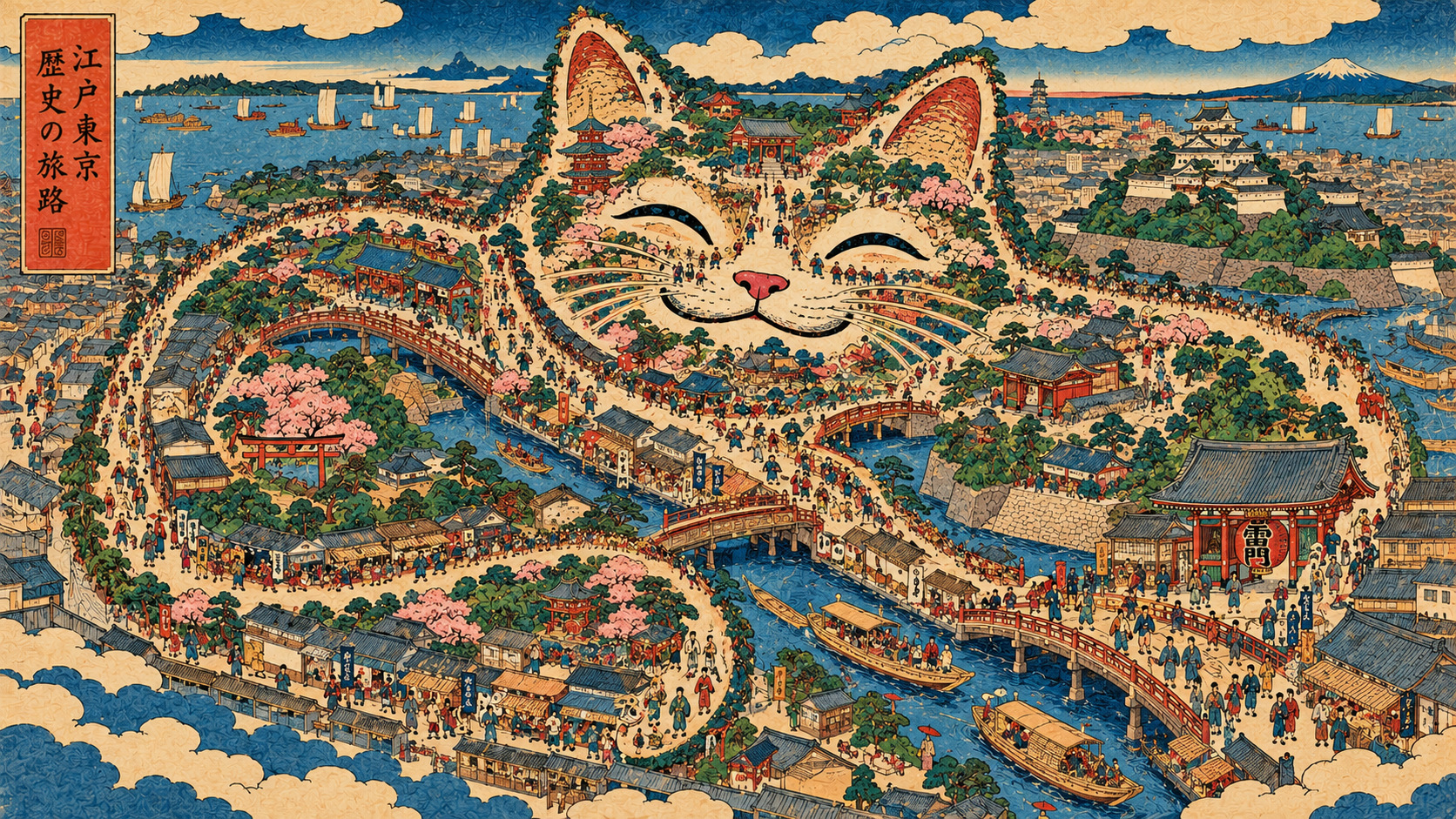
Edo’s landmarks became famous not only through architecture, but through the people who traveled to see, taste and talk about them.
Tokyo had a tourism industry long before it had skyscrapers
Imagine arriving in Edo with a printed guide, choosing a shrine, pausing for a local sweet and heading toward a riverside spectacle. That sounds surprisingly familiar to a visitor to modern Tokyo. An exhibition at the Tokyo Metropolitan Central Library, opened October 24, 2026, investigates the city as a destination: not primarily the seat of shogunal government, but somewhere people traveled, shopped, worshipped and explored. Its title is Go to O-Edo: A Guide to Sightseeing in the Great City of Edo.
A library exhibition with unusually rich source material
The free exhibition runs through November 8 in the fourth-floor exhibition room of the Tokyo Metropolitan Central Library in Minami-Azabu. It is part of Tokyo Cultural Heritage Week 2026 and the Edo Tokyo campaign. Displays are drawn from the library’s special collections, including ukiyo-e prints, neighborhood maps called Edo kiriezu, illustrated books, sugoroku board games and architectural drawings related to Edo Castle. The official announcement identifies important cultural-property documents inherited through the Kora family. This is a display of historic evidence, not a reconstructed theme park.
The guidebook came centuries before the smartphone
The National Diet Library traces illustrated Edo guide literature to books such as Edo Meishoki, published in 1662 and traditionally attributed to Asai Ryoi. It described 81 notable sites. Another early landmark, Edo Suzume (1677), included illustrations by Hishikawa Moronobu. These volumes were bought by visitors and city residents alike. They also became souvenirs. That history complicates the assumption that leisure-oriented urban travel is an entirely modern invention.
Kanda and Ueno: sacred geography and political history
The exhibition’s first neighborhood grouping introduces Kanda and Ueno, including Kanda Myojin and Kaneiji Temple. Shrines were places of worship and festival as well as recognizable destinations. Kaneiji also had close connections to the Tokugawa establishment. To visit such places was to encounter overlapping sacred, civic and political landscapes. Visitors today can explore surviving locations, but should remember that fire, reconstruction and the modernization of Tokyo fundamentally changed their surroundings.
Asakusa: a place of pilgrimage that also sold entertainment
Asakusa appears not merely because of Sensoji Temple. Tokyo’s exhibition announcement also highlights historic sweets and the theater district of Saruwakacho. Religious tourism supported traders and entertainers; fame attracted services, food and performances. Edo’s audience did not divide the city into rigid categories of culture, shopping and spirituality. Those experiences flowed together, much as they still do for visitors around the temple approaches today.
The Sumida River was an entertainment destination
In the Ryogoku and Mukojima section, the official program points to river fireworks, the cherry-blossom rice cakes associated with Chomeiji, and fundraising sumo performances. The river supplied a route and a setting for gatherings. In the city’s historic sightseeing culture, a celebrated view could be inseparable from the timing of a seasonal festival, a street snack or the journey across a bridge. What tourists sought was an experience as much as a monument.
Nihonbashi: where commerce became something to see
Nihonbashi was the starting point of the five principal highways and a center for fish trading and commerce. Its identity depended on connections: roads converged, goods passed through and news circulated. Exhibited maps and images invite readers to imagine an urban district where business itself created bustle worth seeing. Yet the old waterways and street layouts cannot be superimposed straightforwardly upon the modern financial and retail neighborhood; historical comparison requires care.
Edo Castle: drawings reveal a city built around power
The final exhibition section moves toward Edo Castle and the surrounding daimyo residential quarter. A highlight is architectural material passed down by the Kora master-builder family, designated as Important Cultural Property in Japan. These drawings reveal design and construction practices associated with the seat of Tokugawa rule. They should be understood as architectural historical sources, rather than maps created to guide tourists. Alongside illustrated views, they invite a comparison between what ordinary spectators saw and what planners built.
The monumental guide completed over three generations
Edo Meisho Zue, published in 1834 and 1836, ranks among the great late-Edo illustrated gazetteers. The Edo-Tokyo Museum’s catalog traces its compilation through three generations of the Saito family, with drawings by Hasegawa Settan, who visited many sites himself. It covered far more than the territory a present-day visitor might call central Tokyo. Its many illustrations preserve images of streets, temples, markets and landscapes, but these are composed works of art and documentation, not objective photographic snapshots.
What a woodblock picture can tell us—and what it cannot
A printmaker might heighten a dramatic view, crowd figures into a scene or arrange buildings for clarity. Such choices limit the print’s usefulness as a precise map, but also tell historians how a place was presented to buyers. Guidebooks, cut maps, prints and building plans answer different questions. Put together, they reveal the interaction of commercial publishing, civic identity and the everyday desire to see something new.
The people missing from the picture
Old travel writing can be seductive. It may tempt modern readers to imagine that everyone in Edo could wander for pleasure. In reality, money, obligations, social standing and official restrictions shaped who could travel and how. Popular guidebooks privilege recognizable destinations and paying customers, leaving many forms of labor and hardship outside their frames. That absence is itself worth interrogating. A tourism history should ask not only what became famous, but who controlled the story of the city.
A practical visit—and a second visit to the city
The exhibition is at 5-7-13 Minami-Azabu, inside Arisugawa-no-miya Memorial Park, approximately an eight-minute walk from Hiroo Station Exit 1. Regular hours are 10 a.m.–8:45 p.m. on weekdays and 10 a.m.–5:15 p.m. on weekends and public holidays; it is closed November 5. Admission is free. Check the library’s website before traveling. For readers elsewhere, the official archives of the National Diet Library and Edo-Tokyo Museum offer a chance to explore original historical material digitally, without suggesting their digitized items are necessarily physically on display.
The question behind all those famous places
The exhibition offers a different way to read Tokyo. Bridges and temples, theater streets and fish markets, seasonal foods and castle walls were not separate attractions but parts of an interconnected urban experience. To revisit the city through its old guidebooks is to encounter an early version of the tourist’s question: What should I see, and why does this place matter? The answer has never belonged entirely to the past.
Sources and verification
Verified against Tokyo Metropolitan Government and library announcements, the National Diet Library and the Edo-Tokyo Museum catalogs. No site visit or curator interview was conducted. Discussion of a historical book does not imply that particular copy is on view in this exhibition.