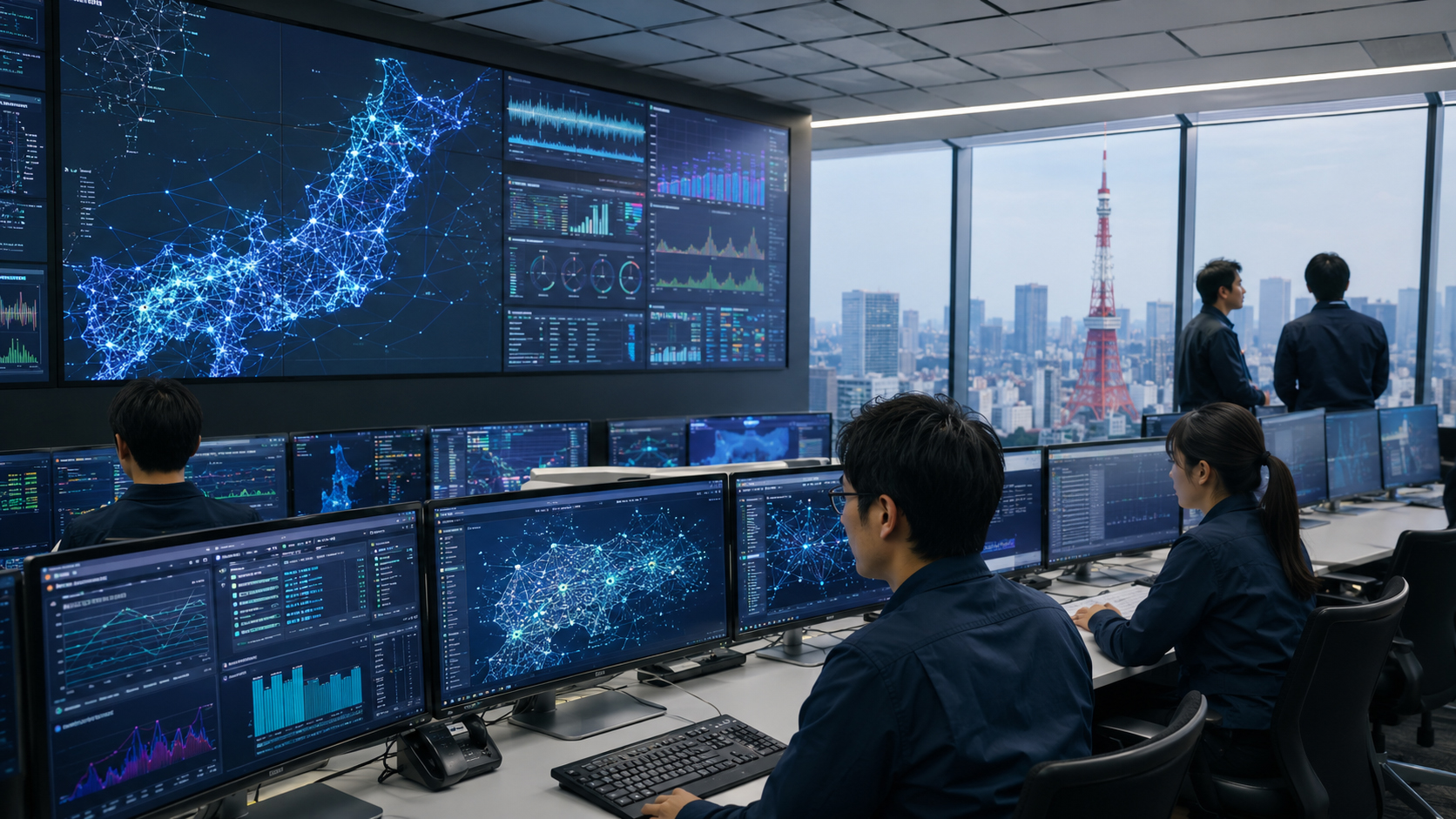
Connectivity is most invisible when it works
When mobile service works, almost nobody thinks about the network. A map opens at the station. A QR code appears before the ticket gate. A taxi app finds a car. A convenience-store payment clears. An earthquake alert arrives. A hospital appointment is confirmed. A child’s message reaches a parent. All of this feels ordinary — and that ordinariness is the hidden triumph of telecom infrastructure.
But when the network stops, modern life suddenly feels old. Payments fail. Videos stall. messages do not send. Disaster information disappears behind a spinning icon. Japan now lives on top of an invisible mobile road system. Whether that road clogs, reroutes, restores, or collapses is no longer just a technical question. It is a social question.
That is why DOCOMO’s deployment of Nokia’s MantaRay AutoPilot matters. It is not a shiny consumer AI launch. It is not a new smartphone, a cute assistant, or a chatbot with a personality. It is a technology users may never see. If it succeeds, the reward is simple: the network feels normal in more places, at more times, under more pressure.
This is not magic. It is the automation of expert work
MantaRay AutoPilot works with Nokia’s MantaRay SON, or Self-Organizing Network. The idea of SON is not new. Networks already monitor themselves, adjust settings, and improve radio conditions through closed-loop control. But earlier automation still required engineers to pre-design many parameters and policies.
Think of a station district that becomes crowded every evening, a stadium that suddenly floods the network after a match, a tourist town that fills with foreign devices on weekends, or an office district where video, payments, and messaging surge at lunchtime. Human engineers have long had to understand those patterns, prepare rules, and tune the network accordingly.
MantaRay AutoPilot changes the level of instruction. DOCOMO can define an “intent” — a desired quality target, such as maintaining communication quality in a specific area. The AI then analyzes base-station performance and quality data, decides which parameters need improvement, and determines the right schedule for execution. In other words, humans define the goal; AI helps design the operational path.
That is not magic. It is expert craft translated into data, models, and cloud-based decision systems. The old telecom engineer’s sense — this cell gets crowded here, that setting affects the neighbor, this pattern repeats at this time of day — is being reassembled as an AI operations layer.
Why now: 5G is not only faster. It is more complicated
5G was sold to the public with simple words: faster, bigger, lower latency. From an operator’s point of view, 5G is not merely a faster road. It is a much more complicated traffic system. There are more lanes, more vehicles, more signs, more intersections, and more kinds of users.
4G and 5G coexist. Multiple vendors’ equipment must work together. Urban and rural traffic behave differently. Phones are joined by IoT devices, payment terminals, cameras, vehicles, factories, event venues, emergency systems, and public services. To preserve quality, operators must watch radio conditions, frequencies, neighboring cells, user mobility, power efficiency, equipment alarms, and changing traffic.
The network has become too large and too dynamic for humans alone to optimize at the speed society now demands. AI is not entering because engineers are unimportant. It is entering because the number of variables has outgrown manual attention. Japan’s cities change their network shape hour by hour: morning stations, lunch districts, evening shopping streets, concerts, tourist weekends, typhoon alerts, and disaster response. Static planning is no longer enough.
DOCOMO’s history has always lived behind the screen
To understand why this matters, it helps to remember DOCOMO’s older role in Japan’s mobile culture. In 1999, i-mode turned the Japanese mobile phone into an information device before the smartphone era. Email, weather, news, games, ringtones, finance, tickets — a small internet was already living in Japanese pockets.
i-mode was not just a product. It was a system: billing, content, handsets, networks, official sites, unofficial sites, emoji, habits, and daily rituals all moving together. Long before the iPhone rewrote the global story, Japan already had a population trained to use the mobile phone as a practical information tool.
After i-mode came 3G, LTE, and 5G. The brand names changed, but the deeper transformation was social. People watched video, navigated cities, made cashless payments, checked safety information during disasters, worked remotely, and carried family coordination in their pockets. The mobile network became the nervous system of everyday life.
AI-driven optimization is the continuation of that history. DOCOMO once helped make the phone a portal to information. Now it is helping make the network itself a system that can read, adjust, and improve itself.
The public cloud detail is bigger than it sounds
One of the most important details in DOCOMO’s announcement is that it implemented MantaRay AutoPilot on a public cloud. DOCOMO says this is the world’s first case of optimizing a commercial mobile network through this system on a public cloud.
That is not just an IT architecture footnote. Telecom networks have long been associated with dedicated equipment, long procurement cycles, tightly controlled systems, and careful operational conservatism. That caution is appropriate for social infrastructure. But the AI era rewards faster model development, data processing, learning, inference, and integration with other AI platforms. Cloud deployment can reduce dependence on hardware procurement lead times and make future integration easier.
Telecom is becoming less like a tower-and-cable industry and more like a software-and-data industry built on towers and cables. The antennas are still real. The fiber, batteries, power systems, and base-station hardware are still necessary. But the intelligence that controls the network is moving upward into software. MantaRay AutoPilot is part of that migration.
| Technology element | What changes |
|---|---|
| Intent-based operation | Operators define desired quality targets instead of writing every detailed step manually. |
| AI analysis | The system reads base-station quality and performance data to decide what should be adjusted and when. |
| MantaRay SON integration | Existing closed-loop automation becomes more adaptive and sophisticated. |
| 15-minute cycles | Optimization can respond to shifting congestion patterns in short operational windows. |
| Public cloud deployment | Cloud architecture can speed implementation and support future AI platform integration. |
This is not just labor saving. In Japan, it is disaster infrastructure
You cannot discuss Japanese telecom infrastructure without discussing disasters. Earthquakes, typhoons, torrential rain, tsunamis, landslides, power outages, and transport disruption are part of the national operating environment. In normal times, mobile networks are convenience. In emergencies, they become lifelines.
People contact family, find shelters, read municipal updates, check roads and trains, receive alerts, and coordinate rescue or recovery. A mobile network outage is not just an inconvenience during a crisis. It can change what people know, where they go, and whether they can ask for help.
Network recovery depends on identifying causes quickly. Which base station? Which line? Which device? Which area? Simple failures can be handled by established procedures. Complex failures require engineers to collect large volumes of data, read alarms, understand topology, and isolate the likely root cause.
In February 2026, DOCOMO separately announced commercial use of an agentic AI system for network maintenance. That platform analyzes traffic and alarm data from more than one million network devices, including base stations and core equipment, to detect anomalies, identify suspected failure points, and recommend actions. MantaRay AutoPilot is about quality optimization, but the larger direction is the same: mobile networks have become too complex to operate with human eyes alone.
A small bridge to AI-native 6G
This is a 5G operations story, but the horizon is already 6G. In the 6G vision, AI is not merely a tool used outside the network. It becomes part of the network’s native design. AI uses the network, the network runs AI, and AI helps control the network.
DOCOMO has already been exploring this future. In February 2026, the company announced a demonstration of AI applications running on CPU resources in virtualized radio access network infrastructure. That matters because it points toward a world where communication processing and AI processing can share the same distributed infrastructure. AI does not have to live only in distant cloud data centers. It can move into the network itself.
Nokia has also framed AI-RAN as a foundation for advancing 5G and moving toward AI-native 6G. The radio access network — the front line between phones and base stations — is becoming more than a pipe. It is becoming a software-defined, AI-aware platform that can optimize performance and potentially support new AI services at the edge.
What will users actually feel?
The honest answer is: perhaps nothing. That is success. A page opens quickly. A video stalls less often. A payment goes through in a crowded store. A map works near the station. Photos upload after a concert. Lunch-hour speed drops less sharply. A failure is isolated faster. A tourist area works better on a weekend.
Network optimization is hard to market because it has no face. A new phone has a camera. A chatbot has a text box. A robot has a body. A better network has only a feeling: less frustration.
But in Japan, that feeling matters. The country combines dense cities, mountains, islands, underground spaces, high-rise districts, aging infrastructure, major disaster risk, tourism pressure, and labor shortages. A mobile network must behave differently in Shibuya, rural Akita, a Kyushu typhoon zone, a ski resort, a baseball dome, a bullet train corridor, and an evacuation center. AI optimization is not a luxury. It is becoming necessary maintenance for a complicated society.
Do engineers disappear? No. Their role rises
AI-based network optimization can sound like engineers being replaced. The reality is more interesting. Human work shifts from manual parameter-by-parameter adjustment toward intent design, supervision, exception handling, risk control, and judgment.
A telecom network is social infrastructure. AI cannot simply do whatever it wants. A setting change can affect neighboring cells. A performance improvement in one place can create a problem elsewhere. Safety, accountability, resilience, and explainability matter. Humans will still decide the boundaries, the priorities, and the rules for exceptional situations.
The future engineer may spend less time turning knobs and more time deciding what the machine should optimize for. Speed? Stability? Power efficiency? Disaster resilience? Event capacity? Rural coverage? Fairness between users? These are not purely technical questions. They are policy, business, and social questions expressed through network settings.
MantaRay AutoPilot is not a surrender of the network to AI. It is more like adding a new nervous system to a giant machine.
Japan’s modernization has always depended on infrastructure
Meiji Japan modernized through railways, post, telegraph, ports, schools, factories, and law. Postwar Japan rebuilt through roads, electricity, telephones, broadcasting, industrial parks, and the Shinkansen. Heisei Japan changed daily life through mobile phones, convenience stores, ATMs, logistics, e-money, and the internet. Reiwa Japan is now changing infrastructure again through AI and networks.
The flashy AI stories imitate human language and images. The deeper AI stories move into electricity, logistics, hospitals, factories, agriculture, water systems, transport, and telecom. There, AI is not a performer. It is a control room.
On the top right of a phone screen, the signal bars look tiny. Behind them are tens of thousands of base stations, network devices, cloud systems, AI models, engineers, operations centers, and maintenance crews. Modern Japan rests on that invisible team.
AI tuning a mobile network may sound like a quiet story. But quiet infrastructure stories are often the ones that matter most. Bridges that do not fall. Water that keeps running. Lights that turn on. Phones that connect. The ordinary must be built, protected, and constantly adjusted.
Japan’s next modernization is not only happening inside the screen. It is happening in the invisible air that lets the screen matter.
- DOCOMO says MantaRay AutoPilot became effective on its commercial mobile network on June 19, 2026.
- The company describes this as the first deployment in Japan of Nokia’s AI-powered MantaRay AutoPilot and the world’s first commercial mobile network optimization using this system on a public cloud.
- The AI uses “intents” — desired quality targets — to analyze base-station data and decide parameter design and execution timing.
- Working with MantaRay SON, the platform can complete an optimization cycle in as little as 15 minutes.
- The deployment points toward autonomous networks, disaster-resilient operations, and AI-native 6G.
Sources and references
This article was based on public information from NTT DOCOMO, Nokia, AWS, Nippon.com, Wired, NTT Technical Review, and AI-RAN materials.
- NTT DOCOMO: DOCOMO Becomes First in Japan to Deploy Nokia's AI-powered MantaRay AutoPilot for Automated Network Optimization
- Nokia: MantaRay SON to NTT DOCOMO's multi-vendor 5G network
- NTT DOCOMO: Commercial deployment of agentic AI system for network maintenance
- NTT DOCOMO: AI application operation using vRAN infrastructure
- Nokia: Building autonomous RAN together — NTT DOCOMO and Nokia’s SMO journey
- Nokia: AI-RAN momentum and path to AI-native 6G
- NTT DOCOMO: Launch of 5G service in Japan
- Nippon.com: NTT Docomo ends i-mode mobile service
- Wired: Pocket Monster — DoCoMo and i-mode