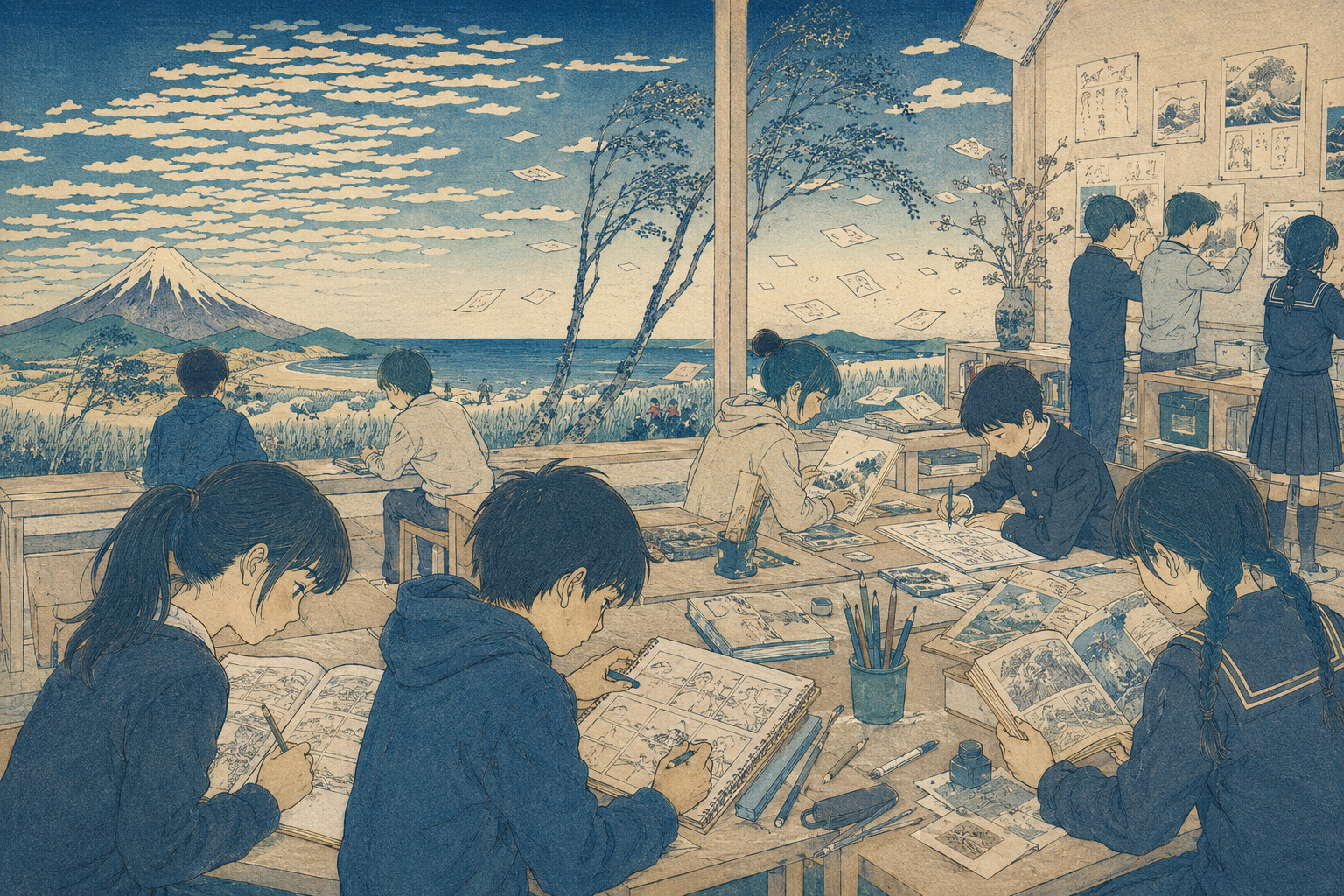
The most consequential encounter with art in a school can begin without a syllabus. A student notices an image on the corridor wall. Another recognizes two characters. Someone who has never called herself an artist sees a desk, a pen and a back bent over unfinished work. The encounter lasts seconds; what follows may last years.
That is the possibility behind a collaboration announced September 1 by Japan's Agency for Cultural Affairs and the live-action film Look Back, due in Japanese cinemas on September 11. A campaign poster will be distributed to elementary, junior-high and high schools, among other schools, across the country. Its line is simple: 「創作はひとを動かす」—“Creative work moves people.”
The scope requires equal clarity. The government announcement does not promise school screenings, curriculum materials, teacher guides, student assignments, artist visits or workshops. It gives no print run, regional breakdown or evaluation plan. In other words, the nationwide element is the distribution of a poster. Reports that say the agency is “taking the film into schools” risk turning a modest public-awareness campaign into an educational program that has not been announced.
A slogan with a shadow
“Creative work moves people” sounds like uncomplicated encouragement. Look Back is compelling because it refuses that simplicity. Making a picture can connect two people and expose the gulf between their abilities. Recognition can create confidence and envy. Solitary practice can become a route toward friendship, a profession or an obsession. The work moves the maker as much as the audience, and not always gently.
The story begins in elementary school. Fujino draws a four-panel strip for the class newspaper. A teacher asks to make room for work by Kyomoto, a classmate who does not attend school. Kyomoto's skill shocks Fujino into harder practice. Competition becomes collaboration and friendship; later, the narrative confronts irreversible loss and the anguished question of whether making art was worth what came with it.
In a statement published for the 2024 animated adaptation, creator Tatsuki Fujimoto described the manga as something he made to force himself to process what he could not digest internally. He added that he did not know whether he had succeeded. That uncertainty matters more in a school than a triumphant promise would. It presents creation not as guaranteed healing, but as a way to give difficult experience a form that someone else can witness.
The 2021 one-shot that kept moving
Shueisha published Look Back on its Shonen Jump+ digital platform on July 19, 2021. The collected volume followed on September 3, running 144 pages. The publisher calls it a long-form youth one-shot: a complete work rather than the opening installment of a weekly serial.
Its formal intelligence lies in repetition. Hands draw. Bodies hunch over desks. A route is walked again. Finished pages matter, but the manga is preoccupied with the time before completion—the labor that disappears once a clean image meets its reader. The English title contains both retrospection and the sight of another person's back. Watching someone work becomes a kind of education.
School is not a promotional setting grafted onto the story in 2026. The class newspaper is its first publication venue, the teacher its first intermediary, and a child absent from the classroom one of its two central creators. This gives the poster unusual relevance and creates a test. Will schools interpret “creative children” only as students already visible in art rooms and clubs, or also as those working privately, remotely or outside the rhythms of attendance?
From drawn motion to filmed bodies
Look Back first reached cinemas as an animated film in June 2024. Kiyotaka Oshiyama directed, wrote the screenplay and designed the characters; Yuumi Kawai voiced Fujino and Mizuki Yoshida voiced Kyomoto. Animation created an exact correspondence between subject and method: artists drawing frame after frame to depict artists drawing panel after panel. The film later received the Japan Academy Film Prize for Animation of the Year and the ceremony's audience-voted award in the works category.
The 2026 adaptation shifts that material into live action under Hirokazu Kore-eda, who serves as director, screenwriter and editor. Natsuki Deguchi plays Fujino and Aju Makita plays Kyomoto, with Furi Nanase and Rokka Okada as the characters in childhood. Masaki Suda appears as manga editor Maeda, while Kankuro Kudo plays elementary-school teacher Tamai. Yuta Bandoh composed the score, and Haruka Kuno directed the rotoscope animation.
The film's official materials emphasize physical preparation. The four performers at the story's center practiced drawing manga for roughly four months. Production followed the characters across 13 years and filmed through four seasons, primarily in Nikaho, Akita Prefecture. Sound design foregrounds the scrape of a G-pen on paper alongside rain, wind and breath. These choices try to make creative labor legible through bodies and sound rather than treating the finished page as magic.
The rollout is large. K2 Pictures says the film will open in 358 Japanese theaters, with Dolby Cinema and Dolby Atmos presentations at selected sites. It also reports selections at Venice, Toronto, the BFI London Film Festival and Busan, plus planned distribution in 98 countries and territories. Those claims come from the distributor before release. The school poster therefore sits at an intersection of a public cultural message and a substantial commercial and international campaign.
July 2021: The original manga appears on Shonen Jump+.
September 2021: Shueisha releases the 144-page collected volume.
June 2024: Kiyotaka Oshiyama's animated film opens in Japan.
March 2025: The anime receives two prizes at the 48th Japan Academy Film Prize ceremony.
September 2026: The agency announces nationwide poster distribution; Kore-eda's live-action film opens September 11.
A poster is not an arts-education program
The agency says it hopes the poster will help children discover the pleasure of creating, express themselves and connect with peers. Those aims fit its broader arts-education language. To understand what is missing, however, compare the campaign with the agency's separate Program for Promoting Cultural and Artistic Appreciation and Experiences at Schools.
That established program sends performing-arts groups and individual artists into schools. It can include advance instruction, demonstrations, hands-on guidance, joint performance and planned, continuing workshops. A creator-dispatch track specifically covers manga, animation, games and film and can operate face to face or through digital technology. In design, it moves from exposure to practice and reflection.
The Look Back announcement contains no such sequence. A poster can produce attention, but it cannot by itself give a child materials, time, feedback, a safe audience or permission to fail. Nor can it support the teacher expected to convert a slogan into a meaningful discussion. Reach and depth are different measures.
| Element | Look Back tie-in | School arts-experience program |
|---|---|---|
| Announced method | Poster distribution to schools nationwide | Touring performances, talks, demonstrations, practical instruction and workshops |
| Student participation | Not specified | Appreciation, creation, dialogue and sometimes joint performance |
| Teacher support | No guide announced | Implementation and application procedures are defined by program |
| Evaluation | No method announced | The wider program has a verification framework |
How manga entered the vocabulary of cultural policy
The campaign is part of a longer institutional change. The Japan Media Arts Festival began in fiscal 1997, recognizing work in art, entertainment, animation and manga and providing public exhibition opportunities. The Agency for Cultural Affairs ended the festival after fiscal 2022, saying that its 25 years of results would feed talent development, archives and international outreach. Whatever one thinks of the festival's end, it helped make manga and animation legible as fields of national cultural policy rather than peripheral entertainment.
The relationship with schools also became more direct in 2018, when administration of the national curriculum guidelines for arts subjects moved from the main education ministry to the Agency for Cultural Affairs. In subsequent policy discussions, the agency has stressed creativity, experimentation and the capacity to pose questions without predetermined answers. A commercially successful manga can now appear in a school campaign because decades of policy have altered the category into which it falls.
Film tie-ins are not new. For the 2018 film The Forest of Wool and Steel, the agency and Toho distributed posters to high schools, universities and public cultural facilities nationwide, then held a preview event with a piano performance and a discussion involving the agency commissioner, the director and piano technicians. In 2019, a tie-in for Talking the Pictures sent approximately 15,000 posters to local governments and schools in Fukushima Prefecture and staged a screening at the historic Kyu-Hiroseza theater.
Those precedents disclosed quantities or added events. The initial Look Back release does neither. It names a broader school range, but nationwide scope should not be mistaken for pedagogical substance.
Public purpose and promotion share the same wall
A poster carrying film imagery eleven days before release is promotional, even when its message serves a public purpose. That is not automatically a disqualifying problem. Familiar culture can lower the threshold to art, and collaboration can make government language less remote. A student may respond to Fujino and Kyomoto more readily than to an abstract statement about creativity.
But schools are not cinema lobbies. Students do not choose the official messages placed in their corridors, and the institution lends legitimacy to what it displays. Transparency is therefore part of the educational value: who paid for printing and delivery, how the title was selected, whether schools are free to decline or remove the poster, and what the studio receives from the partnership.
A fuller program would also connect inspiration with rights literacy. On its child-oriented copyright pages, the agency explains that posting fan art or traced images online generally requires permission even when no money is involved, and that creator guidelines should be checked. Making something because Look Back moved you and learning how to respect another maker's work belong in the same conversation.
Japan.co.jp classroom prompts
- Who is moved? How can a work change its maker before it reaches an audience?
- Who is absent? How can a creative activity include students who do not attend class or do not want to display their work?
- Whose work is it? What do quotation, tracing, fan work and collaboration require in credit and permission?
The six answers still needed
Whether this collaboration expands children's creative lives will not be measurable by delivery alone. Six basic questions remain: the total print run and its regional and school-level breakdown; whether “other” schools include special-needs and compulsory-education schools; whether display is optional; whether accessible poster data and teacher materials will follow; whether screenings, workshops or creator visits are planned; and whether anyone will assess how students respond.
Access to art is uneven. Some schools can host professionals and maintain active clubs; others lack specialist teachers, materials or rooms. Posters are inexpensive and scalable, but they may speak most clearly to children who already have tools and encouragement. The promise becomes more equitable only when students receive time, a place to work, materials, an audience they can choose and adults who make failure survivable.
Still, the medium should not be dismissed. Fujino and Kyomoto's story begins with a tiny comic in a class newspaper. A page on a school wall can be an opening. The responsible measure of success is what happens after someone looks: whether the school turns attention into practice, and whether the agency turns a release-week slogan into lasting access. Only then will the tie-in demonstrate, rather than merely declare, that creative work moves people.
Sources
- Agency for Cultural Affairs: Look Back tie-in announcement (September 1, 2026; purpose, recipients and campaign line; Japanese)
- K2 Pictures: Agency for Cultural Affairs × Look Back (film-side announcement; Japanese)
- Live-action Look Back official site (cast, staff and film information; Japanese)
- K2 Pictures: September 11 release and lead cast announcement (drawing preparation and locations; Japanese)
- K2 Pictures: Sound-format announcement (theater count, story duration and sound design; Japanese)
- Shonen Jump+: Look Back (original July 19, 2021 publication and official synopsis; Japanese)
- Shueisha Books: Tatsuki Fujimoto, Look Back (publication date, length and bibliographic data; Japanese)
- Animated Look Back official site (Tatsuki Fujimoto and Kiyotaka Oshiyama statements, cast and staff; Japanese)
- Animated Look Back: 48th Japan Academy Film Prize results (March 21, 2025; Japanese)
- Agency for Cultural Affairs: Program for Cultural and Artistic Appreciation and Experiences at Schools (performances, artist and creator dispatch, workshops; Japanese)
- Ministry of Education: First Arts Working Group minutes (transfer of arts-subject administration and the agency's account of arts education; Japanese)
- Agency for Cultural Affairs: Japan Media Arts Festival overview (1997–2022 program history; Japanese)
- Agency for Cultural Affairs: The Forest of Wool and Steel tie-in (2018 school distribution and event; Japanese)
- Agency for Cultural Affairs: Talking the Pictures tie-in (2019 distribution count and screening; Japanese)
- Agency for Cultural Affairs: Copyright essentials for young people (fan art, tracing and permissions; Japanese)
Japan.co.jp checked material published through 11:10 p.m. JST on September 2, 2026, prioritizing Japanese primary sources. Japanese names, titles, roles, dates, statements and administrative terminology were verified against the agency, Shueisha and the official film and anime sites. This report distinguishes announced poster distribution from unannounced screenings or curriculum. The live-action film had not opened at publication; this is a policy and cultural-history analysis, not a review.
Image rights: © 2026 Japan.co.jp. This AI-assisted editorial illustration uses no official manga, film or campaign artwork. Unauthorized reuse is prohibited. For licensing, visit the contact page.