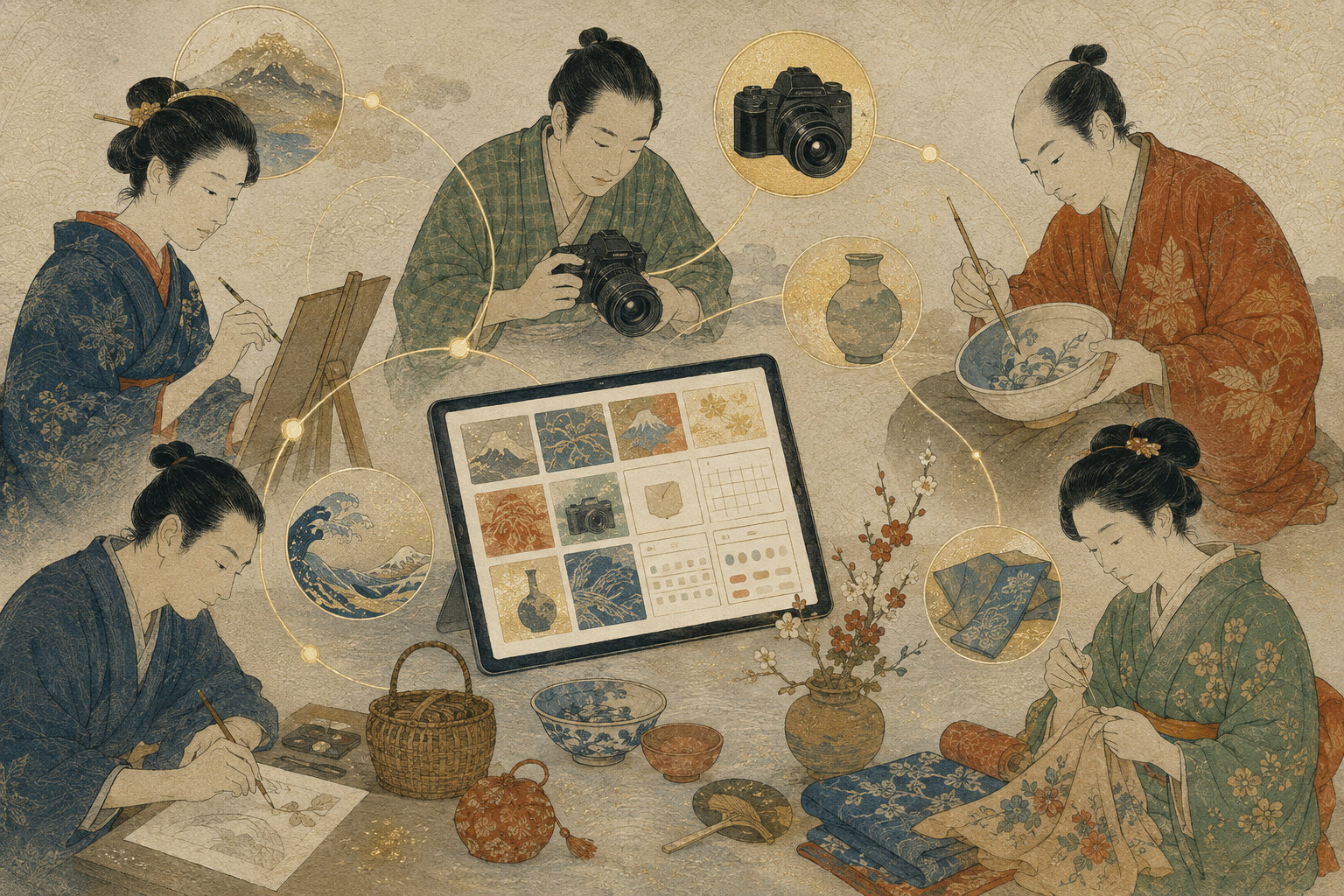
At 8:03 on a humid Monday evening, a small company in Fukuoka pressed publish on a large promise: put photographers, camera operators, editors, sound engineers, lighting technicians, designers, narrators, models, performers and production teams in one searchable market, give each of them a portfolio and a bookable calendar, and let a customer ask for an estimate or reserve a working date.
The company is Point Yes, established in June 2015 and based in Wajiro, in Fukuoka’s eastern ward. Its announced capital is ¥8 million. Its ordinary work is not abstract social networking. It supplies LED displays, stage construction, sound, lighting, photography, video, live streaming, equipment rentals and software. Its new platform, Creator Market—branded “クリマーケ” on the live site—grows out of that backstage world.
That origin matters. A logo can be delivered at midnight from another prefecture. A convention cannot. A stagehand must be in the room before the doors open. The camera operator must have the right date free, understand the venue, bring or source the right equipment, and coordinate with sound, lighting and production. The platform’s most interesting object is therefore not its profile page. It is the calendar.
Point Yes says registration, profiles, portfolio publication, job posting, job browsing, estimates, proposals, email notifications and booking-calendar functions are currently free. It warns that payment-provider fees or features with additional conditions may still cost money and asks users to check the latest terms. Individuals, side workers, companies and production teams may register.
A marketplace born backstage
Online labor platforms are often designed from the screen outward: begin with a digital task, divide it into a brief, collect bids, move a file and release money. Creator Market appears to move in the opposite direction. Its operator knows the physical production stack—people, equipment, travel, load-in, rehearsal, show, strike and return.
The live homepage makes that lineage visible. Creator search sits beside a rental storefront filled with cameras, lenses, field recorders, speakers, mixers, stage lights, LED equipment and event supplies. A user can look for a camera operator and, on the same site, browse the machinery of the job. That hybrid may be awkward as information architecture, but strategically it is distinctive. A regional market could match not only talent to demand but crew to kit and kit to schedule.
The occupations named in the announcement extend well beyond events: illustrators, web creators, writers, interpreters, hair and makeup artists, stylists and others. Yet the public interface reveals the operator’s center of gravity. Its first large buttons are camera operator, model, actor, influencer, sound, lighting and event work. Its category list runs through weddings, concerts, corporate ceremonies, livestreams, stage audio and LED visual production. This is a services market built around occasions.
That focus can be an advantage. Broad marketplaces promise every skill and often make a buyer translate a real problem into an unfamiliar category. A venue operator in Kitakyushu may not know whether a 1,000-person hotel event requires a lighting operator, a lighting designer, a console programmer, riggers, power distribution or all of them. A field-literate platform can turn a vague request into a safe crew plan.
But domain knowledge must become product rules. If it remains only in the operator’s head or a telephone support line, the marketplace will not scale fairly. The next stage is to encode the unwritten wisdom of production: call times, overtime, travel, setup, rehearsal, insurance, equipment responsibility, weather, cancellation, safety authority, backups and delivery specifications.
What Creator Market says it offers
The announcement presents two routes to a transaction. A client may search by work samples, fee, region and specialty, inspect availability and contact a creator directly. Or the client may publish a job so creators can submit estimates and proposals. Creators may place photographs, videos, YouTube links, prices, service regions, social accounts and bookable times on a dedicated profile.
Those are useful building blocks, but each label hides a policy decision. Does “reservation” create a binding contract, a hold or only an inquiry? Is a displayed day rate eight hours or a working day of unknown length? Does “region” include travel costs? Is an estimate fixed, capped or provisional? Who may see rejected proposals? When does the platform reveal contact information? Who removes a discriminatory or unsafe request?
| Layer | Published or observed feature | Question still needing a public answer |
|---|---|---|
| Discovery | Search by occupation, region, genre, profile, work and price | How are rankings ordered, sponsored and moderated? |
| Availability | Calendar and reservation-request flow | Inquiry, temporary hold or binding booking—and when? |
| Demand | Clients can publish work and solicit estimates | What minimum fields prevent vague, unpaid or unsafe briefs? |
| Identity | The rental flow requests identity documents | Does marketplace verification cover both clients and creators, and what badge means what? |
| Payment | The release mentions bank transfer, PayPay and points, with stronger online management planned | Who holds money, when is it released, and how are refunds and chargebacks handled? |
| Price | Core marketplace functions described as currently free | Which processing fees and future paid features apply to which party? |
| Rights | Profiles can display creative work | What license does the platform receive, and who owns commissioned deliverables? |
| Failure | Status-management and moderation concepts are referenced | What happens after cancellation, nonattendance, harassment, damage or a disputed delivery? |
A launch does not need every feature. It does need an intelligible boundary between what the software does, what the parties must agree, and what the operator will decide when something goes wrong.
Japan has been building creator markets for eighteen years
Creator Market enters a history, not a blank screen. Lancers was founded in April 2008 and opened its namesake job market that December, combining competitive proposals with an escrow-style mechanism. CrowdWorks followed: the company was founded in November 2011 and its service entered closed beta in March 2012. Coconala, established in January 2012, organized a market around individuals selling knowledge and skills.
At the same time, product marketplaces taught consumers to buy directly from makers. Creema began in May 2010. Minne began in Fukuoka’s orbit on January 17, 2012 as the first project in GMO Pepabo’s effort to create new web services in the region; sales functions arrived that April. By 2023, Minne said its cumulative transaction value had passed ¥100 billion. Creema said that by January 2026 it hosted about 300,000 creators and 20 million listed works.
These services normalized several separate ideas: an individual can be a merchant; a portfolio can be a storefront; a platform can lower discovery costs; reputation can travel beyond personal introductions; and a distant buyer can pay someone they have never met. They also taught a harder lesson. Listings are not transactions. A market must solve search quality, trust, payment, disputes, fraud, repeat business and the imbalance between abundant creators and scarce good commissions.
2008 — Lancers company formation in April; service launch in December.
2010 — Creema begins connecting makers and buyers.
2011–12 — CrowdWorks is founded and opens beta; Coconala is established.
2012 — Fukuoka-born Minne begins as an online display service, then adds sales.
2024 — Japan’s Freelance Act takes effect on November 1.
2026 — Point Yes publicly releases Creator Market with a regional production-services emphasis.
The historical distinction is important. Minne and Creema primarily sell objects. Lancers and CrowdWorks primarily organize commissioned labor. Creator Market is trying to join portfolios, tendering and appointments while living beside an equipment-rental operation. Its closest problem is not “How can art be placed online?” It is “How can a real job with a real date be made legible before the crew arrives?”
Fukuoka already proved that meeting matters
The regional thesis is not fanciful. On January 14, 2026, the Fukuoka Chamber of Commerce and Industry held a creator-matching event with 30 exhibiting creator companies. The chamber reports 156 visiting companies, 209 attendees and 621 business meetings. It is now preparing more face-to-face events, seminars, a design and branding consultation desk and year-round creator profiles.
Those numbers do not prove that every meeting became a contract. They prove something narrower and useful: local companies will devote time to structured encounters with creative suppliers, and one physical day can produce many conversations. Creator Market’s opportunity is to preserve that density between events. A buyer who met three studios in January may need a photographer on a Tuesday in September. A calendar and remembered portfolio can bridge the gap.
Regional density may also be more defensible than immediate national breadth. A national directory can appear large while producing thin results in any one occupation, place and date. A smaller market can be valuable if it reliably answers a narrow request: “Show me three verified sound engineers available in Fukuoka next Friday, each with comparable rates and the correct equipment experience.”
Kyushu has other experiments. Miyazaki’s Creator’s Bridge, announced in 2026, says the first successful match carries fees—10 percent for the creator and 5 percent for the client—while repeat work between the same pair can proceed without another matching fee. Tokyo-based FEAT says direct bank-transfer deals can be free while a platform-managed payment option costs 5 percent. Those models make the trade visible: lower fees may leave more money with the worker; managed payment and dispute infrastructure cost something to operate.
“Free” is a price, not a business model
Free registration is genuinely helpful. A freelance photographer should not have to pay simply to learn that no buyers are present. A small bakery should be able to publish one product-shoot brief without buying enterprise procurement software. Removing the entrance toll encourages experimentation.
But every trustworthy marketplace has a balance sheet. Someone pays to verify identities, review abusive posts, secure personal data, process money, answer weekend emergencies, investigate copied portfolios, resolve scope disputes, refund a failed job, maintain the calendar and attract enough buyers. If core use remains free, revenue may come from payment processing, rentals, priority placement, subscriptions, advertising, enterprise tools, insurance, lead fees or complementary production services.
Each choice changes incentives. A commission aligns revenue with completed trade but encourages users to leave the platform after meeting. A subscription rewards retention but charges creators before income arrives. Paid visibility can finance the market but make ranking less meritocratic. Equipment rental fits Point Yes’s existing business, yet the platform must disclose when recommendations benefit its own inventory. Enterprise procurement can subsidize free creator profiles, but large clients may then shape the rules.
The cleanest launch disclosure would be a one-page fee map. For every path—direct inquiry, platform payment, cancellation, refund, withdrawal and optional promotion—it should show the payer, calculation base, tax treatment, payment-provider charge and date the fee is collected. “Currently free” should have a dated version and a notice rule for change.
A calendar is not a contract
Availability solves one question: can this person work then? It does not answer what the work is. Creative disputes usually begin in the space between a short message and a different expectation. “Film the event” could mean one locked camera or a five-person crew; raw footage or a finished edit; one revision or ten; internal viewing or an international advertising campaign.
Japan’s Freelance Act makes precision more than good manners. Effective since November 1, 2024, the law generally requires a commissioning business to specify transaction conditions immediately in writing or electronically. The information includes the parties, date of commission, content, delivery or service date and place, inspection completion date if applicable, compensation and payment date. Compensation generally must be paid within 60 days of receipt, as soon as practicable.
For engagements of at least one month, covered commissioning businesses face prohibitions including unjustified refusal to accept work, later reduction of compensation, returns, conspicuously low pricing, forced purchases, compelled economic benefits and changes or rework for reasons not attributable to the freelancer. Work-environment duties address accurate recruitment information and harassment systems; longer engagements bring additional considerations.
The law is active. The Japan Fair Trade Commission said that from November 2024 through September 2025 it published four recommendations and provided guidance in 441 cases. It and other authorities surveyed 30,000 commissioning parties in fiscal 2024 and began another 30,000-business compliance survey in fiscal 2025.
A platform can help clients comply without pretending to provide legal advice. It can refuse to publish a brief until required fields are complete; generate a dated transaction record; distinguish fee from expenses; calculate a lawful payment date; log revisions; and warn when a “change” is actually new scope.
| Before a booking becomes work | Minimum practical record |
|---|---|
| Scope | Deliverables, event or shoot plan, crew roles, equipment, file formats and exclusions |
| Time | Call, setup, rehearsal, performance, strike, delivery, overtime unit and delay rule |
| Money | Fee, consumption tax, travel, accommodation, rental, overtime, deposit and payment date |
| Acceptance | Who approves, inspection period, objective defect standard and deemed acceptance |
| Revision | Included rounds, change-request method, extra rate and schedule consequences |
| Cancellation | Weather, illness, venue failure, client cancellation, creator cancellation and force majeure |
| Rights | Ownership, license uses, territory, duration, editing, credit, music/model releases and archive |
| Safety | Responsible producer, site authority, insurance, restricted work, incident and emergency contact |
Copyright does not ride automatically with the invoice
A customer who pays for an illustration, photograph or video does not thereby become its author. Under Japanese copyright principles, the person who creates the work is generally the author. Economic copyright can be transferred; moral rights cannot. A commission therefore needs to say whether the customer receives a limited license, an exclusive license or an assignment.
The difference is commercial. A restaurant may need photographs for its website, menu, social accounts and delivery apps. That does not necessarily include resale to a franchisee, use in an overseas television commercial, alteration by a generative system or indefinite use without credit. A performer may agree to event recording but not a perpetual advertising edit. An illustrator may keep portfolio display rights even after granting exclusive campaign use.
Japan’s Agency for Cultural Affairs advises particular care when transferring rights covered by Copyright Act Articles 27 and 28, concerning adaptations and exploitation of derivative works. A broad transfer clause that omits them may not convey those rights. The agency provides contract templates and a free legal-consultation service for cultural and artistic workers, including photographers, illustrators, stage and film staff.
Creator Market could turn this complexity into comprehensible choices. The booking flow might ask: Where will the work appear? For how long? In which territory? May the client edit it? Is advertising included? May the creator show it in a portfolio? Are source files or raw footage included? Do music, location, model or performer releases exist? A short rights summary should travel with every estimate.
The platform also needs a license for public portfolios—but only the license required to display, resize, cache and promote them. It should not quietly take ownership. It should provide a copied-work complaint process, preserve evidence, allow counter-notice and distinguish between a creator who owns the displayed work and a technician showing a production in which many people hold rights.
The launch-day public paperwork is not ready for the promise
Japan.co.jp’s cutoff-time audit found a gap between the marketplace described in the announcement and the legal pages visible to a public visitor. That is a snapshot, not a claim that the pages cannot change quickly.
The public page labeled “Terms of Use” contained four equipment-rental safety steps: upload identity documentation, await inventory and identity confirmation, inspect at receipt, and return the equipment. It ended with what appears to be an administrative placeholder instructing that the content be edited from the management screen if necessary. It did not present substantive marketplace terms allocating the relationship among creator, client and operator.
The privacy policy, dated February 21, 2026, identifies data such as name, address, telephone, email, company, payment information and rental history. Its stated collection routes and purposes focus heavily on rental reservations, delivery, returns, invoices, identity review and maintenance. It does not clearly explain the data flow implied by public creator profiles, customer job posts, proposals, booking requests, messaging or reputation.
The commercial-transactions notice identifies Point Yes and lists card, bank-transfer and electronic payment methods, plus shipping, transfer and processing costs. Its return and cancellation language is generic and appears oriented toward the operator’s goods and services. It does not answer whether Point Yes is party to a creator-client contract, merely introduces the parties, processes money as an agent, guarantees performance or stays outside the transaction.
- Marketplace terms defining creator, client and operator roles; contract formation; eligibility; moderation; suspension; prohibited jobs; review integrity; and law and dispute venue.
- A transaction policy for estimates, deposits, payment custody, release, refunds, chargebacks, cancellation, no-shows and disputed acceptance.
- A creator-rights and portfolio policy covering copyright, license scope, takedowns, credits, likeness, music and confidential work.
- A marketplace-specific privacy notice mapping public and private fields, identity documents, messages, calendars, payments, processors, retention, deletion and cross-border services.
- A verification legend explaining what the platform has checked—and what it has not—for both sides.
- A fee schedule with version date, tax, provider charges and notice before changes.
This is not bureaucratic decoration. A freelancer deciding whether to upload an identity document and a confidential portfolio needs to know how they are stored. A customer paying a deposit needs to know who can return it. A sound engineer declining an unsafe setup needs to know whether a retaliatory review can stand. The contract is part of the product.
Payment protection is where “free” becomes difficult
Direct payment is cheap to operate and familiar to businesses. It can also leave a creator chasing an invoice after delivery and a client paying a stranger before work begins. Managed payment or escrow-like release can reduce that fear, but it introduces cost, identity and anti-fraud work, refund rules, chargeback exposure and legal obligations.
For event work, a simple “release on delivery” rule is not enough. Much of the value is performed live and cannot be returned. A sensible structure may combine a nonrefundable reservation deposit, milestone payments for preproduction, a balance after the event and a separate acceptance process for edited files. Cancellation must reflect how close the date is and whether the creator refused other work to hold it.
Platform records should distinguish four states: proposed, held, contracted and completed. They should show which party confirmed each transition. A calendar marked busy is not proof of a contract; a client’s request is not consent; an estimate is not always an invoice. Ambiguity creates double booking and blame.
Small creative businesses also need cash-flow visibility. The platform should show the contractual due date, the date funds arrived, any deduction and the remittance recipient. If a payment provider charges a fee, the gross, tax, fee and net amount should be visible before acceptance—not discovered at withdrawal.
Trust must be symmetrical
Platforms often speak of verifying creators because clients fear poor quality or fraud. Creators also face risk: fake jobs used to collect personal information; dangerous locations; harassment; unreasonable auditions; uncompensated sample work; discriminatory casting; last-minute cancellations; stolen proposals; and clients who disappear after receiving files.
Creator Market’s production categories sharpen that duty. A shoot may involve a private residence. A performer’s job may involve costume or physical-contact conditions. A stage job may involve height, electricity and heavy equipment. A model or junior creator may need privacy protections that an ordinary office freelancer does not. “Identity verified” says little about whether the job itself is legitimate or safe.
Verification should therefore be layered and legible: email confirmed, telephone confirmed, identity checked, company registry matched, payment method verified, relevant license or insurance reviewed, and completed platform transactions. No single badge should imply that the operator has certified artistic quality or guaranteed safety.
Reviews also need structure. The platform can separate punctuality, communication, brief accuracy, payment, safety and deliverable quality; allow both parties to submit before either review appears; and create an appeal path for threats, private data or provably irrelevant retaliation. A five-star average alone tends to compress every failure into reputation theater.
The cold start is local, occupational and temporal
Every two-sided marketplace begins with an empty-room problem. Creators do not maintain profiles where clients never arrive. Clients do not post briefs where qualified creators do not respond. Creator Market adds a third dimension: time. Ten photographers in Fukuoka are not useful if none is free on the wedding date.
The public landing page displayed four cards under “new creators.” Four job cards were also visible, all dated February 21 or 22, 2026 and describing event production needs in Fukuoka or Nagasaki. Their existence months before the August announcement suggests the site or its data predated the public release. It does not reveal whether those requests were filled, whether additional private listings exist or how many people are registered.
That is why registration count would be a weak first success metric. The platform needs to measure the probability of a useful match. For each occupation-region-date cell: how many verified creators are active, how many have updated availability recently, how many qualified responses arrive, how quickly the first response comes, and what fraction proceed to a contract and paid completion?
| Metric worth publishing | What it reveals | What it must not be confused with |
|---|---|---|
| Active, recently updated creator profiles | Usable supply | Total historical signups |
| Qualified responses per valid job | Match depth | Raw proposal spam |
| Median time to first qualified response | Buyer usefulness | Automated acknowledgment |
| Contract and paid-completion rates | Movement from discovery to trade | Page views or inquiries |
| Median days from acceptance to payment | Worker cash-flow health | Contractual due date alone |
| Cancellation, dispute and resolution rates | Reliability and operating burden | A perfect-looking five-star average |
| Repeat work, with and without platform payment | Relationship value and leakage | Platform revenue |
| Creator earnings distribution by category | Whether opportunity is broad or concentrated | One top-earner testimonial |
A practical 100-job test
Creator Market does not need to become Japan’s largest creative platform in its first year. It could learn more by making the first 100 eligible jobs unusually well documented.
Point Yes could recruit a focused cohort from the professions it understands: camera, sound, lighting, stage and editing in northern Kyushu. Every brief would pass a human scope check. Both parties would receive a plain-language deal sheet. The platform would log calendar state, response time, agreed fee, additional expenses, rights, cancellation, delivery, acceptance and payment. Afterward, both sides would be interviewed about friction.
The public report should not expose private prices or identities. It could disclose distributions: response time, contract rate, total value, median job value, cancellation, days to payment, dispute themes and repeat work. It should publish the number of jobs rejected for vagueness, illegality, safety or lack of budget. Failed matches are product evidence.
That pilot would also reveal where software ends. Some briefs need a producer, not a form. Some clients need help understanding that a camera body without lenses, sound, light or data backup is not a production plan. Some creators need help pricing travel, prep and usage rights. Human curation may be the regional platform’s strongest early feature.
The opening is real; the market is still to be made
There is something appealingly modest beneath Creator Market’s large category list. A small event company has taken a recurring operational problem—finding the right person who is free at the right moment—and built a public tool around it. It has not announced a billion-yen fund, a celebrity creator roster or an artificial-intelligence revolution. It has offered profiles, portfolios, work posts and calendars without an entry charge.
That can help the little company and the independent worker. A neighborhood manufacturer may finally find a product photographer. A lighting technician may fill a dark Tuesday. A narrator may become visible outside the agency system. A two-person studio may look credible without constructing its own booking software.
But the internet has never been short of directories. The valuable institution is the one that makes a promise inspectable. Who is the client? What exactly is being bought? When is the date held? What does the price include? Who owns which rights? When will money arrive? What happens if the venue cancels, the file is rejected or a person feels unsafe?
Free listing opens a door. The work after the door—contracts, rights, payments, safety, moderation, privacy and market density—is what turns a website into infrastructure. Point Yes comes to that work with an advantage: it has stood behind the stage and knows that a show succeeds because many small promises are made precise before the lights come on. Creator Market’s future will depend on bringing that same precision to the screen.
Reporting notes and principal sources
This article reviews public information available through August 11, 2026 at 8:06 AM JST. Point Yes’s release is the source for its product description, company profile and plans. Those claims are separated from Japan.co.jp’s audit of the live public pages. Four creator cards and four job cards were visible sections of the homepage, not disclosed totals. No user, transaction, revenue or outcome count is inferred. The legal discussion is general reporting, not advice for a specific contract.
- Point Yes release, August 10, 2026: Creator Market launch, functions, professions, free-at-present scope and future plans
- Creator Market live site: search flow, occupations, regions, visible creator and job cards, and equipment-rental storefront
- Creator Market public terms page inspected at the reporting cutoff
- Creator Market privacy policy, dated February 21, 2026
- Creator Market notice under the Specified Commercial Transactions Act
- Point Yes corporate and production-services site
- Point Yes, August 1, 2026: P-MIX Studio release and company profile
- Fukuoka Chamber of Commerce and Industry: January 2026 creator-matching results and continuing program
- Lancers corporate history
- Lancers service launch, December 16, 2008
- CrowdWorks corporate history
- Coconala corporate profile
- Creema: service history and January 2026 creator/work counts
- GMO Pepabo: Minne launch in Fukuoka, January 17, 2012
- GMO Pepabo: Minne cumulative transaction value exceeded ¥100 billion in 2023
- Creator’s Bridge: first-match and repeat-work fee model
- FEAT: direct-payment and managed-payment fee model
- Japan Fair Trade Commission: Freelance Act requirements and guidance
- Government of Japan: Freelance Act conditions, payment and prohibited conduct
- Japan Fair Trade Commission: 2025 enforcement and survey figures
- Agency for Cultural Affairs: revised fair-contract guidance for cultural and artistic fields
- Agency for Cultural Affairs: free legal consultation for cultural and artistic workers
- Agency for Cultural Affairs: authorship, transferable copyright and nontransferable moral rights
- Agency for Cultural Affairs copyright contract manual
- Personal Information Protection Commission: APPI general guidelines