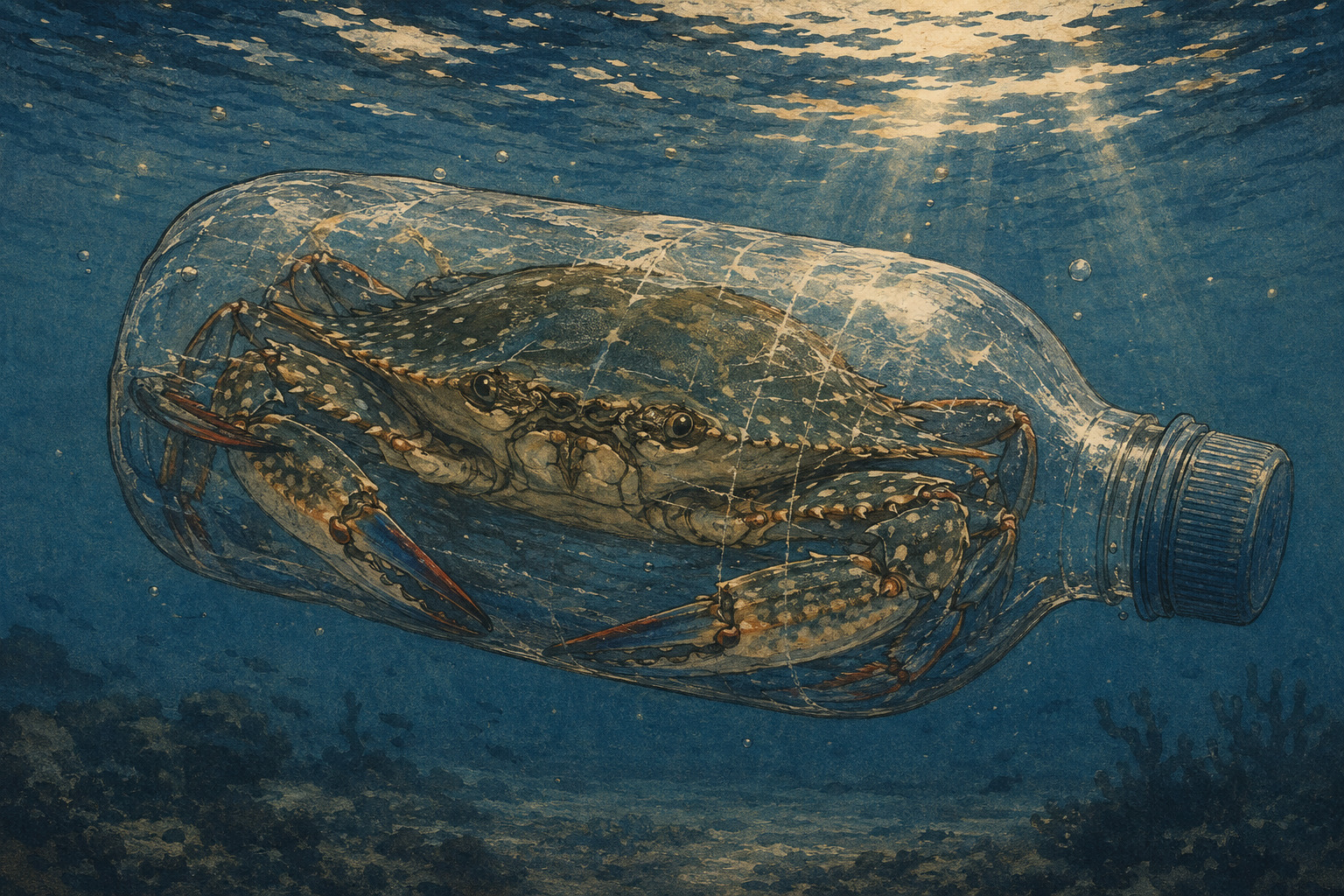
The prisoner was larger than the door
At 8:50 on the morning of July 15, 2022, researchers surveying juvenile fish about 500 metres west of Sesoko Island, Okinawa, dipped an uncapped whitish bottle from the sea. Small fish had gathered around and beneath it. Then the collectors looked inside. A large, living crab occupied the bottle.
The animal was a female three-spot swimming crab, Portunus sanguinolentus, known in Japan as janome-gazami. Its carapace measured 88.23 millimetres across and 40.31 millimetres long. It weighed 42.06 grams and lacked its left third walking leg. The bottle’s mouth measured only 24.0 millimetres across. The crab could not be pulled out intact; the researchers had to cut the plastic.
The geometry rules out a large adult simply crawling through the neck. It does not reveal exactly when or where a smaller crab entered, or whether it entered as a late larva or a juvenile. What it establishes is a one-way growth trap: the animal passed through when small, fed and grew, and eventually exceeded the dimensions of its exit.
An open bottle—not a sealed survival chamber
The container was a 2.38-litre high-density polyethylene, or HDPE, bottle embossed for Shaoxing wine. It stood 36 centimetres high, measured 17 centimetres across internally and bore a manufacture date of November 17, 2021, in Zhejiang Province, China. That date sets only an outer limit: the bottle was no more than about eight months old when found. It does not say when it was emptied, discarded or first reached the ocean.
Most importantly, the cap was absent. Seawater could enter and leave through the neck as waves rocked the floating container. The case therefore does not demonstrate that a crab can live for two months in sealed, stagnant or oxygen-free water. The study did not log dissolved oxygen, temperature inside the bottle, salinity, ammonia or circulation. Calling it a “bottle” should not smuggle in the image of a closed jar.
The manufacturing location also does not identify the polluter. A product made in Zhejiang may be consumed elsewhere, carried on a vessel, resold or transported through many hands. The evidence permits “manufactured in China”; it does not permit “discarded from China.” The authors’ current route is a biological and oceanographic hypothesis, not a traced shipping record.
| Direct observation | Reasonable inference | Not established |
|---|---|---|
| Open HDPE bottle found afloat off Sesoko | Water exchanged through the 24mm mouth | Oxygen or water-quality conditions inside |
| Crab longer and wider than the opening | It entered at a smaller stage and grew | Exact entry date, size and location |
| Zhejiang manufacture mark dated Nov. 17, 2021 | Bottle age was no more than about eight months | Discarder, discard place or sea-entry route |
| Crab missing one leg | It had experienced an earlier injury or autotomy | That the bottle caused the loss |
Four kinds of fish orbited the floating object
The bottle was already more than rubbish by the time it reached Sesoko. The net collected two juvenile rough triggerfish (Canthidermis maculata), five rainbow runners (Elagatis bipinnulata), five Indo-Pacific sergeants (Abudefduf vaigiensis) and one freckled driftfish (Psenes cyanophrys) with it. Algae and stalked goose barnacles grew on its surface.
This attraction has a long natural history. Logs, pumice, coconuts and drifting seaweed create shade, structure and feeding opportunities in otherwise open water. In 1967, Richard Gooding and John Magnuson described the ecological importance of a drifting object to pelagic fish. Modern fish-aggregation devices deliberately exploit the same behaviour. A bottle can accidentally perform a miniature version of that function.
That dual role is the story’s central paradox. The object concentrated possible prey and supported algae, helping keep the crab alive. At the same time, its narrowing neck removed the crab’s freedom to leave. “Habitat” and “hazard” were not alternatives. The same physical structure created both.
Nine scales, bone fragments and a genetic menu
After cutting open the bottle, the researchers dissected the crab. This point matters: the animal was not released after rescue. Its stomach held nine fish scales, hard fragments interpreted as probable fish bone and pieces of algae, with a combined wet mass of 0.023 grams. Those visible remains established recent feeding but could not reliably identify every item by eye.
The team therefore used three genetic targets. Nuclear 18S ribosomal DNA surveyed broad eukaryotic material. MiFish primers targeted a short, informative portion of mitochondrial 12S DNA for fish. The chloroplast psbA marker targeted algae. MiFish sequences matched rough triggerfish and either scissortail sergeant or its close congener, the Indo-Pacific sergeant, at 100 per cent identity. The latter ambiguity is a reminder that a short barcode cannot always distinguish close relatives.
The algal assay found brown algae in the order Ectocarpales and the green alga Ulva compressa at high sequence identity. The paper also reports a picoeukaryotic green alga, Prasinoderma coloniale, but regards it as unlikely to represent direct feeding. The strongest interpretation is modest: fish and attached algae contributed to the crab’s recent diet. DNA cannot reconstruct every meal across two months, show hunting frequency or prove that every prey item entered after the crab became trapped.
| Evidence | What it supports | Limit |
|---|---|---|
| Nine scales and probable bone | The crab had eaten fish | Fragments alone do not identify species |
| MiFish 12S DNA | Rough triggerfish and an Abudefduf sergeant in the recent diet | Two close sergeant species could not be separated |
| psbA DNA | Green and brown algae were ingested | Does not prove where every algal fragment grew |
| Fish observed at capture | Matching prey were available around the bottle | A snapshot, not a two-month census |
| Stomach wet mass: 0.023g | Food remained at dissection | Not a measure of total intake or condition |
The 62-day clock was alive on the bottle
The bottle had no tracking beacon. Its barnacles supplied the closest thing to a logbook. The team measured the capitulum—the plated upper body—of 159 Lepas anserifera goose barnacles. Their sizes formed two peaks, indicating more than one settlement episode. The smallest measured 1.41 millimetres; the largest, 20.71 millimetres.
A newly settled cyprid of this species is about 1.3 millimetres long. Subtracting that starting size from 20.71 millimetres gives approximately 19.3 millimetres of growth. At a mean sea-surface temperature of 28.1°C, the authors applied a published field growth of 13.17 millimetres over 42 days, or 0.313 millimetres per day. Dividing 19.3 by 0.313 yields about 61.7 days, rounded to 62.
| Step | Value | Meaning |
|---|---|---|
| Largest capitulum | 20.71mm | Size at collection |
| Approximate settlement size | 1.3mm | Published cyprid-stage reference |
| Estimated post-settlement growth | 20.71 − 1.3 = 19.41mm, reported approximately as 19.3mm | Growth attributed to time on the object |
| Reference rate | 13.17mm / 42 days = 0.313mm per day | Field rate under similar warm conditions |
| Biological drift estimate | 19.3 / 0.313 ≈ 61.7 days | Approximately 62 days |
This calculation is informative, not exact. Goose-barnacle growth varies with food, season, individual and environment. A 2024 laboratory study reinforced that size is not a simple universal calendar and called for growth-line and shell-chemistry work to improve reconstructions. More fundamentally, the oldest measured barnacle establishes a minimum period since its settlement. The bottle could have floated before that animal attached. And the crab could have entered before or after settlement. “62 days trapped” is therefore a synthesis, not a directly timed event.
A second clock came from the crab’s own growth
Research in Osaka Bay provides an independent, broader estimate. Juvenile P. sanguinolentus with carapace widths of roughly 5.5–50 millimetres associate with drifting seaweed in June and July. Crabs approaching the size of the Sesoko animal appear on offshore substrates roughly two months later, in August and September. Even if this crab entered when its carapace length was already equal to the 24-millimetre bottle opening, the authors reasoned that it probably spent one or two months inside.
Growth in Osaka Bay cannot be transferred mechanically to every tropical crab. Temperature, food, sex and population differ. But it is valuable because it does not depend on barnacle measurements. Two imperfect clocks—one on the bottle and one based on the crab’s life history—converge on the same order of magnitude.
Crabs enlarge by moulting: a rigid exoskeleton is shed and a larger soft shell expands before hardening. The study did not witness a moult inside the bottle or count discarded shells, so it cannot state how many moults occurred. Growth past the mouth is nevertheless unavoidable from the final dimensions. The trap was not closed by a cap; it was closed by development.
A fast-swimming crab built for drifting youth
The three-spot swimming crab is an Indo-Pacific portunid recognisable by three dark, pale-ringed spots across the rear of its carapace. Its flattened final pair of legs works as paddles. Adults occupy sandy and muddy marine habitats and support fisheries in parts of Asia. Early stages can live a more pelagic life, associating with floating seaweed and other surface objects.
That natural history makes entry credible. A small crab seeking structure, food or cover could pass through a 24-millimetre neck. Once inside, the wall offered refuge from some predators and the opening admitted water, algae and sufficiently small prey. The traits that made the bottle attractive—structure in open water and access to a floating community—also exposed the crab to entrapment.
At 88.23 millimetres wide, the female lay above the 82.2-millimetre size at which one South China Sea population reached 50 per cent maturity. Histology in the case study found developing oocytes, consistent with reproductive development. Population thresholds vary, and developing ovaries are not evidence that this animal would imminently spawn. They do underline the cost of confinement: a survivor approaching reproductive life could not choose habitat or mate normally.
Survival is not the same as fitness
The crab was alive, had food in its stomach and was not obviously a starved shell. It is tempting to turn the case into a fable of adaptation. Evolutionary fitness, however, is not measured by endurance alone. It concerns contribution to future generations. The authors conclude that an animal permanently confined by debris has little or no opportunity to reproduce, even if food lets it remain alive.
The bottle could also restrict escape from predators, habitat choice, courtship, migration and responses to poor water quality. None of those outcomes was experimentally measured in this individual. Nor were stress hormones, immune function, plastic additives or microplastics analysed. The study documents mechanical confinement and diet; it should not be used as evidence that this particular crab suffered chemical poisoning.
This distinction keeps the environmental claim proportional. The case is not “plastic made a thriving crab home,” because autonomy and reproduction were removed. It is not “the bottle starved the crab,” because stomach evidence shows feeding. It is an ecological trap with an unusually long-lived captive.
A plausible ride on the Kuroshio—without a known origin
The researchers propose that the bottle travelled from south of the Okinawa Islands on the Kuroshio, then approached Sesoko through a local Kuroshio Counter Current. The powerful western boundary current transports warm water and floating matter northeastward along the Ryukyu arc. Regional models and surface drifters show that countercurrents and island wakes can return objects toward coasts.
But no trajectory was reconstructed for this bottle. The manufacturing stamp, barnacle age and recovery point do not identify a unique path. Windage—the part of an object exposed above water—can make a bottle move differently from a fully submerged drifter. Biofouling changes weight and orientation. Caps, residual liquid and waves change buoyancy. A current diagram can show plausibility, not provenance.
The safest account is therefore geographical but not accusatory: a Zhejiang-made container was recovered in Japanese waters, and the authors hypothesise transport within the Kuroshio system. When it entered the sea, who discarded it and where the crab entered remain unknown.
One small bottle contained a floating food web
The container linked several ecological layers. Algae used plastic as substrate. Goose barnacles filtered particles from passing water and recorded time in their shells. Juvenile fish used the shaded structure. A crab exploited fish and algae from inside. Water exchange connected the interior to the sea while the neck filtered entrants by size.
This resembles a “neopelagic” community: coastal organisms can persist on durable artificial surfaces far offshore, mixed with animals adapted to floating life. Research after the 2011 Great East Japan Earthquake showed how long-lived debris can carry coastal species across oceans. More recent work has documented fish dispersal with marine debris. The Sesoko case adds a different mechanism. The raft did not merely carry an organism attached outside; it changed from nursery-like shelter into a mechanical prison around a growing animal.
The case also explains why visual categories can mislead. A bottle is simultaneously pollutant, substrate, fish-aggregation object, vehicle and trap. Ecological function does not redeem the litter. It shows how a manufactured shape can redirect interactions for months after its intended use has ended.
From drifting shade to ocean plastic: a short history
Scientists studied life around floating objects before “marine plastic” became a research field. Gooding and Magnuson’s 1967 work described fish associated with a drifting object. In 1972, Edward Carpenter and Kenneth Smith reported widespread plastic particles on the Sargasso Sea surface, averaging about 3,500 pieces per square kilometre in their samples, and noted attached diatoms and hydroids. Early observations already contained the two themes seen inside the Okinawa bottle: synthetic debris as pollution and as living surface.
Attention then broadened from ingestion and entanglement to lost fishing gear, rafting species, habitat alteration and chemical effects. Research on “ghost fishing” accelerated from the late 1980s; a 2005 Japanese review showed that unattended traps and nets could continue capturing animals, sometimes for long periods depending on gear and seabed conditions. The idea has since expanded beyond equipment designed to fish.
| Year | Milestone | Connection to the bottle |
|---|---|---|
| 1967 | Gooding & Magnuson describe pelagic fish around a drifting object | Explains why juvenile fish gathered around floating structure |
| 1972 | Plastic particles and attached life recorded on the Sargasso Sea surface | Early evidence that plastic is both pollutant and substrate |
| 1988 | MARPOL Annex V enters into force, banning disposal of plastics from ships | Establishes prevention at sea; does not identify this bottle’s source |
| 2005 | Japanese review consolidates ghost-fishing research | Frames persistent, unattended capture |
| 2011 | A similar P. sanguinolentus grown inside a drifting bottle is reported in Japan | Shows the 2022 observation was not necessarily unique |
| 2020 | Beach debris entrapment estimated to kill large numbers of land hermit crabs on two islands | Extends plastic harm to small crustaceans and containers |
| 2021 | Six submerged tyres in Mutsu Bay trap 1,278 hermit crabs in one year | Demonstrates non-fishing debris acting like fishing gear |
| 2022 | Sesoko bottle collected; crustacean-plastic review synthesises 98 studies | Field case appears amid rapidly widening research |
| 2025 | Plastic debris in trawl catches shown to retain small organisms | Highlights traps hidden within ordinary debris counts |
| 2026 | Okinawa case published with diet DNA and a 62-day drift estimate | Connects geometry, food web and biological time |
Japan had seen this same species in a bottle before
In 2011, Satoshi Ishida published a two-page record in the Bulletin of the Fukui City Museum of Natural History: a three-spot swimming crab that had grown while confined in a drifting plastic bottle in temperate Japanese waters. The 2026 paper cites it explicitly. The recurrence matters more than any claim of a world first.
The new study’s advance is its chain of tests. It documented bottle and crab dimensions, identified associated fish, inspected stomach remains, applied DNA metabarcoding, measured a large barnacle sample and compared the result with crab growth. That converts an arresting anecdote into a testable case study. It still does not supply a frequency: two Japanese records over 15 years cannot tell us whether one in a thousand or one in a billion bottles becomes a crab trap.
Case reports are valuable precisely where monitoring misses small victims. A crab inside an opaque or scuffed bottle may be invisible during surface counts, strand on an unvisited shore or sink after fouling. Absence from databases can reflect absence of observation, not absence of events.
Ghost fishing no longer requires a net
Traditional ghost fishing refers to lost or abandoned gear continuing to capture animals without a fisher. Nets entangle; pots lure animals through entrances that frustrate escape. The Okinawa bottle was never designed to fish, yet its geometry reproduced the one-way logic of a pot. It admitted a small animal and retained a larger one.
Other debris shapes do the same. A 2020 study estimated that roughly 61,000 strawberry hermit crabs on Henderson Island and 508,000 on the Cocos (Keeling) Islands became trapped and died in debris each year. Those are model-based island estimates, not a global count. In Mutsu Bay, a Japanese field experiment found 1,278 hermit crabs in six horizontally placed waste tyres over one year; an aquarium test confirmed that crabs could not climb the concave inner wall to escape.
Bags and benthic plastic can also hold small organisms when fishing nets retrieve the debris, producing a “trapped twice” problem. Different mechanisms should not be collapsed into one number. A beach container, seabed tyre, floating bottle and gillnet operate in different habitats and on different taxa. Their common feature is persistence plus shape: after human control ends, the object continues selecting who enters and who leaves.
HDPE lasts; the manufacture date does not map the voyage
HDPE is less dense than seawater and ordinarily floats when empty. Sunlight, abrasion and oxidation eventually embrittle it, but environmental lifetime varies with thickness, additives, exposure and fouling. The 2026 authors cite a 2019 South Atlantic survey in which the oldest readable HDPE container had retained its shape for more than 28 years. That observation demonstrates possible longevity, not a universal 28-year service life for every bottle.
The same South Atlantic study used language and date stamps to challenge a routine assumption. Rapidly arriving Asian bottles were too newly manufactured to have drifted from Asia, implicating disposal from ships in that region. It is a powerful forensic method—but it cannot be transferred automatically to Sesoko. One bottle and one recovery point lack the accumulation pattern needed to infer a source sector.
MARPOL Annex V has prohibited the discharge of plastics from ships since 1988. Enforcement, port reception facilities and waste management remain essential. Land-based leakage also reaches the sea through rivers, drains, beaches and storms. For this individual bottle, choosing between those pathways would exceed the evidence.
What the case proves—and what it does not
| Supported by this case | Not supported by this case |
|---|---|
| A live female P. sanguinolentus was confined inside an open floating HDPE bottle | That the bottle was sealed or oxygen-free |
| The crab had grown larger than the 24mm neck | The exact entry stage, number of moults or confinement date |
| Visible remains and DNA support feeding on fish and algae | A complete two-month diet, hunting rate or nutritional budget |
| The oldest measured barnacle supports at least about 62 days of drift after settlement | An exactly observed 62-day captivity |
| Crab-growth evidence independently supports roughly one to two months | A precise age transferable across all populations and temperatures |
| Confinement plausibly prevented normal reproduction and habitat choice | A measured population-level decline in this species |
| The bottle was made in Zhejiang and recovered near Okinawa | Who discarded it, where it entered the sea or its unique route |
| This is at least the second published Japanese bottle case for the species | The frequency of such events worldwide |
| The crab lacked one leg | That the bottle caused the injury |
| Mechanical entrapment was documented | Chemical toxicity or microplastic effects in this individual |
Prevention begins before the bottle becomes habitat
Once an occupied bottle is drifting offshore, removal can save some animals but cannot scale to every object. Prevention starts with reducing unnecessary single-use containers, retaining caps where local collection systems require them, designing deposit and return systems that keep containers valuable, and making collection reliable at ports, vessels, beaches and river catchments. Policies must be judged by leakage reduced across the whole system, not by a single photogenic cleanup.
“Wildlife-safe bottle design” is not a simple matter of widening the neck or drilling holes. Changes can affect child safety, product integrity, recycling, breakage and the animals able to enter. A wider opening might release a crab but admit larger organisms; a tethered cap may reduce loose caps but does not prevent the container from becoming debris. The robust design principle is containment within a circular waste system, not an improvised promise that litter will be harmless.
Monitoring can improve too. Debris surveys often count item categories without opening containers. Protocols for transparent inspection, animal handling and reporting could reveal hidden entrapment while protecting observers from sharp edges or contaminated contents. Standard fields—opening diameter, volume, cap status, position, fouling, species, alive or dead—would make scattered cases comparable.
The next experiment is a network, not another anecdote
Researchers now need denominator data: how many floating narrow-neck containers are examined, and how many contain trapped organisms? Coordinated surveys around Okinawa, other Kuroshio islands and temperate Japan could record debris geometry alongside inhabitants. Citizen observations can help if photographs retain scale and location and if live animals are handled under appropriate guidance.
Experimental work could test entry and escape thresholds across crab sizes without exposing animals to lethal conditions. Flow measurements could determine how water exchanges through an uncapped drifting bottle. Barnacle shell growth lines, stable isotopes and temperature-sensitive chemistry could refine time and route. Genomic diet tools could be paired with conventional gut analysis, while current models include windage and changing biofouling.
The most important outcome would be a risk function: probability of entry × probability of retention × exposure time × consequence for survival and reproduction. That would allow bottle design, debris abundance and crab ecology to be connected to population risk. The 2026 case supplies the mechanism. It does not yet supply the rate.
A modern salamander story, with a scientific ending
The researchers compared the crab to Masuji Ibuse’s 1929 story Salamander, in which an animal grows too large to leave its refuge. The literary parallel is exact enough to be unsettling: shelter, food and time transform a chosen space into confinement. But the scientific version must resist a moral too neat for its evidence.
We do not know where this crab entered, whether it tried to leave, how many times it moulted or whether its lost leg preceded the bottle. We know that it was alive, wider and longer than the opening, recently fed, and surrounded by a community that could supply food. We know that the bottle had drifted for at least roughly two months after its oldest barnacle settled. We know a previous Japanese record makes the mechanism repeatable in principle.
The crab’s endurance is real. So is the harm. An animal can survive an ecological trap and still lose the behaviours that make survival matter—movement, choice and reproduction. The bottle’s most revealing transformation was not from waste into habitat. It was from habitat into a door that growth silently closed.
Primary sources and further reading
- Sato, Sakai & Kuwamura, “Swimming crab in a bottle: A two-month drift on the ocean surface while entrapped,” Ecosphere 17:e70609 (published April 3, 2026): central open-access case report, measurements, diet analysis, drift estimate and limitations.
- Hiroshima University, “Swimming crab trapped in plastic bottle survived two months on the ocean” (July 2, 2026): institutional release and researcher explanation.
- Sato et al., Figshare dataset: metabarcoding taxon lists, primer information and supplementary data.
- DDBJ BioProject PRJDB20665: raw sequence records, including runs DRR704690–DRR704692.
- Miya et al., “MiFish, a set of universal PCR primers for metabarcoding environmental DNA from fishes” (2015): basis of the fish-DNA method.
- Ariyama, “Life History of the Red-spotted Swimming Crab Portunus sanguinolentus in Osaka Bay” (1996): juvenile association with drifting seaweed and seasonal growth.
- Yang et al., population structure and reproductive biology of P. sanguinolentus in Honghai Bay (2014): maturity and morphometric reference.
- Inatsuchi, Yamato & Yusa, growth and reproduction in Lepas anserifera (2010): barnacle-growth reference used for the drift clock.
- Mesaglio et al., ecology of Lepas-based biofouling communities (2021): floating-object ecology and marine-forensic applications.
- Watanabe et al., heterogeneous shell growth of Lepas anserifera (2024): cautions and opportunities in treating barnacles as natural data loggers.
- Ishida, “A three-spot swimming crab grown and confined in a drifting plastic bottle,” Bulletin of the Fukui City Museum of Natural History 58:47–48 (2011): the earlier Japanese case.
- Gooding & Magnuson, “Ecological Significance of a Drifting Object to Pelagic Fishes,” Pacific Science 21:486–497 (1967): early study of fish aggregation around flotsam.
- Carpenter & Smith, “Plastics on the Sargasso Sea Surface,” Science 175:1240–1241 (1972): foundational open-ocean plastic observation.
- Gall & Thompson, “The impact of debris on marine life,” Marine Pollution Bulletin 92:170–179 (2015): review of species encounters and evidence.
- Rochman et al., “The ecological impacts of marine debris: unraveling the demonstrated evidence from what is perceived,” Ecology 97:302–312 (2016): evidence discipline and population-level gaps.
- Matsuoka, Nakashima & Nagasawa, “A review of ghost fishing,” Fisheries Science 71:691–702 (2005): history, persistence and evaluation of unattended gear.
- Lavers et al., “Entrapment in plastic debris endangers hermit crabs,” Journal of Hazardous Materials 387:121703 (2020): island estimates for beach-container mortality.
- Sogabe & Takatsuji, “Marine-dumped waste tyres cause the ghost fishing of hermit crabs,” Royal Society Open Science 8:210166 (2021): Japanese field and aquarium evidence.
- González Pisani et al., “Plastics in scene: A review of the effect of plastics in aquatic crustaceans,” Environmental Research 212:113484 (2022): synthesis of physiological and ecological research.
- Benadon et al., “Marine debris facilitates the long-distance dispersal of fish species,” Marine Biology 171:43 (2024): fish and debris rafting.
- Raju & Matsushita, “Trapped twice,” Marine Pollution Bulletin 217:118127 (2025): small organisms retained by benthic plastic debris in trawl catches.
- Ryan et al., “Rapid increase in Asian bottles in the South Atlantic Ocean indicates major debris inputs from ships,” PNAS 116:20892–20897 (2019): bottle forensics and long-lived HDPE.
- International Maritime Organization, Prevention of Pollution by Garbage from Ships: MARPOL Annex V and the prohibition on plastics disposal at sea.
Editorial note: The collection occurred in 2022; the peer-reviewed paper appeared April 3, 2026, and Hiroshima University publicised it July 2, 2026. The bottle was uncapped and exchanged seawater. Approximately 62 days is a minimum bottle-drift estimate based on the largest measured barnacle, supported in broad terms by crab growth; it is not a directly observed confinement duration. The origin route, entry time and discarder are unknown. Stomach DNA identifies recent dietary material, not every meal. The study examined one crab and cannot quantify population impact. It did not test oxygen, stress, plastic additives, microplastics or chemical toxicity. The crab was dissected for analysis, not released. The hero image is an editorial illustration.