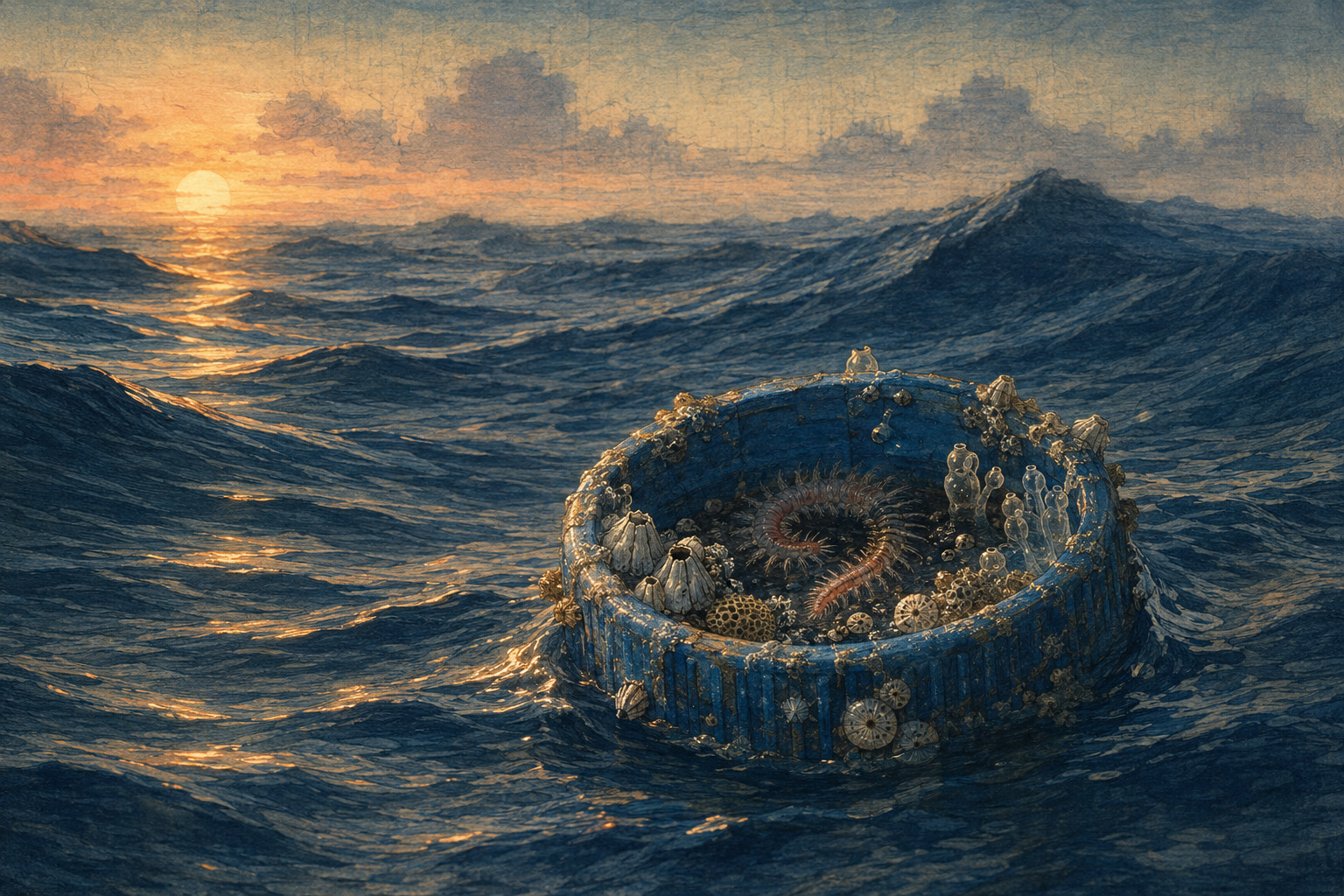
The net caught more than one piece of litter
When a surface-towed net from the Japan Agency for Marine-Earth Science and Technology research vessel Kaimei recovered a worn bottle cap southeast of Kochi Prefecture, the object looked trivial. It was roughly 3.5 centimeters across, smaller than the width of two fingers. In the laboratory, however, researchers discovered that it was not empty.
A team from Nagoya University, the National Institute of Advanced Industrial Science and Technology, the National Museum of Nature and Science, JAMSTEC, Kyoto University and the University of Fukui counted polychaete worms, foraminifera, bryozoans, gooseneck barnacles, flatworms and other inhabitants. The total was 307 individuals belonging to nine taxonomic groups.
The distinction matters: the cap did not contain 307 species. “307 creatures” is the vivid headline, while the scientific count is 307 individual organisms distributed among nine groups. Even with that qualification, the density is remarkable. About three quarters of the individuals were tiny worms that build coiled calcareous tubes. Coastal bottom-dwellers and organisms associated with the open sea occupied the same tiny platform. This was not one lucky hitchhiker. It was a community.
A nine-centimeter worm built a castle
The community’s principal architect was a bristle worm about nine centimeters long, Eunice bipapillata. Longer than the cap was wide, the animal curled inside and used mucus and small stones to construct a nest. The structure spread across the cap’s interior, adding cavities, ledges and protected surfaces to material that began as smooth plastic.
Ecologists call an organism that creates or alters habitat an “ecosystem engineer.” Corals build reefs; beavers build dams. On a radically smaller scale, this worm built rooms. Its nest turned a poor attachment surface into a three-dimensional refuge where minute worms, foraminifera and other organisms could settle. Plastic provided buoyancy and persistence, but a living engineer increased the cap’s carrying capacity.
The worm was also a new record for Japanese waters. That is a warning sign, not evidence of an invasion already accomplished. The study found one animal on a drifting object offshore. It did not demonstrate that the species had reached the Japanese coast, reproduced there or established a population. Arrival, release, reproduction, establishment and ecological harm are separate steps. Responsible reporting must keep them separate.
Three kinds of forensic evidence traced one tiny raft
The origin of marine debris is notoriously difficult to prove. Winds, waves and currents change; labels fade; an object manufactured or sold in one country may enter the ocean elsewhere. The team therefore did not rely on a single clue. It combined three independent archives: the community itself, stable isotopes in foraminiferal shells and a numerical drift model.
| Evidence | What researchers examined | What it contributed |
|---|---|---|
| Biofouling community | The identity, habitat and combination of organisms living on the cap. | A mixture of coastal benthic life and open-ocean foulers consistent with a community assembled during a long voyage. |
| Stable isotopes | Oxygen and carbon isotope ratios in calcareous foraminiferal shells. Oxygen isotopes preserve information related to the water in which a shell grew. | A history that included water warmer than the roughly 22°C conditions near the recovery site, consistent with a lower-latitude origin. |
| Drift modeling | Backtracking from the recovery location over windows of roughly 40, 70 and 100 days. | A plausible connection to the northern Philippines through the Kuroshio system, requiring at least about 70 days and possibly several months. |
A surviving label connected the cap to a Philippine beverage company. It was a strong geographical clue, but not a receipt for the exact place and date of disposal. The shell chemistry independently pointed toward warmer water. The model then linked the recovery area to the northern Philippines, including the waters around Batanes, on the necessary timescale. Because all three pointed in the same direction, the reconstruction became more persuasive than any one clue could be alone.
Foraminifera are single-celled organisms, but those that make calcium-carbonate shells carry miniature environmental archives. Most of the specimens in the cap were living benthic Rosalina globularis; the researchers also found three remains of planktonic foraminifera. Isotopic temperature inference is not a simple thermometer: salinity, growth conditions and biological effects also matter. That is precisely why the researchers checked it against the label, the species assemblage and physical oceanography.
The Kuroshio is a highway, not a railway
The Kuroshio system moves northward from waters east of the Philippines, passes between Taiwan and Japan’s southwestern islands, and continues along the southern coast of Japan. It transports heat, salt, nutrients, organisms and drifting material. A recovery site southeast of Kochi is geographically consistent with northward transport from the Batanes region.
Yet a map arrow can make the voyage look more exact than the evidence permits. A floating cap responds not only to current but also to windage, waves, eddies and storms. Its buoyancy changes as organisms add weight. Its speed changes with the amount of plastic protruding above the surface. A backward simulation therefore describes a family of plausible paths, not a GPS diary of every day at sea.
The defensible conclusion is restrained and still significant: the cap most likely traveled north from around the northern Philippines for at least about 70 days, and perhaps for several months, while sustaining its community. The researchers describe the work as the first to unite inhabitants, shell chemistry and current simulation to reconstruct the history of one small piece of floating plastic. Its novelty lies not in showing that life grows on litter, but in reading that life as evidence of the litter’s voyage.
Life rafted across oceans long before plastic
Rafting is ancient. Seaweed, logs, seeds, coconuts, animal remains and pumice have long carried organisms between islands and continents. A major 2005 review of marine rafting found records on varied substrates in every major ocean. Such journeys helped shape island biogeography and evolution. Floating habitat is not an invention of the petrochemical age.
Japan recently watched a natural rafting event unfold. The August 2021 eruption of the submarine volcano Fukutoku-Oka-no-Ba produced vast quantities of floating pumice. Rafts spread toward the Nansei Islands. A one-year study published in 2025 followed pumice collected at 213 sites, mostly in Japan but also in the Philippines and Thailand. The stones abraded and rounded at sea, and the number and variety of attached organisms rose sharply after about seven months.
The ecological difference between pumice and plastic is not whether organisms can board. It is the abundance, shape and persistence of the vehicle. Seaweed decays. Wood becomes waterlogged. Pumice fragments or sinks. Plastic also weathers, breaks and loses buoyancy, but many forms remain afloat for long periods, and fragmentation can multiply the number of smaller rafts. Humanity has taken an old dispersal mechanism and supplied it with an enormous stock of durable, manufactured substrates.
1972: open-ocean plastic entered the scientific record
In March 1972, Edward Carpenter and K. L. Smith published “Plastics on the Sargasso Sea Surface” in Science. Their samples from the western Sargasso Sea contained an average of 3,500 plastic pieces and 290 grams per square kilometer. Diatoms and hydroids were already attached to those particles. More than half a century ago, scientists could see that open-ocean plastic was not merely inert litter. It was biological surface area.
The 1972 measurements should not be compared directly with a 2026 cap. The nets, size classes, regions and seasons differ. But the paper anticipated the broad trajectory: as plastic production and disposal increased, concentrations at sea would rise. Research subsequently found plastic on beaches, in ice, on the seafloor, in deep trenches and inside marine organisms. The central question expanded from “Is it there?” to “Where does it go, who lives on it, and what does it change?”
A 2018 survey estimated that the Great Pacific Garbage Patch—the diffuse accumulation zone between California and Hawaii—covered about 1.6 million square kilometers and held roughly 79,000 metric tons of plastic represented by an estimated 1.8 trillion pieces. It is not a solid island. Microplastics accounted for 94 percent of the estimated number of pieces but only 8 percent of mass; fishing nets represented at least 46 percent of mass. A bottle cap sits between the spectacular net and the nearly invisible fragment: small enough to overlook, large enough to retain shape, buoyancy and shelter.
2013: scientists named the Plastisphere
In 2013, Erik Zettler, Tracy Mincer and Linda Amaral-Zettler used scanning electron microscopy and genetic sequencing to study microorganisms on plastic debris from the North Atlantic. They found a diverse community of heterotrophs, autotrophs, predators and symbionts distinct from the surrounding seawater. They called it the “Plastisphere.”
The word captures a fundamental shift in perspective. Plastic is not alive, but once submerged it acquires a living film. Microbes colonize first; larger settlers follow; grazers, predators and scavengers may join. Polymer, surface texture, color, shape, location and time all influence the resulting community. The Kochi cap represents a visible, mature version of that process: not merely a microbial coating, but a worm-built structure populated by hundreds of individual organisms.
Calling it an ecosystem is not absolution. Organisms exploit available habitat; their adaptability does not make the release of plastic benign. The surface may support native organisms, move coastal species into the high seas or carry non-native species toward a new shore. The same object can be shelter at the scale of an individual and pollution at the scale of an ocean.
The 2011 tsunami revealed the power of durable rafts
The earthquake and tsunami of March 11, 2011 swept buildings, docks, buoys, vessels and containers from northeastern Japan into the Pacific. In 2017, a Science paper documented 289 living Japanese coastal species from 16 phyla transported over six years on objects that traveled thousands of kilometers to North America and Hawai‘i. The authors described it as a transoceanic biological rafting event without a known historical precedent.
Most of that dispersal occurred on nonbiodegradable objects. The event demonstrated the special power of modern coastal materials: foams, fiberglass, plastic floats and other manufactured structures can remain intact long enough for coastal organisms to survive journeys once considered exceptional. A one-time disaster created an accidental, ocean-wide transport experiment.
The 2026 cap seems like the opposite of a dock or a boat. It is a 3.5-centimeter consumer item, not a major structure. Ecologically, however, the cases form a continuum. Large debris can support many species through a voyage lasting years; a tiny recessed object can concentrate hundreds of individuals over months. Size affects capacity, but small does not mean biologically irrelevant.
2021–2023: a new surface community in the high seas
In 2021, researchers introduced the term “neopelagic community” for a new mixture of open-ocean surface life and rafting coastal species on persistent plastic. Coastal organisms in the high seas had often been treated as temporary passengers crossing an inhospitable space. Durable rafts challenged that assumption by supplying habitat that can persist for years.
A 2023 study examined 105 pieces of plastic debris collected in the eastern North Pacific Subtropical Gyre. It recorded 37 coastal invertebrate taxa, largely of western Pacific origin. Coastal taxa occurred on 70.5 percent of the debris and their richness was three times that of pelagic taxa. Evidence of reproductive capacity showed that some coastal organisms were not merely surviving; they could reproduce in the open ocean.
The bottle-cap study advances this story in a different direction. Gyre surveys map a broad, emergent community. The cap investigation reads one object as a case file. Its label suggests commerce and origin; its passengers reveal habitat; its shells record environmental conditions; a circulation model supplies geography and time. Plastisphere science has moved from discovering life on plastic to reconstructing the travels of particular rafts.
What this one cap proves—and what it cannot
The research is a detailed case study, and the sample is one cap. That limitation is not a flaw to hide; it defines the next scientific question. The finding does not mean every bottle cap carries 307 organisms. Cap geometry, polymer, orientation, season, initial fouling, route, predators and storms can all change the outcome. This object may be typical, or it may have been an unusually successful full ship. Only systematic sampling can tell.
| The evidence supports | The evidence does not yet establish |
|---|---|
| One 3.5-centimeter cap held 307 individuals from nine taxonomic groups. | How frequently caps at sea develop comparable communities. |
| Community composition, isotopes and modeling agree with a long voyage from around the northern Philippines. | The exact disposal place, disposal date or daily route. |
| A worm’s nest created three-dimensional habitat inside the cap. | Which organisms boarded near the origin and which joined later. |
| A worm not previously recorded from Japanese waters arrived on offshore debris. | That the species reached the coast, reproduced, established or caused harm in Japan. |
Biological invasion is a sequence. An organism must be transported alive, released into suitable habitat, survive, reproduce and sustain a population. Many voyages undoubtedly fail. Yet when the number of rafts and repeated arrivals rises, even a low-probability outcome receives more chances to occur. Prevention and early detection are valuable precisely because ecological establishment is easier to stop before it is obvious.
Count litter not only as waste, but as a vector
Marine plastic policy is commonly measured in kilograms collected, items counted, recycling rates and shoreline coverage. The bottle cap adds another dimension: what can an object carry, for how long and between which ecosystems? A light, recessed, durable item may be a more effective biological vector than its mass suggests. A heavier item that sinks may create a different habitat on the seabed. One item is not always equivalent to another in ecological risk.
Japan’s 2019 Resource Circulation Strategy for Plastics called for “zero emission” of plastic waste into the sea, recovery of coastal debris, improved monitoring, research on microplastic impacts and international observation networks. The 2026 case shows what advanced monitoring can mean in practice. Counting and polymer identification should be joined by taxonomy, DNA barcoding, isotope chemistry and physical ocean models.
Four layers of action follow. First, prevent caps, containers and fishing gear from leaving waste systems, rivers and ports. Second, coordinate sampling and data across the Philippines, Taiwan, Japan and other places connected by the same currents. Third, watch ports, aquaculture sites and strandlines for early arrivals, using morphology and genetic identification. Fourth, distinguish passengers found offshore from species that have begun reproducing on a coast.
A half-century of science inside one bottle cap
| Date | Milestone | Why it matters now |
|---|---|---|
| Deep history | Natural rafting on seaweed, wood, seeds and pumice | Long-distance dispersal is an old force in evolution and island biogeography. |
| 1972 | Plastic particles and attached organisms reported in the Sargasso Sea | An early record of manufactured habitat in the open ocean. |
| 2005 | Major review synthesized floating substrates and rafting organisms | Natural and artificial rafts could be compared within one ecological process. |
| 2011–2017 | Tsunami debris carried 289 Japanese coastal species across the Pacific | Durable objects supported survival for six years and thousands of kilometers. |
| 2013 | The “Plastisphere” was named | Plastic-associated microbial communities became a distinct field of study. |
| 2018 | North Pacific accumulation estimated at 1.8 trillion pieces and 79,000 tonnes | Quantified the vast supply of floating manufactured substrate. |
| 2021–2023 | Neopelagic communities and coastal reproduction documented | Coastal life can persist—and sometimes reproduce—in the high seas. |
| 2021–2025 | Fukutoku-Oka-no-Ba pumice followed across 213 sites | A modern record of natural rafts weathering and gaining organisms over time. |
| 2026 | One cap reconstructed with biology, isotopes and current modeling | A method to infer source region, environmental history and community transport together. |
Small enough to miss, large enough to carry a warning
Images of ocean plastic favor the dramatic: a ghost net, a beach covered in bottles, a bag wrapped around an animal. A 3.5-centimeter cap disappears at the bottom of a cleanup sack. In this case, 307 lives were hidden inside that smallness. The purchase price and weight of an object bear little relationship to the ecological role it may acquire at sea.
The discovery presents resilience and responsibility in the same frame. A worm transformed waste into shelter and created room for other organisms. That biological ingenuity is extraordinary. But it operated on a disposable object that should not have entered the ocean, and the resulting community crossed from one biogeographic region toward another.
One cap cannot reveal the rate of future invasions. It can reveal a transport mechanism that routine litter counts overlook. In 1972, researchers saw small organisms attached to Sargasso Sea plastic. After 2011, tsunami debris showed that whole coastal assemblages could survive an ocean crossing on modern materials. In 2026, a cap off Kochi demonstrated that even fingertip-sized waste can carry a route, a chemical archive and a community. Plastic at sea does not merely persist. It is inhabited, engineered and set in motion.
Sources and further reading
- Nagoya University: Japanese research announcement on the bottle-cap voyage: the 3.5-centimeter cap, nine groups, 307 individuals, the Eunice bipapillata nest, isotopes and the approximately 70-day reconstruction.
- Nagoya University: “Cast away—tracing the voyage of a plastic bottle cap”: English account of the community and inferred route from the Philippines to Japan.
- Jimi et al.: “Multi-proxy reconstruction of bottle-cap rafting using biofouling communities, stable isotopes and drift modeling” (Marine Pollution Bulletin, 2026): peer-reviewed paper and DOI.
- Thiel & Gutow: “The Ecology of Rafting in the Marine Environment. I. The Floating Substrata” (2005): review of seaweed, wood, seeds, pumice, plastic and other rafts.
- Carpenter & Smith: “Plastics on the Sargasso Sea Surface” (Science, 1972): early survey of open-ocean plastic and attached diatoms and hydroids.
- Zettler, Mincer & Amaral-Zettler: “Life in the ‘Plastisphere’” (Environmental Science & Technology, 2013): distinct microbial communities on marine plastic.
- Carlton et al.: “Tsunami-driven rafting” (Science, 2017): 289 living Japanese coastal species from 16 phyla transported over six years.
- Lebreton et al.: “Evidence that the Great Pacific Garbage Patch is rapidly accumulating plastic” (Scientific Reports, 2018): estimates of area, mass, piece count and size composition.
- Haram et al.: “Emergence of a neopelagic community” (Nature Communications, 2021): the emerging mixture of oceanic and coastal life on persistent rafts.
- Haram et al.: “Extent and reproduction of coastal species on plastic debris” (Nature Ecology & Evolution, 2023): 105 debris items, 37 coastal taxa and occurrence on 70.5 percent of items.
- Geological Survey of Japan, AIST: Discovery and observation of the Fukutoku-Oka-no-Ba pumice raft: direct observations of a natural floating substrate spreading near Japan.
- Ishimura et al.: One-year record of the 2021 Fukutoku-Oka-no-Ba drift pumice (Progress in Earth and Planetary Science, 2025): 213 sites, abrasion, dispersal and a sharp increase in attached life after seven months.
- Ministry of the Environment, Japan: Resource Circulation Strategy for Plastics (2019): marine-plastic prevention, recovery, monitoring, research and international cooperation.
Editor’s note: This article uses the count of 307 individuals stated in Nagoya University’s July 10, 2026 announcement. The source region and duration are a multi-proxy reconstruction, not a determination of the exact disposal place or date. The hero artwork is an editorial illustration, not a photograph of the collected specimen.