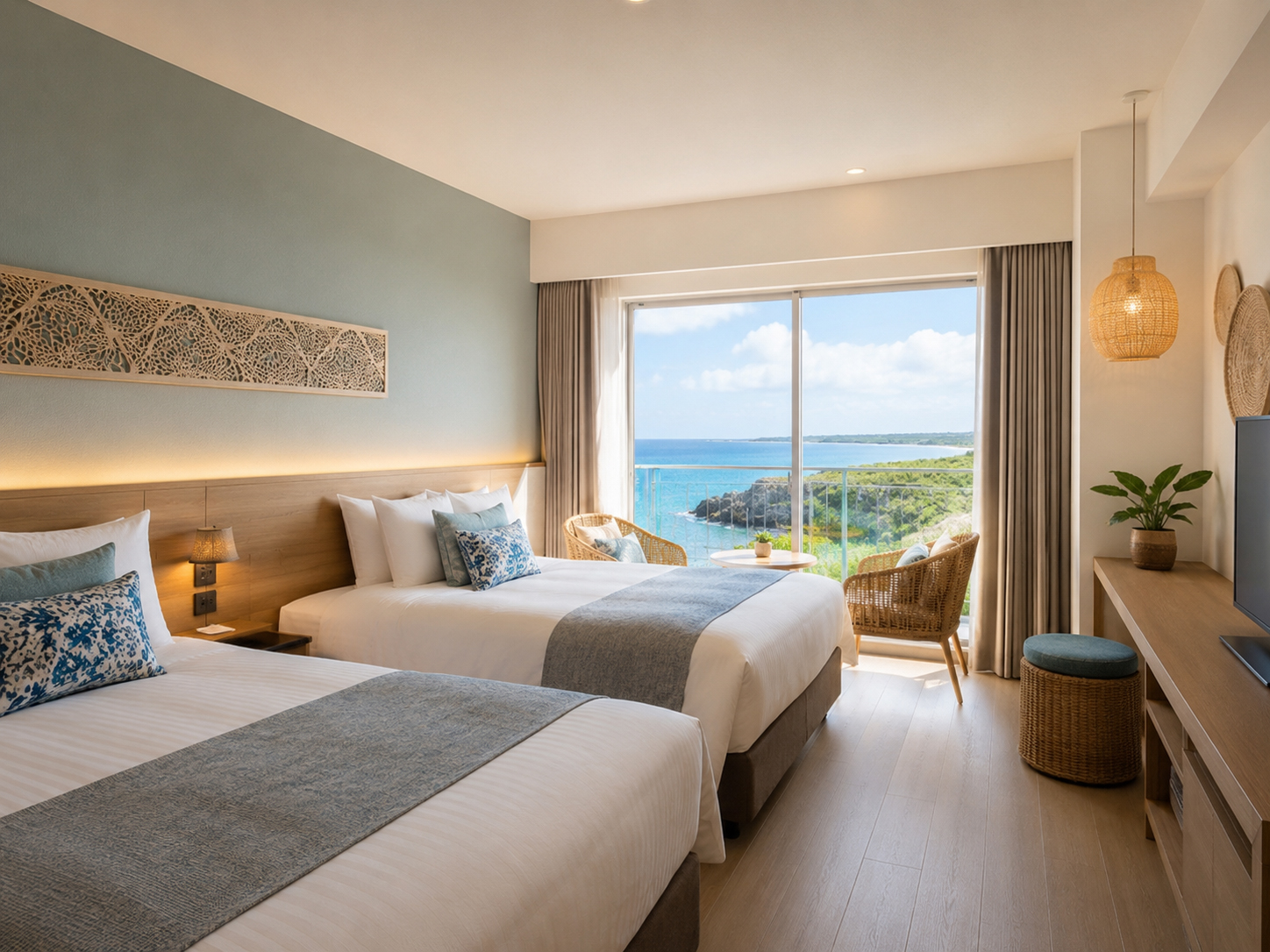
Morning on Ishigaki begins with color. The sea is not simply blue; it holds green, light and distance. The air is humid but strangely easy to breathe. Somewhere there is the sound of birds, traffic, and the slower clock of a southern island. What does a traveler eat in that morning? What do they read? Where do they go? What stars do they see at night? On June 26, 2026, Comfort Hotel Ishigaki Island rebranded as Comfort Hotel ERA Ishigaki Island, and the new name is trying to turn that entire island day into the hotel’s story.
More than a rebrand, this is a story about why travelers stay on Ishigaki
Choice Hotels Japan announced that Comfort Hotel Ishigaki Island was rebranded as Comfort Hotel ERA Ishigaki Island on June 26, 2026. The company described the update as a stay experience shaped around sea, stars, the Comfort Library Cafe, breakfast, and encounters with island culture and food — a way for guests to feel Ishigaki even while inside the hotel.
The practical details matter. The hotel is located at 340 Maezato, Ishigaki City, Okinawa. It has 81 rooms across five floors and is fully non-smoking. The Japanese release says Ishigaki Airport is about 18 minutes by local bus to the Yaeyama Godo Chosha-mae stop; the global Choice Hotels page also places the property about 25 minutes by car from the airport and about 15 minutes from the ferry terminal. It is positioned near Maesato Beach, Kabira Bay, Banna Park, Ishigaki Stalactite Cave and Azamiya Minsah Craft Center.
ERA and the idea of recharging a traveler
The ERA name comes from Excite, Refresh and Active. The official brochure frames the brand as a charge of energy for the mind and body, especially for travelers with limited vacation time. This is not the language of a grand destination resort. It is the language of a practical island base that wants guests to arrive tired, recover quickly, and re-enter the island with curiosity.
That idea fits the current direction of Japanese travel. Visitors no longer want only a checklist of famous sights. They remember where they stayed, what they ate in the morning, what they read in the lobby, and what they talked about at night. In a place as culturally and naturally strong as Ishigaki, a hotel is both an entry point to the outside world and an indoor interpretation of the island itself.
Comfort Library Cafe turns the lobby into an island reading room
The most symbolic part of the rebrand is the updated Comfort Library Cafe. The announcement says the cafe will hold about 300 books selected around Ishigaki’s culture, nature, daily life and changing seasons, with local crafts displayed to match the themes. The idea is simple but smart: before guests go out to the island, the hotel gives them a way to read it.
Travelers often arrive before they understand a place. They may not know the rhythm of local names, the distances between island spots, the meaning of local food, why the night sky matters, or what a minsa textile pattern represents. A hotel bookshelf can become a gentle translator. It does not replace going outside; it makes going outside more meaningful.
The hotel is also adding time-of-day services such as “Sweets Time,” featuring regional sweets, and “Cocktail Time,” offering Okinawan drinks. A southern island evening is not only about going to sleep early. It can be the hour when travelers sit with awamori or another Okinawan drink and turn a day of beaches, boats and viewpoints into memory.
Breakfast as a small edible journey through Okinawa
Comfort Hotel ERA Ishigaki Island’s breakfast is built around a “Cheerful Morning” concept. The announcement highlights Spam curry, goya curry, goya chanpuru, taco rice and sata andagi, along with local and regional dishes meant to energize the body from the inside out.
Okinawan food is history on a plate. It reflects the Ryukyu Kingdom’s trade networks, contact with China and Southeast Asia, the relationship with mainland Japan, postwar American influence, and the ingredients of individual islands. Chanpuru means “mixed,” and that word could describe much of Okinawan food culture itself. Goya’s bitterness, Spam’s salt, taco rice’s postwar playfulness, and sata andagi’s simple sweetness all carry pieces of place. A breakfast buffet can teach more directly than a brochure because the guest literally takes the island in.
Ishigaki is the gateway to Yaeyama
Okinawa’s official tourism information describes Ishigaki as the gateway to the Yaeyama Islands. The archipelago sits about 400 kilometers southwest of Okinawa’s main island, and Ishigaki functions as its transport, commercial and cultural center. From Ishigaki Port, ferries connect travelers to Taketomi, Iriomote, Kohama, Kuroshima, Hateruma and other islands. Staying on Ishigaki therefore means holding a key to a wider island world.
That geography changes what a hotel does. Some travelers want to stay at a large beachfront resort and remain there. Others want to board a boat in the morning, walk a different island by day, then come back to Ishigaki in the evening. A hotel in the Maezato area can act as a practical midpoint between beach, airport, city, port and island sightseeing. Its value is not only glamour; it is movement made easier.
Maesato Beach, Kabira Bay, Tamatorizaki and Banna Park
The hotel sits within reach of several of Ishigaki’s defining places. Maesato Beach is one of the easiest ways to feel the sea soon after arrival. Kabira Bay is the island’s postcard landscape: emerald water, pale sand and glass-bottom boats. Tamatorizaki Observatory opens wide views toward both the East China Sea and the Pacific side of the island. Banna Park brings subtropical greenery, lookout points and a different sense of Ishigaki’s interior.
Ishigaki is not a one-view destination. There are beach days and hill days, cave walks and craft visits, port dinners and stargazing nights. If the hotel’s promise is that the stay itself becomes Ishigaki, that promise must work both ways: by sending guests outward into the island and by making the return to the hotel feel connected to the same place.
A hotel concept built around stars is not marketing fluff here
On Ishigaki, “stars” are not decorative language. Iriomote-Ishigaki National Park was designated an International Dark Sky Park in 2018, the first such designation in Japan and one of the earliest in Asia. DarkSky International describes the park as part of the Yaeyama Islands in Okinawa, about 270 kilometers east of Taiwan. Yaeyama tourism materials also describe the region’s coral seas and starry skies as core attractions.
Turning a night sky into a tourism asset also means protecting darkness. Much of urban Japan is brilliantly lit, convenient and restless. Yaeyama offers the opposite value: darkness as beauty, darkness as ecology, darkness as a condition that lets hidden things appear. If the hotel uses stars as part of its design language, it is also borrowing from a regional choice to treat the night as something worth preserving.
Island culture survives quietly
Ishigaki and Yaeyama culture are not identical to Okinawa’s main island, and they are certainly not the same as mainland Japan. Language, song, dance, festivals, textiles, food, house forms and the relationship to the sea all have local textures. Historically, the islands were connected to the maritime world of the Ryukyu Kingdom, later reshaped by modern Japan, war, postwar Okinawa and tourism.
The more popular Ishigaki becomes, the more easily local culture can become decoration. That is why a hotel must be careful when it claims to present regional charm. Books, crafts, local food, Okinawan drinks and thoughtful guidance can help visitors see the island more respectfully. They can also reduce the risk that “local culture” becomes a lobby slogan and nothing more.
A practical island hotel is not the opposite of a resort
Ishigaki offers many lodging styles: high-design villas, beachfront resorts, large hotels, guesthouses, inns and long-stay properties. Comfort Hotel ERA Ishigaki Island’s role is different from a pure luxury resort. It is a practical, approachable base that connects ease of use with local experience. With 81 rooms, it is neither a mega-resort nor a tiny inn. It suits families, island hoppers, short vacations and travelers who want comfort without being sealed off from the island.
Travel is rarely perfect. Weather changes. Ferries may be delayed. Children get tired. Beach days run long. Plans stretch. In that reality, a reliable hotel matters. A comfortable room, amenities, breakfast, cafe space, Wi-Fi, access and a calm place to return to can shape the whole trip. The unglamorous details are often what make island travel feel easy.
What tourism leaves behind
Ishigaki’s popularity also raises the question of tourism quality. Coral reefs, beaches, night skies, neighborhoods and local life are not unlimited resources. Visitors bring spending and energy, but also crowding, environmental pressure and simplification of culture. A hotel that speaks about “regional charm” should also encourage respect for the region.
A good hotel can turn a traveler from a consumer into a visitor. This is someone’s home. The sea is not only a photo background; it is an ecosystem. The stars are not only a design theme; they depend on protected darkness. Okinawan breakfast is not just a cute local menu; it is layered history. If the rebrand helps guests understand even a little of that, it becomes more than a new sign on the building.
Beginning an Ishigaki day from the hotel
Imagine waking to goya bitterness and curry aroma at breakfast. Walking Maesato Beach in the morning. Heading to Kabira Bay by midday. Looking over the island from Banna Park in the afternoon. Eating near the port in the evening. Looking up at the sky at night. On a rainy day, reading in the cafe, studying local crafts, and planning tomorrow. That is the real meaning of a hotel where the stay continues the trip.
Ishigaki is far from Tokyo, Osaka and even Naha. Distance is part of its value. The body loosens when it finally arrives. Sea, stars and island food should not be overproduced, but they should not be missed either. For summer 2026, Comfort Hotel ERA Ishigaki Island’s rebrand is a modest but useful signal: the Yaeyama trip is not only where you go during the day. It is also how your morning begins and how your night returns.
Sources and references
This article draws on Choice Hotels Japan’s rebrand announcement, official hotel information, the hotel brochure, Okinawa tourism information, DarkSky International, and Yaeyama tourism materials. Hotel services, breakfast items, rates, transportation and hours can change; check official sources before booking or traveling.
- Ryukyu Shimpo / PR TIMES: June 26, 2026 rebrand announcement for Comfort Hotel ERA Ishigaki Island.
- Choice Hotels Japan: Official Comfort Hotel ERA Ishigaki Island brochure.
- Choice Hotels: Official Comfort Hotel Ishigaki Island information.
- Visit Okinawa Japan: Ishigaki and Yaeyama Islands travel information.
- DarkSky International: Iriomote-Ishigaki National Park’s International Dark Sky Park designation.
- Yaeyama Islands: Official regional tourism information.