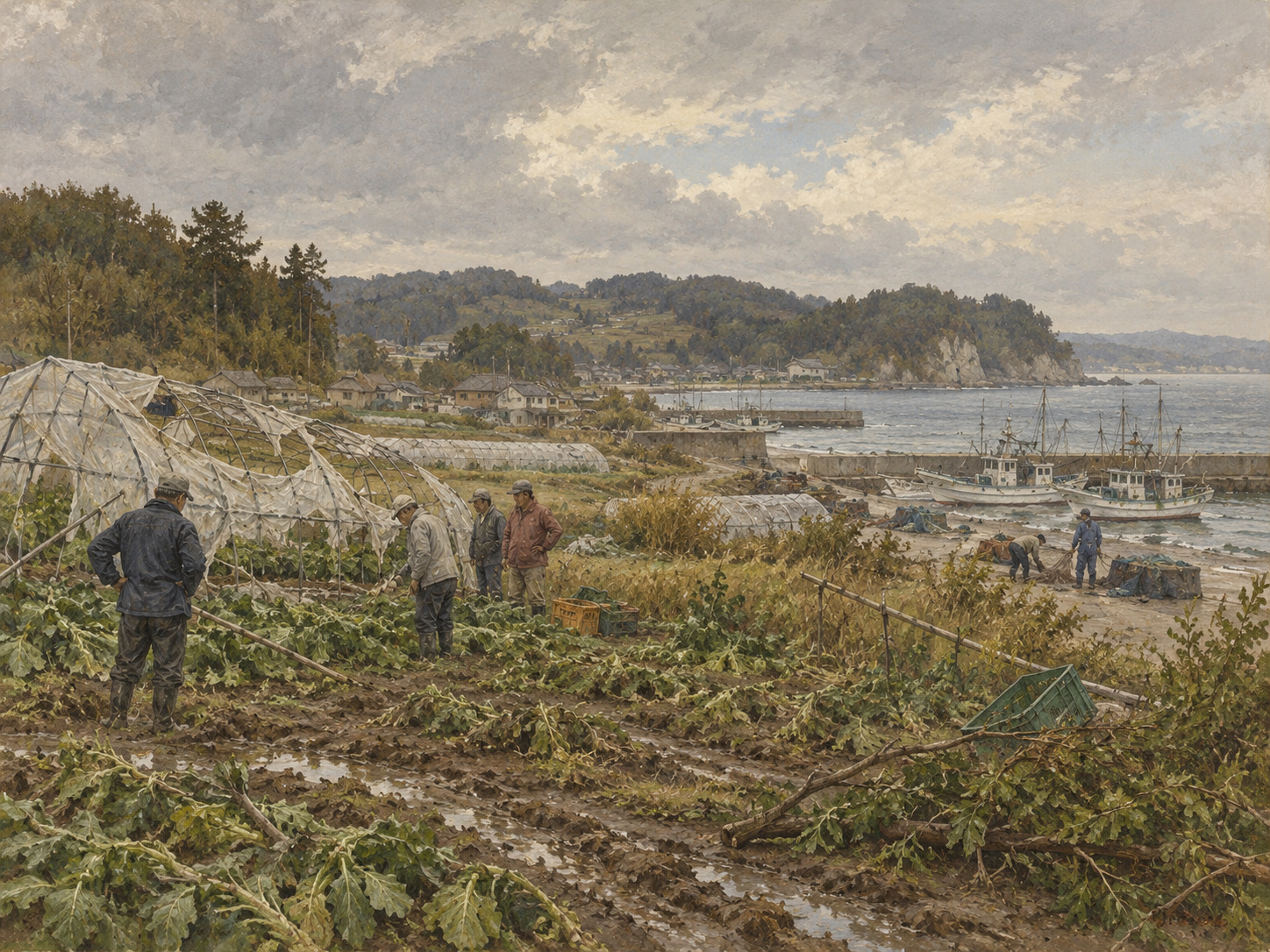
For farms and fisheries, a storm does not end when the rain stops. Floodwater recedes and leaves mud, straw and damaged pumps. A greenhouse can be repaired yet still miss the next planting window. A harbor can be cleared while aquaculture or processing equipment remains unusable.
As of noon September 30, Chiba Prefecture had confirmed about ¥2.6 billion in agriculture, forestry and fisheries damage from Typhoon No. 25 across 46 municipalities. The total included about ¥1.12 billion in crops, ¥892 million in farmland and agricultural infrastructure, ¥282 million in fisheries facilities, ¥238 million in agricultural production and distribution facilities, and ¥28 million in forestry land and infrastructure. Eight prefectural facilities were still under assessment, and Chiba says the figures may change.
Floodwater, not only wind, drove much of the crop damage
Rice was inundated or hit by sediment across 1,531.77 hectares, with estimated losses around ¥144 million. Carrots suffered roughly ¥329 million in damage across 77.39 hectares; green onions about ¥142 million; cabbage ¥112 million; and daikon about ¥100 million. Peanuts, sweet potatoes and taro—products strongly associated with Chiba agriculture—were also hit.
Flooding has aftereffects not fully captured by immediate loss estimates: disease, reduced quality, debris removal and delays that can spill into the next production cycle.
¥892 million in shared agricultural infrastructure
Chiba recorded 37 damaged rice-field embankments, 68 farm-road failures, 70 damaged channels, 14 pumping facilities, three reservoirs and eight community drainage facilities. Across 206 sites, estimated restoration cost was about ¥892.1 million.
Shared infrastructure makes recovery collective. One flooded pumping station can affect many farms, and one broken channel can hold back planting over a wider district.
Fisheries losses reached harbors, aquaculture and inland waters
Fisheries facilities recorded roughly ¥282.4 million in restoration damage across 62 sites and eight vessels. Nineteen fishing-port sites suffered sediment, debris or embankment damage estimated around ¥200 million; 16 aquaculture, processing and related facilities had about ¥81 million in damage.
Narita reported 3,000–4,000 kilograms of eel dead or escaped as well as ornamental carp losses. Ichihara reported 500–600 ayu dead or escaped. Those monetary losses were still under investigation.
Chiba doubled key disaster-loan ceilings
The prefecture expanded its agricultural and fisheries disaster-loan program, originally activated after the August Chiba torrential rain, to cover the September 6–7 rain and Typhoon No. 25.
Operating-stability loans now cover up to 80% of damage with a ¥6 million ceiling, up from ¥3 million. Facility-restoration loans rise from ¥5 million to ¥10 million, also generally capped at 80% of damage. Operating-loan repayment extends from five to seven years; facility loans from six to seven years with up to two years of grace. The end-user rate remains 0.55%.
Why the prefecture tells producers to photograph everything
Chiba urges affected producers to photograph damaged crops and facilities before cleanup. Those records can become evidence for disaster certification, insurance, mutual aid, loans and later support programs.
Agricultural, forestry and fisheries offices have separate consultation channels because a flooded carrot field, damaged forest road and inundated aquaculture facility require different expertise.
Support includes technical advice and faster insurance payments
Chiba published technical guidance for post-typhoon crops and straw deposited by floods, asked mutual-aid organizations to accelerate payments, and asked lenders to respond quickly to working-capital needs. Japan Finance Corporation also opened a special consultation desk for Typhoon No. 25.
The ¥2.6 billion total excludes earlier 2026 flood damage
This is the most important caveat in the prefecture’s own materials: the Typhoon No. 25 total does not include damage already reported from the August Chiba torrential rain or the September 6–7 heavy rain.
That is why the support framework covers all three events. Many producers are not recovering from one shock but from a sequence.
Chiba remembers 2019
Typhoon Faxai in 2019 caused about ¥42.755 billion in agriculture, forestry and fisheries damage in Chiba, including roughly ¥27.567 billion in agricultural facilities and ¥10.577 billion in crops. As many as 641,000 customers lost electricity and 133,474 households lost water.
Typhoon No. 25’s current ¥2.6 billion estimate is far smaller. But 2026 poses a different challenge: several damaging rain events have arrived within weeks of one another.
Japan’s No. 4 agricultural prefecture
MAFF reports that Chiba’s 2024 agricultural output was ¥453.3 billion, fourth highest among Japan’s prefectures. Livestock was its largest broad sector, and Chiba held the largest prefectural share of national egg output value.
That makes repeated disaster damage a supply-chain issue as well as a local farm issue. But annual output and disaster damage should not be divided mechanically: they measure different things, and disaster estimates do not capture every future loss or business interruption.
Even rainfall-warning thresholds were lowered
After Typhoon No. 25, the Japan Meteorological Agency lowered rainfall-related warning thresholds in Narita, Inzai and Sakae to 70% of normal because damaged rivers and levees can fail under less rain. Chiba City and Yachiyo remain under an 80% temporary threshold introduced after the August disaster.
The Disaster Relief Act covers 24 municipalities
Chiba applied the Disaster Relief Act to 24 municipalities for Typhoon No. 25, including Choshi, Kisarazu, Narita, Asahi, Katsuura, Kamogawa, Kimitsu, Futtsu, Minamiboso, Katori and Isumi. The same 24 municipalities had already been covered after the August torrential rain.
The structural risk is not weather alone
An aging workforce, labor shortages, higher fuel and input costs, old infrastructure and existing debt can reduce recovery capacity before a storm arrives. Drainage, insurance, shared facilities and repair labor can make the same rainfall far less damaging economically.
Doubling loan ceilings is useful emergency policy. If repeated disasters become an operating condition, however, resilience investments—drainage, stronger greenhouses, backup power, flood protection for aquaculture and better insurance coverage—become just as important as post-disaster credit.
There is still no final damage number
Many lines in the September 30 report remain marked “under investigation,” including some vessels, fish stocks, forestry losses and prefectural facilities. The ¥2.6 billion figure is provisional and does not include the earlier August and September rain events.
The real test is next year’s production
Were channels repaired before the next rain? Did farms plant again? Did ports and processors resume operations? Could operators repay disaster loans while still investing in resilience? Did younger successors stay?
Chiba’s response combines finance, advice and technical recovery. But if extreme weather becomes a recurring business risk, the goal can no longer be only to restore agriculture and fisheries to their previous state. The harder task is to make them capable of continuing through the next shock.