Stand at Sekiyado today and the strategic geography feels obvious: broad floodplains, huge levees and the modern split between the Tone and Edo river systems.
Chiba Prefectural Sekiyado Castle Museum’s new exhibition, “Sengoku Sekiyado — Musō no Meichi,” asks why the Yanada, Koga kubō, Uesugi Kenshin and Later Hōjō fought so hard over this corner of the Kantō Plain.
Hōjō Ujiyasu saw Sekiyado as worth a province
The museum cites the Kiragawa documents to explain Hōjō Ujiyasu’s view of Sekiyado as a “matchless strategic place,” so valuable that taking it was comparable to taking a province.
The Yanada and the Koga kubō
The traditional museum account dates Sekiyado Castle to 1457, when Yanada Shigesuke, a powerful retainer of Koga kubō Ashikaga Shigeuji, moved from Mizumi Castle. Noda City notes that the exact origin has competing traditions.
The Yanada derived strength not only from military service but from river transport and their place within the Koga Ashikaga political system.
In 1558, Sekiyado became a kubō residence
Ashikaga Yoshiuji entered Sekiyado Castle in 1558 and became known as “Sekiyado-sama.” The exhibition treats this moment as evidence that the castle had become political and cultural as well as military.
Boat tolls financed power
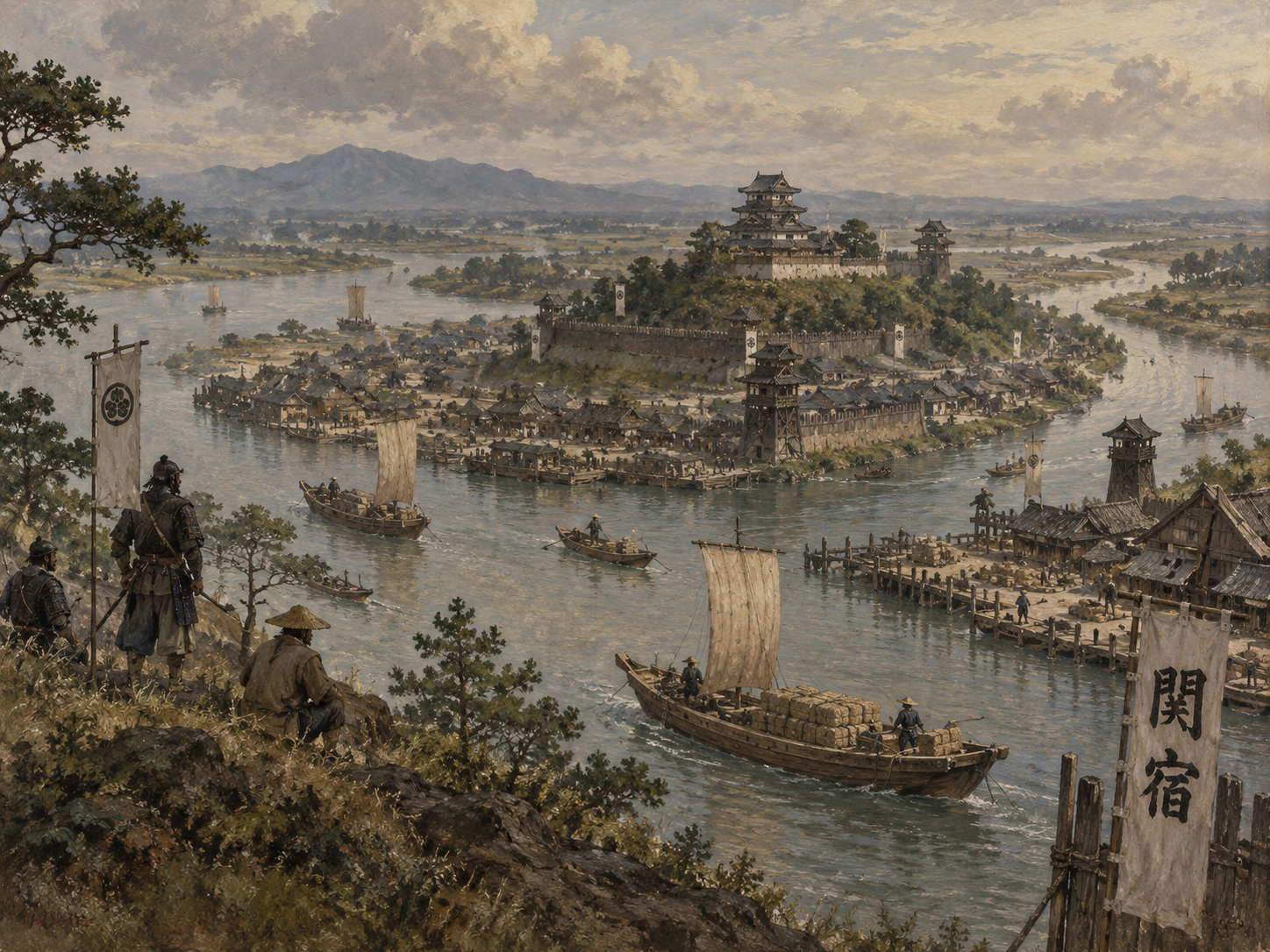
The exhibition’s “Logistics in Eastern Japan and Sekiyado” section explains that the Yanada and Koga kubō taxed boats passing through the area and used river traffic to strengthen their economic base.
The site functioned as a combination of port, toll point and military checkpoint in an age when rivers were among the most efficient routes for bulk transport.
Uesugi Kenshin raised the stakes
When Uesugi Kenshin pushed into Kantō around 1560–61, Sekiyado became a major base in the struggle between the anti-Hōjō coalition and the expanding Later Hōjō.
The museum describes Kenshin working with the restored Yanada leadership, supporting a rival kubō and asserting his authority as Kantō kanrei.
Three major Sekiyado battles
Noda City’s medieval chronology identifies major Hōjō attacks in 1564, 1568 and 1574.
In the final campaign, Yanada Harusuke surrendered Sekiyado and withdrew to Mizumi Castle. Sekiyado then became a Later Hōjō branch castle and forward base.
A 1551 oath shows how difficult the relationship had become
The museum preserves discussion of a 1551 oath from Hōjō Ujiyasu to Yanada Harusuke promising, among other things, not to abandon him if Sekiyado came under threat.
The later conflict makes the document especially revealing: the Hōjō did not simply conquer an enemy castle; they spent years managing a politically important family tied to the Koga kubō.
Do not project today’s Tone–Edo junction unchanged into the Sengoku period
This is the essential geographical caveat. The modern river channels visible at Sekiyado are not identical to the sixteenth-century river system.
MLIT explains that the present Edo River and Tone system were substantially shaped after Tokugawa Ieyasu entered Kantō, with the Tone River eastward-diversion works beginning in 1594 and continuing for roughly six decades.
So the Sengoku struggle was for an already vital river-and-land transport zone, but not for the exact modern junction shown on today’s map.
1590: Sekiyado enters the Tokugawa order
After the Later Hōjō were destroyed in Toyotomi Hideyoshi’s 1590 Odawara campaign, Tokugawa Ieyasu entered Kantō and placed his half-brother Matsudaira Yasumoto at Sekiyado, beginning the Sekiyado domain.
The shogunate continued to station trusted hereditary lords there, preserving the location’s political and military importance close to Edo.
The Tone diversion expanded Sekiyado’s logistics role
From 1594, Tokugawa river engineering progressively redirected the Tone eastward and developed the Edo River into a major transport route toward Edo.
Goods from Tōhoku and northern Kantō increasingly moved through the Tone–Edo network, turning an already strategic Sengoku location into a larger early-modern logistics gateway.
By 1927, strategic water control was concrete infrastructure
Sekiyado Water Gate and Lock was begun in 1918 and completed in 1927. It regulates flow from the Tone into the Edo and includes a lock allowing boats to pass between different water levels.
The place Sengoku rulers valued for control of movement remained important under a modern state—only the tools changed from castles and tolls to gates, levees and hydraulic engineering.
The museum is not the original main enclosure
Chiba Prefectural Sekiyado Castle Museum opened in November 1995 on a super levee near the modern river split. Its tower was reconstructed from historical records to evoke the former castle.
The actual main enclosure site lies roughly 500 meters south. Noda City notes surviving traces of the castle layout, including moat and bailey features.
The exhibition runs through November 29
“Sengoku Sekiyado — Musō no Meichi” runs from October 3 through November 29.
Its sections cover the Yanada and Koga kubō, the birth of “Sekiyado-sama,” eastern logistics, Uesugi Kenshin’s Kantō campaign, the Sekiyado battles and the end of the Sengoku order at the castle. Loans include portraits associated with Hōjō Ujiyasu and Uesugi Kenshin and a war fan traditionally connected with Kenshin; some originals are displayed only for limited periods.
Put logistics back into castle history
Sengoku history is often told through commanders and battles. Yet armies need food, castles need revenue and political power needs routes through which people and information can move.
At Sekiyado, rivers connected all three. Boats could be taxed, supplies transported, troops moved, water used for defense and the Koga kubō housed at a politically meaningful seat.
The geography changed; the strategic logic remains visible
Today’s Sekiyado is a different engineered landscape from the sixteenth century. Yet the museum’s view over the Kantō Plain still makes the historical logic legible.
The Sekiyado battles were not simply fights for a castle. They were fights over who would control circulation across the eastern Kantō region.