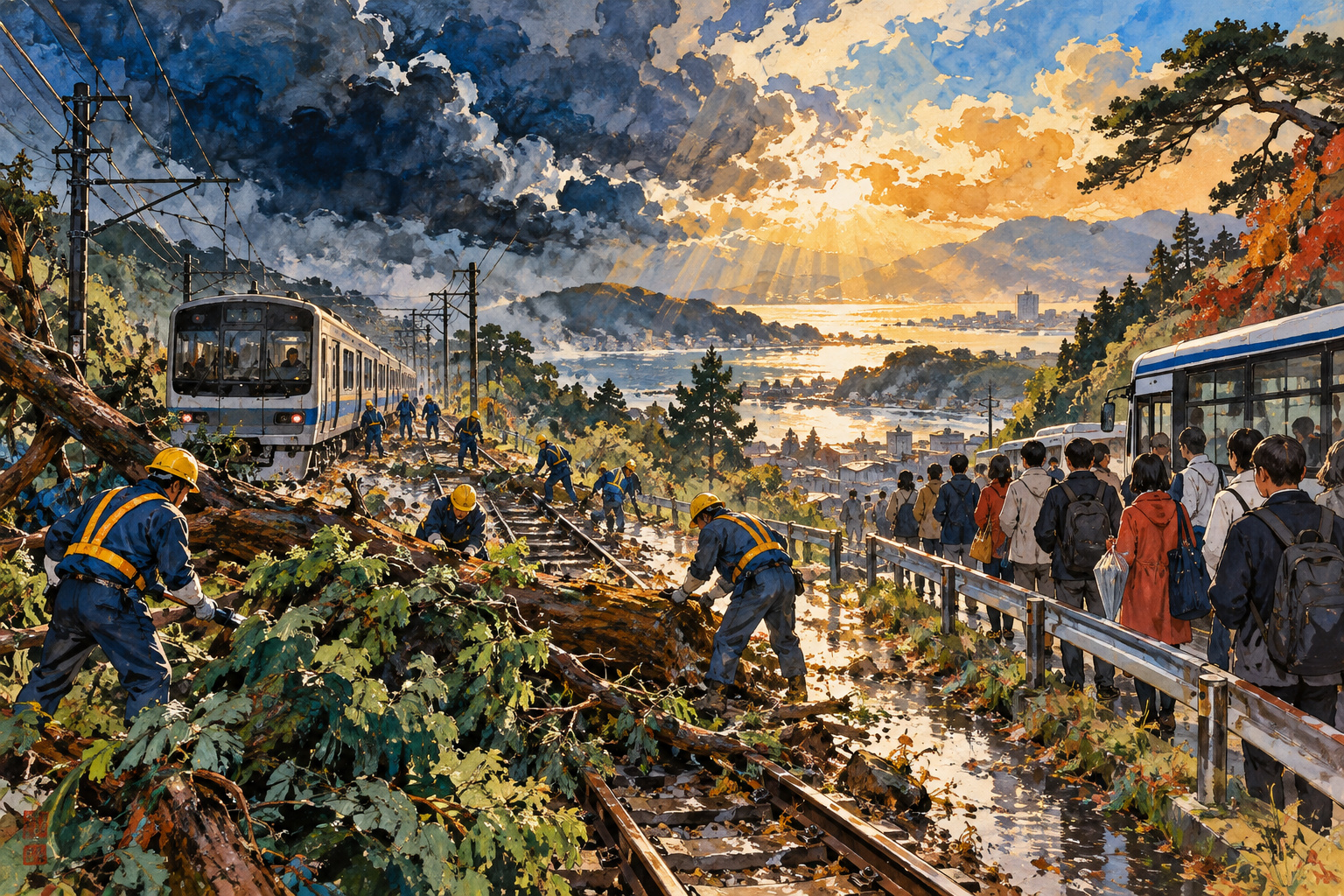
Chiba’s railway recovery is splitting into very different timelines after Typhoon No. 25. Some services have returned, while JR East estimates that restoring the Uchibo Line between Anegasaki and Kisarazu will take at least about three months. The uneven recovery creates a planning problem for employers, schools and households whose journeys cross several sections.[1]
Service information was checked on the afternoon of September 24, Japan time. Reopening targets are forecasts, not confirmation that trains are running. Check the operators’ current notices before travelling.
Reopening does not restore every connection
JR East’s September 23 evening plan puts morning and evening Uchibo services between Chiba and Anegasaki at roughly 20% of normal. It lists Chiba–Enokido on the Sobu Main Line at approximately 60%. The company has asked passengers to consider remote working where possible.[1]
Chiba City notified residents of plans to reopen the Sotobo Line from Chiba to Awa-Kamogawa with the first trains on September 24.[4] JR East’s afternoon status page subsequently listed that line as operating normally.[2] A functioning line, however, may still connect with another that is closed or has fewer trains.
The longer repair timelines
JR East’s information checked September 24 gives the following estimates. These are approximate durations stated by the operator, rather than fixed reopening dates.[2]
| Line and section | Restoration estimate |
|---|---|
| Uchibo: Anegasaki–Kisarazu | At least about three months |
| Sobu Main: Enokido–Naruto | About one month |
| Narita: Sawara–Choshi | About two weeks |
| Kururi: Kisarazu–Kururi | About one week |
| Kururi: Kururi–Kazusa-Kameyama | No reopening estimate |
September 26 is the target for Kisarazu–Awa-Kamogawa on the Uchibo Line and Araki–Kioroshi on the Narita Line. Replacement buses from September 28 onward are being considered for the first four sections in the table. That is not a confirmed bus timetable.[1]
Road damage constrains alternatives
Kominato Railway’s September 23 notice says Goi–Kazusa-Ushiku is operating normally, but Kazusa-Ushiku–Kazusa-Nakano remains suspended until further notice. Damage to parallel roads means no replacement transport through September 27; arrangements from September 28 remain undecided. The operator says its earlier plan following August’s heavy rain has been withdrawn.[3]
This makes the availability of an alternative route a central issue. A household cannot assume that a train cancellation will be covered by a bus, or that a journey possible in the morning will have a workable return connection.
Planning around actual journeys
In Japan.co.jp’s assessment, employers should base staffing decisions on employees’ routes and usable departure times. Remote work may help some teams, while workplaces requiring attendance will need to consider shift timing and access arrangements.
Schools face a similar practical question: whether students can reach classes and return home using the services actually available. Families should consult their school’s instructions on attendance and schedules rather than infer them from a railway reopening announcement.
For local shops and visitor businesses, disruption can affect both staffing and customer access. This report does not establish losses at individual businesses or increases in school absence. The published repair estimates nevertheless provide a reason to reassess operating plans beyond the next few days.
Recovery for communities will depend on usable service frequency and connections as well as repaired infrastructure. The next developments to watch are confirmed replacement-transport arrangements and the restoration of journeys at the times residents need them.
Sources
- JR East: Chiba operating plan from September 24, issued September 23 at 19:30 JST (PDF, Japanese)
- JR East: Kanto service status, checked September 24 afternoon (Japanese)
- Kominato Railway: service notice updated September 23 (Japanese)
- Chiba City: notice of Sotobo Line reopening, September 23 (Japanese)
