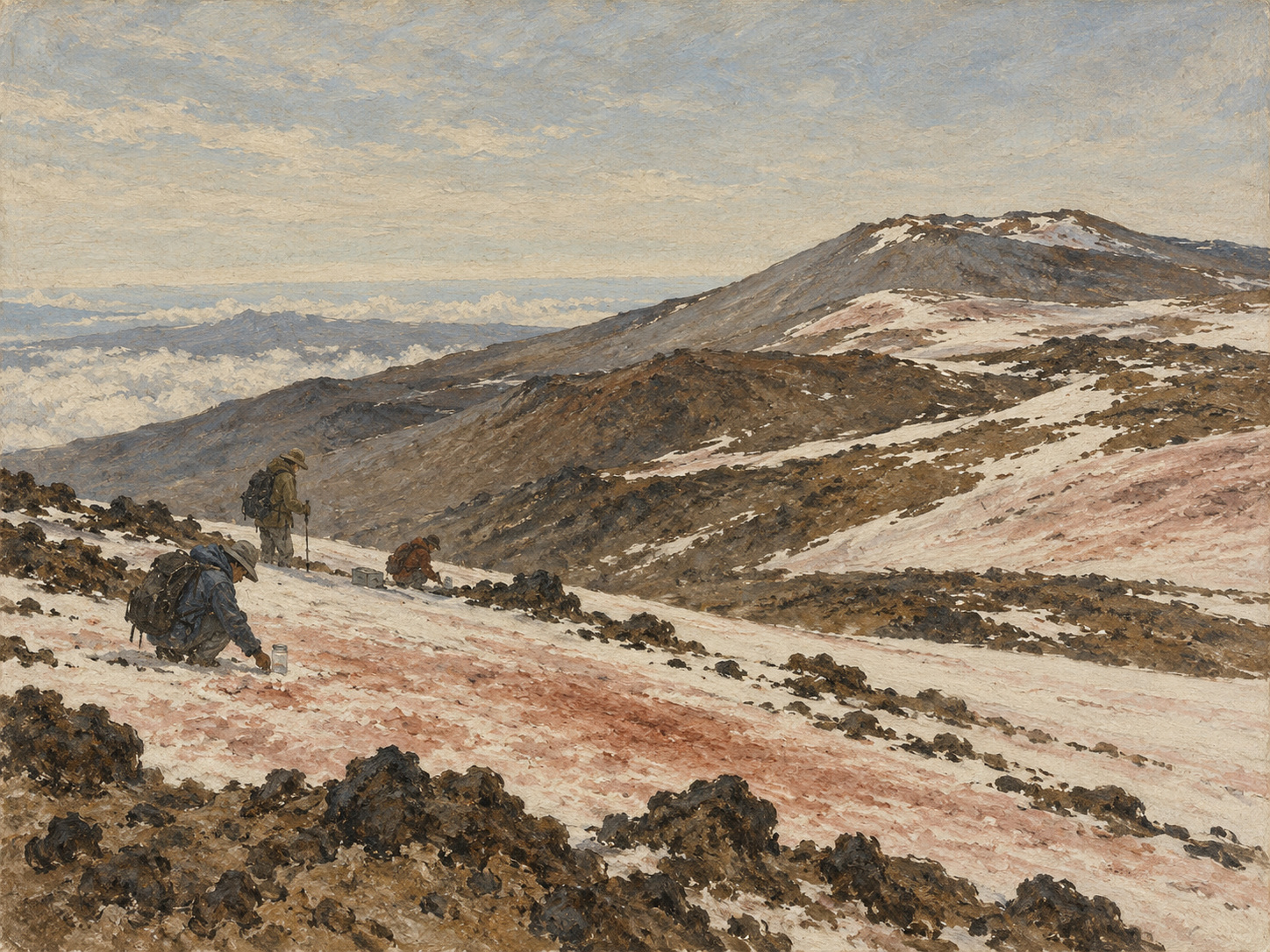
Mauna Kea is a tropical mountain that can hold snow. Above 4,000 meters on Hawai‘i Island, winter storms can cover the summit region, and in unusual years patches survive into spring or even summer. On those temporary snowfields, a microscopic ecosystem can turn the surface red.
An international team including Takahiro Segawa of the University of Yamanashi, Nozomu Takeuchi of Chiba University, Ryo Matsuzaki of Osaka Institute of Technology and Takahiro Yonezawa of Hiroshima University analyzed red-pigmented snow algae from Mauna Kea and reconstructed their colonization history. The paper was published in The ISME Journal on September 5, 2025; Chiba University issued its joint release on October 1, 2025.
Red snow is photosynthetic life, not a mineral stain
Snow algae are cold-adapted photosynthetic microbes that grow on snow and ice. Many accumulate red pigments including astaxanthin, which helps protect cells from intense ultraviolet radiation. When cell densities become high, the snow surface can appear pink or red.
Red snow occurs in polar regions and high mountains around the world. Mauna Kea is exceptional because it is extraordinarily isolated from other persistent cryospheres. That makes it a natural test of how tiny organisms reach remote snow habitats and whether they simply arrive repeatedly or establish local evolutionary lineages.
The key opportunity came in 2023, when snow survived into July
According to the paper, Mauna Kea snow normally disappears by early May. In 2023, however, snow persisted to the end of July under unusual conditions associated with a strong La Niña period.
Historical records cited by the authors indicate that residual snow survived into July only four times during the previous 50 years: 1975, 1989, 1990 and 2023. The 2023 event was the first such mid-summer persistence in at least 33 years, with the remaining snow patch covering roughly 350 square meters in July.
Red-pigmented algae were not detected in March or April 2023 samples but were present in June and July. They had also been found in an April 2021 sample. The timing suggests that bloom development depends on snow surviving long enough into the melt season.
Genetics revealed two very different journeys
The researchers analyzed the ITS2 region of nuclear ribosomal DNA and identified two major green-algal groups.
One belonged to the cosmopolitan genus Sanguina, whose relatives occur in snowpacks around the world. The other belonged to the Chloromonadinia snow group and contained Hawaiian lineages that appear to have evolved in long isolation.
The authors conclude that cosmopolitan Sanguina can disperse into Hawai‘i under present climate conditions, while the endemic Chloromonadinia assemblage reflects older colonization events.
The oldest Hawaiian lineage overlaps an Ice Age on Mauna Kea
Molecular dating placed the largest endemic Hawaiian clade’s colonization between roughly 253,000 and 130,000 years ago.
That interval overlaps the Pohakuloa glaciation, corresponding broadly to Marine Isotope Stage 6, when Mauna Kea’s summit region carried glacial ice. A more persistent cryosphere would have provided a much more stable habitat than the short and irregular snow seasons seen today.
The researchers argue that those glacial conditions likely gave immigrant snow algae enough time to establish and diverge into local lineages.
How did the algae cross an ocean?
The genetic relationships indicate long-distance dispersal, but the study did not directly observe individual cells traveling to Hawai‘i.
Possible mechanisms include airborne transport and biological transport on migratory birds. Those are plausible pathways discussed in the wider snow-algae literature, but this paper does not determine which pathway delivered a particular lineage to Mauna Kea.
Cosmopolitan algae tell a story about the present; endemic algae tell one about the past
The two groups also appear to use the Mauna Kea habitat differently.
At some sites, endemic Chloromonadinia dominated in June while the share of cosmopolitan Sanguina increased by July. The authors interpret the cosmopolitan lineages as organisms able to exploit rare modern windows of long-lasting snow, while the endemic lineages may represent populations adapted over long periods to Mauna Kea’s short and unpredictable snow seasons.
One red snow patch can therefore contain lineages operating on radically different timescales.
What happens when the snow disappears?
Chiba University explains that snow algae can form thick-walled resting cells when habitat conditions deteriorate, allowing them to remain dormant until favorable conditions return.
That ability is crucial on Mauna Kea, where some years may offer little or no persistent snow. The survival strategy raises a deeper question: where do those resting cells persist during snow-free periods, and how do they recolonize a new snowpack when it appears?
Climate change does not simply mean “more red snow”
Pigmented snow algae can darken snow, lower albedo and increase absorption of solar radiation, which can accelerate melt. Takeuchi’s group at Chiba University has studied this biological contribution to snow and glacier melt in Japan, the Arctic and other mountain regions.
But the Mauna Kea result should not be simplified into “warming creates more red snow.” Algae need snow habitat in the first place. If warming shortens snow duration too severely, the growth window may disappear.
The 2023 bloom became observable precisely because the snow lasted unusually long. Climate change therefore changes not only algal growth rates, but whether and when the habitat exists at all.
Snow algae can also accelerate melt
Red and green pigments darken snow and can reduce its reflectivity. A darker surface absorbs more solar energy, potentially increasing melt.
This biological feedback has become an important topic in Greenland and mountain-glacier research. But the snow ecosystem is not one-directional. Chiba University work published in 2023 showed that chytrid fungi can parasitize snow algae, potentially reducing algal biomass and therefore moderating some melt-enhancing effects.
Mount Gassan shows how different a Japanese snow ecosystem can be
Takeuchi’s group also studied seasonal snow algae on Mount Gassan in Yamagata. There, green blooms appeared first in lower-elevation forest zones in May and spread upslope as the season advanced; red blooms became prominent at higher sites in June and July.
The Mount Gassan work linked algal abundance to nutrients from spring vegetation, including materials shed from deciduous trees.
Mauna Kea is almost the opposite ecological setting: isolated, volcanic, high-elevation terrain with highly irregular snow and no surrounding temperate forest feeding the snowpack in the same way.
An isolated mountain becomes a laboratory for microbial biogeography
Island biology has long been used to study how organisms colonize isolated places and then evolve independently. Snow algae extend that question to microbes.
Microorganisms are small enough to travel extraordinary distances, yet geographic isolation can still leave a strong evolutionary signature once populations establish.
Mauna Kea therefore demonstrates two truths at once: even one of the world’s most isolated cryospheres is connected to global microbial dispersal, and isolation can still generate endemic evolutionary lineages.
How can genetics estimate an arrival 250,000 years ago?
The authors used sequence divergence and phylogenetic relationships to estimate when lineages split. This is molecular dating, not a direct historical record.
The estimate of roughly 253,000 to 130,000 years ago therefore carries uncertainty. The study does not identify a precise year or single arrival event. Its significance is that the inferred divergence interval overlaps the glacial period when Mauna Kea offered much more persistent snow and ice.
Why preserving genetic diversity matters
If the endemic Chloromonadinia lineages have evolved on Hawai‘i for more than one glacial cycle, their genetic diversity cannot simply be replaced by snow algae arriving from elsewhere.
Members of the Chloromonadinia snow group are obligate snow algae, meaning they are known to grow specifically on snow surfaces. If persistent snow becomes even rarer, their opportunities to reproduce may decline sharply even if dormant stages can survive between seasons.
The conservation argument is therefore broader than protecting an unusual red patch. Short-lived snow habitats can contain evolutionary histories found nowhere else.
This is a 2025 study, not a new 2026 discovery
The underlying research was published September 5, 2025, and Chiba University’s joint announcement followed on October 1, 2025.
For the October 2026 Chiba edition, the scientifically accurate framing is as a research feature on Chiba University’s long-running cryosphere biology program, not as breaking news.
A red snowfield records both climate and migration
The two Mauna Kea lineages tell different stories.
Cosmopolitan Sanguina demonstrates that global microbial dispersal can still reach Hawai‘i. Endemic Chloromonadinia records a much older period when glaciation created a stable enough home for colonists to establish and diverge.
Climate determines both the road and the destination: whether organisms can reach a place, and whether the habitat lasts long enough for them to stay.
A few hundred square meters of red-tinged snow may look ephemeral. Genetically, it can preserve a history stretching across oceans and hundreds of thousands of years.
Sources
- Chiba University, joint release on red snow algae on Mauna Kea
- The ISME Journal, “Colonization history of snow algae on Hawai‘i island”
- Hiroshima University, joint research release
- Chiba University, “Investigating the Growth of Snow Algal Blooms on Mount Gassan, Japan”
- Chiba University, research on chytrid fungi parasitizing snow algae