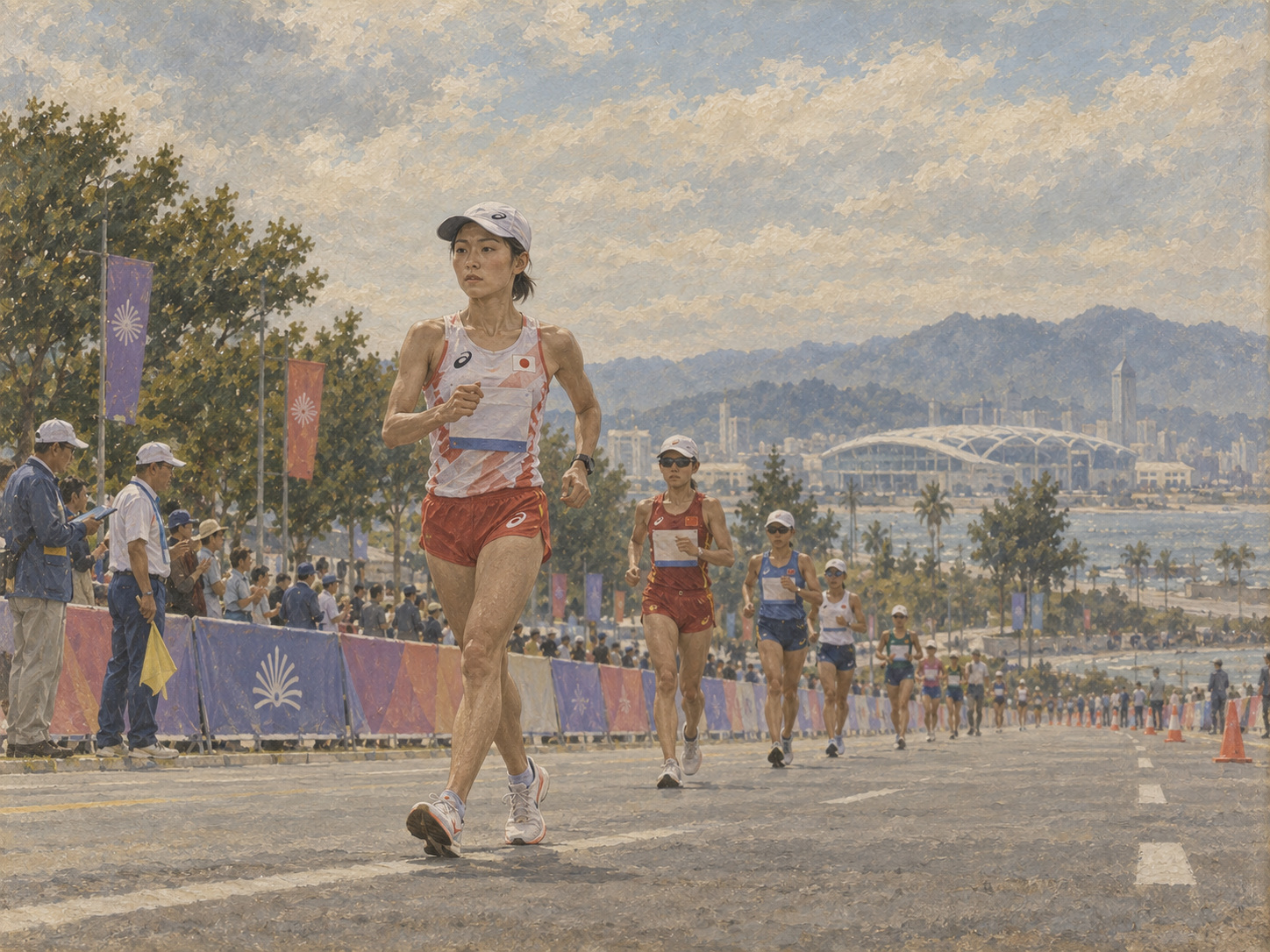
Walk 42.195 kilometres—but do not run. From 2026, that is the premise of the marathon race walk, World Athletics’ new standard long-distance road race walking event.
The distance is familiar from running. The technique is not. A race walker must maintain visible contact with the ground and keep the advancing leg straight from first contact until it passes under the body. Over more than three and a half hours, endurance and technical discipline become inseparable.
Maika Yagi of Chiba Kogyo Bank finished the women’s marathon race walk at the Aichi-Nagoya Asian Games in an official fourth place, clocking 3:36:40. The Japan Association of Athletics Federations and JOC both list her employer and team affiliation as Chiba Kogyo Bank. Born January 21, 1999, she attended Nishinomiya Prefectural High School in Hyogo and Chukyo University before entering the corporate athletics system.
The result changed after the finish
The order in which the athletes crossed the line on September 27 was not the final order.
Kazakhstan’s Yasmina Toxanbayeva initially finished first in 3:22:20 but was disqualified after a successful protest over footwear that did not comply with World Athletics shoe rules.
The Olympic Council of Asia confirmed the revised result on September 28: Danzengquzong of China moved to gold in 3:26:09, China’s Ma Li to silver in 3:32:26, Japan’s Yukiko Umeno to bronze in 3:34:59, and Yagi to fourth in 3:36:40.
Race walking is famous for judging over technique, but this time the decisive post-race ruling concerned equipment rather than gait.
A Chiba story through corporate sport
Yagi is not a Chiba-born athlete. Her official JAAF profile traces her education from Nishinomiya Prefectural High School in Hyogo to Chukyo University.
Her Chiba connection is professional: she competes for Chiba Kogyo Bank.
That distinction matters. Japan’s corporate sports system has long allowed elite track and field athletes to remain employed while training and competing internationally. For a specialist event such as race walking, an institutional employer can provide the continuity needed to sustain a long senior career.
Second at the Japanese Championships in March
Yagi had already tested herself over the new marathon distance on March 15 in Nomi.
At the Japanese Race Walking Championships, Yukiko Umeno won in 3:33:47. Yagi was second in 3:36:06, with veteran Masumi Fuchise third in 3:36:36.
World Athletics’ race report described Yagi drawing level with Umeno before 20km, then losing contact when Umeno increased the pace. Yagi’s 3:36:06 remains her listed marathon race walk personal best.
The new distance rests on an old 35km foundation
Yagi’s 35km personal best is 2:55:55, set in April 2022. She placed fourth at the 2025 Japanese 35km championships and competed over 35km at the 2025 World Championships in Tokyo.
So moving to 42.195km is not a completely different sport. It extends the endurance problem by another 7.195km while preserving the technical demands of race walking.
Why World Athletics changed 35km to 42.195km
World Athletics approved new standard senior road race-walking distances beginning January 1, 2026.
The 20km race walk becomes the half-marathon race walk at 21.0975km. The 35km race walk becomes the marathon race walk at 42.195km.
The governing body said the change was intended to make performances easier for fans to understand, connect race walking with familiar road-running distances and encourage mass participation.
For athletes, however, the change is substantial. Moving from 35km to 42.195km increases the race distance by about 20.6%.
From 50km to 35km to the marathon distance
Long-distance race walking has changed with unusual speed.
The men’s 50km walk was an Olympic event from 1932 and became one of the sport’s defining tests. In the early 2020s, World Athletics moved away from the 50km and established the 35km as the standard longer championship event for both men and women.
The 35km debuted at the 2022 World Race Walking Team Championships and was used at the 2022, 2023 and 2025 World Championships.
Beginning in 2026, the standard long road event moved again—to 42.195km.
Elite race walkers have therefore lived through three long-distance frameworks in only a few years.
Paris 2024 brought the marathon distance into race walking first
The marathon distance had already entered elite walking through the Marathon Race Walk Mixed Relay at the Paris 2024 Olympic Games.
That event uses one man and one woman, each walking two alternating legs, for a combined 42.195km. World Athletics said the marathon distance was chosen partly for its familiarity and its connection to Olympic tradition.
The 2026 individual marathon race walk is different: one athlete covers the entire 42.195km alone.
Yagi already owned an Asian Games medal in another walking format
JOC records that Yagi won silver in the mixed 35km race walk at the Hangzhou Asian Games.
That event belonged to the transitional 35km era. Her 2026 appearance therefore links two successive generations of Asian Games walking formats.
For athletes such as Yagi, adaptability has become a competitive skill in itself.
The difficulty is not only going farther
Race walking demands a legal gait throughout the race. Fatigue makes that harder.
As hip, knee and ankle mechanics deteriorate late in a race, an athlete must continue producing speed without visible loss of contact or a bent advancing knee.
At marathon distance, fueling, hydration and thermal management become more important, but so does technical reserve—the ability to maintain a legal, efficient walking pattern deep into the fourth hour.
Her Asian Games time was only 34 seconds off her personal best
Yagi’s 3:36:40 in Nagoya was 34 seconds slower than the 3:36:06 she set in Nomi in March.
That consistency matters in the first year of a new international distance. It suggests that her March performance was not an isolated result and that she has been able to reproduce a similar standard under championship conditions.
But the medal gap is also clear. Umeno’s bronze was 1:41 ahead; the official gold-medal time was 10:31 faster than Yagi’s.
Fourth place in race walking carries a special kind of tension
Race-walking results can remain provisional after the finish because judging, penalty procedures, protests or technical regulations can alter the classification.
That makes simply completing the distance legally an important part of performance—especially in a newly extended race.
Yagi finished the full marathon distance and remained in the official top four after the final adjudication.
What Chiba Kogyo Bank represents in the story
Yagi’s local connection is corporate, not geographic childhood development.
Japan’s corporate athletics teams form a bridge between university competition and international senior careers. Employers provide a stable organizational home for athletes whose events may not generate enough commercial income on their own.
That makes Yagi’s Asian Games result a Chiba-linked sports story in a specific sense: a Chiba-based financial institution is supporting a Japanese international in one of athletics’ most specialized endurance disciplines.
Women’s race walking has a shorter Olympic history
Race walking has roots in the early Olympic era, but women joined the Olympic programme much later.
Women’s race walking debuted at Barcelona 1992 over 10km and changed to 20km at Sydney 2000.
Men, by contrast, long had both 20km and 50km championship traditions. The more recent 35km era and now the marathon-distance era have moved international race walking toward equal long-distance formats for men and women.
Can the marathon name make race walking easier to understand?
That is part of World Athletics’ theory.
A general sports fan already knows what 42.195km means. The half-marathon distance is similarly familiar. Using those same distances creates a reference point that 20km and 35km race walking did not necessarily offer.
The challenge is that the distance is the easy part to explain. Judging remains technical. For the sport to become more accessible, fans also need to understand loss-of-contact rules, knee rules, red cards and penalties.
The next step is from Asian top four to the world level
Yagi has now competed at the 2025 World Championships over 35km, finished second at Japan’s first-season marathon race walk championship and taken fourth at the Asian Games over 42.195km.
That is a meaningful body of experience during a major rules-and-distance transition.
The next challenge is straightforward to describe but difficult to achieve: maintain a faster sustainable pace, preserve technical form late in the race and close the remaining gap to Asia’s medal positions and the world’s leading walkers.
Sources
- Japan Association of Athletics Federations, Maika Yagi profile
- JAAF, Aichi-Nagoya Asian Games profile
- JOC, Maika Yagi profile and Asian Games placing
- Olympic Council of Asia, official revised women’s marathon race walk result
- World Athletics, Maika Yagi profile
- World Athletics, 2026 Japanese/Asian Race Walking Championships report
- World Athletics Council, new half-marathon and marathon race-walking distances
- World Athletics, Marathon Race Walk Mixed Relay introduction
- World Athletics, 35km race walk history