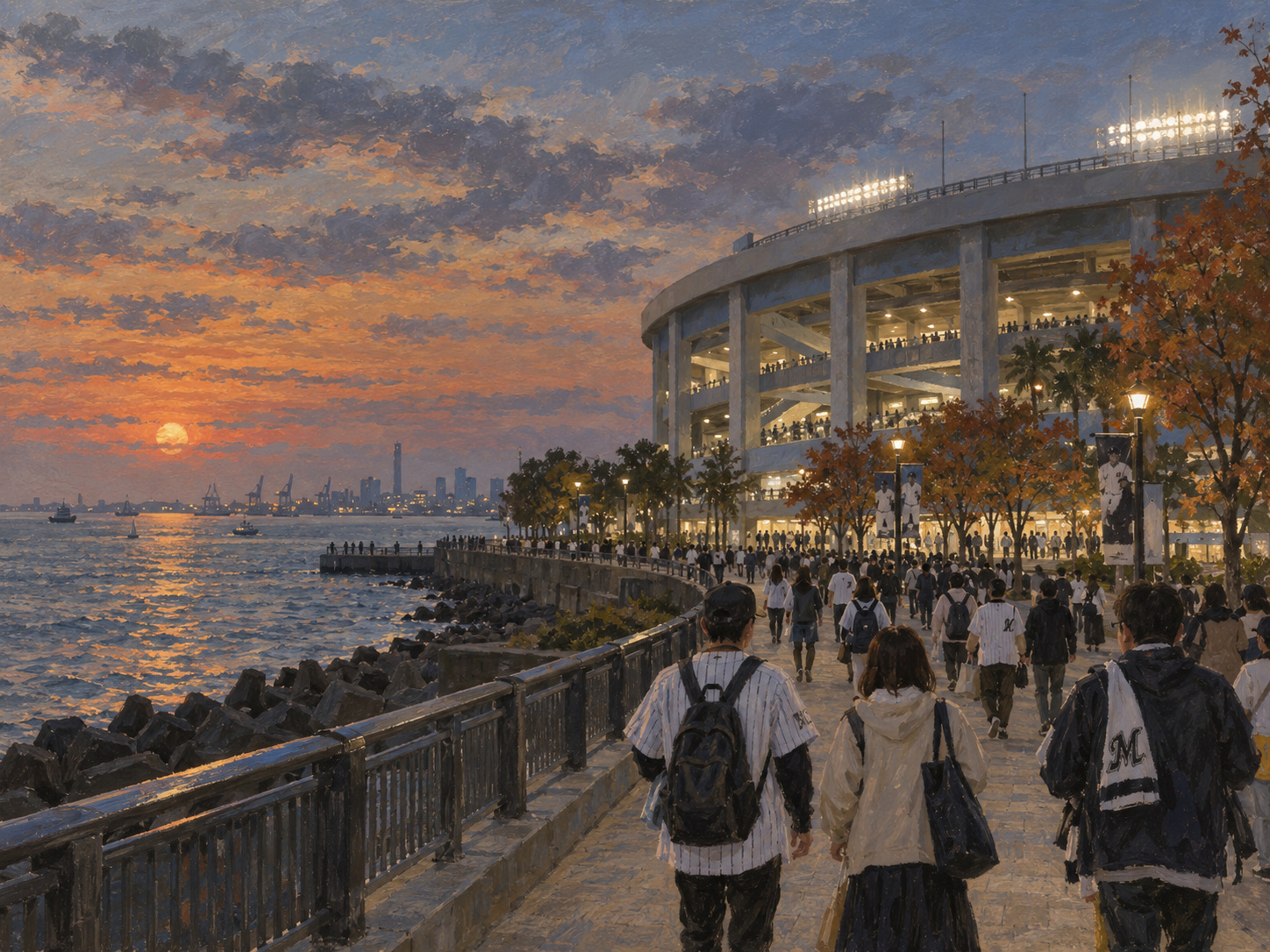
At 6 p.m. on October 4, the Chiba Lotte Marines are scheduled to host the Tohoku Rakuten Golden Eagles at ZOZO Marine Stadium. It is a Sunday night game in the final days of the Pacific League season—but it is not a playoff-deciding game.
Through October 1, the three Pacific League postseason places were already secured by the Fukuoka SoftBank Hawks, Saitama Seibu Lions and Hokkaido Nippon-Ham Fighters. Lotte stood fifth at 61-74-3, a .452 winning percentage. Rakuten was sixth at 56-83-1, .403. Lotte had been eliminated from Climax Series contention on September 17.
That changes the meaning of October baseball rather than eliminating it. The questions become what a team can carry into next year, which players receive late-season opportunities, what fans are given after postseason hope is gone—and what a stadium that has driven traffic into Makuhari for more than three decades means to the local economy even in a losing season.
The postseason race is already over for Lotte
After games on October 1, SoftBank led the Pacific League at 90-47-3, followed by Seibu at 77-60-4 and Nippon-Ham at 78-62-3. Those three clubs had already clinched the league’s Climax Series berths.
Seibu and Nippon-Ham clinched on September 17, mathematically shutting Lotte out of the top three.
So the October 4 game cannot move the Marines closer to a postseason berth. Its competitive value lies elsewhere: final record and placing, individual statistics, player evaluation and the chance to leave supporters with evidence of what the 2027 club might become.
Rakuten at ZOZO Marine, 6 p.m.
NPB and the Marines’ stadium calendar both list October 4 as Chiba Lotte vs. Tohoku Rakuten at ZOZO Marine Stadium, starting at 18:00.
Through October 1, Lotte led the season series 15-9. Rakuten was sixth and also outside the postseason field.
Calling it merely a “meaningless game,” however, misses how professional baseball works. At-bats and innings can affect roster decisions. Younger players can earn larger roles. Veterans can close statistical milestones. And the club still needs to give tens of thousands of paying supporters a reason to come to the waterfront.
Lotte closes the regular season with a run of home dates
The stadium calendar lists Nippon-Ham on October 1, SoftBank on October 2 and 3, Rakuten on October 4, and Seibu on October 5 and 6—all 18:00 starts at ZOZO Marine.
That concentrates the final stretch of the regular season on the Chiba waterfront.
October 2 also carries Katsunaka Katsuya’s retirement ceremony, for which the club organized a fan-made confetti project. Even after the standings stop offering postseason drama, the ballpark continues producing other kinds of baseball meaning.
The stadium was born as part of Makuhari, not as an isolated sports venue
Chiba Marine Stadium was completed on February 22, 1990 and opened that March on the bay side of Makuhari Messe. Chiba City’s history describes the original facility as a roughly 30,000-capacity international-scale stadium with about 44,782 square meters of floor area.
The timing matters. Makuhari Messe had opened in 1989. In 1990, the JR Keiyo Line completed service through to Tokyo, Makuhari Techno Garden opened and the new stadium arrived.
It was one component of a larger attempt to build Makuhari New City as a mixed district of offices, conventions, hotels, parks, homes and transportation infrastructure.
Lotte moved from Kawasaki to Chiba in 1992
In 1991 the stadium was selected as the home of the Lotte franchise, which became the Chiba Lotte Marines from the 1992 season.
The club identifies April 7, 1992 against Daiei as its first regular-season home game at Chiba Marine, a 5-1 victory. On August 31, 2021, the Marines recorded their 1,000th regular-season home win at the stadium.
Chiba City describes the Marines as a hometown club that contributes not only to sport but to community development and local sports culture.
From QVC to ZOZO: the name itself became an economic asset
QVC Japan acquired naming rights in 2011, creating QVC Marine Field. From December 2016, a naming-rights agreement with Start Today—now ZOZO—created the ZOZO Marine Stadium name.
In June 2026, Chiba City, the Marines and ZOZO agreed to extend that naming-rights relationship for another seven years, from December 1, 2026 through November 30, 2033.
The price is ¥400 million per year before consumption taxes.
A municipal ballpark whose name alone commands ¥400 million annually is not simply a playing field. It is also a national advertising platform and a piece of city branding.
More than two million people a year: a Makuhari traffic generator
Chiba City’s new-stadium planning material describes ZOZO Marine as a core source of activity in Makuhari New City visited by more than two million people annually.
A city-related 2024 business report said the stadium supported 62 professional regular-season games drawing 1,662,840 attendees and separately recorded nine interleague games with 252,406 attendees.
Those visitors do not spend only on tickets. They use trains, buses, parking, restaurants, convenience stores, hotels, ballpark food, merchandise and nearby retail. The stadium’s economic footprint therefore extends well beyond the team’s own accounts.
A city study estimated ¥17 billion a year in local economic ripple effects from visitor spending
Chiba City’s 2023 basic study on the future of the stadium estimated that visitor spending associated with the stadium could induce about ¥17.0 billion per year in economic production inside Chiba City and the equivalent of 2,052 induced jobs per year.
For the rest of Chiba Prefecture outside the city, it estimated an additional ¥10.2 billion in induced production and 1,093 jobs.
Those numbers require care. They are economic-impact model estimates, not Marines revenue, profit, tax receipts or literal payroll headcount. They depend on spending and input-output assumptions.
ALL FOR CHIBA turns a game into a regional market
The Marines’ “ALL FOR CHIBA” hometown events bring local food, products, mascots and Chiba-linked guests into the stadium.
For the June 19–21, 2026 series, the club explicitly promoted Chiba foods and local products as part of a home-town celebration.
That makes the baseball crowd a marketplace for regional promotion. Municipal sponsorship games and local-product events connect a professional-sports audience with businesses and communities that may have no direct relationship to baseball.
The waterfront identity also accelerates the stadium’s aging
The current stadium entered its 36th year in 2026. Its oceanfront setting is part of its identity—and a maintenance burden.
Chiba City’s condition study identified leaks, standing water, corrosion of fences and handrails, clogged wastewater and water pipes, flooding in staff parking areas, narrow concourses, inadequate wheelchair seating and heavy postgame traffic.
The famous sea wind is therefore both part of the baseball experience and a source of salt-related deterioration.
A new stadium is planned for the Makuhari Messe parking area
In September 2025, Chiba City adopted its basic concept for reconstructing Chiba Marine Stadium and selected the Makuhari Messe parking area as the intended location for a new stadium.
In June 2026, Chiba City, the Marines and Aeon Mall signed a three-party agreement to develop the basic plan, with Aeon Mall selected as project partner.
The current work compares an open-air stadium with an all-weather alternative and examines functions, circulation, transport, disaster readiness, costs, construction schedule and public-private responsibilities.
The concept-stage estimate was roughly ¥65 billion, with an opening targeted around 2034. As of October 2026, however, the final project authorization, roof type and final cost are not all fixed.
Why the next ballpark is supposed to work 365 days a year
The present stadium hosts roughly 70 professional baseball dates in a typical year. Baseball therefore occupies only a fraction of the calendar.
Chiba’s redevelopment concept calls for a public stadium with baseball, event and disaster functions plus privately financed commercial and entertainment uses, aiming for a facility that can be enjoyed “365 days a year.”
The urban-planning logic is clear: connect the stadium more effectively with Makuhari Messe, Aeon Mall, hotels, Makuhari Seaside Park and the Kaihin-Makuhari and Makuhari-Toyosuna stations, creating movement and spending even on days without a Marines game.
What the October 4 game means to the sports economy
On the standings page, Lotte-Rakuten is a late-season meeting between teams outside the playoff field.
On the street, it is still an event. At 6 p.m., trains unload spectators. Food counters open. Merchandise is sold. Restaurants turn tables. Advertising appears on screens. Parking and buses move. People walk through Makuhari.
A hometown sports economy cannot work only in championship seasons. Its resilience comes from spectators still showing up when the standings are disappointing.
A losing season tests the ballpark’s value
For a club that has missed the postseason, October home games become demonstrations of the future.
Play younger players. Let pitchers earn 2027 roles. Give a proper farewell to veterans. Reward the supporters who stayed through the season.
For Chiba City, the same dates occur while officials and private partners are designing the next generation of the waterfront ballpark.
What was not yet known when this article was prepared
This report was prepared on October 2 JST. The results of the October 2 and 3 SoftBank games, the October 4 announced starters, day-of-game roster moves, weather and the exact final shape of the fourth/fifth-place standings were not yet known and are not fabricated here.
The October 4 18:00 Rakuten fixture is confirmed, as is Lotte’s elimination from the Climax Series and the identity of the three Pacific League postseason teams.
Sources
- NPB, October 4, 2026 regular-season schedule
- NPB, 2026 Pacific League standings
- Chiba Lotte Marines, stadium calendar
- Chiba City historical timeline
- Chiba City, Makuhari New City overview
- Chiba City, Chiba Lotte Marines hometown page
- Chiba Lotte Marines, stadium guide
- Chiba City, ZOZO Marine Stadium basic study
- Chiba City, three-party new-stadium planning agreement
- Chiba City, ZOZO naming-rights renewal