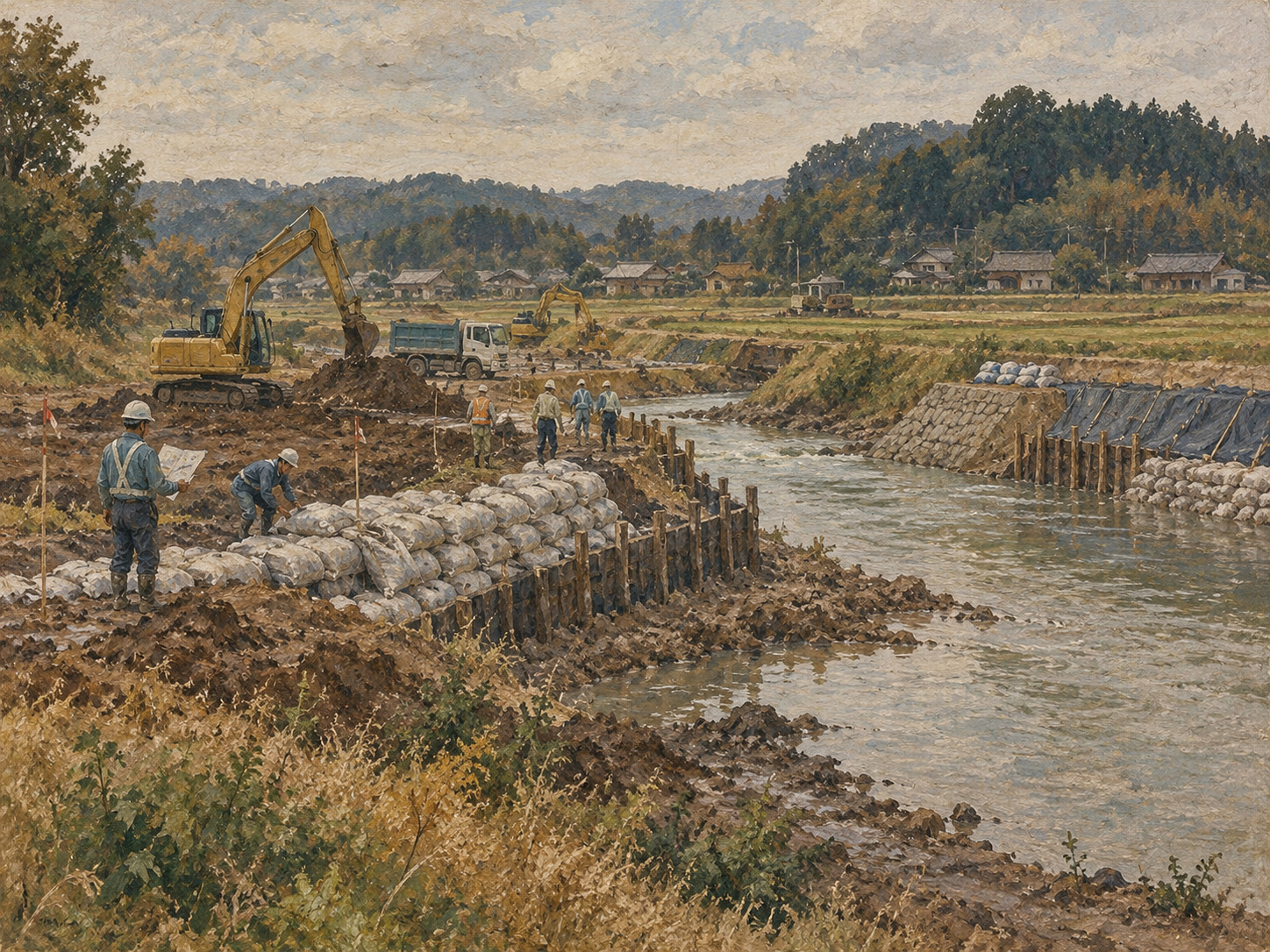
Flood recovery runs on two clocks. One is the long clock needed to investigate failure and reconstruct a permanent levee. The other is short: close the breach and reduce exposure before the next major rain arrives.
By September 30, Chiba Prefecture had completed the emergency rough closures under its responsibility at the Kadokawa drainage channel in Narita and the Nagato River at Sakanao in Sakae. Chiba says the openings were blocked with large sandbags, water-blocking sheets and related materials. These are emergency works, not permanent reconstruction.
A multi-site failure beginning September 22
Chiba’s official timeline says breaches were confirmed at North Inba Lake and the Kadokawa channel on September 22. The Nagato River breach was confirmed September 23, when Chiba requested national assistance and TEC-FORCE was dispatched.
On September 25, MLIT began emergency work at North Inba Lake and Chiba began work at Kadokawa. On September 26, Chiba began emergency restoration on the Nagato. Kadokawa was completed September 29 and Nagato September 30.
What an emergency rough closure actually does
The Japanese term arajimekiri refers to quickly blocking an open breach. Chiba identifies large sandbags and water-blocking sheets among the materials used at Kadokawa and Nagato.
The prefecture’s October 1 release explicitly says it will continue working with MLIT and the Japan Water Agency to consider permanent restoration. “Completed,” therefore, describes the emergency closure stage, not restoration of full pre-disaster levee performance.
Kadokawa, Nagato and North Inba Lake are one hydraulic problem
The breaches occurred at the Funakata reclamation area on North Inba Lake, the Kadokawa agricultural drainage channel in Shimokata, Narita, and the Nagato River at Sakanao in Sakae.
Kadokawa drains agricultural land toward North Inba Lake. The lake stores water. The Nagato River connects the Inba system to the Tone River. Closing one breach while lake levels remain high can leave pressure on another weak point.
That is why the response has combined breach closure, emergency pumping from inundated areas and lowering Inba Lake as much as possible.
Team Inbanuma joined three institutions
On September 25, Chiba Prefecture, the Japan Water Agency and the Kanto Regional Development Bureau created Team Inbanuma. Its purpose is to coordinate emergency drainage and levee restoration across a broad and prolonged inundation area.
The arrangement matters because the water system crosses institutional boundaries. Pumps, lake levels, agricultural channels, river works, access roads and construction equipment must operate toward the same hydraulic objective.
Lowering the lake is part of the repair
Temporary closures must resist water pressure. Higher lake levels place greater load on provisional works and leave less storage margin for the next storm.
Chiba therefore describes the combined operation as three simultaneous tasks: lower Inba Lake as far as practical, restore breached levees, and pump water from inundated areas.
Inba Lake is also an engineered flood-control system
The Japan Water Agency says Inba Lake was historically called an “abare-numa,” a rampaging lake that repeatedly flooded surrounding communities. Flood-control and water-use projects were attempted from the Edo period but repeatedly struggled.
Postwar reclamation and irrigation-drainage works began in 1946. As industrial-water demand grew, the Inba Lake Development Project became a Water Resources Development Public Corporation project in 1963.
Today the Inba shortcut channel links North and West Inba Lakes. The Nagato River links Inba Lake to the Tone River. Inba Pumping Station can discharge floodwater toward the Tone, while Owada Pumping Station can discharge toward Tokyo Bay. Sakanao gate and pumping facilities help regulate water levels.
A Nagato breach damages an outlet of the system
Because the Nagato River connects Inba Lake with the Tone, a breach at Sakanao is more than a local riverbank problem. It damages one of the routes through which the broader lake system is controlled.
The Sakanao area also contains water-control infrastructure, which makes restoring the river connection important to the operation of Inba Lake as a whole.
Kadokawa was built to drain farmland
The Kadokawa collection channel is an agricultural drainage route entering North Inba Lake. Under normal conditions it carries excess water away from fields.
During extreme rain, high downstream levels can make drainage difficult. Once the channel levee fails, an infrastructure asset designed to remove water can become a route through which inundation spreads.
Closing Kadokawa was therefore a prerequisite for meaningful agricultural recovery: there is little value in clearing mud from a field if the same opening remains available to the next storm.
Do not invent the engineering quantities
The October 1 Chiba release confirms the materials used and the work dates. It does not provide, in the public text, a complete quantity of sandbags, fill volume, workforce, final cost, temporary-section design or a specific water level the emergency closures are guaranteed to withstand.
North Inba Lake is still under tighter warning rules
The incomplete return to normal is visible in warning operations. Chiba temporarily lowered North Inba Lake water-level notification thresholds because the breach reduced defensive capability and says enhanced monitoring will continue until emergency restoration is complete.
In other words, emergency construction is being paired with a more conservative warning system. The physical works and the information system are both operating in a temporary state.
September 30 was not the end of Inba Lake restoration
While Chiba completed its two emergency closures, MLIT’s North Inba Lake work at Funakata was being tracked separately. Chiba’s October 1 status page continued to list all three damaged locations.
September 30 was a milestone, not an end point: the two breach sites under prefectural responsibility had been closed on an emergency basis.
The next rain does not wait for permanent design
Permanent reconstruction requires engineers to inspect the foundation and levee, investigate the failure mechanism and decide whether the final repair needs ground improvement, a redesigned levee section, bank protection, drainage structures or other work.
That investigation takes time. Weather does not.
Emergency works buy engineering time
Large sandbags and waterproof sheets are not permanent infrastructure. Their value is that they create a safer interval in which inundated land can be drained, lake levels lowered, damaged ground surveyed and permanent repairs designed.
That is the significance of the Kadokawa and Nagato completions. They do not close the disaster. They open the next phase of recovery.
Three things to watch next
First, when will emergency restoration be complete across all major Inba Lake breach sites? Second, what permanent methods, costs and completion schedules will be selected for Kadokawa and Nagato? Third, what will the failure investigation say about recurrence prevention?
Those answers will determine whether the 2026 work simply restores the old system or becomes an opportunity to strengthen the wider Inba Lake flood-control network.
Sources
- Chiba Prefecture, completion of rough closures at Kadokawa and Nagato
- Chiba Prefecture, restoration status around Inba Lake
- Chiba Prefecture, North Inba Lake levee breach
- Chiba Prefecture, formation of Team Inbanuma
- Chiba Prefecture, temporary North Inba Lake water-level operation
- Japan Water Agency, Inba Lake Development Project
- Japan Water Agency, history of the Water Resources Development Public Corporation