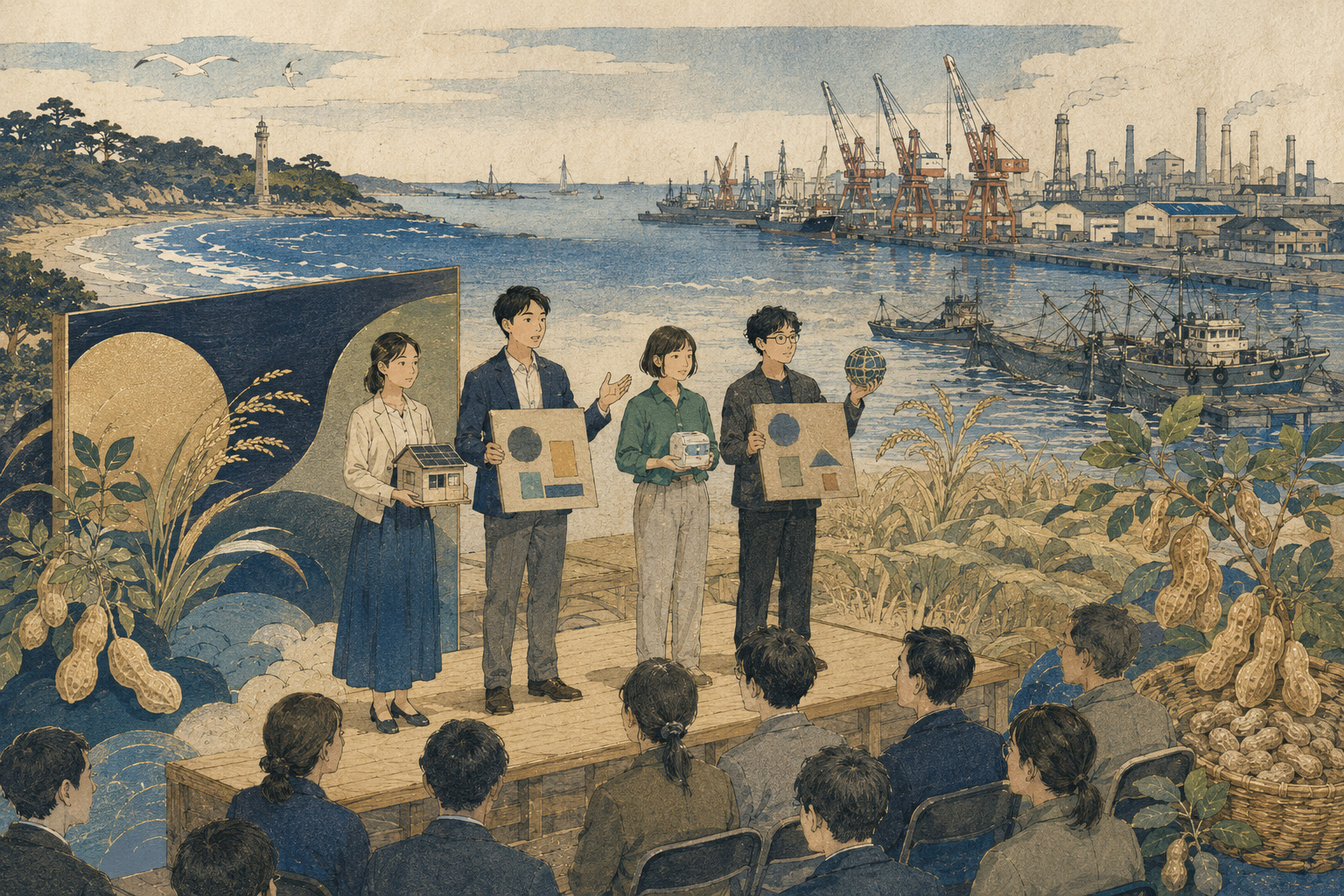
A business plan can begin with something small enough to be missed from Tokyo: bruised sweet corn that cannot be sold at full price; a dangerous blind spot at a swimming pool; an empty coastal house; rice that tastes familiar but behaves differently after a meal. In Chiba, those details are not peripheral. They are the raw material of an economy that runs from commuter cities and research laboratories to ports, steelworks, farms, fishing grounds and tourist towns.
The prefecture has opened the 2026 edition of its principal business-plan competition to people who can turn one of those details into an operating venture. Age, gender and nationality are not restrictions. An applicant may be an individual or group, need not yet have incorporated and may be at the planning stage. Existing founders can apply if they are less than five years from founding; business successors can enter a “second founding” plan within five years of succession.
But there is a territorial bargain. The plan must contribute to Chiba’s vitality or address a prefectural problem, and the entrant must have a business base in Chiba or intend to establish one within roughly a year of applying. The organizers are not merely asking, “Could this grow?” They are asking, “Why here, for whom here, and what becomes stronger here if it works?”
That framing can make room for companies overlooked by a venture-capital vocabulary of blitzscaling and exits. A repair service that keeps an aging town functioning, a food processor that raises a farmer’s realized price, a childcare operation that permits five skilled people to keep working, or a successor who modernizes a family manufacturer may never become a unicorn. It can still be excellent entrepreneurship and public value.
From an application file to a public stage
The selection funnel is straightforward. Applications are reviewed on paper in mid-October and about 15 plans are expected to advance. Those entrepreneurs receive a course on improving the business plan and presentation, plus individual expert help focused on commercialization, revenue and finance. On November 9, representatives pitch in Chiba City. Five finalists move forward and receive roughly three rounds of coaching from active business leaders before the January final.
The Governor’s Awards comprise one Chiba Entrepreneur Grand Prize and two Excellence Prizes. A judges’ special award is intended for strong plans that make use of Chiba’s regional characteristics or strengths. Separate supporter prizes are chosen by participating companies and organizations under their own criteria. The official page does not advertise a main cash purse. It emphasizes support.
Every applicant is promised feedback, priority booking for seminars at the large entrepreneur exchange event and limited networking with supporter companies. The three Governor’s Award winners receive mentoring and expert dispatch. They also receive preferential treatment for the separate Chiba Startup Support Grant: the grand-prize winner is exempted from that grant’s screening, while Excellence Prize winners receive additional points. The grant has its own eligibility rules. An award is therefore not the same as a grant decision or cash in the bank.
| Stage | Scheduled date | What happens | Support attached |
|---|---|---|---|
| Application | Aug. 3–Sept. 30, 2026 | Submit the prescribed plan; incorporation is not required | Feedback, seminar priority and supporter networking for applicants |
| First review | Mid-October | Paper review selects about 15 | Plan/pitch workshop and individual expert guidance |
| Second review | Nov. 9 | Representative pitches in Chiba City; five finalists selected | About three coaching sessions before the final |
| Public final | Jan. 20, 2027 | Final pitches and Governor’s Awards | Mentoring, expert dispatch and grant preference for top winners |
| Supporter awards | Across the process | Companies and groups choose under their own standards | Media, work space, consulting or other in-kind benefits may vary |
There are obligations. The named representative must be available for the November and January events and willing to receive the support. Travel, presentation preparation and participation costs are borne by the entrant. Judges’ deliberations are not disclosed, and the organizers say they will not answer individual questions about the judging.
The process therefore rewards more than an idea. It requires time, travel, repeated revision and the confidence to stand before evaluators. For a founder in southern Bōsō, a parent with care duties or a sole proprietor who must close a shop to attend, those are real costs. Formally open eligibility is an important start; practical accessibility determines who can use it.
Eleven contests have already widened the definition of a Chiba business
The competition belongs to the Chiba Entrepreneur Support Project, begun in fiscal 2015 to build motivation, networks, consultation and expert assistance around new business formation. The 2026 event is the 12th cycle. Its history is long enough to ask more than who held a trophy: what kinds of regional problems have become thinkable as businesses?
The 2025 contest drew 62 applicants. Five reached the final at Makuhari Messe in January 2026. Prime Sense took the Grand Prize for Meel, a sensing system designed to detect pool drowning emergencies without cameras or images. Excellence prizes went to Kurukuru Yahho for a Chōshi-centered plan to turn off-grade corn into distilled spirits and participatory regional products, and to a Chiba University entrepreneur-in-residence project, Smart GlycoRice, which seeks to apply university research to rice that moderates post-meal glucose spikes without sacrificing familiar taste.
The judges’ special award went to Sosei for a concept linking empty houses and a future model of fisheries. Other finalists addressed work for people with disabilities and sustainable regional health care. These plans ranged across safety technology, agriculture, food, university research, welfare, medicine, housing and fisheries. That breadth is important. A regional contest becomes shallow when “innovation” is used as a synonym for software.
The previous cycle offered the same lesson. The 2024 Grand Prize winner, Manabe-ing, proposed NexTeachers, a coaching- and learning-theory program for university students studying education. Excellence prizes went to a Minamibōsō sake-brewery tourism plan led by KAIGAN and to WellMent’s AI-avatar wellbeing platform. One dealt with how future teachers teach; one with an old house, brewing culture and inbound visitors; one with digital health.
In 2026 the official site invited 2016 finalists back to discuss “the reality and trajectory of ten years in management.” That is precisely the right horizon. A pitch compresses a venture into minutes; a company is revealed across payroll cycles, customer complaints, weather shocks, price increases, succession decisions and the founder’s willingness to change an assumption.
The competition publishes past winners and testimonial videos, but public accountability could go further. A simple annual cohort register—started, not started, operating, closed, pivoted, employment, Chiba base, follow-on support, founder consent permitting—would make the program a learning institution. Failure should not be hidden. A disciplined shutdown after evidence disproves a plan can be a better outcome than keeping a subsidized operation alive without customers.
Chiba was entrepreneurial before anyone called it a startup ecosystem
Long before slide decks, a business in Chiba was already solving a geography problem. Noda’s soy-sauce brewers had soybeans, wheat, water and the Edo River. Boats brought ingredients and carried finished sauce toward the expanding market of Edo; Kikkoman’s history says a morning shipment could reach Nihonbashi by noon. Brewing in Noda dates to the 17th century. In 1917, eight family companies merged into Noda Shoyu, the predecessor of Kikkoman, pooling practice and scale without abandoning a place-based product.
Farther east, Chōshi faced the Pacific and the Tone River system. Fishing, processing, trade and craft formed a different commercial world. Chōshi chijimi, a finely crinkled textile, was produced by more than 40 weaving houses and over 100 outworkers in the late Edo period; farm and fishing households, including women working at home, fed goods into river transport for Edo. The industry later declined under cost and mass-production pressure, then was reconstructed after the war by recovering knowledge and rebuilding machinery. It is a compact history of regional enterprise: networked production, market access, disruption, lost technique and deliberate revival.
Modern Chiba added infrastructure on a much larger scale. Reclamation for the Keiyō coastal industrial zone and the prefecture’s first industrial waterworks began in Ichihara in 1957, accelerating a postwar transformation around steel, petroleum and chemicals. The 2020 prefectural input-output table put manufacturing at 31.6 percent of Chiba’s ¥43.46 trillion in total output—the largest sector by that measure.
Narita Airport opened on May 20, 1978. It gave the prefecture a global passenger and freight gateway; its cargo-terminal warehouse area is now about 233,000 square meters. Its history also carries a warning. The airport decision produced an intense, decades-long conflict with local residents, and later formal dialogue acknowledged the need to end forceful confrontation and rebuild decisions through discussion. Infrastructure creates opportunity, but development imposed without procedural trust can impose a generational cost.
Makuhari Messe opened on October 9, 1989, turning reclaimed waterfront into a national stage for trade fairs, conferences, concerts and, eventually, entrepreneur pitches. The Tokyo Bay Aqua-Line opened in December 1997, remaking Kisarazu’s relationship with Kanagawa and ending the car-ferry route. Each intervention shortened a distance. Each also changed land, labor, customer flows and who benefited.
17th century — Soy-sauce brewing takes root in Noda, connected to river transport and Edo demand.
1917 — Eight brewing families form Noda Shoyu, predecessor of Kikkoman.
1957 — Ichihara reclamation and industrial-water development mark the growth of the Keiyō coastal zone.
1978 — Narita Airport opens.
1989 — Makuhari Messe opens.
1997 — The Tokyo Bay Aqua-Line opens.
2015 — Chiba’s prefectural entrepreneur-support project begins.
2026 — The 12th CHIBA Business Contest opens.
This history changes what “regional strength” should mean in judging. It is not a decorative peanut on a pitch slide. It can be a supply relationship, a technical tradition, a logistics advantage, a university laboratory, a food-processing constraint, a tourism season, a flood risk, an aging customer base or a conflict from which institutional memory should be retained.
There is no single Chiba market
Chiba’s nominal gross prefectural product was ¥22.17 trillion in fiscal 2023. Its scale can disguise internal difference. The Tokyo-facing northwest contains dense commuter cities, universities, medical markets and businesses tied closely to the capital. The Keiyō coast concentrates factories, energy and logistics. Narita connects aviation, cargo, tourism and an expanding airport-city strategy. Hokuso and the eastern districts are major farming and livestock areas. The Pacific and Tokyo Bay support different fisheries. Southern Bōsō combines agriculture, tourism, health care, small-town services and acute demographic pressure.
Agriculture alone produced ¥402.9 billion in 2023, fourth among Japan’s prefectures. Chiba ranked first in the value of items including Japanese pears and peanuts; eggs were first, flowers second, and vegetables, pork and other products ranked near the top. Prefectural fishing-port landings were valued at ¥44.3 billion in 2022, sixth nationally. These sectors are not quaint background for a technology contest. They need sensors, cold chains, waste reduction, hiring, finance, succession, branding, energy, transport and customer discovery.
The demographic map makes the challenge sharper. Chiba’s preliminary 2025 census counted 6,258,512 people, down 25,968 from 2020—the first census-to-census decline since Japan’s first modern census in 1920. Yet 12 western cities gained population. Chiba City added about 20,000 people; Nagareyama grew 7.65 percent and Inzai 7.59 percent. Elsewhere, 25 cities and 17 towns or villages lost population. A service designed for a young family arriving in Nagareyama and one designed for an older customer in Minamibōsō may both be “Chiba businesses,” but almost everything about demand and delivery differs.
| Regional economy | Inherited strength | Problems open to founders | Evidence a plan should show |
|---|---|---|---|
| Northwest / Tokyo-facing cities | Population density, rail access, universities, metropolitan customers | Childcare, aging, mobility, small-space services, talent competition | Neighborhood-level demand, acquisition cost and retention |
| Keiyō coast | Manufacturing, ports, energy and industrial supply chains | Decarbonization, maintenance, safety, workforce renewal, resilience | Pilot partner, procurement path, certifications and sales cycle |
| Narita / Hokuso | Airport, cargo, farms, livestock and international flows | Cold chain, visitor services, export, land use, multilingual labor | Operating permissions, logistics economics and local consent |
| Chōshi / Kujūkuri | Fishing, food processing, wind and Pacific tourism | Catch value, waste, climate adaptation, empty properties, seasonality | Supply variability, off-season cash plan and buyer commitments |
| Southern Bōsō | Nature, food, tourism, care and distinctive communities | Population loss, health access, transport, succession, disaster recovery | Low-density unit economics and a durable local operator |
A fair statewide contest should not mistake the presentation polish available in the northwest for greater underlying merit. Nor should it romanticize rural hardship and accept a plan merely because it uses an attractive local story. Judges need comparable evidence but region-sensitive economics. A customer reachable on foot in Funabashi may require an hour’s drive in Awa. A B2B founder selling into a steel works faces a procurement cycle unlike a café owner’s. The question is not which looks more like a startup. It is whether the model understands its real market.
The hidden prize is a network—if it produces work
In the 2025 cycle, 29 supporter companies offered independent prizes. The benefits show why an in-kind network may matter more than a ceremonial check. Published examples included six months in a Narita station-area shared space, one year of shared-office access, consulting, regional radio exposure, crowdfunding assistance, product-development support and help arranging equipment or services for opening a business.
For an early founder, those are not equal. A radio feature may be valuable for a consumer product and irrelevant to an industrial supplier. Free office space is useful only if it is reachable and substitutes for a cost the founder would otherwise pay. Consulting has value when the adviser has the right domain expertise, enough time and no hidden sales agenda. “Introductions” are not outcomes unless a relevant person agrees to a next meeting.
The network should be matched, not merely counted. A seafood venture may need a processor, a cold-chain carrier, a food-safety specialist and a buyer. A care company may need a municipality, a clinic and a labor expert. A university spinout may need a technology-transfer office, regulatory strategy, a pilot site and patient capital. A successor manufacturer may need production engineering, cyber security and a lender who understands machinery investment.
- Need: Does this solve the founder’s current bottleneck, or merely add another meeting?
- Owner: Is one named person responsible for the introduction or advice?
- Deliverable: What concrete work, access or decision will be completed?
- Conflict: Is the supporter selling a service, seeking equity or controlling publicity?
- Follow-through: Will the founder and supporter report what happened six months later?
Chiba’s wider support landscape has grown beyond the annual competition. The prefecture runs youth entrepreneurship programs, open-innovation matching, proof-of-concept support, startup growth assistance, business succession consultation and a large startup-community initiative. Chiba City separately runs Venture Cup CHIBA, which reaches its 25th edition in 2026. The banks’ student contest has operated since 2012 and reports 61 winning teams and 22 company formations. These are different doors. A founder should be able to see the pathway among them without filling out the same biography and explaining the same business from zero each time.
The contest is most useful as a triage and relationship system: identify what the founder needs next, make a qualified connection, record consent, and keep the case moving. The applause matters for morale. The warm handoff matters for survival.
A persuasive pitch is not the same thing as a predictive one
A pitch competition must choose, so it relies on a compact representation of a company: problem, solution, market, advantage, team, money and impact. The format creates urgency and comparability. It also creates error. Charisma, fluency, design skill and confidence are visible immediately; operational discipline, listening, resilience and honest bookkeeping are harder to stage.
Research outside Chiba is a warning, not a verdict on this contest. A study of a large Nigerian business-plan competition found that judges’ plan scores were uncorrelated with survival, employment, sales or profit three years later; all prediction methods performed poorly. A 2025 study of the first ten seconds of digital pitches found that rapid perceptions of traits such as competence and aggressiveness affected funding outcomes. Other recent work finds that reactions to a neutral face or voice can be gendered. None proves that Chiba’s judges make the same errors. Together they show why presentation should not be mistaken for ground truth.
The remedy is not to abolish the stage. It is to triangulate it. Scores should distinguish evidence from delivery. Has a founder interviewed customers outside family and friends? Is there a paid pilot, letter of intent, repeat use or documented refusal that changed the plan? Do price, gross margin, working capital and founder salary fit together? What assumption would kill the venture? What has the team learned that contradicts its first story?
Local contribution needs equal discipline. “We will revitalize Chiba” is not a metric. A plan can specify local purchasing, jobs with wages and hours, retained fishing value, reduced waste, accessible transport, improved care capacity, preserved technical skill, increased off-season revenue or measurable emissions reduction. The plan should also state trade-offs: traffic, water use, land pressure, noise, displacement, safety, privacy or dependence on one public subsidy.
Judges can protect the “little guy” by evaluating the right scale. A stable five-person company may be too small for a venture fund and exactly right for a town. Its addressable market can be modest if margins, repeat demand and succession are credible. Growth is not only headcount or valuation; it can be deeper productivity, higher producer income, a broader service area or a model another local operator can adopt.
Publicity is opportunity—and an intellectual-property boundary
The rules say applicants retain intellectual-property rights in their submitted work. They also say the final is a public presentation, media may attend, and a business plan disclosed through the competition will generally become public. The organizers may publish award-winning plans. Entrants are expressly told not to reveal inventions, know-how or secret information they want to keep confidential.
That warning deserves more attention than a footnote. Japanese patent law generally denies novelty to an invention publicly known, practiced or made available before filing. Japan has an exception procedure for certain inventor disclosures, but the Japan Patent Office calls it an exception to the rule, warns that third-party prior filing can still defeat a claim and notes that other countries’ rules differ. The practical lesson is simple: a founder with a potentially patentable invention should obtain qualified advice and decide what to file before a public pitch, not after the video circulates.
Trade secrets require a different discipline. The pitch can explain the customer problem, benefit, validation and business model without displaying the recipe, algorithm, detailed manufacturing tolerance, source code, unpublished data or supplier term that creates the advantage. A founder should prepare a public deck and a confidential diligence room, then know which room each fact belongs in.
There are reputational boundaries too. Health, safety, climate and social-impact claims need evidence. A prototype is not a certified product. A letter of interest is not revenue. A university affiliation is not proof that the institution endorses commercialization. “Japan’s first” needs a search method and date. A regional story invites emotional trust; founders and judges should be especially careful not to spend that trust on a claim that cannot yet be supported.
Organizers could make the boundary easier to manage by offering a pre-pitch intellectual-property clinic, a public-disclosure checklist and clear guidance about recorded video, slides, press materials and later website use. That would not replace legal advice. It would help founders recognize when advice is needed.
What should success look like on January 20—and in 2030?
On final day, a successful event will be lively, comprehensible and fair. Five founders will explain why their plans belong in Chiba; judges and the audience will make difficult distinctions; supporters will offer help suited to the ventures. By evening there will be winners. The deeper evaluation begins the next morning.
For applicants, the right short-term outcome may differ. One wins. Another finds a customer. A third learns that its price cannot support delivery. A fourth meets a successor manufacturer with the missing capability. A fifth chooses not to launch. The competition adds value if each decision is better informed than it was on August 3.
For the prefecture, success should be measured by cohort and over time, including non-winners. At six months: which plans started, filed, piloted, changed or stopped? At one year: which established the promised Chiba base, won paying customers, entered a procurement process, obtained appropriate finance or formed a local partnership? At three years: which survived, paid wages, improved founder income, retained workers, produced demonstrable regional benefit or closed responsibly?
| Claim | Useful evidence | When to check | Misleading shortcut |
|---|---|---|---|
| The contest finds viable ventures | Starts, survival, customers, revenue quality and responsible closures for every cohort | 6, 12 and 36 months | Winner testimonials only |
| It benefits Chiba | Operating base, local purchasing, jobs, services, partnerships and quantified problem reduction | Annual | Founder’s Chiba address |
| Support is effective | Introductions completed, pilots signed, advice implemented and bottlenecks removed | 3 and 12 months | Number of mentors |
| Access is broad | Applicants and advancement by region, gender, age, disability, care duties and business type—with privacy safeguards | Each cycle | “Open to everyone” in the rules |
| Judging is sound | Rubric, conflict management, score reliability and later outcome review | Each cycle and after 3 years | Stage applause |
Publication does not require exposing private accounts or embarrassing founders. Aggregated data, voluntary case studies and clear definitions can show whether the public program learns. It can also reveal where the pipeline fails: too few applicants from the south, women eliminated disproportionately at the pitch stage, research teams unable to find operators, promising sole proprietors unable to travel, supporter connections that never become meetings.
The 2025 census provides a sober backdrop. Chiba is large, productive and internationally connected, yet its population has begun to decline overall while growth concentrates in a western arc. Entrepreneurship cannot reverse demography alone. It can preserve a service, create a reason to stay, translate research into practice, raise the value of a catch or crop, make a dangerous activity safer, and build a new connection between regions that increasingly live at different speeds.
Chiba’s commercial history was never one story. It was river boats and home looms, brewing families and fishing crews, reclaimed factories and airport warehouses, commuter neighborhoods and convention halls. The next business may begin on a polished Makuhari stage. More likely, it will begin earlier—in an annoyance, a loss, an underused skill or a conversation with a customer who says no.
The contest can help a founder hear that answer, revise the plan and meet the person who makes the next test possible. That is less glamorous than declaring the prefecture’s next star entrepreneur. It is also how a regional economy is actually renewed: not by one winning speech, but by many people becoming a little better at turning local knowledge into durable work.
Reporting notes and principal sources
This article reviews public information available through August 11, 2026 at 8:06 AM JST. The 2026 competition is still accepting applications; no claim is made about its entrants or results. Historical and statistical values use the latest public editions located during reporting, which refer to different statistical years. Research about pitch judging is used as a general caution and is not evidence about the conduct of CHIBA Business Contest judges.
- CHIBA Business Contest 2026: purpose, eligibility, schedule, awards, support and disclosure rules
- Chiba Prefecture: 2025 contest’s 62 applicants, five finalists, 29 supporters and project history
- Innovative Hive: 2025 Governor’s Award and judges’ special-award results
- Innovative Hive: published 2025 supporter awards and in-kind benefits
- Chiba Prefecture: 2024 contest results
- Chiba Prefecture: preliminary 2025 census population and municipality changes
- Chiba Prefecture: fiscal 2023 prefectural accounts
- Chiba Prefecture: 2020 input-output table and industrial composition
- Chiba Prefecture: agriculture, fisheries and regional industry profile
- Kikkoman: Noda brewing history and the 1917 merger
- Kikkoman: the Edo River supply and distribution system
- Chiba Prefecture: history of Chōshi chijimi production and revival
- Chiba Prefecture: 1957 Ichihara reclamation and industrial waterworks
- Narita International Airport: official history and 1978 opening
- Narita International Airport: conflict, symposium and regional dialogue history
- Makuhari Messe: 1989 opening and corporate history
- Chiba Prefecture: 1997 Tokyo Bay Aqua-Line opening
- Chiba Prefecture: 2026 youth entrepreneurship program
- Chiba Prefecture: 2026 open-innovation program
- Chiba Prefecture: 2026 startup growth support
- Chiba City: Venture Cup CHIBA 2026
- Bank of Yokohama: Chiba–Yokohama student business contest history and outcomes
- McKenzie and Sansone: three-year prediction limits in a business-plan competition
- Journal of Innovation & Knowledge: first impressions and digital-pitch outcomes
- Japan Patent Office: pre-filing disclosure and the novelty exception