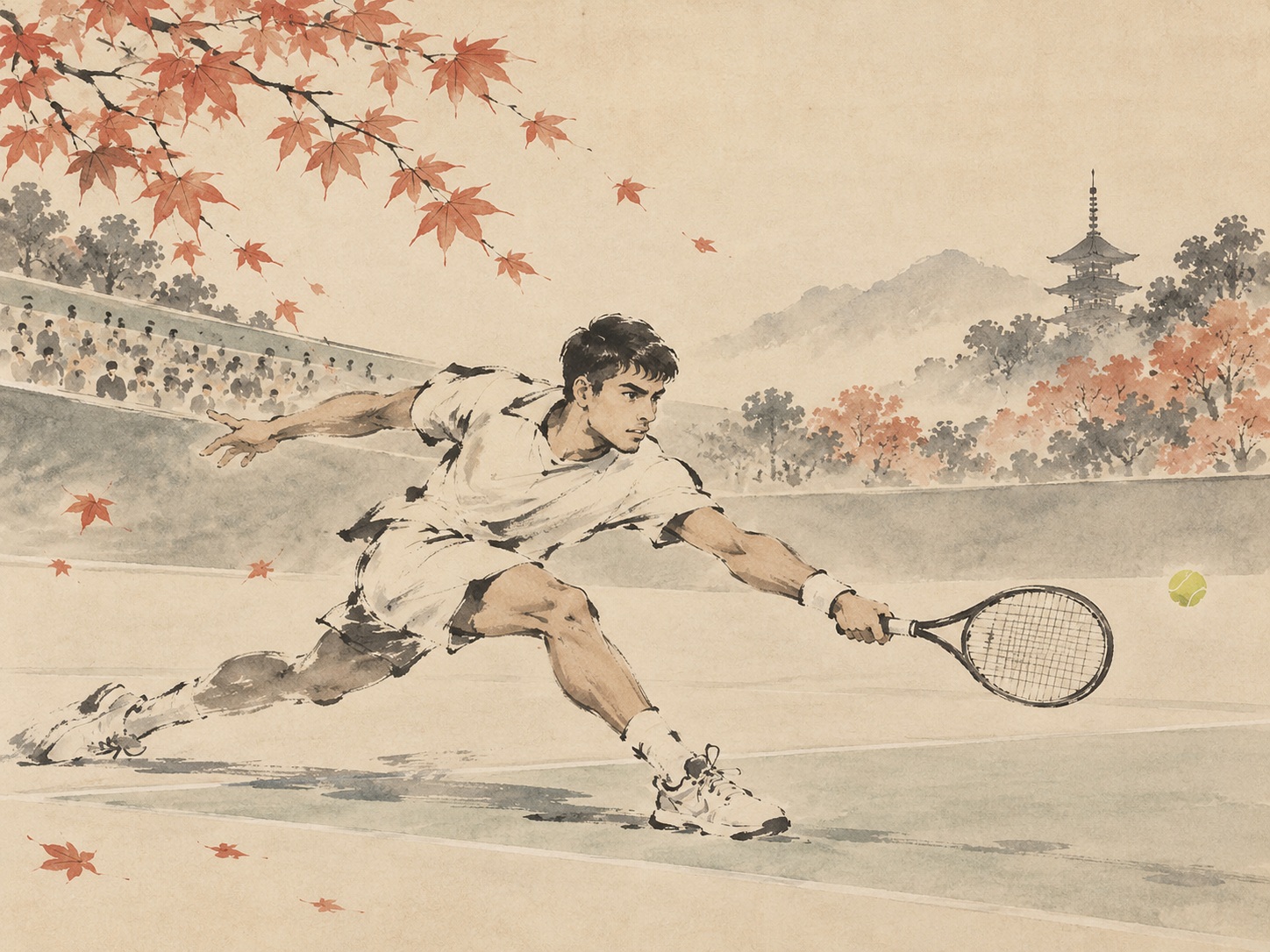
Carlos Alcaraz’s most revealing tennis in Tokyo has not come when everything works. It has come in the minutes when almost nothing does. Against Matteo Arnaldi on October 3, the defending Japan Open champion reached the first-set tiebreak and fell behind 2–6, giving the Italian four set points. Alcaraz then won six consecutive points, took the set 7–6(6) and ran away with the second 6–1.[1]
One day later, Alcaraz again survived a difficult first set against Denis Shapovalov. He was broken three times, recovered from 3–5, saved another set point and won the tiebreak 7–3. Shapovalov retired with Alcaraz leading 7–6(3), 2–1, sending the Spaniard into the semifinals. At this article’s October 4 reporting cutoff, his October 5 semifinal against Jaume Munar had not yet been played.[2]
What changed at 2–6?
The first set against Arnaldi was unusually untidy. The Japan Tennis Association’s tournament report says Alcaraz won only 22% of the points behind his second serve in the set and committed an unusual number of unforced errors. Arnaldi absorbed the Spaniard’s topspin and counterpunched effectively. At 2–6 in the tiebreak, the obvious thought was survival until set two.[1]
Alcaraz later said he told himself the set was not over until his opponent won the final point. But the comeback was tactical as well as psychological. He recognized that Arnaldi was comfortable with the heavy topspin and adjusted by using less spin, accepting slightly less pace and prioritizing making the Italian play another ball.
The change denied Arnaldi the easy counterpunching pattern he had been using. Suddenly the Italian had to create offense himself. Six points later, a set that had seemed finished belonged to Alcaraz.
Tokyo had been uncomfortable from the first match
Alcaraz’s title defense was not smooth from the beginning. In the first round on October 1, American Alex Michelsen pushed him to three sets before Alcaraz won 7–6(1), 4–6, 6–1. He had arrived from the Laver Cup in London and had limited practice in Tokyo because of persistent rain. The indoor practice court felt very different from Ariake Coliseum with its retractable roof open.[3]
“It took me a while to reach the point where I realized I had to completely change the way I was playing,” Alcaraz said in the tournament’s official report. After losing four straight games from 4–2 in the second set, he accepted the conditions and dominated the decider.
That is one definition of elite tennis. The best player on paper rarely gets ideal travel, weather, ball behavior, court speed and rhythm at the same time. Winning often means finding the version of your game that works on that particular afternoon.
The same problem returned against Shapovalov
In the quarterfinal, Alcaraz won only 48% of first-serve points in the opening set and was broken three times. He trailed 3–5, broke back, saved a set point at 4–5 and again dragged a difficult set into a tiebreak. The tournament report explicitly described the pattern as another escape from trouble after the Arnaldi match.[2]
Shapovalov’s retirement means the match never reached a normal competitive conclusion. It would be misleading to call the quarterfinal a dominant Alcaraz victory. What it did reinforce was the theme of his week: he has repeatedly found a way through a bad first set.
He won Tokyo on his first visit
Alcaraz made his Japan Open debut in 2025 and won the title immediately. In the final he defeated second seed Taylor Fritz 6–4, 6–4. The official tournament report noted that it was Tokyo’s first final between two Top 5 players in 14 years, since Andy Murray defeated Rafael Nadal in 2011.[4]
The path was not trouble-free. Alcaraz injured his left ankle in his opening match but recovered and lost only one set on his way to the trophy. ATP later noted that Tokyo was one of a tour-leading eight titles he won in 2025.[5]
That gives this year’s difficulties a familiar quality. Ariake has already been a place where Alcaraz has had to win while something felt wrong.
The Japan Open was born from Japan’s entry into professional tennis
The Japan Tennis Association traces the tournament to the sport’s Open Era. World tennis opened professional events to professionals and amateurs in 1968, but Japan’s governing structure initially made professional participation complicated. In 1972, the Japanese association staged its first open tournament, the Japan Open.[6]
A major catalyst had come two years earlier, when Tokyo hosted the inaugural Masters year-end championship in 1970. Rod Laver, Ken Rosewall and other international stars helped create a tennis boom. Japan then joined Hong Kong and the Philippines in organizing an Asian circuit and transformed an older invitational into the Japan Open.[7]
Today the tournament is an ATP 500 played at Ariake Coliseum and Ariake Tennis Forest Park. Its original purpose—to let Japanese fans watch the world’s best compete seriously on home soil—is almost perfectly embodied by Alcaraz’s presence.
A champions list that connects eras
ATP highlights the extraordinary names who have won in Tokyo: Stefan Edberg, Pete Sampras, Roger Federer, Rafael Nadal, Andy Murray and Novak Djokovic among them. Twelve players who at some point reached world No. 1 have won the event since its early years.[8]
A Tokyo title is not a major championship. But as one of the leading stops on the Asian autumn swing, it has repeatedly attracted players who defined their generations. Alcaraz joined that list in 2025.
In 2026, he completed the Career Grand Slam at 22
Alcaraz began 2026 by doing something no man had done so young. At the Australian Open, he defeated Novak Djokovic in the final to win his first Melbourne title and complete the Career Grand Slam at 22 years and 272 days, the youngest man ever to win all four majors at least once.[9]
It was his seventh major title. ATP placed him in the small Open Era group with Andre Agassi, Roger Federer, Rafael Nadal and Djokovic to have completed the full set of major championships.[9]
The season since then has been less linear. Injury interrupted his year, and he lost a dramatic US Open quarterfinal in September. He entered Tokyo as the tournament’s top seed but not as an invulnerable player.
A 23-year-old defending the five-set tradition
While in Tokyo, Alcaraz also entered the debate over tennis’ exhausting calendar. Reuters reported that he opposed shortening Grand Slam men’s matches from best-of-five to best-of-three as a workload solution, arguing that five-set tennis is part of the majors’ legacy. He instead pointed toward calendar reform, late finishes and the demands of an 11-month season.[10]
The subject fits his Tokyo week. Elite players are expected to change continents, conditions and rhythms continuously and still perform on demand. Alcaraz can criticize that system while also being one of the players most capable of surviving it.
What Japanese fans are seeing after the Big Three
As the Federer-Nadal-Djokovic era recedes, Alcaraz has become one of the central figures of men’s tennis. His appeal is visual as well as statistical: the explosive forehand, drop shot, sprinting defense, sudden net attacks and willingness to improvise make individual points feel like performances.
The 2025 final report described Ariake erupting after spectacular shots and falling completely silent when the server began his motion. That relationship between global star and local audience is what the Japan Open was created to produce more than half a century ago.[4]
The title defense is still unfinished
At the October 4 cutoff, Alcaraz was in the semifinals. He had not yet produced his cleanest tennis of the year, and Shapovalov’s retirement meant his quarterfinal ended prematurely.
But the most interesting evidence from Tokyo may be how he has handled imperfection. Against Michelsen, he changed his game to fit the court. Against Arnaldi, he changed the shape of his ball. Against Shapovalov, he recovered from 3–5 and another set point.
Some skills are easy to see: serve speed, forehand pace, court coverage. The harder skill to measure is the ability to abandon a failing idea during a match and replace it before the scoreboard makes the choice for you. At Ariake, the six straight points from 2–6 may be the clearest six-point demonstration of why Alcaraz has already collected every major title in tennis.
Sources and references
- Kinoshita Group Japan Open / Japan Tennis Association, Alcaraz defeats Arnaldi, October 3, 2026.
- ATP Tour, Alcaraz advances after Shapovalov retires, October 4, 2026.
- Kinoshita Group Japan Open / JTA, Alcaraz defeats Michelsen in three sets, October 1, 2026.
- Kinoshita Group Japan Open / JTA, 2025 final: Alcaraz defeats Fritz 6–4, 6–4.
- ATP Tour, Alcaraz set to defend Tokyo title in 2026, February 28, 2026.
- Japan Tennis Association, history of the association and the 1972 launch of the Japan Open.
- Japan Tennis Association, historical feature on the road to the Japan Open.
- ATP Tour, history of elite world No. 1 champions in Tokyo, September 23, 2025.
- ATP Tour, Alcaraz completes the Career Grand Slam, February 1, 2026.
- Reuters, Alcaraz on five-set Grand Slam tennis and calendar reform, October 1, 2026.
Reporting cutoff: October 4, 2026, after the quarterfinals. The October 5 semifinal and October 6 final are not reflected in this version.