- The next frontier for an imaging company is the darkness of Earth
- A collaboration that runs from the detector to the end user
- What is a single-photon avalanche diode?
- From a 2021 SPAD milestone to a satellite proposal
- The other half of Canon’s history is already in orbit
- Nighttime Earth observation did not begin in 2026
- Where greater nighttime sensitivity could make a difference
- Why the two data partners matter
- What the Japanese public funding decision actually means
- The measurements that will decide whether it works
The next frontier for an imaging company is the darkness of Earth
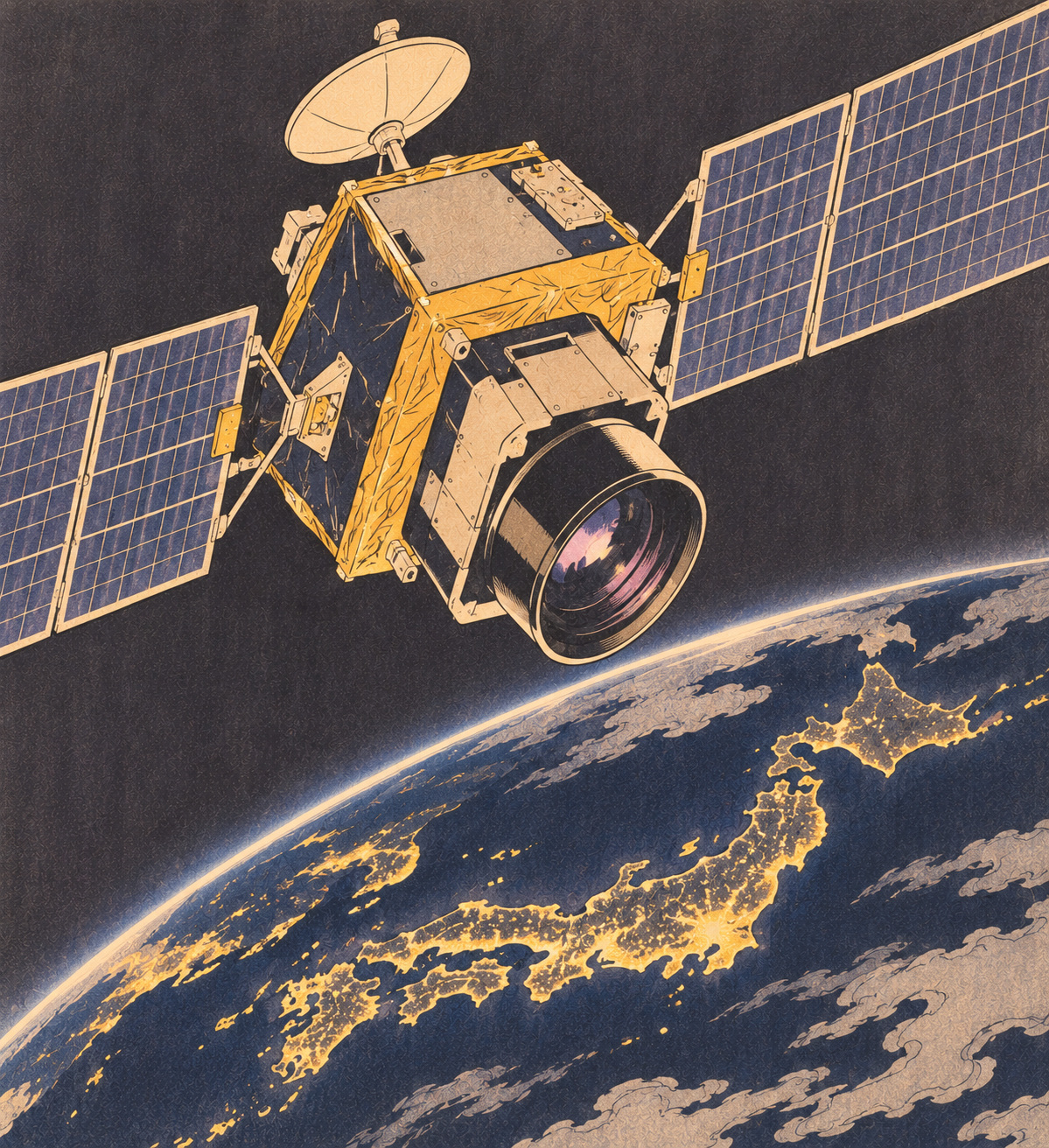
A satellite can scan an immense swath of the planet, yet a camera that cannot gather enough light may reveal remarkably little after sunset. That mismatch matters whenever the subject is a dim coastline, an infrastructure site, or a rapidly evolving emergency. Canon believes a photon-counting sensor could help narrow the gap between what satellites see by day and what optical imagers can distinguish at night.
The Japanese company announced on November 17 that its proposal for an ultra-sensitive satellite using a single-photon avalanche diode, or SPAD, had been selected under the third phase of JAXA’s Space Strategy Fund. The official selection register dates the notice and public listing to November 13. The ambition is high-resolution color Earth observation across morning, daytime and nighttime, demonstrated in orbit.
This is a development-project selection, not the announcement of a working satellite or a successful nighttime image from space. Canon and its partners must still build the relevant hardware, launch it, obtain measurements and show that the data are useful.
A collaboration that runs from the detector to the end user
Canon Inc. is the lead organization. Canon Electronics brings experience designing small spacecraft through the CE-SAT series, while Tenchijin Inc. and Marble Visions Inc. are named partners for satellite-data processing and application trials. The arrangement reflects a practical challenge: making a sensitive camera is only one step toward delivering trustworthy Earth-observation information.
The company identifies an intended support window running from January 2027 through December 2032. It explicitly qualifies that window: initial subsidy support extends from the grant decision to the fiscal year in which the first stage-gate assessment is completed, and later support can change with evaluations.
A domestic Japanese launch is planned, but the release does not identify a launch provider, launch date, orbital altitude, pixel count for the flight sensor, ground sample distance or project-specific funding amount. Those are important unknowns, not details to be filled in from earlier Canon cameras.
What is a single-photon avalanche diode?
Conventional CMOS image sensors convert incoming light into electric charge and accumulate that charge during an exposure. A SPAD pixel operates in a different regime: it detects the arrival of individual photons using avalanche multiplication. Very small light signals can therefore become detectable events, creating opportunities for imaging in conditions that defeat conventional systems.
The distinction is not magic. If little light reaches a spacecraft, the system must still contend with photon statistics, lens aperture, exposure duration, motion across the ground, sensor noise and data-processing tradeoffs. No device can create accurate detail that was never optically captured.
Canon also emphasizes dynamic range. A night image may contain a brightly illuminated harbor and almost unlit adjacent terrain. Preserving detail in both areas requires more than sensitivity alone. The proposed new sensor is intended to improve both the minimum illumination needed and the separation of dark and bright content within one frame.
From a 2021 SPAD milestone to a satellite proposal
In December 2021, Canon described a compact 3.2-million-pixel SPAD sensor designed for high-resolution color imaging under extremely low illumination. The company later documented the pixel architecture and its ability to count photon events, while noting performance figures from controlled tests.
In 2023, Canon announced development of the MS-500 ultra-high-sensitivity interchangeable-lens camera, joining the SPAD sensor to a long-range broadcast lens for applications such as viewing vessels in dark coastal waters. The work brought photon-counting technology closer to practical imaging equipment.
Translating a ground camera into a space camera is not straightforward. A fast-moving orbital platform has a narrow opportunity to collect light over each patch of terrain. Radiation, thermal cycling, mechanical alignment, power demand and downlink limitations introduce problems that do not disappear because a sensor worked well in a laboratory or a harbor.
The other half of Canon’s history is already in orbit
Canon Electronics launched the CE-SAT-I microsatellite from India in 2017, and Canon’s account reports that the satellite successfully reached its planned orbit. Roughly half a meter wide and 85 centimeters tall, it combined camera technology with the engineering needed to point, operate and communicate from space.
The CE-SAT program built upon the group’s existing capabilities in optics, motors, miniaturization, electronic systems and manufacturing. Those capabilities help explain why Canon is positioned to consider a vertically integrated project stretching from a detector to a satellite platform.
The history is relevant, but should not be mistaken for proof of the new instrument’s performance. CE-SAT was a separate satellite effort. The orbital demonstration in the newly selected program remains to be accomplished.
Nighttime Earth observation did not begin in 2026
Satellites have photographed and measured Earth at night for decades. Meteorological and environmental systems have mapped city lights and other nighttime emissions, providing insights into electricity access, settlement patterns and natural or human-made events. Radar satellites, meanwhile, can acquire imagery without depending on sunlight in the same way as optical cameras.
The proposed Canon advance is narrower and more technically meaningful than a claim to invent nighttime imaging: it seeks improved high-resolution color optical observation under very low light, while retaining detail across strong illumination contrasts. The eventual value will depend on comparisons with real existing systems under defined conditions.
Optical sensing still faces clouds and atmospheric limitations. A SPAD instrument is not radar, does not see through thick clouds, and cannot guarantee useful scenes at every time or place. These distinctions matter particularly in disaster reporting, where the temptation to promise all-weather coverage is strong.
Where greater nighttime sensitivity could make a difference
Canon names disaster risk reduction, infrastructure monitoring and maritime observation as prospective application areas. Additional usable optical information after dark could prove valuable when an emergency occurs overnight or when operators need to examine a dimly lit coastal facility.
But sensitivity is not the same as availability. An orbiting satellite must be in the right place; clouds must cooperate; its imaging task must be scheduled; and data must be transmitted, processed and delivered before it can support a decision. A single satellite cannot provide uninterrupted live video of an arbitrary location.
Similarly, a satellite that resolves an object does not automatically classify it correctly. Ship identification, detection of changes in infrastructure and assessment of disaster impacts require algorithms, validation data and clear criteria for false alarms. Canon has not released orbital performance figures showing how well the proposed system meets those tasks.
Why the two data partners matter
Getting photons onto a sensor is an engineering accomplishment. Turning the result into information people can trust is a different discipline. Images must be calibrated, aligned geographically, corrected for sensor characteristics and interpreted in the context of changing illumination and weather.
Tenchijin and Marble Visions are designated collaborators for data processing and use-case demonstrations. Their inclusion suggests the consortium is thinking beyond the satellite as a piece of hardware, although the release does not assign each partner a comprehensive commercial role or report completed demonstrations.
Canon envisions possible businesses involving sensors and camera modules, spacecraft development and supply, and services built around satellite data. Which of these can support sustained demand will depend on cost, reliability, customers and the quality of the eventual observations.
What the Japanese public funding decision actually means
JAXA administers the Space Strategy Fund as part of Japan’s efforts to advance space technology and build industrial capacity. Canon was selected under a third-phase theme concerning optical and quantum sensing for satellite applications. The official project title highlights high-resolution color imaging during morning, day and night as well as an orbital test.
The selection signals that the project qualified for the program’s evaluation process; it does not mean all requested money has been disbursed or that every performance target has been achieved. Stage-gate assessments are a substantive feature of the announced timeline.
Industrial success will be measured differently from a scientific milestone. A sensor can perform impressively in a test while the resulting service remains expensive or commercially narrow. Conversely, a modest but dependable improvement in difficult nighttime scenes could have real value to specialized customers.
The measurements that will decide whether it works
The next evidence to watch includes the planned sensor’s illumination threshold, dynamic range, radiation tolerance and calibration stability. Later milestones would include launch, commissioning, verified night imagery and trials showing whether imagery improves a real monitoring workflow.
Impressive color images will not be enough on their own. Potential users need numbers: ground resolution, swath, revisit intervals, latency, cloud-related availability, illumination conditions, false-detection rates and costs. Without these, comparisons to existing optical and radar offerings are largely speculative.
Canon spent generations building tools to capture light in controlled and uncontrolled environments. Its proposed space project asks whether that expertise can now reveal more of the planet when light is scarce. The selection is a significant opening move; the proof must come from the images and operational measurements that follow.
Primary sources and reporting limitations
This independently prepared analysis is based on Canon’s November 17 announcement, JAXA’s November 13 listing and Canon’s official technology and satellite histories. We have not inspected flight hardware, interviewed the project team or validated orbital images. Undisclosed budgets, launch dates and performance specifications have not been inferred.
- Canon: November 17 announcement of SPAD satellite development and orbital demonstration
- JAXA Space Strategy Fund: selection record, notification and announcement on November 13
- JAXA: November 2026 implementation-body selection notice
- Canon: 2021 announcement of a 3.2-million-pixel SPAD sensor
- Canon: SPAD sensor technology and photon-counting principles
- Canon: 2023 development of MS-500 ultra-high-sensitivity camera
- Canon: satellite development and the 2017 CE-SAT-I milestone
- Canon: history and technical background of CE-SAT-I
- JAXA Space Strategy Fund: selected projects and program status
- NASA Earth Observatory: history and examples of satellite nighttime imaging