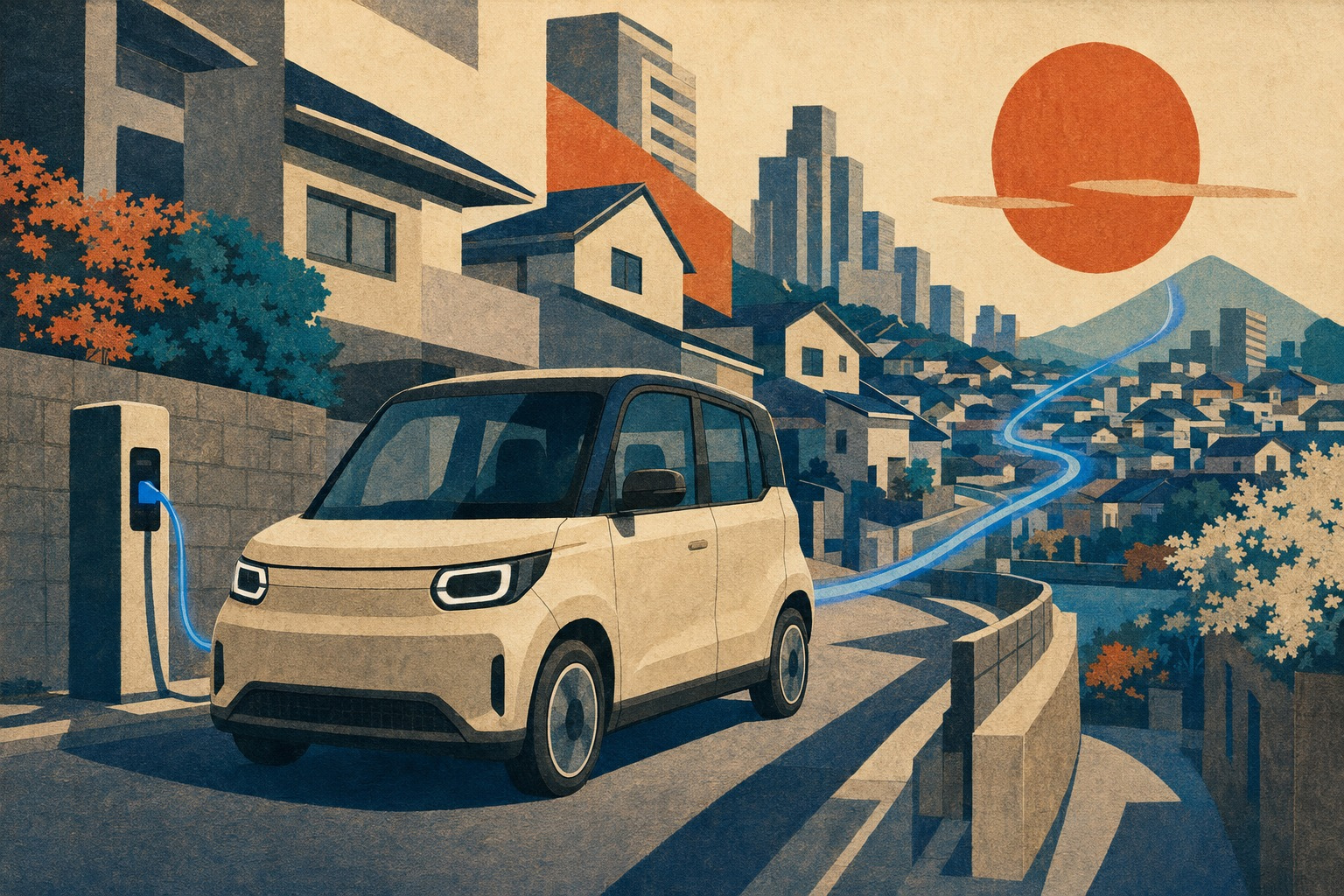
Five millimeters remain. BYD’s new Racco electric minicar is 3,395 millimeters long and 1,475 millimeters wide—just 5 millimeters inside Japan’s kei-car ceilings of 3.40 meters and 1.48 meters in each direction. It stands 1,800 millimeters high. The name evokes a friendly sea otter; the packaging is predatory. BYD has taken the small box created by Japan’s law and taxation and filled nearly every available line with passenger space and battery.
BYD Auto Japan began sales through authorized dealers on July 28. This is a four-seat, front-wheel-drive, super-tall wagon designed only for Japan. Both rear doors slide electrically. Its front motor produces 47 kilowatts and 160 newton-meters. A parent can put a child into a seat without swinging a door into the neighboring car; an older passenger can step through a large opening in the rain. These are not incidental details. They are the daily rituals refined by Japan’s most successful domestic kei cars.
This is not a Chinese-market city car trimmed to fit an export order. BYD says the chassis, body, drive system and controls were newly designed, making it the first dedicated kei EV from an overseas automaker. It also calls the Racco the world’s first software-defined kei vehicle, able to update functions wirelessly. Those are BYD’s “first” claims, not independent certifications. Yet the underlying decision matters: a global manufacturer has treated kei not as a short-lived derivative but as a strategic product category of its own.
Three Raccos, Two Batteries
The base Racco 200 carries a 22.4-kilowatt-hour lithium iron phosphate battery and is rated for 210 kilometers on Japan’s WLTC cycle. The 300 Plus and 300 Premium use 35.84 kWh packs and claim 320 kilometers. The 200 accepts up to 3 kW on AC and 37 kW at a DC fast charger; the 300 models raise those figures to 6 kW and 49 kW. Heating, air conditioning, highway speed, cold weather, hills and payload will all reduce real range, so 320 kilometers must not be read as a promise. Even so, fitting 35.84 kWh into a kei footprint materially lowers the psychological barrier to an occasional longer trip.
The battery is BYD’s lithium iron phosphate “Blade Battery.” Compared with nickel-rich chemistries, LFP generally gives up some energy density in exchange for lower material cost, long cycle life and thermal stability. In the Racco, BYD bases its package on cell-to-body engineering and a model-specific “X-PACK” that integrates the battery, power conversion and control systems. The company says about 70 percent of the body uses high-strength steel.
Battery-capacity coverage lasts eight years or 160,000 kilometers and guarantees at least 70 percent of initial capacity. A ¥18,000 extension takes that to ten years or 200,000 kilometers. General vehicle coverage and major components associated with driving, steering and braking are covered for six years or 150,000 kilometers; roadside assistance also runs for six years. For an unfamiliar brand, warranty is not merely after-sales service. It is a sales instrument that turns “What if the battery degrades?” and “Will parts arrive?” into dates and odometer readings.
| Vehicle | Tax-included / after national subsidy | Battery and rated range | Charging headline |
|---|---|---|---|
| BYD Racco 200 | ¥2,145,000 / ¥1,995,000 | 22.4 kWh / 210 km WLTC | 3 kW AC / 37 kW DC |
| BYD Racco 300 Plus | ¥2,398,000 / ¥2,248,000 | 35.84 kWh / 320 km WLTC | 6 kW AC / 49 kW DC |
| BYD Racco 300 Premium | ¥2,497,000 / ¥2,347,000 | 35.84 kWh / 320 km WLTC | 6 kW AC / 49 kW DC |
| Nissan Sakura S | ¥2,448,600 / ¥1,868,600 | 20 kWh / 180 km WLTC | Up to 30 kW DC |
The after-subsidy column mechanically subtracts only the national incentive. It does not normalize equipment, dealer fees, discounts or municipal programs. Before assistance, the Racco 200 is ¥303,600 cheaper than the Sakura S. Under the fiscal 2025 supplementary CEV program, however, the Racco receives ¥150,000 while the Sakura receives ¥580,000. The Sakura therefore ends up ¥126,400 cheaper. BYD has cut the sticker price, but it cannot erase the industrial-policy difference behind the subsidy.
A Social Dimension Created in 1949
“Kei” means light, but Japan’s kei car is more than a low vehicle weight. It is a legal category that folded postwar income, roads, taxation and industrial development into one set of dimensions. The category appeared in vehicle regulations in 1949. Its initial one-meter width and four-stroke engine limit of 150 cubic centimeters were so restrictive that a practical mass-produced four-wheeler was difficult to build.
A 1954 revision removed the separate two- and four-stroke limits. From April 1955, three- and four-wheeled vehicles were unified at three meters long, 1.3 meters wide and 360 cc. Suzuki launched the front-wheel-drive Suzulight that October, helping begin Japan’s minicar age. In 1958, Fuji Heavy Industries drew on its aircraft heritage to release the Subaru 360. A light monocoque body carried four adults and put the dream of a “people’s car” onto ordinary Japanese roads.
Narrow farm lanes and shopping streets, small household parking spaces and still-low incomes imposed constraints. Japanese makers turned them into expertise. Engines moved sideways; wheels went to the corners; floors dropped and roofs rose. The kei car evolved from a cheap small vehicle into a form of industrial design that maximized daily life inside a fixed exterior.
The box grew with society. In 1976, the limit became 3.2 meters by 1.4 meters and 550 cc. In 1990, length became 3.3 meters and displacement 660 cc. A safety-driven revision in 1998 established today’s 3.4-meter length and 1.48-meter width. The Racco’s 3,395-by-1,475-millimeter plan is drawn almost to the edge of graph paper created across seven decades.
1949 — The legal kei-vehicle category is established.
1955 — Rules converge at 360 cc, 3 meters long and 1.3 meters wide; Suzuki launches the Suzulight.
1958 — The Subaru 360 becomes an emblem of the Japanese people’s car.
1976 — The category expands to 550 cc, 3.2 meters and 1.4 meters.
1990 — The engine ceiling becomes 660 cc and length 3.3 meters.
1998 — Today’s 3.4-meter length and 1.48-meter width take effect.
2009 — Mitsubishi launches the mass-produced i-MiEV.
2022 — Nissan Sakura and Mitsubishi eK X EV bring kei EVs to a broad market.
2026 — BYD launches what it calls the first foreign automaker’s dedicated kei EV.
Why This Is a Kingdom, Not a Niche
Kei is not the edge of Japan’s automobile market. The Honda N-Box was the country’s top-selling kei model in 2025 with 201,354 units; Suzuki’s Spacia followed with 165,589. Reuters describes kei vehicles as roughly one-third of Japanese auto sales. At the end of 2024, Japan held 32,108,227 kei four-wheelers—54.46 for every 100 households.
Japan’s national kei association says 64 percent of passenger-kei users are women and 43 percent are at least 60 years old. Ownership rises where public transportation is hard to use. Kei trucks enter fields, vans complete the last kilometers of parcel delivery, and tall passenger models take a child to school and a parent to a clinic on the same day. Their rival is often not a train. It is the inability to travel at all.
This pattern can favor electricity. Short daily trips, a car that returns home at night, low annual mileage and quiet acceleration let a small battery perform useful work. Japan’s Agency for Natural Resources and Energy says filling stations continue to disappear because fuel demand is falling and owners cannot find successors, leaving some communities without a nearby pump. A driver with home charging can “refuel” while asleep. The Racco’s vehicle-to-load function can also power appliances during a blackout.
But a detached house able to install a 200-volt charger is not an apartment or rented parking space. Cold weather, cabin heat, mountain roads and expressways reduce range. Rural users may travel farther and have fewer alternatives if the car cannot go. “Is an EV right for the countryside?” has no universal answer. It depends on access to charging and the route, not on the yellow license plate alone.
Japan Opened This Electric Road First
The marriage of kei and electricity is not BYD’s invention. Mitsubishi Motors began EV research in 1966 and produced the Minica Van EV in 1971. In 2009 it launched the i-MiEV, based on the kei-class “i,” initially for fleets. Mitsubishi calls it the world’s first mass-produced electric vehicle. It was expensive and its range limited, but it previewed the present EV routine: a battery under the floor, charging at home and DC fast charging on the road.
In 2022, Nissan’s Sakura and its Mitsubishi sibling, the eK X EV, broadened the market. The Sakura won Japan Car of the Year and showed that 20 kWh could be enough for a daily second car. Japan registered 14,093 Sakuras and 1,442 eK X EVs in 2025. Both totals declined from a year earlier, but they remained central to the country’s electric-car market.
The Racco 200 pushes that idea through price and equipment. The 300 asks a different question: must a kei EV be a neighborhood-only car? It combines 320 kilometers of rated range, 49 kW fast charging, power sliding doors on both sides, a 10.1-inch screen, driver assistance, an NFC phone key and battery preconditioning. That specification is aimed not only at Sakura prospects but at people replacing gasoline-powered N-Boxes, Spacias and Tantos.
BYD Sells a Battery; the Customer Chooses a Dealer
BYD began as a battery company in 1995, entered automobiles and vertically integrated cells, motors, power semiconductors and vehicles. It built scale in China and carried LFP batteries and lower-priced EVs overseas. The company announced its Japanese passenger-car entry in 2022 and began selling the Atto 3 in 2023.
Yet BYD had sold only a little more than 7,400 cars in Japan by the end of 2025, including 3,742 that year. A target of 10,000 Racco orders in the five remaining months of 2026 is larger than BYD’s previous annual business in the country by itself. BYD Auto Japan President Atsuki Tofukuji told Reuters that the goal came more from resolve and instinct than a detailed market model. From 2027, he said, about one order per dealer per day could sustain annual sales near 10,000.
The arithmetic is easy; the retail counter is hard. BYD advertises a network of more than 70 dealers. Nissan, Honda, Suzuki and Daihatsu have sales companies, workshops, courtesy cars, parts logistics and used-car appraisal relationships reaching small cities and towns. A kei buyer chooses not just a range figure but a place to change winter tires, conduct the mandatory inspection, repair crash damage, diagnose the battery and trade the car several years later.
The Racco’s long warranty and balloon loan target that weakness precisely. A deferred balance of 50 percent lowers the advertised monthly payment and shifts some uncertainty about a Chinese car’s future resale value into a financial contract. But BYD’s own note says the residual is not unconditionally guaranteed at the end. Mileage, vehicle condition and final settlement rules still matter.
The ¥430,000 Subsidy Gap Is Industrial Policy
Japan’s CEV subsidy is not a simple percentage of battery capacity. Evaluation reaches beyond vehicle performance into charging support, maintenance, cybersecurity, parts supply, disaster cooperation and manufacturing decarbonization. The Sakura’s ¥580,000 and the Racco’s ¥150,000 show that two electric kei cars can receive very different policy treatment.
For a shopper, that difference turns a Racco 200 that is roughly ¥304,000 cheaper before assistance into a car about ¥126,000 more expensive than the Sakura S afterward. Municipal incentives—especially Tokyo’s—can move the result again. BYD’s price competition therefore depends not only on factory cost and the exchange rate, but on how deeply it builds Japanese charging, repair, battery recovery and disaster-response systems.
The difference is not guaranteed forever. Subsidies change with budgets, fiscal years and evaluation rules and may end when funds are exhausted. A household keeping a car for five to ten years should care more about total ownership cost: electricity, insurance, tires, repairs, degradation and resale. Whether BYD’s generous written warranty arrives with fast repairs and available parts is something only post-launch service can prove.
A Software-Defined Kei Car Keeps Changing After Sale
The Racco can update software over the air. If BYD can improve charging management, interfaces and driver assistance after delivery—not just maps and entertainment—the ownership model changes. Fixing a non-safety defect without a dealer visit would also help a company whose physical network remains relatively small.
But “a car like a smartphone” carries the smartphone’s liabilities. An update can alter a familiar control or introduce a bug. A communications standard may close; a server shutdown may remove a function. Where is vehicle data sent, in which country is it processed, and can the owner refuse an update? How are intrusions detected, and for how many years will security patches arrive? For a long-term owner, the support-end date and data terms matter more than a marketing “world first.”
BYD also says it developed the Racco with the goal of achieving the top level in Japan’s J-NCAP safety assessment. At launch, it did not say that the vehicle had already received that rating. Roughly 70 percent high-strength steel, six airbags, child-presence detection, surround monitoring and driver assistance are relevant features; they are not a substitute for a published independent crash-test result.
- Can the car charge reliably at home or work most nights?
- Is there a reserve for the longest routine trip in winter, with heat and expressway driving?
- What national and municipal subsidies apply on the registration date?
- Where is the nearest service center, crash-repair facility and courtesy car?
- What inspections and exclusions govern the eight-year battery-capacity warranty?
- What are the balloon loan’s final payment, mileage and damage-settlement rules?
- What speed, price and congestion should be expected from public fast charging?
- Where are app and vehicle data stored, and how many years will OTA support last?
- How does the Racco compare when an independent J-NCAP result appears?
Five Numbers That Will Decide the Result
First is registrations, not orders. Compare the 10,000-order target with cars actually delivered after cancellations. Second is monthly sales per outlet. If the president’s “one a day” persists across more than 70 dealers, supply and regional variation will quickly matter.
Third is conquest beyond the Sakura: how many gasoline-kei owners switch? If BYD merely divides the existing pool of EV buyers, its effect on Japan’s electrification will be modest. Fourth is time in the workshop—warranty repairs, parts waits and measured battery capacity. Fifth is the three-year used price. A kei car is a household asset; residual value converts brand trust into a number.
The Sakura’s 14,093 registrations in 2025 make BYD’s five-month order goal audacious. Against the N-Box’s 201,354, however, it remains a beachhead. To unsettle domestic makers, BYD must do more than win one comparison of rated range. It must accumulate a reputation through several winters, inspections, crash repairs and used-car transactions.
Five Millimeters of Space, Seventy Years of Resistance
The Racco reads Japan’s rules well. Its footprint brushes the legal maximum. The roof rises, the doors slide, the battery lies beneath the floor, a phone opens the car and the car can power appliances in an outage. From the outside, BYD has produced something remarkably fluent in the language of “kei.”
Yet kei is not a market entered by passing a dimensional inspection. In the 70 years since the Suzulight and Subaru 360, manufacturers, affiliated dealers, repair shops, municipalities, farmers, shopkeepers and families created a bundle of institutions and habits. The Nissan Sakura has already put electricity into daily life, supported by a national dealer network and a larger subsidy.
The Racco’s real novelty is therefore not that a Chinese company squeezed in a larger battery. It is that one of the world’s biggest EV manufacturers has recognized Japan’s smallest domestic category as a central market worth a dedicated platform, local price, growing retail network and long warranty.
Engineering has already placed the car inside the last 5 millimeters. Now BYD has to place itself inside Japanese routines and trust. Whether the Racco becomes a member of the kei family or remains a fascinating imported EV will be decided less at the end of its 320-kilometer rated range than by the distance to the nearest service bay—and what happens after the first fault light comes on.
Reporting Notes and Principal Sources
This article uses BYD, Nissan, Mitsubishi Motors, Japan’s Light Motor Vehicle Inspection Organization, the Japan Light Motor Vehicle and Motorcycle Association, the Agency for Natural Resources and Energy, Subaru, Suzuki and Reuters material available by July 29, 2026, 11:30 a.m. JST. WLTC range is a test value, not a guarantee. Prices and subsidies can vary by registration date, region, budget availability, equipment and fees. “First dedicated kei EV from an overseas automaker,” “first SDV-based kei EV” and the goal of top-level J-NCAP performance are BYD descriptions and are distinguished from completed independent certification.
- BYD Japan: Racco launch, prices, warranties and engineering
- BYD Racco official site: equipment, network and daily use
- Impress Watch: Racco body, X-PACK and safety design
- EVsmart: battery capacities and charging performance
- Reuters: order target, Japan sales, competition and subsidies
- Light Motor Vehicle Inspection Organization: origin and evolution of kei rules
- Subaru: the Subaru 360 and Japan’s people’s-car history
- Suzuki: corporate history and the 1955 Suzulight (PDF)
- Japan Light Motor Vehicle and Motorcycle Association: 2025 model sales
- Japan Light Motor Vehicle and Motorcycle Association: household ownership (PDF)
- Japan Light Motor Vehicle and Motorcycle Association: users and regional mobility (PDF)
- Nissan: 2026 Sakura price, battery and rated range
- Nissan: Sakura CEV subsidy
- Mitsubishi Motors: ten years of the i-MiEV
- Agency for Natural Resources and Energy: communities without nearby filling stations