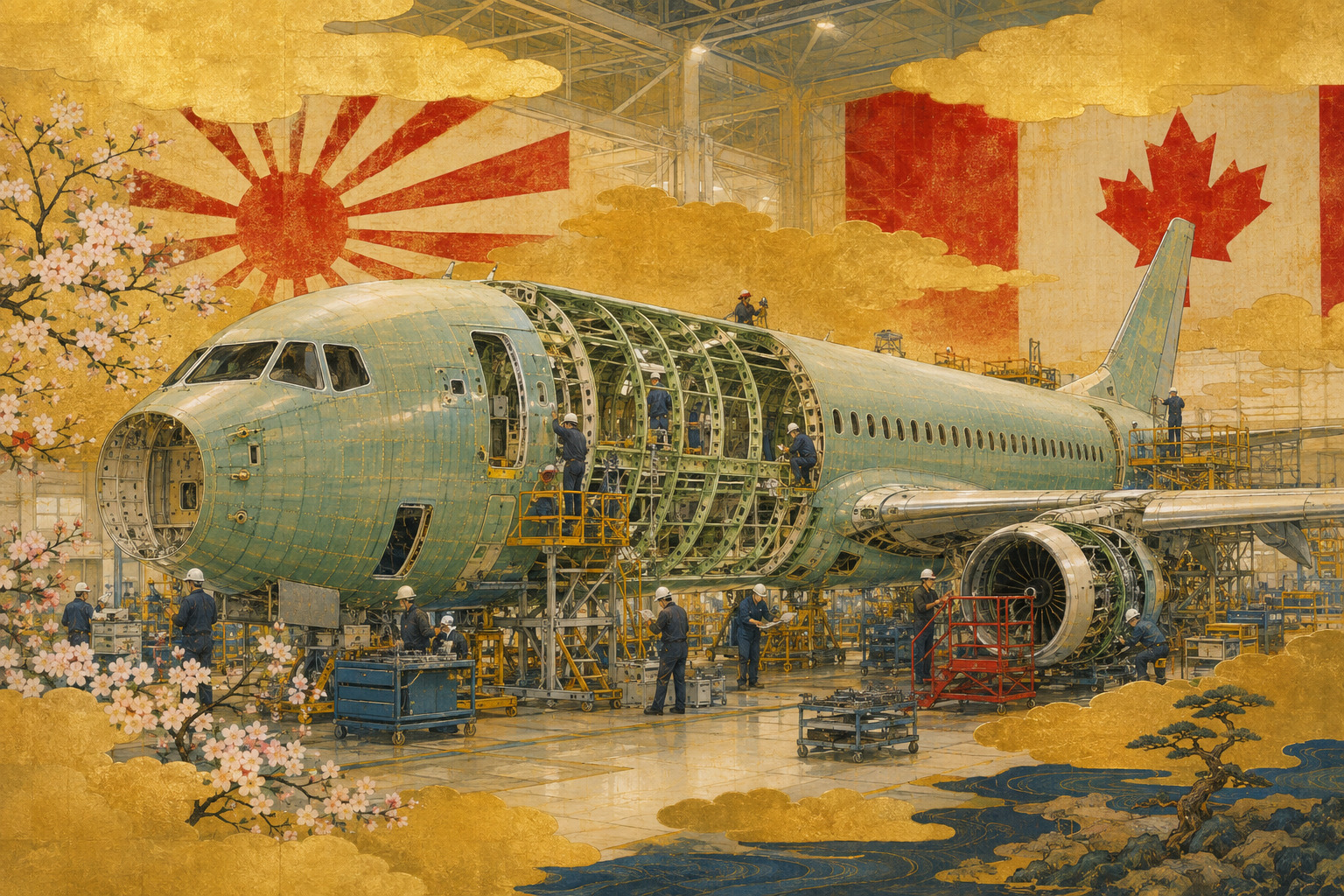
A wing can travel through several companies before it ever carries an aircraft. Design authority may sit with the plane maker, subassemblies may begin in another country, and a specialist supplier may join, seal, wire and test the structure before it reaches final assembly. Bombardier's latest acquisition is about shortening that chain at one of its most consequential points.
Bombardier Inc. and Mitsubishi Heavy Industries, Ltd. have agreed that Bombardier will acquire assets of MHI Canada Aerospace, Inc., or MHICA, in Mississauga, Ontario. Announced on September 1 in Canada and September 2 in Japan, the transaction is expected to close later in 2026, subject to regulatory approvals and customary conditions. The price and other terms remain confidential.
The acquisition is expected to bring MHICA's aerostructures capability and approximately 750 employees into Bombardier. The operation supports the Global 5500, Global 6500 and Challenger 3500 business-jet programs with work that includes wing assemblies, fuselage sections, systems installation, flight-control installation and testing. MHICA says its footprint includes a 270,000-square-foot manufacturing plant and a 70,000-square-foot logistics center coordinating material from more than 30 North American supply-chain partners.
MHI will provide transitional support for an interim period. The companies say their shared objective is to preserve continuity for employees, the Mississauga operation and the aircraft programs while ownership changes.
From buying wings to controlling their production
Aerostructures are not interchangeable shells. A wing carries aerodynamic loads, houses fuel and incorporates control surfaces, wiring, hydraulics and other systems. The center fuselage transfers loads between major sections of the aircraft. Tight tolerances, sealing, structural joining, systems installation and functional testing must converge before a completed structure can move to the next station.
That makes an aerostructures supplier both a source of expertise and a potential production gate. A late component can delay an assembly, but so can a tooling problem, a quality escape, a shortage of skilled labor or a mismatch between the supplier's schedule and the final line. When demand is strong, the cost of that lost time grows.
MHICA is not an unfamiliar target. It has worked on Bombardier aircraft for decades. Bringing it inside the company could make engineering changes, production sequencing, inventory decisions, quality response and workforce planning easier to coordinate. Bombardier may gain earlier visibility into bottlenecks and align wing and fuselage work more directly with aircraft delivery schedules.
Vertical integration does not remove risk; it changes who carries it. Bombardier would absorb fixed costs, capital requirements, working inventory, labor relations and responsibility for execution. If business-jet demand weakens, capacity cannot simply be pushed back onto a supplier. Because the purchase price, assumed obligations and investment plan have not been disclosed, outsiders cannot yet measure the financial return expected from that control.
An operation that began inside Bombardier
The history makes the transaction look less like the purchase of a stranger than the return of a function that gradually developed outside the customer. MHI says the operation began in 1996, when it organized independent contractors inside a Bombardier facility to complete and resolve outstanding work on products shipped from Japan.
MHI incorporated MHICA in Ontario in 2006. A year later, the company obtained a 90,000-square-foot facility and began assembling Global wings, integrating center fuselages and installing systems on structures sourced from MHI in Japan. Challenger-series wing assembly and systems installation followed in 2008. Growth led to a move from Meadowvale to the larger Mississauga operation in 2012.
MHICA therefore grew around a specific industrial bridge: MHI's structural manufacturing knowledge on one side and Bombardier's aircraft programs on the other. Its current product page centers on Bombardier's Global 5500/6500 and Challenger 3500. When a supplier's people, processes and output are already deeply dedicated to one customer, ownership by that customer can become more logical than an arm's-length relationship.
1996: MHI establishes a contractor group inside a Bombardier facility.
2006: MHI Canada Aerospace is incorporated in Ontario.
2007: Global wing assembly, center-fuselage integration and systems work expand.
2008: Challenger-series wing work is transferred to Canada.
2012: The growing operation moves to its current Mississauga facility.
2020: MHI completes its purchase of Bombardier's CRJ program.
2026: Bombardier agrees to acquire the MHICA assets tied to its programs.
Six years ago, the buyer and seller were reversed
The transaction invites an obvious comparison with the CRJ deal, but the two asset packages are fundamentally different. In June 2019, MHI agreed to buy Bombardier's Canadair Regional Jet program. The acquisition closed in June 2020 for approximately US$550 million in cash, subject to adjustments, plus MHI's assumption of roughly US$200 million in liabilities related to credit and residual-value guarantees and lease subsidies.
MHI acquired the CRJ type certificates along with maintenance, support, refurbishment, marketing, sales and a service network. It did not acquire a continuing CRJ production business in the ordinary sense. Bombardier retained the Mirabel production facility, assembled the remaining backlog for MHI and planned to end production after those aircraft were delivered.
At the time, MHI saw the CRJ support organization as complementary to the SpaceJet regional airliner it was developing. SpaceJet development was discontinued in 2023, but the CRJ aftermarket operation continues. MHI says more than 1,100 CRJs remain in service and that MHIRJ supports them through service centers, partner facilities, offices and parts depots in the United States, Canada and Europe.
The 2026 agreement does not return the CRJ type certificates or that support network to Bombardier. It transfers manufacturing capability for current Bombardier business jets in the opposite direction. The symmetry is striking, but it is not a corporate undo button.
Two deals, two different businesses
| 2020 CRJ transaction | 2026 MHICA transaction |
|---|---|
| MHI bought from Bombardier. | Bombardier is buying from MHI. |
| Type certificates, aftermarket support, parts and customer services were central. | Aerostructures production for current Bombardier business jets is central. |
| Cash consideration and assumed liabilities were disclosed. | Price and transaction terms are confidential. |
| MHIRJ continues to support the installed CRJ fleet. | About 750 MHICA employees are expected to join Bombardier. |
Why Bombardier is selectively rebuilding in-house capacity
Bombardier spent the period from 2019 through 2021 becoming a very different company. It exited regional aircraft, sold its remaining A220 interest, disposed of its rail business and transferred broad aerostructures operations in Belfast, Morocco and the United States to Spirit AeroSystems. The sprawling transportation group narrowed itself to business aircraft built around the Challenger and Global families.
Buying the Mississauga assets does not reverse that entire restructuring. Bombardier is not re-entering independent aerostructures as a broad supplier to the industry. It is acquiring an established operation directly tied to aircraft it currently designs, sells and delivers. The better description is selective vertical integration: control the production links that matter most to the remaining franchise.
The timing is supported by demand. Bombardier reported a US$21.8 billion backlog at June 30, 2026, up US$4.3 billion from the end of 2025. A strong order book creates opportunity only if the company can convert orders into completed aircraft. Wing and fuselage availability, skilled labor and production stability therefore have financial value far beyond the accounting value of factory equipment.
The acquisition also fits a wider post-pandemic aerospace lesson. Plane makers discovered that supplier distress, shortages, labor turnover and logistics disruptions could constrain output long after demand returned. Owning a bottleneck can improve visibility and response. It can also concentrate operational exposure. The test will be whether Bombardier obtains better delivery performance without allowing the acquired cost base to erode margins.
What the sale means—and does not mean—for MHI
MHI's Japanese notice is deliberately concise. It says the company will work closely with Bombardier to preserve continuity and support an orderly transfer. It also says the MHI group will continue aerospace relationships and support systems developed in Canada through other business activities. The joint English announcement adds that MHI remains committed to commercial aerospace and defense and will retain a significant Canadian presence through other operations.
Still, MHICA is a visible manufacturing platform built over three decades. After the transaction, MHI's Canadian aviation emphasis will tilt more toward CRJ aftermarket support and other aerospace and defense relationships rather than ownership of this Bombardier-dedicated assembly operation. MHI has not disclosed the expected gain or loss on sale, how it will use the proceeds, or whether the transaction changes the long-term capital allocation of its commercial aviation business.
One strategic reading is straightforward. If MHICA's main programs and customer are concentrated in Bombardier, the operation may fit more naturally beneath the aircraft maker. MHI can direct capital and management attention toward areas where it owns more of the technology, customer relationship or aftermarket economics, including CRJ support, structures for other manufacturers, engines, defense and space. That is Japan.co.jp's inference from the asset pattern, not a detailed sale rationale published by MHI.
The workforce is the capability
The approximately 750 employees are not an attachment to the factory; they are much of what Bombardier is purchasing. Aerostructures production depends on repeatable manual skill, tooling knowledge, quality discipline and the ability to diagnose variation. Drawings and machines do not automatically reproduce that experience.
The joint release says the team will join Bombardier and emphasizes continuity. That is meaningful, but it is not a public description of every employment term. The companies have not disclosed individual transfer arrangements, treatment of seniority and pensions, collective-agreement details, future staffing levels or the post-closing management structure.
Retention will matter immediately. A nominally transferred plant can lose output if experienced employees leave during uncertainty or if systems, certifications and supplier accounts do not migrate cleanly. MHI's promised interim support is designed to reduce that risk, but the duration, service scope and economics of the transition arrangement are confidential.
Five tests after signing
What Japan.co.jp will watch
- Transaction perimeter: Which plants, leases, inventory, contracts, intellectual property and obligations actually transfer?
- Workforce continuity: How many of the approximately 750 employees join, and under what terms?
- Regulatory completion: Which approvals are required, and does the deal close before year-end?
- Production performance: Do delivery timing, quality and cost improve across the Global and Challenger programs?
- Financial return: What do later filings reveal about consideration, integration costs and capital spending?
Aircraft brands sit on the nose and tail, but delivery schedules are governed by a network of structures, engines, landing gear, electronics and specialized labor. The stronger demand becomes, the more leverage any single delayed link acquires. Bombardier's decision is a wager that one such link should no longer sit beyond its corporate boundary.
For MHI, the agreement changes ownership without ending the relationship. The company that once worked inside Bombardier's plant, then built a Canadian supplier around Bombardier programs, will help transfer that capability back to the customer while continuing other Canadian aviation work. For Bombardier, the acquisition marks another stage after retrenchment: not rebuilding the old conglomerate, but taking selective control of the industrial machinery behind its surviving franchise.
The announcement is only the beginning. Success will not be measured by the number of square feet acquired. It will be measured by whether wings move on schedule, workers carry their knowledge across the legal boundary, supply disruptions diminish and a US$21.8 billion backlog becomes delivered aircraft.
Primary documents and reporting
- Mitsubishi Heavy Industries, Japanese notice of the subsidiary asset-transfer agreement — September 2, 2026; authoritative Japanese description of scope.
- MHI and Bombardier joint announcement — Workforce, transitional support, expected closing and confidential terms.
- Bombardier, “Bombardier to Acquire MHICA Assets in Mississauga” — Buyer's official announcement.
- Japan External Trade Organization report on the transaction — Japanese public-sector reporting on programs, work scope and history.
- MHI Canada Aerospace, “Our Background” — Official history from 1996 through the Mississauga move.
- MHI Canada Aerospace, “Products and Services” — Manufacturing footprint, logistics center, processes and supply-chain network.
- MHI, 2019 agreement to acquire the CRJ program — Original scope, consideration and production arrangements.
- Bombardier, closing of the CRJ sale — June 1, 2020.
- MHI, current CRJ program overview — Installed fleet and MHIRJ support network.
- Bombardier, closing of the 2020 aerostructures sale to Spirit AeroSystems — Historical restructuring context.
- Bombardier, completion of its strategic exit from the A220 program — February 2020.
- Bombardier, closing of the Transportation sale to Alstom — January 2021.
- Bombardier second-quarter 2026 results — Backlog at June 30, 2026.
- MHI, discontinuation of SpaceJet development activities — February 7, 2023.
Reporting note: This report is based on material available through 6:30 a.m. JST on September 5, 2026. Japanese primary sources were used to verify the official company descriptions, transaction scope and Japanese terminology. The Japanese and English editions were written independently. Strategic interpretations are identified as Japan.co.jp analysis, and an asset purchase is not described as an acquisition of the entire MHICA legal entity.
Image rights: © 2026 Japan.co.jp. This AI-assisted editorial illustration may not be reproduced or reused without permission. For licensing, visit the contact page.