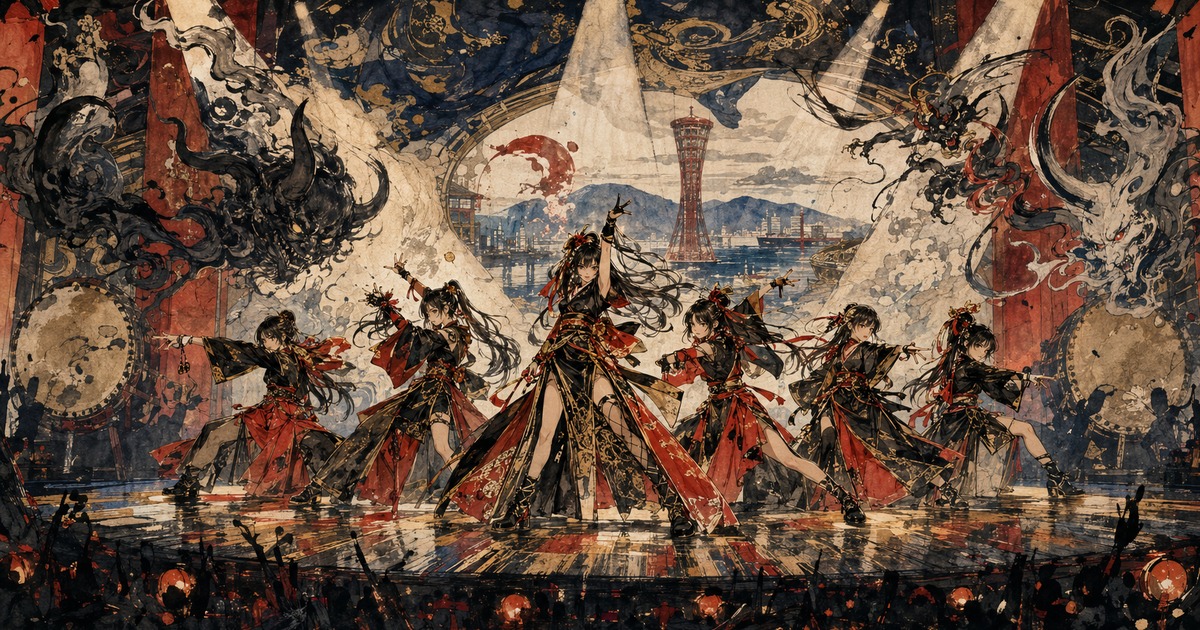
At 6 p.m. on Tuesday, the lights are scheduled to fall inside Marine Messe Fukuoka Hall A, near the wharves of Hakata Port. A second concert begins at the same hour on Wednesday. Doors open at 5 p.m. for both. After launching the tour with three Seoul performances from June 26 through 28 and beginning its Japanese run in Kobe, BABYMONSTER’s 2026–27 World Tour, “춤 (CHOOM),” has reached Kyushu.
This is a same-day preview, not a review written after the fact. Japan.co.jp’s reporting cutoff is 10:29 a.m. Japan Standard Time on July 28; the first Fukuoka concert has not yet begun. Dates, venue, prices and the tour route therefore come from official announcements. Discussion of songs and production describes the structure documented at the Seoul opening and treats it as a likely frame, not a promise that Fukuoka will reproduce every cue or sequence.
The importance of the two nights is already visible. BABYMONSTER ended its first Japan tour at Fukuoka International Center on April 19 and 20, 2025. YG Entertainment said that ten-show run drew a cumulative 150,000 people. Fifteen months later, the group is back at Marine Messe, a venue with a maximum theater-style capacity of 15,000, and is heading toward two Kyocera Dome Osaka dates in September. Fukuoka has become a measuring point on a steep curve from fan meetings to arenas to a first Japanese dome concert.
Why Fukuoka matters
Fukuoka is not merely the next city after Tokyo and Osaka. It is a port whose traffic in people, goods and language has connected the Japanese archipelago with the Asian continent since antiquity. The Fukuoka Prize, established by the city and local institutions, explicitly describes Fukuoka as a historic gateway for exchange with Asia. Modern flights, ferries, tourism and food culture make the border with Korea feel less like an abstract line than a repeated journey.
Marine Messe Fukuoka opened in 1995 for that year’s Summer Universiade. Hall A is now a flexible site for exhibitions, sports and concerts; official convention information lists a maximum theater-style capacity of 15,000. A stage, runway, production equipment and blocked sightlines reduce the sellable number for any specific concert, so two dates should not automatically be reported as 30,000 attendees.
Even with that caution, the move from Fukuoka International Center in 2025 to Marine Messe in 2026 is a clear increase in scale. The group is returning to last year’s finish line and turning it into a central stop on a larger tour. For fans, the visit is a reunion. For the promoter, it is a test of whether demand in Kyushu and western Japan can be repeated and enlarged rather than merely celebrated once.
“춤” puts the body before the explanation
The tour title “춤”—romanized here as CHOOM—is the Korean word for dance. YG released the third mini album of the same name on May 4 and described its subject as the moment music and dance become one. The title track is built around a bouncing synth figure and heavy percussion. “MOON” provides a darker hip-hop opening; “I LIKE IT” uses a country-colored guitar riff for a brighter dance song; “LOCKED IN” shifts the focus toward R&B voices.
YG said CHOOM sold approximately 750,000 copies in about eight days, according to its internal count. That is a company announcement, not identical to independently audited, market-wide data. Still, its reported early performance above the 552,837 first-week sales of the previous mini album, WE GO UP, helps explain why the group’s touring footprint and its physical-album economy are expanding at the same time.
“SUGAR HONEY ICE TEA” followed in June, and the “I LIKE IT” video arrived in July after the song’s first live presentation at the Seoul concerts. The tour is therefore not a retrospective of a finished catalog. It is an active product into which new music keeps arriving. The Seoul opening moved from “WE GO UP” through “CHOOM,” “BATTER UP” and “DRIP,” then into “MOON,” “CLIK CLAK,” “SHEESH” and “PSYCHO.” Solo performances, a ballad medley, recent summer songs and remixed encores changed the pace.
- Opening pressure: “WE GO UP,” “CHOOM,” “BATTER UP” and “DRIP” place the tour’s declaration beside the group’s biggest calling cards.
- A darker center: “MOON,” “CLIK CLAK,” “SHEESH” and “PSYCHO” concentrate the bass, rap and dramatic switches associated with YG production.
- Individual outlines: Solo covers selected and shaped with member input let distinct performers emerge from the machinery of the group.
- Space for voices: A medley including “Stuck in the Middle,” “Love, Maybe” and “DREAM” moves singing outside the heaviest choreography.
- The 2026 present: “SUGAR HONEY ICE TEA” and “I LIKE IT” keep the show from becoming a fixed replay of older hits.
Note: This describes the Seoul opening and does not guarantee Fukuoka’s exact set list or production.
Six complete performers, one acknowledged absence
BABYMONSTER is officially a seven-member group: Ahyeon, Rami and Rora from South Korea; Ruka and Asa from Japan; and Pharita and Chiquita from Thailand. Its current work is being carried by Ruka, Pharita, Asa, Ahyeon, Rora and Chiquita. Rami stepped away in May 2025 for health reasons. YG said again the following month that she needed ample time to recover and that the company would continue supporting both her recovery and the group’s activities.
Since then, the six active members have made “HOT SAUCE,” WE GO UP and CHOOM and moved into the current tour. Professional performance creates a difficult double obligation. The six people onstage must create a complete show in the present. At the same time, the history of a seven-member group should not be rewritten as though Rami never occupied it.
This article does not infer a diagnosis, condition or return date. Fan hope and an artist’s health do not necessarily move on the same timetable. The responsible approach is to assess the work of the active lineup directly without turning an absent member’s recovery into suspense, content or promotion.
Selling the idea that the voices are live
BABYMONSTER’s concert reputation has been built partly on visible handheld microphones and live-band arrangements. In 2024, Teen Vogue noticed that the group brought a band to a “SHEESH” music-show performance and used handheld microphones rather than standard headsets. During the 2025 Japanese tour, YG argued that word of mouth about the members performing the full set with handheld mics helped drive demand.
A K-pop arena show is a composite of choreography, video, lighting, click tracks, supporting audio, live instruments and audience noise. It cannot be usefully reduced to a binary choice between “completely live” and “completely mimed.” The more revealing question is how much breath, tone, spontaneous ad-libbing and response to the crowd survives inside an intensely timed production.
YG’s report on the Seoul opening described massive textured structures, multidimensional stage design, cinematic video, a live band and dancers. Within that precision, the moments when six voices slightly disturb the plan are precisely what can justify attending in person instead of watching a polished clip later.
“The next BLACKPINK” is an inadequate description
Comparison is unavoidable for the first YG girl group after BLACKPINK. The heavy hip-hop foundation, contrast between rap and high vocals, collective chants near a song’s climax, and integration of fashion with visual world-building belong to a YG grammar extending through 2NE1 and BLACKPINK.
But calling BABYMONSTER a successor alone removes its most interesting differences. The members were introduced through the 2023 selection series Last Evaluation; several spent around six years in YG’s trainee system. The group has no fixed leader. Korean, Japanese and Thai members distribute responsibility while working across language differences. Ruka and Asa became YG’s first Japanese women to debut as members of one of its groups.
“BATTER UP” arrived in November 2023 with six performers while Ahyeon was absent for health reasons. The complete seven-member lineup began official promotion with BABYMONS7ER on April 1, 2024, then moved through “SHEESH,” the full album DRIP and a first world tour. Rami’s hiatus returned the group to six. This short history is not the frictionless ascent of a completed brand. It is also a history of repeatedly changing shape and rebuilding credibility onstage.
Japan is not simply an overseas market
BABYMONSTER moved unusually quickly in Japan. About six weeks after the seven-member debut, it opened an Asian fan-meeting tour with two dates at Ariake Arena in Tokyo in May 2024, then appeared at Summer Sonic. That November, the DRIP campaign reached TV Asahi’s Music Station, NHK’s Venue101 and other Japanese television programs. For the 2025 Japan tour, the initial 100,000 tickets sold out; restricted-view seats and additional shows were opened. YG ultimately reported 150,000 cumulative attendees across ten concerts.
This growth does not exactly follow the older sequence in which a Korean act first recorded a Japanese version and then entered Japan as a localized product. Ruka and Asa can address audiences directly in Japanese; the other members work in a multilingual environment spanning Korean, English and Thai. The songs often arrive first through global video and streaming, with television, fan meetings and arenas deepening the relationship afterward.
Japan is therefore not the endpoint at which a completed overseas product is sold. It is one of the places where performance habits, fandom and scale are developed. The Fukuoka shows are not isolated promotional dates for Japan. They are working performances in the construction of a tour intended to cross five continents.
Beyond the localization model pioneered by BoA
Korean popular music in Japan was not always called K-pop. In the 1970s and 1980s, Korean singers were known primarily through enka and trot. Korean rock and dance music gained limited attention in the 1990s, but BoA’s Japanese debut in 2001 and TVXQ’s in 2005 marked a major change. Both learned Japanese, entered Japanese production, distribution and television systems, and localized so thoroughly that they could be accepted as J-pop acts rather than occasional foreign visitors.
Around 2010, KARA, Girls’ Generation and other girl groups became mainstream without hiding their Korean origin. YouTube and social platforms then allowed audiences to form before a formal local debut. By the 2020s, K-pop had moved from one part of Japan’s international-concert business toward its center. Nippon.com, using data from the All Japan Concert & Live Entertainment Promoters Conference, reported that South Korean performers overtook North American performers in number of international-artist shows in 2024. In 2025, the K-pop live market reached about ¥88.3 billion, or 13.7% of the total.
BABYMONSTER layers these eras. It uses localized infrastructure—Japanese members, a Japanese fan club, ticket lotteries and television—while allowing global video to carry songs before they are translated. More fundamentally, it does not present Japanese and Thai performers as guests added to a Korean product. Their presence is part of what contemporary K-pop understands itself to be.
| Period | Korean music in Japan | What leads toward BABYMONSTER |
|---|---|---|
| 1970s–80s | Korean singers were known mainly through enka and trot | Entry depended on fitting an established Japanese genre |
| 2001–05 | BoA and TVXQ used intensive Japanese-language localization | Long-term promotion, fan clubs and nationwide touring |
| Around 2010 | KARA and Girls’ Generation made the K-pop identity itself mainstream | Choreography, video and member personalities as one package |
| 2020s | Video creates fans before a formal Japan debut; arena touring accelerates | Multinational lineups, simultaneous global release and rapid scaling |
| 2026 | South Korean acts occupy the center of Japan’s international live market | CHOOM moves from two Fukuoka nights toward BABYMONSTER’s first Japan dome shows |
From ¥9,400 to ¥28,000: A ladder of fandom
There is no single price for the Fukuoka concert. The official page lists assigned standing positions at the rear of the second level for ¥9,400; a limited rear-area WELCOME SEAT for ¥9,900; an assigned S seat for ¥13,000; SS for ¥15,000; and a designated seated-viewing ticket for ¥17,000. Fan-club-linked upgrades reach ¥23,000 for YG FAMILY SEAT and ¥28,000 for BABYMON SEAT, which includes a guaranteed forward area or near-stage seat and collectible benefits.
| Seat category | Tax-included price | At ¥163.74 per U.S. dollar |
|---|---|---|
| Assigned standing position, Fukuoka | ¥9,400 | About $57.41 |
| WELCOME SEAT | ¥9,900 | About $60.46 |
| Assigned S seat | ¥13,000 | About $79.39 |
| Assigned SS seat | ¥15,000 | About $91.61 |
| Designated seated-viewing ticket | ¥17,000 | About $103.82 |
| YG FAMILY SEAT | ¥23,000 | About $140.47 |
| BABYMON SEAT | ¥28,000 | About $171.00 |
The WELCOME SEAT is explicitly intended as a less expensive entry for people trying a BABYMONSTER concert for the first time. BABYMON SEAT combines position, trading cards and original merchandise. The gap therefore sells more than a view. It prices proximity, identity and limited objects while leaving a roughly ¥10,000 point of entry.
With one U.S. dollar buying ¥163.74, even the highest category converts to about $171 before card rates and fees, potentially improving the value for overseas visitors. For young fans earning yen, the burden rises once transport, accommodation and merchandise are added. Sustainable growth depends not only on how much an established fan will pay but on whether a new fan can afford a first night.
From two Kyushu nights to a first Japan dome
After Fukuoka, the Japanese itinerary continues to Pia Arena MM on August 1 and 2, LaLa arena TOKYO-BAY on August 11 and 12, and IG Arena in Nagoya on August 16. The route reaches Kyocera Dome Osaka on September 22 and 23 for BABYMONSTER’s first solo dome concerts in Japan. The 11 shows in six cities begin in Kobe and connect western Japan, the Tokyo–Yokohama region and central Japan before the dome finale.
The wider tour continues through Manila, Macao, Jakarta, Bangkok, Kuala Lumpur, Taipei, Singapore, Auckland, Melbourne, Sydney and Hong Kong, with Europe, North America and South America announced for later additions. Fukuoka is not a minor dot in a five-continent plan. It is a practical center where the group proves whether it can graduate to the next scale in one of the world’s largest and most demanding music markets.
What the concerts will actually test
- Six voices: How much breath, ad-libbing and audience response survives inside the synchronized production?
- Connecting catalogs: Can “BATTER UP,” “SHEESH” and “DRIP” flow into “CHOOM” and “I LIKE IT” as one growth story?
- Using the arena: Can Marine Messe’s depth and height become intimacy and movement rather than merely larger screens?
- Kyushu’s fan base: Can the energy created at the 2025 tour finale support two nights in a larger building?
- A dome preview: How much of the concentration and scale required at Kyocera Dome is already visible?
The measure of success is not only the volume of screams or the next day’s video count. As a young group moves into larger buildings, faces migrate onto screens, audience talk becomes scripted and space is filled more efficiently. The danger is that the individual habits developed across years in a practice room disappear inside the machinery. The real arena-to-dome test is whether a huge production can still make the audience feel that these particular six performers are irreplaceable.
Where the border grows thin
When BoA learned Japanese and entered the charts in 2001, connecting the Korean and Japanese industries required crossing one boundary at a time. In 2026, BABYMONSTER can place the Korean word “춤” at the center of a tour and bring Japanese and Thai performers to a Fukuoka arena. The audience does not wait for every element to be translated before moving. It receives sound, choreography and member narratives together and answers in its own language.
That makes July 28 and 29 the next chapter after the old headline that K-pop “succeeded in Japan.” Japan is no longer merely a large wallet viewed from outside. It is a place that helps change artist lineups, touring geography, the language of fandom and the production technology of the show itself.
At 6 p.m., analysis gives way to sound. Whether “WE GO UP” begins the night, whether Fukuoka receives a unique addition and how far six voices carry through the room can only be judged once the lights fall. Last year’s finish line has become this year’s point of departure. The answer to whether BABYMONSTER can turn scale into a story—toward Kyocera Dome and beyond five continents—begins with two nights beside the water.
Sources and further reading
The official Japan tour page is the primary source for dates, venue, ticket categories and the Japanese itinerary. Because the first Fukuoka concert begins after this article’s reporting cutoff, no unperformed result or production change is presented as fact. Sales and past attendance are labeled as YG Entertainment announcements; venue scale, market history and K-pop’s Japanese development were cross-checked against the sources below.
- Official 2026–27 BABYMONSTER World Tour “CHOOM” in Japan page
- YG Entertainment: official world-tour schedule
- YG Entertainment: Seoul opening set and stage production
- YG Entertainment: CHOOM sales announcement after approximately eight days
- YG Entertainment: third mini album CHOOM announcement
- YG Entertainment: “I LIKE IT” and its Seoul live debut
- YG Entertainment: 150,000 on the 2025 Japan tour and its Fukuoka finale
- YG Entertainment: 2025 sellouts, restricted-view seats and added shows
- The Chosun Daily: 2026 arena sellouts and the first Japan dome concerts
- YG Entertainment/Weverse: Rami’s health-related hiatus notice
- YG Entertainment: statement prioritizing Rami’s recovery
- Japan National Tourism Organization: Marine Messe Fukuoka Hall A capacity and facilities
- Fukuoka Prize: Fukuoka as a historic gateway for exchange with Asia
- Nippon.com: Six decades of international concerts and the rise of K-pop in Japan
- Electronic Journal of Contemporary Japanese Studies: BoA, TVXQ and K-pop girl-group flows in Japan
- Teen Vogue: BABYMONSTER’s training, multinational lineup and handheld-mic performance