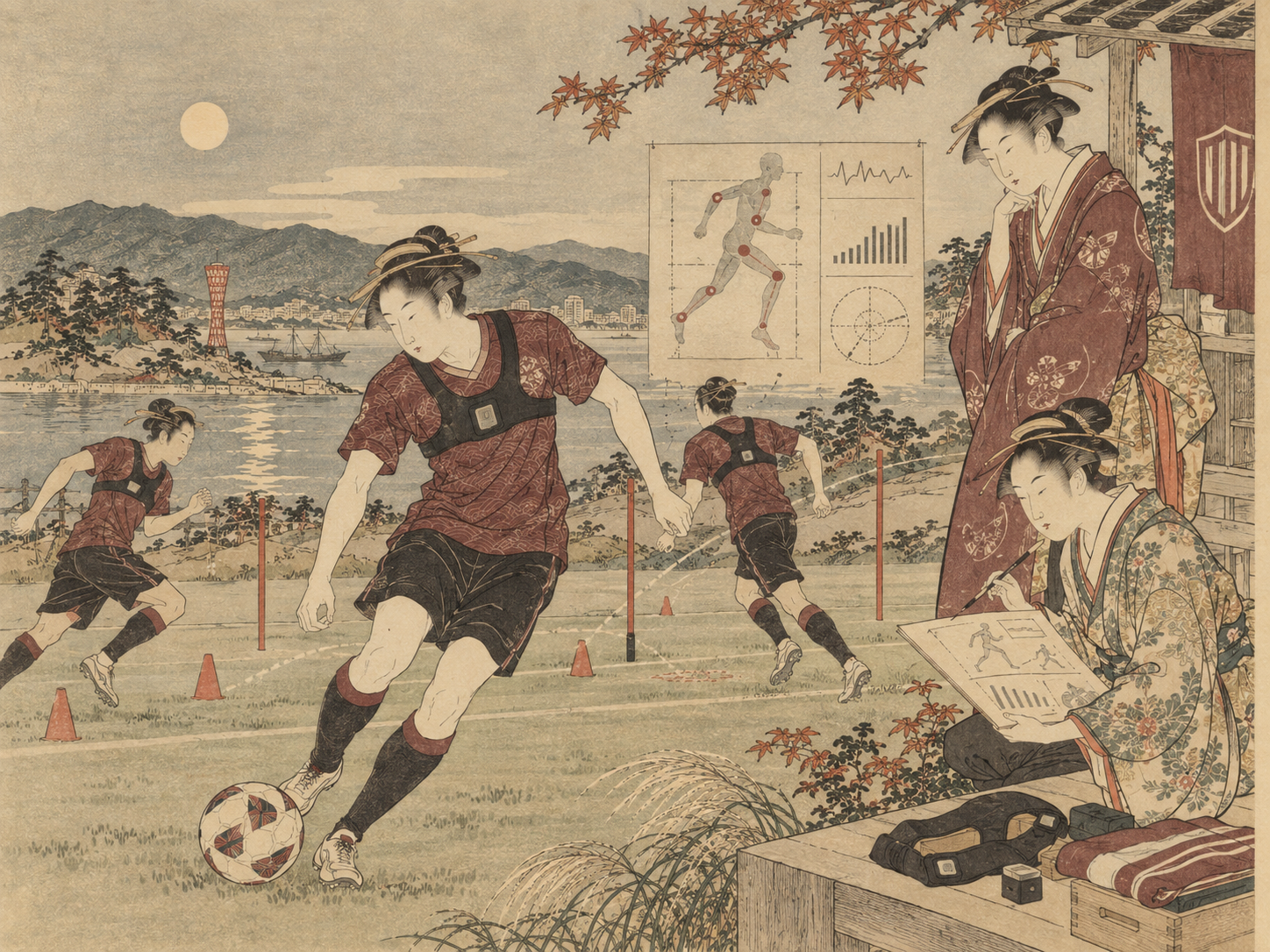
Football has no shortage of numbers. Distance covered. Sprint count. Top speed. High-speed running. Training load. The harder question is whether any of those numbers tell a coach what to change on Tuesday so that a 20-year-old player is better on Saturday—and still better six months later.
ASICS and Vissel Kobe announced on September 15 that they have begun a joint research program aimed at improving football-player performance. The first participants are players from U-21 Vissel Kobe, measured at the ASICS Institute of Sport Science. The companies say the program will repeatedly measure players rather than rely on one-off testing, focusing on movements such as acceleration, deceleration and change of direction and trying to identify which movements matter most for performance and development. [1][2]
Vissel goes further in its own announcement: it wants to move beyond familiar external measures such as running distance and sprint count toward deeper movement analysis, using the results to improve training quality and make individual development more visible. ASICS also intends to use findings in product development, including football boots. [1][2]
The premise is plausible. The conclusion is not yet proven. Measurement can reveal change. It cannot, by itself, show that a training intervention caused the change, that the change improves match performance, or that the same metric means the same thing for a fullback, a central midfielder and a forward.
The partners say U-21 Vissel Kobe players are undergoing repeated motion measurement and analysis, with acceleration, deceleration, change of direction and development-relevant movement among the research targets. The September 15 releases do not publish the participant count, sensor system, test battery, measurement frequency, study duration, statistical plan, primary outcome, data-governance terms or publication protocol. This is a research launch, not a result showing that the program has already improved football performance. [1][2]
Why distance and sprint counts are not enough
Running totals are useful because they summarize workload. They also flatten football into movement that looks more continuous than the game really is. Players repeatedly accelerate, brake, turn, re-accelerate and adjust to an opponent, often while controlling a ball or scanning for options.
That is why both ASICS and Vissel foreground acceleration, deceleration and change of direction. Vissel explicitly says the research will add deeper movement analysis to familiar metrics such as running distance and sprint frequency. [2]
A systematic review of 42 studies supports the importance of that layer. Acceleration and deceleration demands vary with drill design, playing position and the point in the training week; small-sided games, for example, can produce more acceleration and deceleration demand than running-based work. [10] Two players can cover the same distance while experiencing very different mechanical and tactical demands.
The complication is that acceleration is also one of the easier metrics to make unstable. It is derived from changing velocity over time, so small errors in position, sampling, filtering or thresholds can create large differences in the number of “efforts” a system reports.
The danger of a precise number that is not precisely comparable
A scoping review covering 276 team-sport studies found major methodological inconsistency in how acceleration and deceleration data were derived and cleaned; 60% of the studies did not report those procedures adequately. [11]
Earlier validation work showed why that matters. In one football GPS study, devices from the same brand differed substantially in the number of high accelerations and decelerations they recorded, and a software update itself changed event counts. The authors advised caution when comparing such data across devices, units or software versions. [12]
A 2026 review of high-intensity locomotor actions in professional men’s football found that monitoring remains dominated by GPS and absolute thresholds, with limited individualization and relatively little integration of tactical, positional and video context. Training also tended to under-replicate some match demands, particularly for non-starters. [13]
Use comparable conditions across repeat tests; keep devices, thresholds and data-processing rules consistent; and interpret movement numbers together with position, drill design, match exposure and maturation. A metric is only as useful as the comparison behind it.
The real advantage of repeated testing is seeing a player against himself
The most significant word in the announcement may be “continuous.” A single lab visit can rank players on a given day. U-21 development is dynamic: body mass changes, strength changes, playing time changes, roles change and recovery from injury changes.
Repeated measurement creates a different question. Instead of asking only whether Player A is faster than Player B, coaches can ask whether Player A reaches the same speed more quickly than he did four months earlier, whether his braking asymmetry is narrowing, or whether his first movement after deceleration deteriorates when fatigue rises.
ASICS Institute director Shuhei Takemura says the ability to measure and analyze U-21 players continuously is itself a major source of value because it can reveal knowledge that one-time measurements cannot. [1]
That is not the same as predicting who will become an elite professional. The stronger use is developmental: put one player’s changing movement profile on a timeline, then test whether coaching decisions make sense against that timeline.
U-21 is not an arbitrary test group
The research begins just as Japanese professional football has created a new competition around the same developmental problem. The U-21 J.League launched in the 2026/27 season because J.League identified a gap after age 18: youth and high-school football provide regular matches, but players aged roughly 19 to 21 can struggle to secure an appropriate competitive environment after graduation. [4][6]
The league’s design explicitly seeks year-round opportunities to play full 90-minute matches, a repeating match-rest-training-match cycle, and serious games with spectators. [4] Vissel Kobe is one of five WEST clubs. Its own U-21 page frames the competition as a stage for young talent during a critical period for professional development. [5]
U-21 Vissel opened its league campaign on August 23 with a 4-0 home win over V-Varen Nagasaki in front of 272 spectators at Ibukinomori Training Ground. [15] The score is not evidence for the ASICS project; the timing is useful context. These players are entering a new cycle of regular competitive exposure at the same moment researchers begin following their movement profiles.
That makes interpretation harder as well as richer. A player may improve because of a training intervention, because he is playing more 90-minute matches, because he matured physically, because he changed position, or because he recovered from an earlier limitation. Longitudinal data gives researchers more observations—but also more variables to disentangle.
Vissel wants a development guide, not merely a dashboard
Vissel president Yuki Chifu says the goal is to combine ASICS’s sports engineering with the club’s field experience to provide more precise, individualized guidance for the next generation and build a development model capable of producing players who can compete globally from Kobe. [2]
The club says its academy had produced 107 professional players by the end of May 2026. That is Vissel’s own institutional count, not a research outcome, but it explains why the project is being framed around development rather than only first-team conditioning. [14]
A measurement becomes useful to a coach only when it can change a decision. “Change-of-direction score: 82” is not enough. “The player loses braking quality on the left after repeated efforts,” or “his first step is slower late in sessions despite unchanged top speed,” can lead to a technical, strength or recovery question.
The translation layer—from laboratory variable to training action—is where Vissel’s role matters. ASICS brings measurement and engineering. The club brings knowledge of what a player is being asked to do in a particular position and training exercise.
Data should add questions for coaches, not replace them
Football is not a 100-meter race in which the performance metric is essentially the result. A faster player is not automatically a better winger. A player with lower running load may be positioning himself efficiently. A rapid change of direction means little if the ball is lost or the movement is tactically wrong.
The useful function of movement data is therefore often diagnostic rather than judgmental. Why does one player accumulate much more deceleration load in the same drill? Why does an asymmetry appear only late in a session? Is it technique, strength, fatigue, role, surface or equipment? Those questions can then be checked against video, player feedback, medical information and coaching context.
Data does not explain football by itself. Good data gives players and coaches better questions to ask about football.
ASICS has a history in Kobe of turning movement into product design
The project is not ASICS’s first attempt to connect football movement analysis with footwear. The Institute of Sport Science traces its roots to the consolidation of shoe and apparel research functions in 1985; its dedicated Kobe research facility was completed in 1990. ASICS describes the institute’s approach as “Human Centric Science,” analyzing human movement and translating it into materials and structural design. [3]
There is also a direct Vissel-era precedent. ASICS analyzed Andrés Iniesta’s play in detail and incorporated his feedback into a dedicated football boot line. The first Iniesta model appeared in 2019; the 2021 ULTREZZA 2 AI was designed around multidirectional steps, turns and acceleration, with sole structures intended to flex and stabilize in multiple directions. [7]
That earlier project began with an already exceptional individual and asked how a product could support his movement. The new program asks a different question: what can be learned by following developing players before their movement patterns are finished?
The 2025 TDK project shows ASICS trying to move analysis beyond the lab
ASICS’s broader research strategy has also been moving toward continuous and field-based measurement. In September 2025 it began joint research with TDK on next-generation sensing devices designed to visualize training movement in real time. Prototype devices worn around the ankle were initially aimed at athletics, with practical implementation considered from 2027 onward. [8]
The stated goal was to make advanced analysis possible outside the laboratory, connect athletes, coaches and product developers, and use the resulting data to support technique, condition management and product innovation. [8]
ASICS has simultaneously expanded its research network geographically, adding a U.S. Institute of Sport Science in 2025 and a European research function in 2026, including a partnership with HumanFab. [3][9]
None of this establishes that the Vissel project uses the TDK prototype, and the new announcement does not say that it does. The relevant continuity is strategic: ASICS is increasingly trying to connect athlete measurement, coaching environments and product development rather than treating them as separate activities.
The same findings may feed two different customers: player development and boot design
ASICS says knowledge from the research is expected to feed product development, particularly football boots. [1] The project therefore has two obvious outputs. Vissel wants better player development and training support. ASICS wants knowledge that may improve equipment.
In principle, repeated movement analysis could inform questions such as outsole stiffness, flex location, stud configuration, upper support or how a shoe behaves during braking and multidirectional loading. Those are possible design uses, not announced conclusions of the current study.
The dual purpose makes methodological transparency valuable. If findings are eventually published with measurement procedures, analysis rules and uncertainty, other researchers can evaluate whether the result is generalizable beyond one club and one product-development context.
Young-player data is also competitive information
Longitudinal movement data can become sensitive in a sporting sense. Asymmetries, fatigue response, recovery trends and repeated movement limitations can reveal aspects of a player’s condition that clubs ordinarily manage carefully.
The U-21 competition can also include eligible younger academy players under prescribed rules. [5] That means some participants in the wider player pool may be minors, depending on whom the research ultimately enrolls.
The September 15 releases do not describe consent procedures, anonymization, retention periods, ownership between club and company, third-party access, transfer of data if a player leaves the club, or academic-publication rules. That is not evidence those protections are absent; it means the public announcement does not specify them. Research agreements, ethics review and consent may exist separately.
As athlete data becomes more useful, “Who gets to use it?” becomes part of performance science. A system that helps a player understand himself can be empowering. The same dataset can also have commercial and competitive value. Good governance needs to travel with good measurement.
Can training data change performance?
Yes—but not by existing. Data changes performance only after several translations succeed. A measurement must be valid enough to trust. A coach must understand what it means. The finding must point toward an intervention. The player must perform that intervention. The effect must survive outside the lab and appear in football actions that matter.
That chain is why this project is more interesting than a single technology announcement. ASICS has measurement expertise and a product pathway. Vissel has a development environment and a new U-21 competition giving players repeated match exposure. The longitudinal design can show change rather than a snapshot.
It can also fail in familiar ways: too many metrics, unstable thresholds, effects too small to separate from natural development, findings that make sense in the lab but not to coaches, or impressive movement gains that do not improve football decisions.
The partners have started with the right scientific question rather than a finished answer: which movements are worth watching as a footballer develops? The next evidence will matter more than the launch announcement. Which metrics survive repeated testing? Which ones change before coaches notice? Which interventions follow? What appears in matches? What reaches a boot? And what proves useful to the player himself?
If those questions are answered clearly, training data can become more than a record of what happened. It can become part of how development decisions are made. Until then, the most accurate headline remains a question.
Sources and references
- ASICS: ASICS and Vissel Kobe begin joint research to improve football-player performance (Sept. 15, 2026)
- Vissel Kobe: Joint research with ASICS for performance improvement begins (Sept. 15, 2026)
- ASICS: Institute of Sport Science — history and research structure
- J.League: U-21 J.League established for post-youth development (May 27, 2025)
- Vissel Kobe: U-21 J.League — purpose and competition background
- J.League: U-21 J.League launch and development rationale
- ASICS: ULTREZZA 2 AI football boot co-developed with Andrés Iniesta (2021)
- ASICS: Joint sensing-device research with TDK to visualize training movement (Sept. 3, 2025)
- ASICS: Institute of Sport Science Europe and HumanFab partnership (June 16, 2026)
- PubMed: Systematic review of acceleration and deceleration demands during football training
- PubMed: Scoping review of derivation and cleaning methods for acceleration/deceleration tracking data
- PubMed: Monitoring accelerations with GPS in football — device and software variability
- PubMed: 2026 scoping review of high-intensity locomotor-action measurement in professional soccer
- Vissel Kobe partnership data: 107 professional players produced by the academy as of May 2026
- J.League: U-21 Vissel Kobe beat V-Varen Nagasaki 4-0 in its opening league match (Aug. 23, 2026)
Evidence reviewed September 16, 2026, Japan time. The September 15 ASICS and Vissel Kobe releases control the description of the joint study, initial U-21 cohort, longitudinal intent and planned use in football-product development. The releases do not disclose participant count, specific sensors, measurement frequency, primary endpoint, study duration, statistical plan or detailed data-governance/publication terms, and the article does not infer them. Scientific limitations around acceleration/deceleration monitoring are grounded in peer-reviewed reviews and GPS validation research. ASICS’s 2025 TDK sensing project is described as separate because neither 2026 release says the Vissel study uses that device. Analysis is Japan.co.jp’s unless otherwise attributed.