Every object seems real. The world they share does not.
An ocean that refuses to stay an ocean
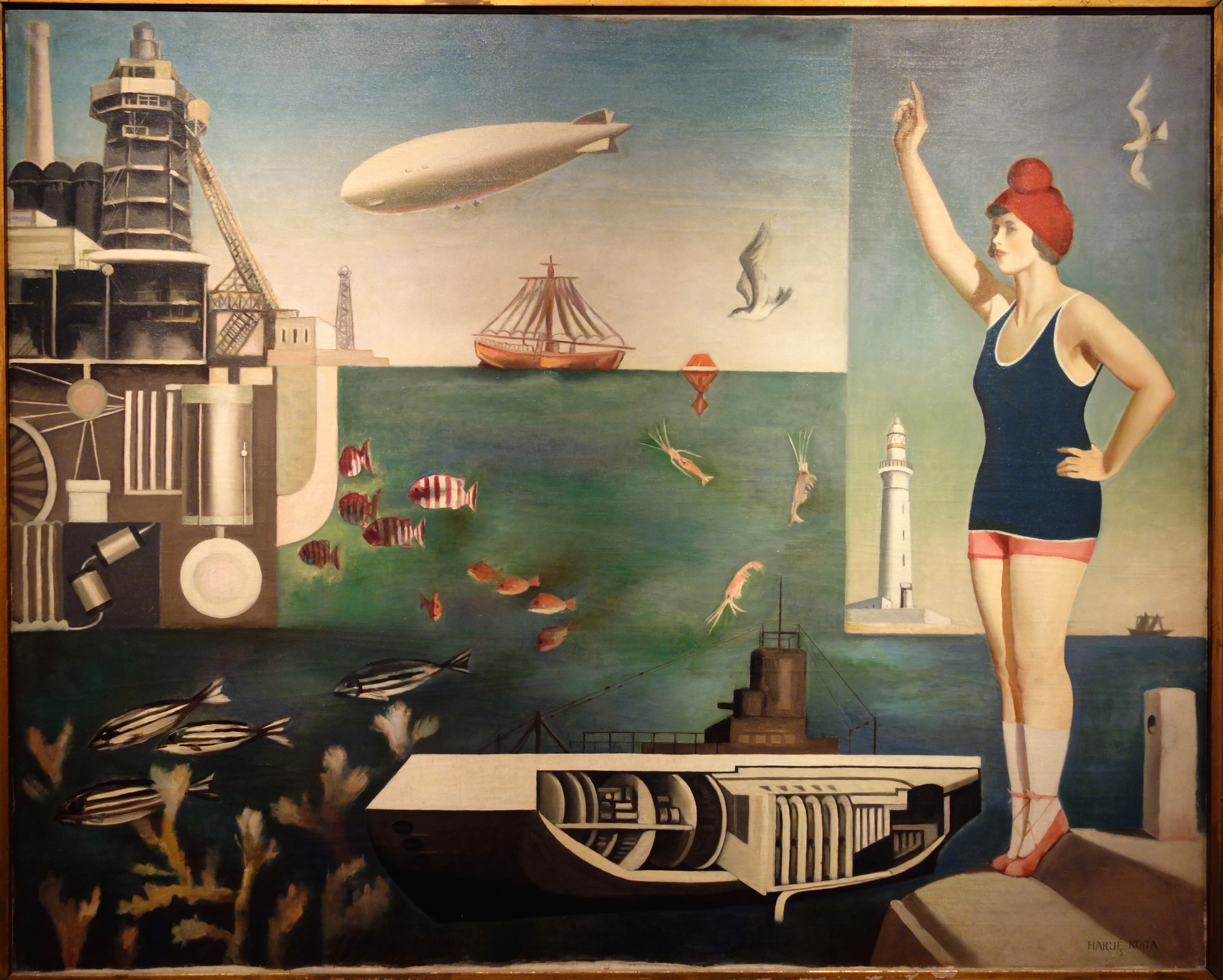
There is a swimmer on the shore, machinery in the water and an airship above it. A bird and a fish still occupy their natural domains, yet industry and technology seem to have acquired the same freedom of movement. Painted in 1929, Koga Harue’s Sea has the composure of an advertisement and the logic of a dream. Everything is rendered with enough confidence to be recognizable; almost nothing sits where a straightforward seascape would put it. It is a painting about looking again.
What the museum record establishes
The National Museum of Modern Art, Tokyo, owns Sea, an oil painting on canvas measuring 130.0 by 162.5 centimeters. Japan’s National Museum of Art collection database records its presentation at the 16th Nika Exhibition in Tokyo in September–October 1929 and the museum’s acquisition in fiscal 1964. Those facts are important because the painting is often circulated online without the context of its original exhibition or the decades through which it entered a national collection. This is not a digital invention or a contemporary homage: it is an original work from the first years of the Shōwa era.
The artist with an unexpected name
Born in Kurume, Fukuoka Prefecture, in 1895, the painter used the professional name Koga Harue. The Fukuoka Prefectural Museum of Art gives his birth name as Kameo, read Yoshio. The name Harue should not lead readers to assume the artist was a woman. After leaving the prefectural Meizen school in 1912, he went to Tokyo and joined the Taiheiyō Art Association; in 1913 he entered the Japan Watercolor Association’s research institute. He later expanded into oil painting. He died in 1933, aged 38.
A young painter enters a changing world
Koga’s generation inherited the project of learning Western oil painting but also witnessed artists questioning what painting itself could be. European Cubism upset conventional perspective; Paul Klee offered new relationships between signs, color and imagination; Surrealism began to unsettle the boundary between waking experience and dreams. These terms describe currents rather than a fixed curriculum that Koga simply copied. Fukuoka’s prefectural museum characterizes his experiments as Cubist-like, Klee-like and Surrealist-like. Their coexistence is part of what makes him distinctive.
The year 1922 and the case for experimentation
The prefectural museum credits Koga with receiving a Nika prize in 1922 and cofounding the avant-garde group Action in the same year. He had reached a point at which technical competence was not the end of an artistic education. A painting could break apart a view, rearrange familiar materials or insist that recognition was not the same as understanding. His earlier works help demonstrate the range: Tokyo’s National Museum of Modern Art holds Avalokitesvara, dated 1921, and The Moon and Flowers, dated 1926.
A fish beneath an airship: the painting’s visual argument
One way into Sea is to consider its pairings. Birds and airships cross the sky; fish and submarines travel underwater. The organic appears alongside the engineered, and the factory chimney stands in implicit conversation with the human figure. This arrangement invites a reading about modern people borrowing the capacities of nature through technology. Yet there is no need to present that interpretation as the artist’s documented manifesto. The painting remains more provocative precisely because its symbols resist a single decoded meaning.
Why it looks plausible and impossible at once
Koga did not abandon recognizable objects. On the contrary, their familiar detail gives the painting its first jolt. The second comes from scale, placement and transitions between visual zones. A machine can look meticulously rendered and still feel displaced. Sea anticipates the way modern image culture can combine pieces of disparate realities into an apparently coherent whole. Describing this as a resemblance, however, is different from claiming that Koga foresaw a specific digital technology.
The excitement—and unease—of 1929
Early Shōwa urban life was saturated with new forms of circulation: photographs, illustrated magazines, films, electrical systems, advertising and changing methods of travel. Sea belongs to that cultural atmosphere. The New York stock-market crash later in 1929 transformed the world economy, but it would be historically careless to call this already exhibited painting a response to the crash. Its contradictions can be read within a broader modernity without assigning the artist a prophecy he did not make.
Another painting from the same year
The Fukuoka Prefectural Museum of Art holds Fisherman, also made in 1929 and listed as exhibited in the 16th Nika show. The coincidence offers a useful invitation to compare how Koga approached the maritime world in a single year. It does not establish that Fisherman and Sea were conceived as companion pieces. That more specific claim would demand letters, preparatory materials or comparable documentary evidence. Responsible art history begins with what can be seen and recorded, and leaves space around what remains unknown.
A Japanese Surrealist—but not only that
Koga is frequently positioned among Japan’s early avant-garde painters and linked to Surrealism. The label is useful, though incomplete. His practice moved through different formal experiments, and visual affinities with European painters do not mean the works carried identical cultural meanings. The Japanese modernist experience involved translation, selection and local reinvention. Sea is particularly interesting when approached not as a textbook illustration of a French movement but as an individual artist’s deliberate recombination of forms.
The painter was also a poet
The prefectural museum’s biography notes Koga’s talent as a poet. That fact suggests a fruitful connection between his pictorial choices and the way poetry can place unrelated things together to create new associations. It is tempting to attach a neat quotation to Sea and thereby explain everything. Without identifying an authentic text and its date, that would substitute decoration for evidence. The more compelling approach is to let the painting’s own peculiar visual syntax remain visible.
The long life of a short career
Koga died in 1933, only four years after Sea was made. The museum’s records show that the painting later appeared in multiple exhibitions before entering the Tokyo national collection in fiscal 1964. His works continued to be studied and displayed long after his death. Reputation is not simply a verdict delivered at the easel: preservation, exhibitions, archival research and the interpretations of new generations all help establish what later viewers understand as a major work.
Why Fukuoka should claim this strange sea
For an issue devoted entirely to Fukuoka Prefecture, Koga offers something better than a predictable illustration of a local landmark. A man born in Kurume imagined a horizon populated by machines, life, human bodies and unlikely relationships. His picture reaches outward beyond the prefecture while keeping a genuine regional connection. Fukuoka today is home to research, manufacturing, ports and culture, but the point is not that Sea predicted those industries. Rather, it presents an enduring question for a modern society: what happens to our view of nature and ourselves when machines enter every part of the landscape?
Sources and interpretation
Based on public collection records from the National Museum of Modern Art, Tokyo, and the Fukuoka Prefectural Museum of Art. Visual readings are interpretations, not authenticated statements of the artist’s intentions; no curator interviews were conducted.
- National Museum of Modern Art, Tokyo: Sea collection record
- Fukuoka Prefectural Museum of Art: Koga Harue biography
- Fukuoka Prefectural Museum of Art: Fisherman (1929)
- National Museum collection: Avalokitesvara (1921)
- National Museum collection: The Moon and Flowers (1926)
- Wikimedia Commons: Daderot photograph of Sea (CC0)