A deadline arrives for Japan’s troubled coastal seas
On October 27, Japan’s Environment Ministry announced that two specialist panels will meet jointly on November 4 to review a draft of the 2026 assessment of the Ariake and Yatsushiro seas. The meeting is not a declaration of ecological recovery. Its significance is the timing: a restoration effort pursued under a special law since 2002 is approaching a formal review of goals set roughly a decade ago.
Two connected seas, many different livelihoods
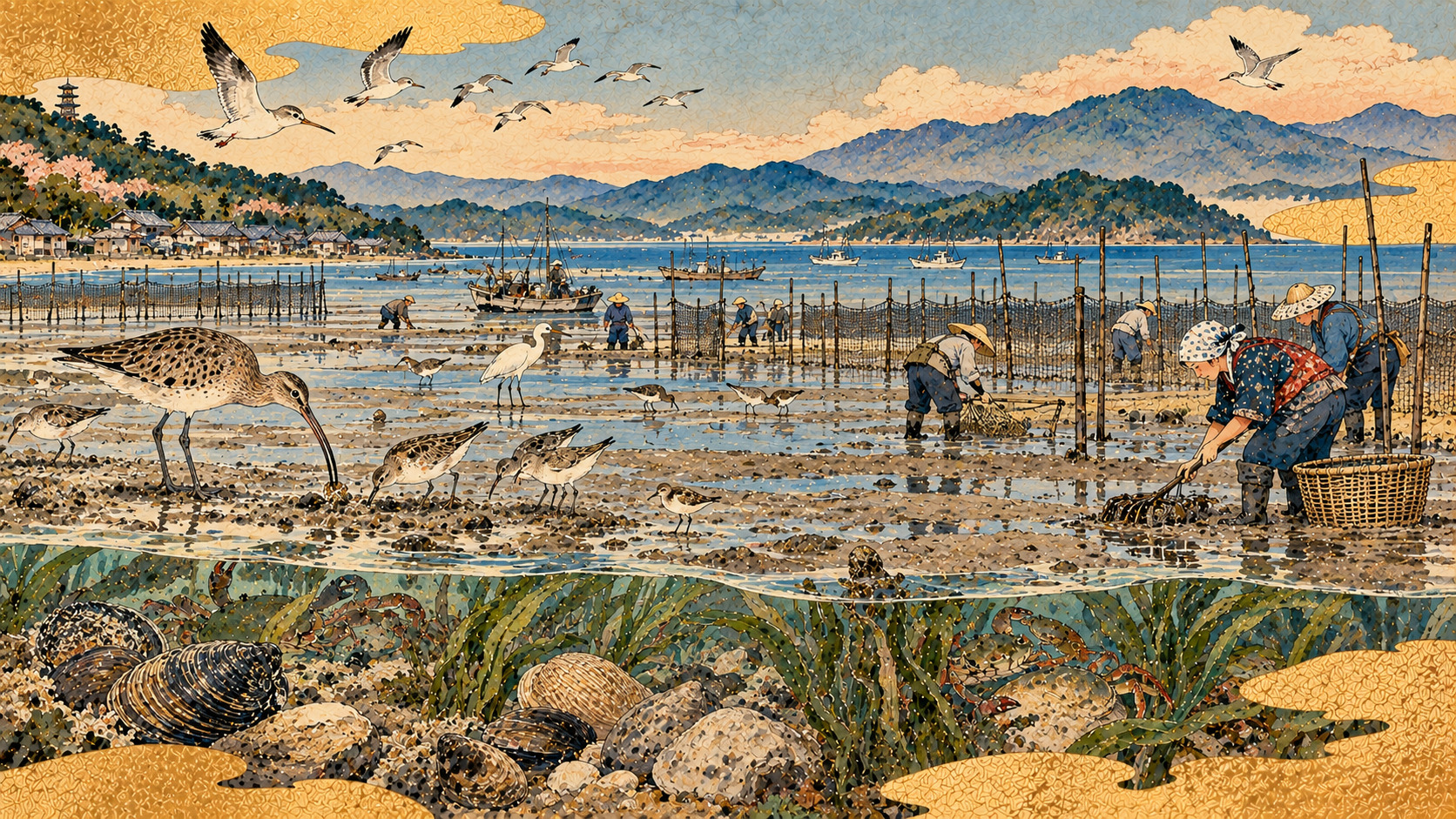
Ariake Bay, on western Kyushu, is known for extensive tidal flats and a remarkable tidal range. Seaweed cultivation, clams, pen shells and other coastal resources support distinctive communities and food traditions. The neighboring Yatsushiro Sea supports aquaculture and fisheries in a different physical setting of bays and islands. Treating the two as interchangeable would obscure important differences in water exchange, seabed conditions and ecological pressures.
The seaweed crisis that became a national issue
A severe loss of color in cultivated nori in 2000 became an emblem of what was widely called the “Ariake Sea anomaly.” The decline of commercially important bivalves prompted further investigation. In Yatsushiro, harmful algal blooms and their effects on fisheries also demanded attention. These are documented problems, but they do not establish that every observed change across the two seas came from one cause.
A law, three major reviews and a changing climate
A special restoration statute took effect in 2002, followed by a comprehensive committee report in 2006. The legal framework was amended in 2011; another extensive assessment followed in 2017. A 2022 interim review examined implementation and highlighted emerging concerns including increasingly intense rainfall and higher air and water temperatures. The history makes an important distinction: repeated assessment is proof of sustained attention, not proof that recovery has been achieved.
Why 2026 is more than another meeting year
The 2017 assessment identified approximately 2026 as the near-term horizon for restoration goals. At a March 2026 meeting, the national evaluation committee described the forthcoming report as an opportunity to judge the preceding decade and set priorities for the next one. The November draft review is therefore a test of the government’s ability to state where progress occurred, where it stalled, and what the data can actually support.
Clams, pen shells and nori tell different stories
Clams need suitable intertidal habitat; pen shells depend on healthy seabed conditions; nori is an extensively managed aquaculture crop. Their populations and yields respond to different combinations of physical and biological factors. Environment Ministry papers separately examine pen-shell condition, oxygen depletion and variation among marine subareas. A single catch figure cannot stand in for the health of the entire ecosystem.
The problem beneath the waterline
When water layers stop mixing efficiently, dissolved oxygen near the seabed can fall, creating hypoxic conditions that stress or kill bottom-dwelling organisms. Sediment quality, food availability, recruitment of larvae and changing currents may compound the effects. Government research materials examine how low-oxygen waters develop and disappear and how these conditions relate to pen shells. Such work matters because habitat improvement in one place may not solve a problem originating elsewhere.
Red tides, heavy rain and the danger of one-cause explanations
Harmful algal blooms can damage fish farms and other marine livelihoods, particularly in parts of the Yatsushiro Sea. Their occurrence depends on species, nutrients, temperature and water conditions. Extreme rainfall can alter river discharge and sediment delivery, while warmer waters may change longer-term ecological patterns. Japan’s 2022 interim assessment identified these pressures as areas requiring attention; it did not provide an all-purpose causal verdict.
The controversial history of Isahaya Bay
Debates about the Isahaya Bay reclamation project and its sea dike have shaped public understanding of the Ariake Sea for decades. It would be irresponsible to erase that history—or to suggest from the sources reviewed here that one engineering project definitively explains every ecological change in Ariake and Yatsushiro. Evaluations must keep observation, proposed mechanisms, litigation positions and policy choices distinct. This report does not attempt to adjudicate disputed causation.
What credible recovery would look like
A serious scorecard should go beyond projects funded and surveys completed. Indicators include tidal-flat and seagrass extent, oxygen conditions, benthic biodiversity, shellfish survival and recruitment, harmful bloom impacts and the stability of fishing incomes. Monitoring needs consistent methods and geographic specificity. A gain in one bay cannot erase losses in another, and a short improvement cannot automatically be called a durable trend.
For fishing families, ecology is the economy
A decline in harvests can affect processors, wholesalers, restaurants and young people deciding whether to remain in coastal communities. That makes restoration an economic issue as well as an environmental one. The decision to convene fisheries-resource and marine-environment working groups together reflects their interdependence. Yet the October announcement does not announce new compensation, a specific budget, or confirmed improvement in fisheries incomes.
The questions for November 4
According to the ministry, the joint panels will meet online from 1:00 p.m. to 3:30 p.m. Japan time on November 4, discussing a report overview and revised general and detailed drafts. Documents are to be posted ahead of the meeting and minutes afterward. The questions worth asking are clear: Will the review distinguish improvements from failures across individual subareas? Will it identify remaining evidence gaps? And can the next decade’s restoration goals be measured rather than merely promised?
Sources and reporting notes
Sources include original Environment Ministry notices, assessment reports, meeting records and technical working papers. The pending draft is not a final outcome. No direct interviews with fishers or researchers were conducted.
- Environment Ministry: November 4 joint subcommittee meeting announced October 27
- Environment Ministry: Evaluation committee and history of assessments
- Environment Ministry: March 2026 committee meeting transcript
- Environment Ministry: September 2026 working-group draft documents
- Environment Ministry: March 2026 committee papers
- Environment Ministry: 2017 comprehensive assessment
- Environment Ministry: 2006 assessment report
- Environment Ministry: Research papers on pen shells and hypoxia