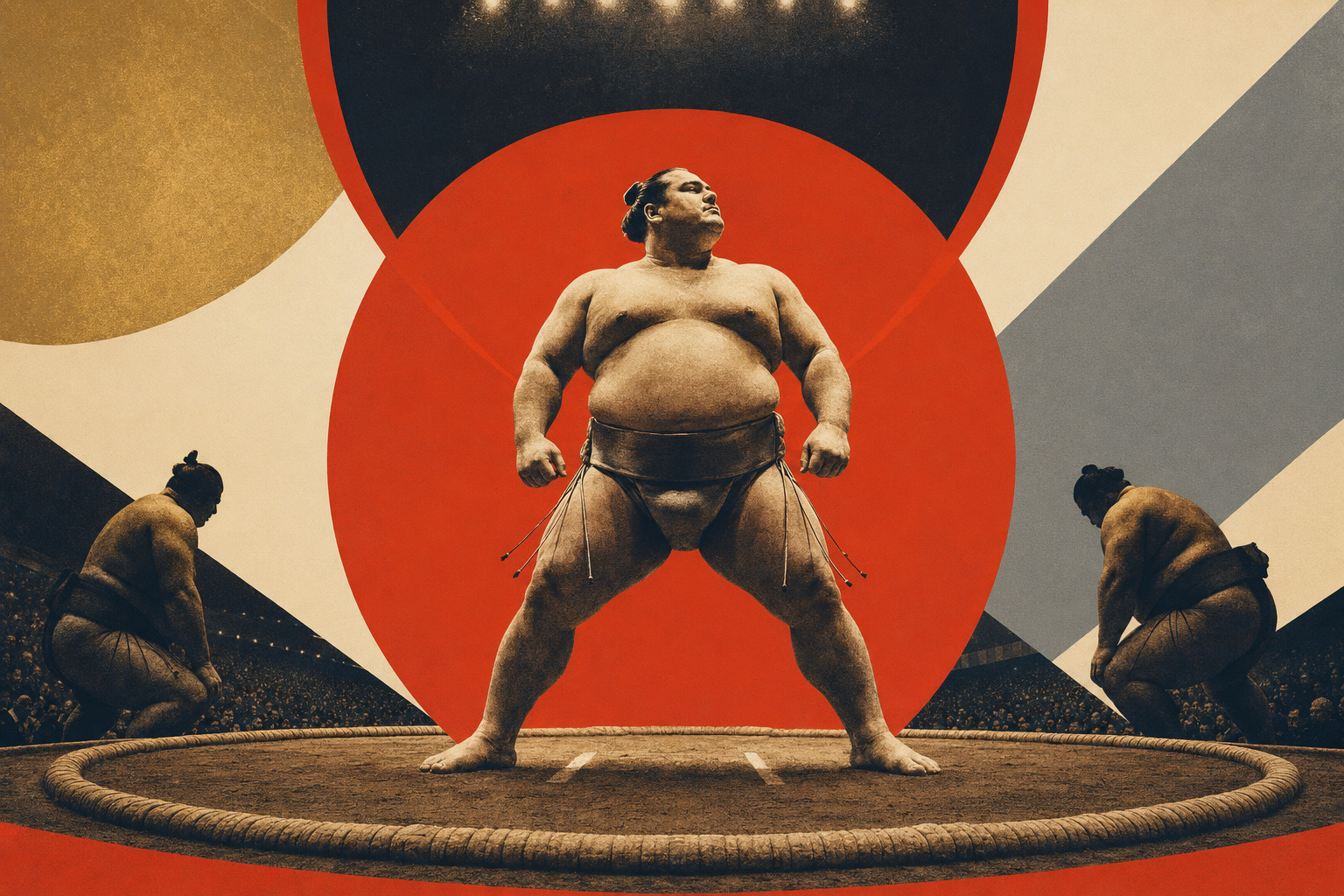
The defeat did not end his chance to win. It made the pain suddenly visible.
On July 26 at IG Arena, west sekiwake Aonishiki entered the final day at 12–2, alone atop the standings. One more victory would secure his third Emperor’s Cup. Across the ring stood fellow sekiwake Atamifuji at 11–3, a 23-year-old whose size and forward pressure had made him the last direct obstacle between Aonishiki and the title.
Atamifuji drove through him. Aonishiki went over the straw bales and landed, almost hopping, on the injured left foot that had shaped his entire summer. His expression tightened. Atamifuji was now 12–3. In the following bout, ozeki Kirishima defeated Kotozakura and joined them. After yokozuna Onosato beat Kotoshoho in regulation’s final contest, the raised clay ring entered a different kind of time.
Three wrestlers. The same record. A tomoesen—sumo’s three-way championship playoff, decided not by a round-robin table but by the first wrestler to win twice in succession.
Aonishiki returned to the preparation room. Tape that had covered only his left foot appeared around both. The injury history was long enough to feel like a second opponent: a broken left little toe during the March tournament, then a left ankle sprain and damage to the lateral ligaments before May. He had missed the entire Summer Basho and fallen from ozeki. In Nagoya, his left big toe bled at mid-tournament, and walking itself hurt.
He went back out anyway. The private message that carried him from the closed room to the arena was simple: he was not a person who would end here.
Atamifuji beat Kirishima in the playoff’s opening bout, pushing the ozeki over the edge. One more win would bring Atamifuji his first championship and the first top-division title for a wrestler from Shizuoka Prefecture. The opponent between him and history was the same man he had just defeated in regulation.
This time, Aonishiki got lower, arrested the charge and kept moving forward. He forced Atamifuji out by yorikiri. The first would-be winner had been stopped. The triangle turned.
Kirishima came next. Aonishiki put his head into the ozeki’s chest, disrupted the outside of his right leg and drove. Another yorikiri. Both men went below the ring; Aonishiki planted a hand and rose with pain written across his face. The condition had been met. Two wins in a row. Three bouts in one day, the last two victories belonging to the man who had already lost once.
The three matches that kept changing the story
A tomoesen is not an ordinary round robin. Lots determine the opening pair. The winner stays to face the waiting third wrestler. The sequence continues until somebody wins two consecutive matches. If the winners alternate, the circuit can turn again and again. What matters is not merely beating each rival at some point. A champion must sustain a victory through the next opponent.
For Aonishiki, drawing the initial bye created both recovery time and an observation post. If Atamifuji won, he would receive an almost immediate rematch of the regulation defeat. If Kirishima won, Aonishiki would revisit the ozeki he had beaten by katasukashi on Day 13. Either way, the old result was unusable. He needed one adjustment for the next initial charge.
| Sequence | Bout | Decision | What changed |
|---|---|---|---|
| Regulation | Atamifuji def. Aonishiki | Oshidashi | Atamifuji pulled level; Kirishima’s subsequent win produced a three-way tie at 12–3. |
| Playoff 1 | Atamifuji def. Kirishima | Forward pushing attack | Atamifuji moved one victory from his first Emperor’s Cup. |
| Playoff 2 | Aonishiki def. Atamifuji | Yorikiri | Aonishiki corrected the regulation loss and broke Atamifuji’s run. |
| Playoff 3 | Aonishiki def. Kirishima | Yorikiri | Aonishiki completed two consecutive wins and claimed his third championship. |
For Atamifuji, the reversal was severe. He beat Aonishiki in regulation, beat Kirishima in the first playoff bout and stood a single victory from history. He also carried the memory of January, when he had pressured Aonishiki to the edge in a two-man championship playoff only to lose to a desperate kubinage headlock throw. In Nagoya, Atamifuji solved him once in the most direct possible way. The unsolved part was doing it again before the same evening ended.
Kirishima’s place in the triangle mattered too. The 30-year-old ozeki was pursuing a fourth championship and a continuation of his own yokozuna campaign. He had regained ozeki after a 12-tournament absence through the normal promotion process in March, an achievement accomplished after falling far beyond the one-tournament restoration window. Aonishiki defeated him twice in Nagoya, on Day 13 and again for the cup. The young sekiwake was not merely recovering symbolically. He was proving ozeki-level strength against an ozeki.
Ozeki demotion: ten wins are a one-tournament door
Unlike yokozuna, an ozeki can be demoted. Under the system in place since 1969, two consecutive losing tournaments drop an ozeki to sekiwake. There is one narrow exception: if the wrestler wins at least 10 bouts in the tournament immediately after demotion, he returns to ozeki without rebuilding a standard promotion case—usually understood as roughly 33 wins across three tournaments at the sanyaku ranks.
Before Aonishiki, the immediate-return route had been completed only seven times by six wrestlers: Mienoumi, Takanonami, Musoyama, Tochiazuma twice, Tochinoshin and Takakeisho. None won the championship in the tournament that returned him to ozeki. Aonishiki reached his 10th win on Day 11 in Nagoya and could have treated the rest as surplus. He did not. The target he and stablemaster Ajigawa had set before the tournament was not ten victories. It was the title.
The distinction explains why the Nagoya result is larger than a procedural restoration. In November 2025, Aonishiki won his first championship as a new sekiwake and earned promotion. In January 2026, he won again as a new ozeki. March was supposed to be a yokozuna bid. Instead, a broken little toe contributed to a 7–8 record, his first losing tournament since entering professional sumo. Before May, he sprained the left ankle and injured its lateral ligaments. Ajigawa withdrew him for all 15 days. A second consecutive losing record was unavoidable, and his first ozeki tenure ended after three tournaments.
Ajigawa’s May decision was protective and ambitious at the same time. He would not send out a wrestler incapable of performing Aonishiki’s sumo. If his pupil returned, the master said, the intention would be to make him champion. In Nagoya, when pain returned after the 10-win benchmark, withdrawing remained conceivable. The title they had named months earlier kept him in the field.
That choice should not be romanticized without qualification. Ajigawa later said he had considered when he might have to stop his wrestler. Japan Sumo Association chairman Hakkaku described Aonishiki as battered throughout the tournament. The fact that persistence produced a cup does not make every decision to continue medically wise. Recovery before September is now as important to Aonishiki’s long career as the record he made in July.
From Vinnytsia to Ajigawa stable
Aonishiki Arata was born Danylo Yavhusishyn on March 23, 2004, in Vinnytsia, central Ukraine. He began sumo at seven and also trained in wrestling. By 2019, he had finished third at the World Junior Sumo Championships. At 17, he became a Ukrainian national champion.
Russia’s full-scale invasion began in February 2022. Yavhusishyn left with his family for Germany, then made a separate choice: at 18, he would go to Japan to continue sumo. He arrived in April. His connection was Arata Yamanaka, a Japanese wrestler he had met at the 2019 junior event. Yavhusishyn stayed with Yamanaka’s family, trained at Kansai University and Hotoku Gakuen, and was introduced to former sekiwake Aminishiki, now stablemaster Ajigawa. He became a trainee at the new stable in December 2022 and made his professional debut at the September 2023 tournament.
His shikona carries the route inside it. The “A” comes from Ajigawa. “Nishiki” comes from Aminishiki, the master’s ring name. “Ao,” blue, refers to the Ukrainian flag and Aonishiki’s eyes. His given ring name, Arata, honors Yamanaka, the friend who helped create a path into Japan.
The name does not ask one part of his life to erase another. It places Ukraine, Japan, stable, teacher and benefactor in a single reading.
He arrived without Japanese. He now speaks comfortably in televised victory interviews. After struggling to sing the national anthem at his January celebration, he practiced Kimigayo with the stablemaster’s wife and quietly joined it in Nagoya. The detail matters not as a loyalty test, but as evidence of how he entered sumo from the inside—through language, ritual, communal living, daily training and the banzuke, rather than merely appearing as an outside athletic novelty.
The line to Ukraine remains. His parents live in Germany; friends and acquaintances remain in his homeland. After his first championship, he phoned his parents. His mother cried; he was told his father did too, away from view. A sumo victory cannot alter a war. But every time Aonishiki climbs the dohyo, the sport’s map includes Vinnytsia, Germany, Kansai, Tokyo and now Nagoya.
A record ascent—and the years hidden inside the speed
September 2023: Professional debut from Ajigawa stable.
March 2025: Top-division debut after nine tournaments; 11–4 and the Fighting Spirit Prize.
July 2025: Defeated Hoshoryu with watashikomi for a first kinboshi in a modern-record 12 tournaments.
September 2025: New komusubi after 12 tournaments, the fastest modern rise to sanyaku without a special starting status.
November 2025: Won at new sekiwake, beating yokozuna Hoshoryu in a playoff; Ukraine’s first top-division champion.
January 2026: Won at new ozeki, defeating Atamifuji with kubinage in a playoff.
March 2026: Yokozuna bid ended at 7–8 while he carried a broken left little toe.
May 2026: Sat out with a left ankle injury; demoted after consecutive losing records.
July 2026: Went 12–3 and won the ninth top-division tomoesen, securing immediate ozeki return and a third cup.
Aonishiki reached ozeki 14 tournaments after debut, breaking the six-tournament-era speed record of 19 held by Kotooshu. His consecutive championships as a new sekiwake and new ozeki had not been achieved since Futabayama in 1937, 89 years earlier. Winning a first top-division title in his 14th tournament was second fastest among wrestlers without a special amateur starting rank, behind Takerufuji.
Records can make him look like an athlete who materialized fully formed. Count from age seven, however, and Nagoya was the product of roughly 15 years. Ukrainian sumo and wrestling, practice at Kansai University and Hotoku Gakuen, fundamentals at Ajigawa stable, and hours studying old masters sit beneath the official banzuke acceleration.
His stability was visible before the first cup. From his top-division debut, he posted four consecutive 11-win tournaments and won a special prize in each. At about 182 centimeters and 142 kilograms in Nagoya, he is not unusually large by makuuchi standards. He cannot solve 197-kilogram Atamifuji or the explosive pushing of Onosato through mass alone. His real speed is diagnostic: the speed with which he reads what failed and changes it.
Low head, front grip, twist: a smaller wrestler’s answer
Aonishiki’s best sumo begins with a low contact point. He puts his head into an opponent’s chest, lowers the center of gravity and hunts for a shallow mawashi grip. His preferred position is migi-yotsu—right hand inside, left outside—and his most common finish is yori, a controlled forward force-out. But describing him as a yorikiri wrestler misses the imagination.
His wrestling background appears in the way he reads legs, hips and shifting weight. Shitatehineri, uchimuso, katasukashi, watashikomi and kubinage emerge as responses rather than preselected tricks. Against Hoshoryu in July 2025, he absorbed a throw attempt, gathered the yokozuna’s leg and won by watashikomi. Against Wakamotoharu, he kept his head low and finished with a sharp underarm twist. Against Oho on Day 6 this July, he believed his body was moving toward an inner-thigh propping twist; the official kimarite was shitatehineri. The body answered before the label did.
His study list is almost a syllabus in smaller-man sumo. He has named the technically versatile third Wakanohana as an ideal, studied Harumafuji’s right-hand use and throat attack, Asahikuni’s survival at the edge and Kotonishiki’s speed. His own stablemaster, Aminishiki, spent a long career navigating injuries with an inventory of techniques that earned him the nickname “department store of skills.”
- Low contact: His head under the opponent’s chest helps raise the other man’s center and blunt forward pressure.
- Migi-yotsu and a shallow grip: Right hand inside, left seeking the front of the belt, creating a repeatable driving position.
- Wrestling reactions: He turns changes in leg position and balance into twists, trips and improvised finishes.
- Immediate correction: Pushed out by Atamifuji in regulation, he tied him up and forced him out in the playoff.
The full system appeared in the tomoesen. With an injured foot, large lateral movement was expensive. He reduced the options: get low, put his head in the chest, stop the charge and go forward. The two title-winning yorikiri were not exotic. They were the most reliable version of himself, selected when pain made reliability essential.
Only nine evenings like this since 1956
Top-division championship playoffs are familiar enough. A three-man playoff is not. The first makuuchi tomoesen was held in March 1956. Only eight had occurred through January 2025, when Hoshoryu defeated Kinbozan and Oho consecutively. Nagoya 2026 was the ninth, after a gap of nine tournaments and 18 months.
The rarity begins with arithmetic. Three wrestlers must reach the end of 15 days with the same best record. Then the order of final-day matches must keep all three alive. Atamifuji had to defeat Aonishiki, and Kirishima had to beat Kotozakura. Change either result and Nagoya produces either an outright title or a two-man playoff.
Playoffs also suspend some ordinary scheduling barriers. Stablemates and close relatives, normally kept apart in regulation, can meet if a championship requires it. Playoff results do not add to the official banzuke record—the winner remains 12–3, not 14–3—yet those extra bouts alone determine who receives the Emperor’s Cup. The sport preserves both books at once: the record and the champion.
Aonishiki has now won all three of his championships after the scheduled 15 days ended. In November, he beat yokozuna Hoshoryu. In January, he escaped Atamifuji at the bales. In July, he beat Atamifuji and Kirishima. He has never been an uncontested champion, yet he has never lost the contest that followed the tie. That is a different kind of dominance: repeated success when certainty has already run out.
Ukraine’s first champion, in Europe’s unfinished lineage
Aonishiki is the second Ukrainian-born professional rikishi after Shishi and the first from his country to win a makuuchi championship. Ukraine became the fourth European country to produce a top-division winner after Bulgaria’s Kotooshu, Estonia’s Baruto and Georgia’s Tochinoshin. All three predecessors reached ozeki. No European-born wrestler has become yokozuna.
Sumo’s international history cannot be reduced to the line that foreigners succeeded in a Japanese sport. Akebono became the first foreign-born yokozuna in 1993. Musashimaru followed from Hawaii, then Mongolian-born Asashoryu, Hakuho, Harumafuji, Kakuryu, Terunofuji and Hoshoryu shaped long stretches of the championship era. Each entered a stable, learned Japanese, received a ring name and lived within the sport’s hierarchy. Each also carried a different athletic background and expanded what top-level sumo could look like.
Aonishiki’s version joins Ukrainian youth sumo and wrestling, forced migration and the Japanese stable system. When he says he wants the “highest rank,” the ambition is personal. It also opens the possibility of Europe’s first yokozuna.
Nagoya does not place the white rope around his waist. He was a sekiwake in July and returns to ozeki for September. Yokozuna promotion is conventionally built from consecutive championships or an equivalent record at ozeki, alongside the character expected of the rank. The third cup restarts the conversation; it does not complete it.
A championship that did not belong to the yokozuna
Nagoya was not dominated by the sport’s highest rank. Onosato finished 9–6. Hoshoryu withdrew on Day 14 with pain in his right hamstring and closed at 7–7–1. Their absence from the final championship geometry left two sekiwake and one ozeki at 12–3.
It was also the fifth consecutive tournament in which 12–3 stood as the championship record. That number describes an open era: fewer 15–0 or 14–1 campaigns of total control, more contenders surviving into the final days. Aonishiki has collected three cups in that landscape, but he has not yet built a yokozuna’s reign. Onosato, Hoshoryu, Kirishima, Kotozakura, Atamifuji and others keep presenting different physical and tactical problems.
The Nagoya title restarts Aonishiki’s route upward while warning against haste. Losing ozeki, regaining it immediately and winning the title is extraordinary resilience. The taped feet reveal its cost. Yokozuna cannot be demoted; the rank assumes a body and record capable of carrying its responsibility over time. Before chasing another cup in September, Aonishiki and Ajigawa must learn what July 26 took from the ankle.
Ajigawa knows that problem intimately. As Aminishiki, he fought through serious knee injuries and remained effective through craft, adjustment and longevity. The master’s next act of guidance may be less about teaching his pupil how to win than deciding when winning can wait.
What it means to be the last man standing
Aonishiki said the third championship felt as joyful as the first. The first cup was proof that he could arrive. This one was proof that, after falling, he could return.
In November 2025, he called the first championship a beginning. In January, he matched the pace of Futabayama and could see yokozuna almost immediately ahead. March and May broke that straight line. Nagoya did not restore the original trajectory. It drew a more complicated one.
The regulation loss to Atamifuji remains. So do the injury, the 7–8 record and the three-tournament ozeki reign. The banzuke does not erase failure from a career. Sometimes, though, sumo offers another meeting with the same problem before the evening is over.
Aonishiki used that chance twice. He forced out Atamifuji. He forced out Kirishima. He fell below the ring, put down a hand and stood again.
A champion is not necessarily the man who never hurts or never loses. Nagoya’s tomoesen selected the wrestler who changed shape after losing and won the next two without interruption.
In September, the rankings will again read “Ozeki Aonishiki.” The truer Nagoya title is harder to fit on paper: three bouts in one day, three men level, two straight victories; a 22-year-old who left a country at war, rose faster than any modern ozeki, fell with injury and returned through the first door available. The final image is not the cup. It is the instant after the last yorikiri, when he climbed from below the dohyo and stood.
Reporting notes and sources
Information was checked through July 31, 2026, at 2:05 p.m. JST (5:05 a.m. UTC). Bout order, records, injury diagnoses and historical claims were cross-checked against multiple reports and public profiles. Reports describe the first playoff win as pushing Kirishima over the edge; the table therefore characterizes the attack without assigning a disputed official kimarite.
- JAPAN Forward: Nagoya result, playoff order and winning techniques
- Nikkan Sports: Aonishiki’s third championship and arena interview
- Nikkan Sports: three-bout final day, injured foot and historic ozeki-return title
- Nikkan Sports: Atamifuji and Kirishima produce the ninth top-division tomoesen
- Nikkan Sports: comments from Ajigawa and JSA chairman Hakkaku; prior return cases
- TV Asahi: playoff format and comeback championship
- Sponichi: broken toe, ankle sprain, ligament injury and May withdrawal
- Sponichi: ozeki demotion and immediate-return rules since 1969
- Sponichi: new-ozeki title, Atamifuji playoff and Futabayama comparison
- Sponichi: first Ukrainian championship, ozeki promotion and shikona
- Sponichi: origin of Aonishiki Arata’s full ring name
- Sponichi: record ozeki rise and Wakanohana as a technical model
- Nikkan Sports: low stance, twisting techniques, wrestling and film study
- Nikkan Sports: watashikomi over Hoshoryu and record-fast first kinboshi
- Nikkan Sports: Day 6 shitatehineri and upper-body training
- Nippon.com: Vinnytsia-to-Japan journey and European champions
- Reuters: family, migration and Ukraine’s first Emperor’s Cup
- Associated Press: Ukrainian sumo background, family, build and technique
- The Guardian: early life in Japan, the Yamanaka family and European yokozuna ambition
- GQ Japan: return from injury and Aonishiki’s view of sumo culture
- Nikkan Sports: IG Arena’s first sumo tournament and venue scale