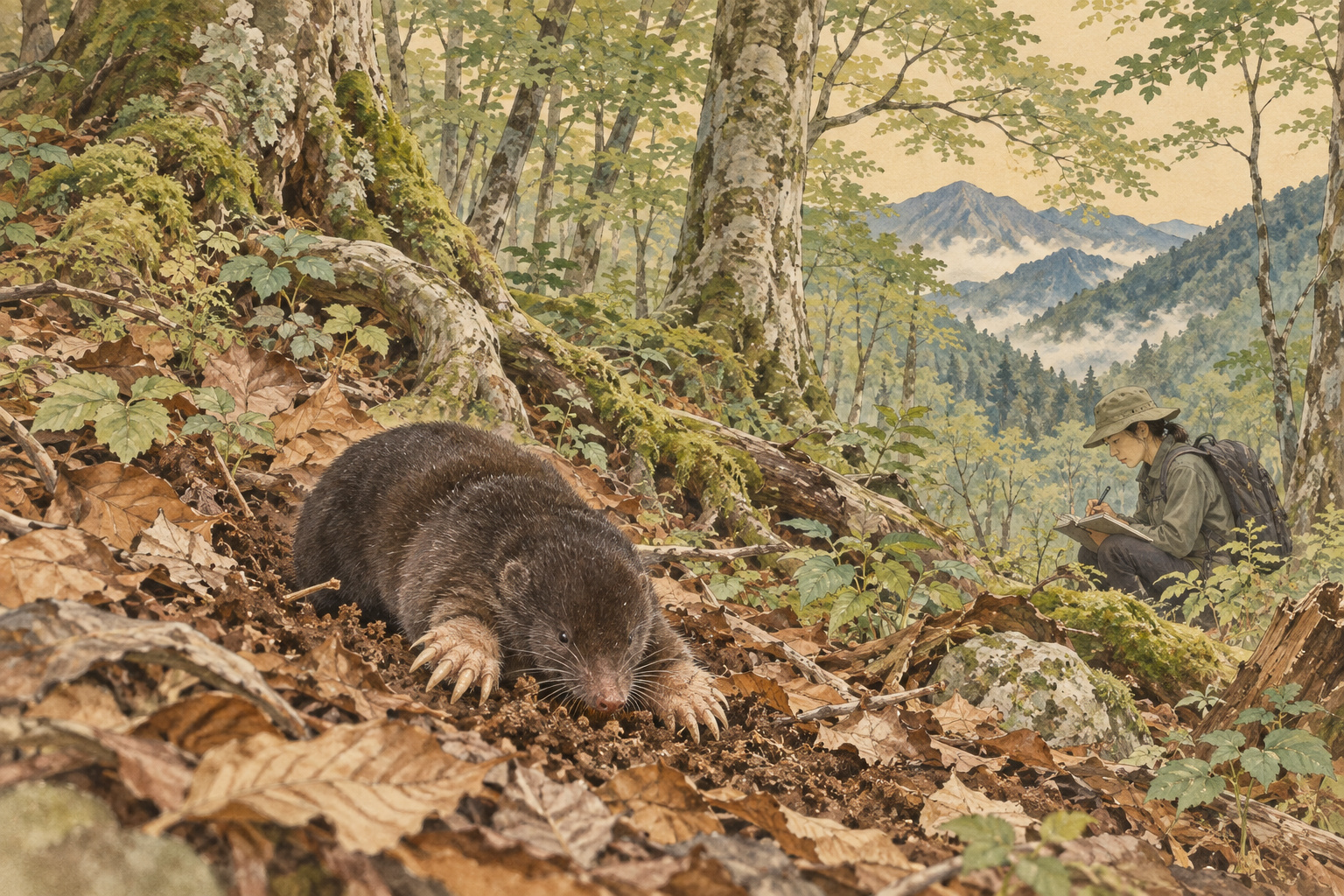
A small mammal has added a new point to Shirakami-Sanchi’s wildlife map. Hirosaki University announced on September 2 that researchers had confirmed the Japanese mountain mole in the region for the first time, after examining a specimen found near the Anmon Falls.[1]
A specimen, rather than a new species
The report in Mammalian Science describes a dead mole recovered on a forest road at about 320 metres elevation in the World Heritage buffer area. The specimen is preserved at Hirosaki University’s Shirakami research center. The paper appeared online on July 30.[2]
The animal, Oreoscaptor mizura, was already known to science. What changed was the evidence for where it occurs.
A western addition to the distribution map
Previous Aomori records centered on the Hakkoda mountains and Mount Iwaki’s southern slopes. The new locality lies farther west, prompting the authors to suggest a wider distribution across Shirakami and its surroundings.[2]
That remains a possibility to investigate. One record cannot establish population size or continuous occupancy across a mountain range. Nor does a first recorded occurrence demonstrate that the animal recently arrived.
The forest beyond its familiar trees
Japan’s Environment Ministry describes Shirakami-Sanchi as a mountain region spanning Aomori and Akita. Around 17,000 hectares in its central part form the World Heritage area, preserving extensive natural beech forest and an interconnected community of plants and animals.[3][4]
The mole adds a less conspicuous subject to that picture. A forest can be internationally recognized while basic questions about its wildlife remain open.
What researchers still want to know
The university identifies the species’ preferred habitat and its relationships with other moles as poorly understood. It sees the find as a starting point for investigating those questions.[1]
The significance lies in a documented occurrence that future research can build on. Knowing a species is present is the beginning of understanding how it lives within a forest.
Sources and further reading
- Hirosaki University: announcement, September 2, 2026 (Japanese)
- Original report: first record of Oreoscaptor mizura in Shirakami, Mammalian Science 66(2), 271–274 (Japanese)
- Ministry of the Environment: Shirakami-Sanchi World Heritage area (Japanese)
- Ministry of the Environment, Tohoku office: forest ecosystem overview (Japanese)
