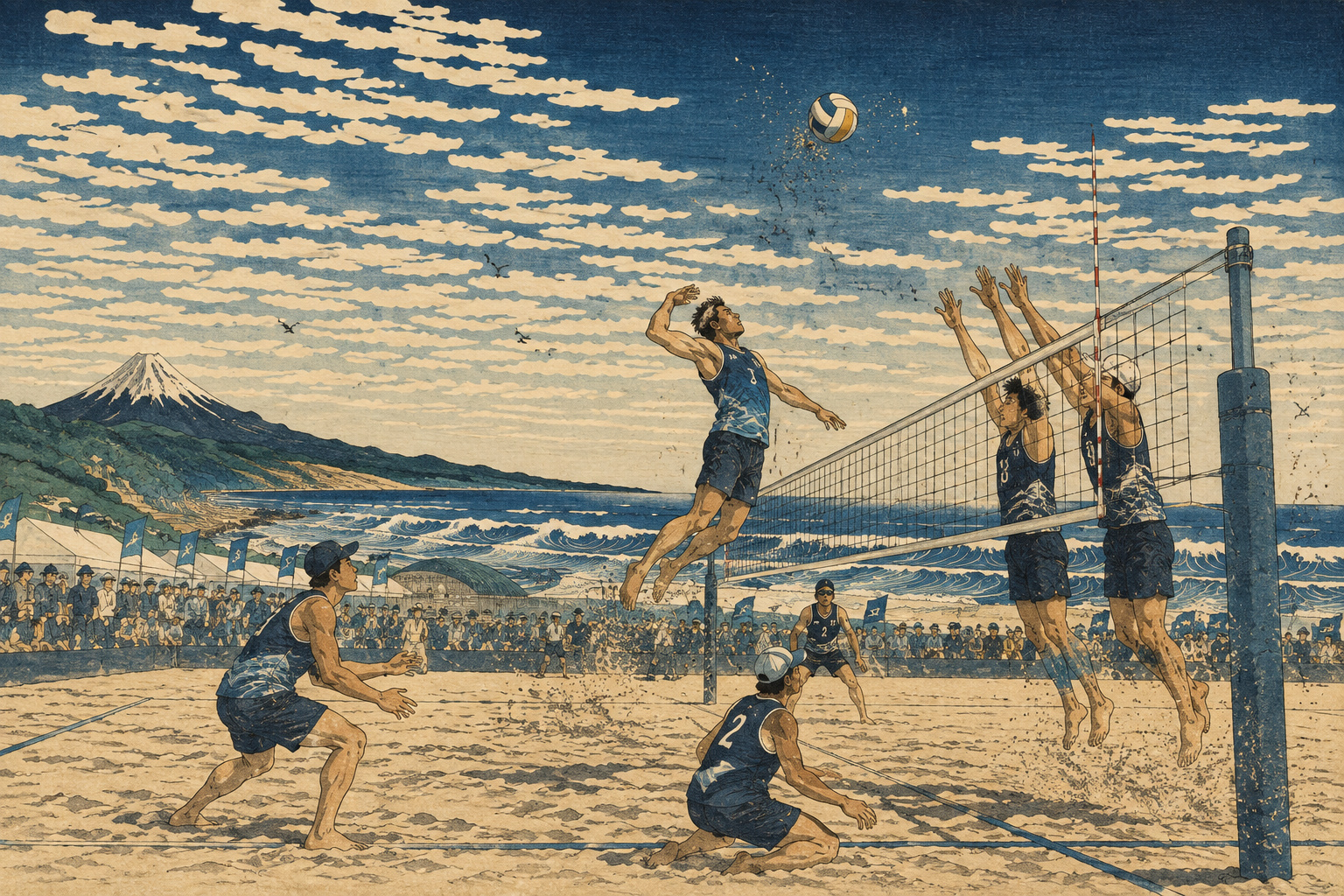
A national multi-sport festival can feel abstract until it is reduced to two teenagers, one ball and a rectangle of sand. At 9:30 a.m. on September 3, the first beach-volleyball matches of the 80th Japan Games are scheduled to begin on four temporary courts at Sunset Beach Asamushi in Aomori City. By 1 p.m., 16 opening-round matches—eight for boys and eight for girls—are due to have started or finished.
A tournament that starts before the opening ceremony
The main session of the Aomori Japan Games runs from October 10 through October 20. Beach volleyball, however, belongs to the first pre-opening phase, scheduled from September 3 through September 13. That phase contains 13 official sports and is expected to involve 7,175 athletes and coaches from all 47 prefectures.
The distinction matters. The 7,175 figure is not the size of the beach-volleyball field; it covers the entire first pre-opening phase. Beach volleyball’s allocation is 144 people: 96 athletes and 48 coaches. Nor is Asamushi the only place where the Games stir on September 3. Artistic swimming, gymnastics and clay target shooting are also among the opening-day sports.
Still, the beach tournament provides one of the Games’ first visible competitive moments. The ceremony comes later. The bracket comes first.
The prefecture on the shirt
Each division contains 24 prefectural teams. Regional allocations provide one berth for Hokkaido, three for Tohoku, four for Kanto, two for Hokushinetsu, two for Tokai, three for Kinki, two for Chugoku, two for Shikoku and four for Kyushu. Host Aomori receives the remaining place.
The teams have emerged through prefectural and regional-block competition, but the rulebook strips away much of their everyday identity at the national stage. The team name and the name displayed on the uniform must be the prefecture. High-school names are not permitted, and even labels such as “Aomori Select” are barred.
That is more than uniform housekeeping. It expresses the institutional logic of the Games: athletes compete as territorial representatives, and their results feed prefectural standings. In indoor team sports, that identity is distributed across a large roster. On the beach, two players carry it.
The age standard covers competitors born from April 2, 2008, through April 1, 2011, corresponding to Japan’s three high-school-age cohorts. The rule defines age rather than guaranteeing a participant’s school status, but the event is plainly both a national title contest and part of Japan’s youth-development pathway.
No place to hide in a two-player game
The court measures 16 by 8 meters. The first two sets are played to 21 points and a deciding third set to 15; a team must win two sets. Every Aomori match is a best-of-three contest. The format is single elimination, followed by matches to determine third and fourth place and the tied placement positions fifth and seventh.
Two-player volleyball exposes skill and decision-making. Both athletes must receive, set, attack, defend and manage the block-and-backcourt relationship. Sand reduces acceleration. Outdoor air changes the ball’s path. Sun angle, wind direction and the condition of the surface are not scenic background; they are part of the problem each pair must solve.
The official Aomori introduction also notes that a beach-volleyball ball is held at lower internal pressure than an indoor ball, slowing it and helping rallies continue. The effect is not to make the sport easier. It gives opponents more time to extend a point—and gives a tired pair one more problem to solve.
Aomori enters at 10:40
Under the brackets published on August 16, Aomori’s boys are scheduled to play Saga at 10:40 a.m. on Court A. Aomori’s girls are due on Court C at the same time against Tottori. These are announced pairings, not completed results, and late participation changes or operational revisions must be checked against event-day information.
| Date | Boys: Courts A and B | Girls: Courts C and D | Scheduled times |
|---|---|---|---|
| Thu., Sept. 3 | Opening round, 8 matches | Opening round, 8 matches | 9:30 / 10:40 / 11:50 / 13:00 |
| Fri., Sept. 4 | Second round, 8 matches | Second round, 8 matches | 9:30 / 10:40 / 11:50 / 13:00 |
| Sat., Sept. 5 | Quarterfinals and semifinals | Quarterfinals and semifinals | Quarterfinals 9:30 and 10:40; semifinals 13:00 |
| Sun., Sept. 6 | Placement matches and final | Placement matches and final | 9:30 / 10:40 / 11:50; finals 13:30 |
From postwar reconstruction to “JAPAN GAMES”
The institutional history behind this small tournament begins with a national event spread across 1946 and 1947. The first edition opened with summer competition in Hyogo, continued with an autumn program across Kyoto, Osaka, Shiga, Nara and Hyogo, and then brought winter skating to Hachinohe in Aomori Prefecture in January 1947. The Japan Sport Association records that 5,377 athletes arrived carrying their own food. In an era of disrupted transport and scarcity, staging the Games was itself part of the stated effort to help build a new postwar Japan.
From 1961, the festival became an important event under national sports legislation, and its current co-hosts are the Japan Sport Association, the Ministry of Education, Culture, Sports, Science and Technology, and the host prefecture. The event’s legal basis now sits in the Basic Act on Sport.
In 2024, the Japanese name changed from Kokumin Taiiku Taikai—the National Sports Festival—to Kokumin Sports Taikai, abbreviated Kokuspo. The official English branding became “JAPAN GAMES.” A new name does not by itself modernize a large public event, but it invites a broader test: can the Games serve not only elite competition, but also spectators, volunteers, community sport and durable regional value?
Aomori last hosted the main festival in 1977, when the Asunaro National Sports Festival became the first edition to stage its winter, summer and autumn seasons entirely within one prefecture. Asamushi was part of that earlier map: its yacht harbor hosted sailing during the summer program. Forty-nine years later, the same seaside district is receiving beach volleyball and open-water swimming.
The 80th edition returns under the name “Aono Kirameki Aomori Kokuspo,” with the slogan “Soar toward the future, riding the wind of Jomon.” The milestone edition, Aomori’s long interval and Asamushi’s own history as a waterside sports venue now meet in one event.
How beach volleyball moved into the national festival
The Japan Volleyball Association records the launch of the men’s national Beach Volleyball Japan championship in 1987 and the women’s Beach Volleyball Japan Ladies championship in 1990. Beach volleyball became an Olympic medal sport at Atlanta 1996. Four years later, Yukiko Takahashi and Mika Saeki finished fourth for Japan at the Sydney Games. Junior championships, university events, national championships and a tour circuit have since widened the domestic pathway through coastal venues.
Its place inside the National Sports Festival also evolved. The Japan Volleyball Association’s 2015 business plan listed the Wakayama beach-volleyball event as an “event project.” Its 2018 plan identified beach volleyball at the 73rd National Sports Festival in Obama, Fukui Prefecture, as an official competition. The reviewed documents establish a transition in status; they do not, by themselves, settle every procedural question about the single first year of permanent official inclusion.
That distinction is important because institutional history is often flattened after a sport becomes familiar. The 2026 tournament is not merely an Olympic discipline dropped onto a scenic beach. It is the result of a domestic structure that now links regional qualifying, youth development and prefectural scoring.
Asamushi has already rehearsed
Sunset Beach Asamushi lies on the western side of the Asamushi Onsen district, facing Mutsu Bay. The resort’s older hot-spring streets are east of the railway station; the beach and water recreation are to the west. Official tourism information places the district about 20 minutes by train from Aomori Station.
The venue has not been reserved for a single ceremonial week. In September 2025 it hosted the Japan Beach Volleyball Tour Satellite Aomori event as the discipline’s official rehearsal competition. On September 9, 2026, the same special venue is also scheduled to receive the Japan Games open-water swimming race.
Repetition creates the possibility of institutional memory: how to build on sand, move competitors, brief volunteers, manage spectators and coordinate land and water safety. It does not automatically create a legacy. Publicly reviewed documents did not establish the full temporary-venue cost, spectator capacity, post-event restoration plan or a guaranteed calendar of future competitions.
Japan.co.jp analysis: five tests beyond the podium
- Competition: Did qualifiers receive fair and safe conditions in which to perform?
- Operations: Were changes involving wind, heat, lightning, transport or timing communicated quickly?
- Development: Is there a visible route for Aomori juniors to enter and continue in the sport after the Games?
- Place: Did the beach, station, hot-spring district and local businesses connect in a way that can outlast four days?
- Accountability: Can cost, use, environmental restoration and recurring benefit be measured afterward?
The result after the result
The boys’ and girls’ finals are scheduled for 1:30 p.m. on September 6. Winners will leave with rank and prefectural points. Every competitor will leave with the unusually concentrated experience of representing a place through a two-person team.
Aomori’s result will take longer to read. It will appear in whether the temporary knowledge becomes permanent capability, whether local young people find a court and coach after the banners come down, and whether Asamushi remains a working sports venue rather than a remembered backdrop.
The first serve on September 3 begins a championship. It also begins the more difficult accounting of what a national festival leaves behind.
Sources and documentation
- Aomori Japan Games, Volleyball Competition Guidelines (dates, field size, format, qualification and age rules; Japanese)
- Aomori Japan Games, Beach Volleyball Competition Schedule (Japanese)
- Japan Volleyball Association, 80th Japan Games event page (Japanese)
- Japan Volleyball Association, Boys’ Tournament Bracket (August 16, 2026; Japanese)
- Japan Volleyball Association, Girls’ Tournament Bracket (August 16, 2026; Japanese)
- Aomori Japan Games, Volleyball introduction and venues (Japanese)
- Aomori Japan Games, competition periods (Japanese)
- Japan Sport Association, first pre-opening phase overview (August 28, 2026; Japanese)
- Japan Sport Association, Japan Games overview (Japanese)
- JSPO Plus, history and stated value of the national festival (Japanese)
- Japan Sport Association, first Games overview (1946–47 venues, Hachinohe winter competition and food carried by athletes; Japanese)
- Japan Sport Association, 32nd Games overview (1977 Asunaro festival and Asamushi Yacht Harbor; Japanese)
- Aomori Japan Games, official event name, history and slogan (Japanese)
- Aomori Japan Games, official rehearsal competitions (Japanese)
- Amazing AOMORI, official Asamushi Onsen visitor information (Japanese)
- Japan Volleyball Association, 2015 Business Plan (event-project description; Japanese)
- Japan Volleyball Association, 2018 Business Plan (official-competition description; Japanese)
- Japan Volleyball Association, institutional history (national championships, Olympic adoption and Japan’s Sydney result; Japanese)
- FIVB, Beach Volleyball History (Olympic debut)
This report checked materials published by 3:00 a.m. JST on September 2, 2026, and was written before competition began. It separates announced participation from actual starters, the 7,175-person phase-wide figure from the 144-person beach allocation, and event-wide claims from venue-specific evidence. Japanese official sources were used for event names, divisions, rules, schedules and terminology.
Image rights: © 2026 Japan.co.jp. This is an AI-assisted editorial illustration. Unauthorized republication or reuse is prohibited. For licensing, use the contact page.