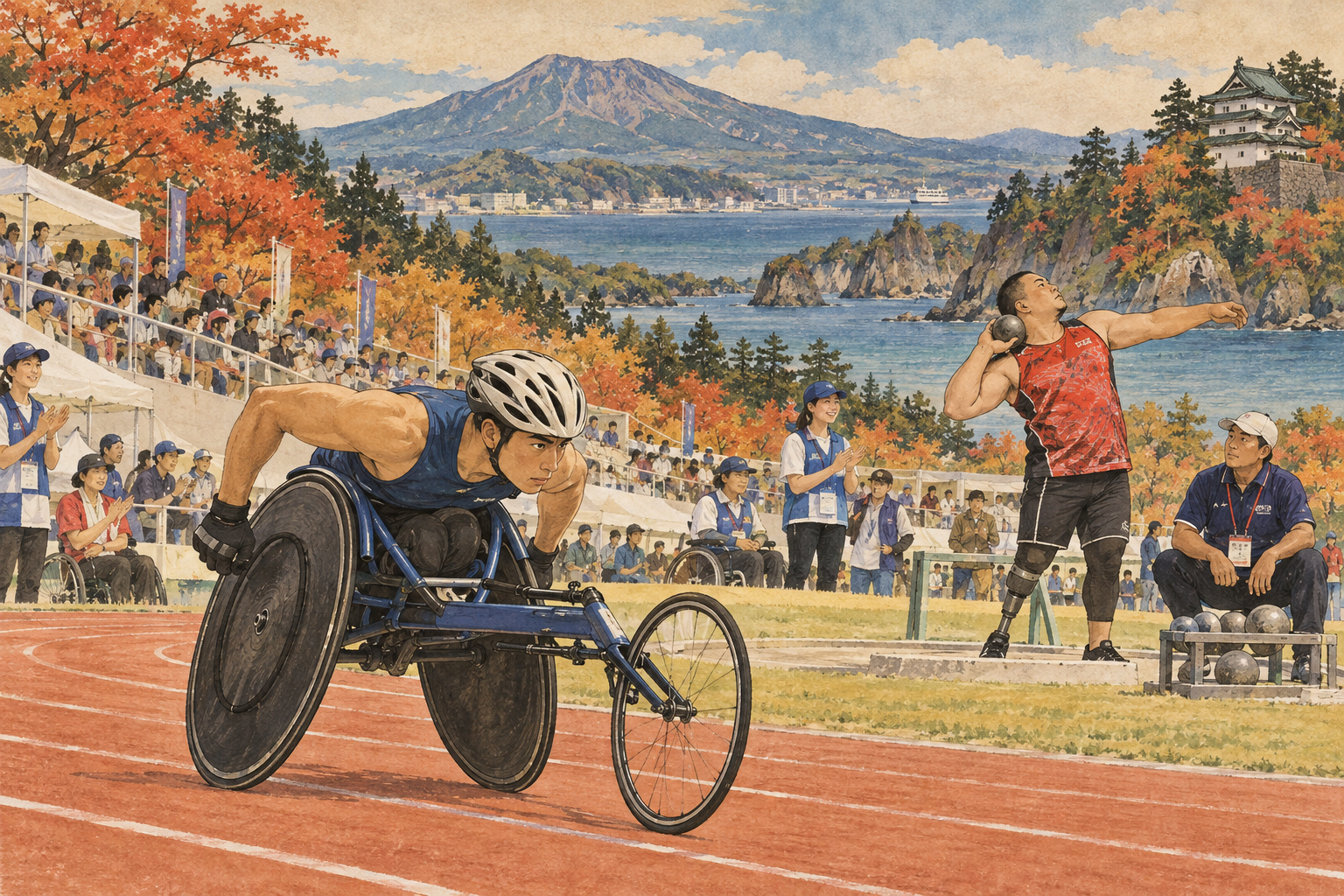
In boccia, the next decision may be whether to approach the white target ball or move another ball out of the way. In flying disc, the challenge may be accuracy rather than distance. In sound table tennis, a rolling ball supplies information through sound. Aomori’s National Sports Festival for People with Disabilities brings these different forms of sporting judgment into view from October 23 to 26.
The 25th edition, branded Ao no Kirameki Aomori Shospo, has opening and closing ceremonies scheduled at Maeda Arena in Aomori city, with competition distributed around the prefecture. Its significance lies both in the performances and in the arrangements that allow athletes to take their places on a national stage.[1]
A return after 49 years—and a first
Aomori last hosted the predecessor National Sports Festival for People with Physical Disabilities in 1977. The organizing committee describes 2026 as a return after 49 years, but also the prefecture’s first staging of the present National Sports Festival for People with Disabilities. Both descriptions are accurate: the institution has changed in the intervening decades.[2]
The 1964 Tokyo Paralympics helped stimulate the development of disability sport in Japan. A historical account from the health ministry describes national competition for people with physical disabilities beginning the following year in the prefecture hosting the National Sports Festival. It also traces a growing understanding of sport as something to enjoy in its own right, beyond its association with rehabilitation.[4]
A separate national festival for people with intellectual disabilities began in 1992. The two were brought together in 2001, when Miyagi hosted the first edition of the combined festival. Volleyball for athletes with psychosocial disabilities joined at the 2008 Oita edition, according to the history published by the Saga organizing authorities.[5]
That sequence explains why the 1977 connection matters without making this a simple anniversary. The Aomori event of 2026 belongs to a broader framework of participation than the event held there almost half a century earlier.
Participation with a competitive purpose
The Japanese Para-Sports Association describes the festival as promoting enjoyment of sport, greater public understanding of disability and social participation. Its overview identifies competitors as athletes aged 13 and over selected by prefectures or designated cities. Individual eligibility remains subject to the relevant competition requirements; this is not an event where a visitor can simply arrive and enter.[3]
The association also explains why competitions use disability and age divisions, and why some team sports assign players points related to impairment. These arrangements seek to prevent the type or degree of disability from determining the outcome in place of sporting skill.[3]
For a spectator, that changes the useful question. What choice did the player make? How accurately was it executed? How did an opponent respond? Broader access and serious attention to performance belong in the same account of the festival.
Fourteen sports, different ways to read a contest
The Aomori program lists seven individual and seven team sports. Alongside athletics, swimming and table tennis are boccia, flying disc, blind baseball and foot softball. Eligibility differs by sport. The published program includes physical, intellectual and psychosocial disability categories in table tennis and volleyball.[6]
Boccia provides a particularly clear introduction to tactical play. Players seek to place red or blue balls near the white jack, and can change the position by striking other balls. The organizer’s explanation includes the use of a ramp by players unable to throw, with the athlete communicating their intentions to an assistant. Aomori Prefectural Budokan in Hirosaki is the competition venue.[7]
The equipment is part of how the play happens. The decision remains something to follow: the route chosen, the space left, the possibilities created for the next ball.
Flying disc, also hosted in Hirosaki, has two distinct challenges. Accuracy involves aiming through a circular target; distance measures how far the disc travels. The venue is the athletics stadium at Hirosaki City Sports Park. Knowing which challenge is being contested helps a newcomer understand what a successful attempt looks like.[8]
Sound table tennis asks spectators to attend to a different source of information. The organizer describes players with visual impairments using the sound of a ball containing metal pieces, struck with rackets without rubber coverings. It is included in the table-tennis program at Kakuhiro Group Super Arena in Aomori city.[9]
A festival spread across communities
The official schedule assigns wheelchair basketball to Misawa, basketball to Mutsu and volleyball for athletes with psychosocial disabilities to Goshogawara. Football in Hachinohe is scheduled for October 24–26, continuing into the closing day. The four-day overall period should therefore be read alongside each sport’s dates.[1]
For the host communities, the geography brings both opportunity and responsibility. Athletes and spectators encounter local facilities, routes and people. Directions, places to rest and the way information is communicated all become part of the experience of a national event.
Preparation has a practical timetable
The prefectural committee describes its rehearsal competitions as opportunities to improve event operations and officiating, while building public understanding. Its published rehearsal page includes May 31 schedules and links to results for sports including swimming, table tennis and boccia. Competition itself has formed part of the preparation process.[10]
The committee’s current volunteer update lists assignment notices for August–September and clothing and other identifying items for dispatch from mid-September into early October. Duties include reception, guidance, cleaning, wheelchair lending and ceremony assistance. Recruitment for that operational volunteer program has closed.[11]
Those are concrete preparations, but a timetable is not an independent assessment that every venue is ready. The quality of arrangements ultimately has to be judged through the experience of the people using them. That distinction matters in reporting an event whose stated purpose includes participation.
Making a welcome understandable
Since fiscal 2024, the organizers have distributed sign-language explanation videos as part of their “Motena Shuwa” campaign. The material introduces everyday and event expressions, including thanks and applause, alongside information intended to improve understanding of disability.[12]
Learning an expression can begin a conversation. It cannot by itself meet every communication need. Asking someone which method works for them, and what assistance they actually want, makes a welcome more practical.
The question extends beyond October. Can useful ways of giving directions, communicating and supporting participation remain in everyday sports facilities? That is a question for reporting after the festival, rather than a legacy that can already be declared achieved.
Before choosing a seat
Aomori city advises that some competitions may change admission times or require advance spectator applications. Start with the particular sport, date and venue, then check the latest admission information.[13]
Anyone needing a step-free route, wheelchair viewing space, suitable toilets or communication support should confirm the specific arrangements with the venue or organizer. Follow event instructions on cheering and quiet periods, especially where players use sound during competition.
The sporting invitation is to pay close attention: to an athlete’s technique, to the decision before a shot, and to the response that follows. Aomori’s festival also offers a local question with a longer life—what must a community put in place so that more people can keep playing?
Sources and further reading
- Aomori organizing committee: Disability sports competition calendar (Japanese)
- Aomori organizing committee: About the 25th festival (Japanese)
- Japanese Para-Sports Association: National festival overview (Japanese)
- Health ministry: Disability sport policy report, 2011—historical background (Japanese)
- Saga Prefecture: SAGA2024 overview and national festival history (Japanese)
- Aomori organizing committee: Sports and eligibility categories (Japanese)
- Aomori organizing committee: Boccia (Japanese)
- Aomori organizing committee: Flying disc (Japanese)
- Aomori organizing committee: Table tennis and sound table tennis (Japanese)
- Aomori organizing committee: Rehearsal competitions (Japanese)
- Aomori organizing committee: Current operational volunteer information (Japanese)
- Aomori organizing committee: Motena Shuwa sign-language campaign (Japanese)
- Aomori city organizing committee: Festival schedule and spectator notices (Japanese)
