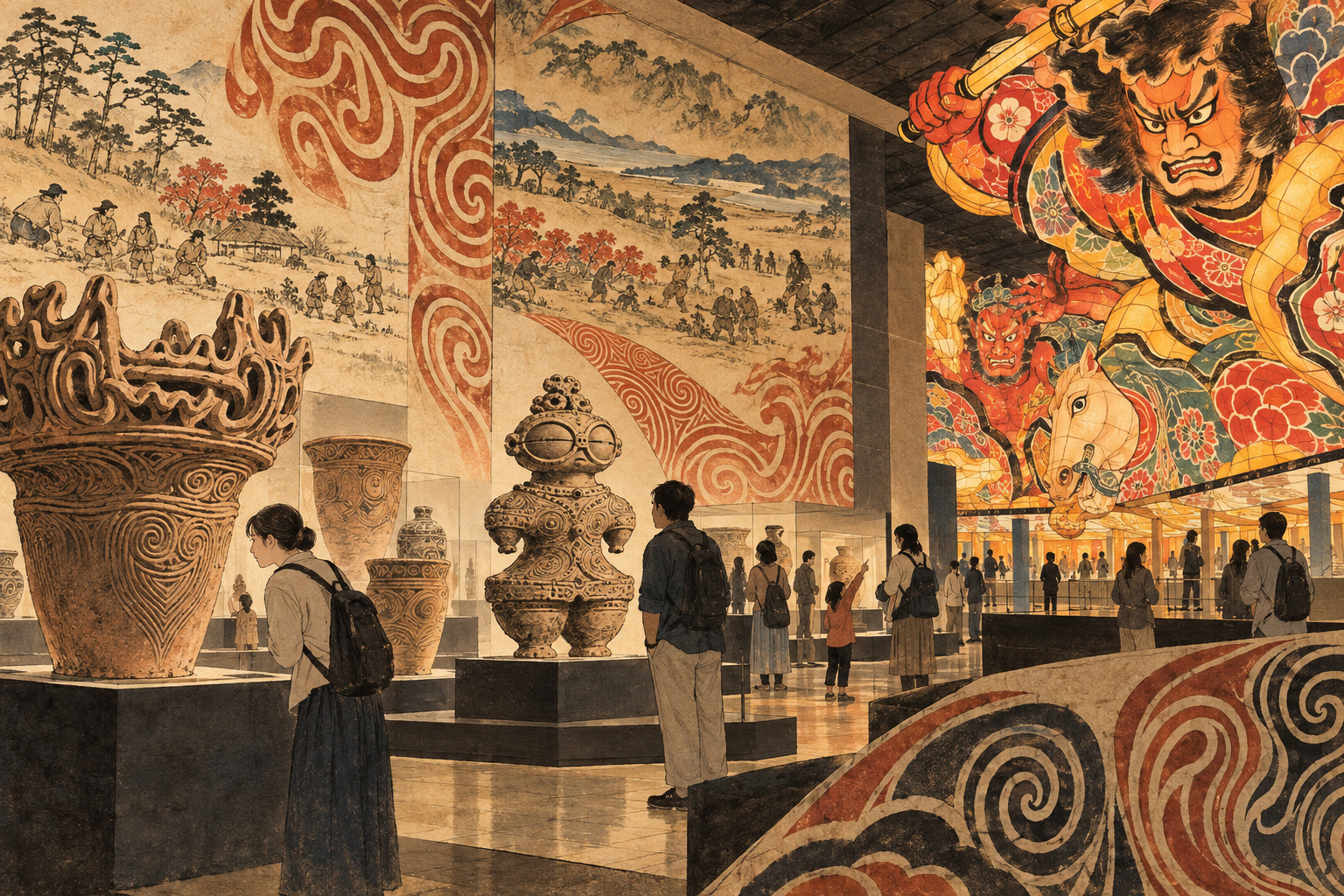
A decorated manuscript, a clay figure and an illuminated festival float ask different things of the eye. Aomori Museum of Art brings them into the same conversation in its 20th-anniversary exhibition, 装飾する魂—a title that can be rendered as “The Decorating Soul”—which reaches its scheduled final day on Sunday, September 27.[1]
The pleasure of the subject is that it begins with something familiar. We choose patterned clothes, arrange flowers and wrap presents. Yet the question becomes more demanding when the decorated object belongs to a distant society: what did making its surface beautiful accomplish, and for whom? This exhibition offers a way into that question through Aomori’s own artistic and archaeological surroundings.
A museum built beside deep history
The museum opened on July 13, 2006, beside the Sannai-Maruyama archaeological site. Architect Jun Aoki drew on the excavation landscape in designing a building where cut-away ground and a white structure meet. The museum’s connection to Jomon culture is therefore architectural as well as curatorial. Its anniversary provides an opportunity to reconsider a relationship present from the beginning.[3]
Supervising the exhibition is Mayumi Tsuruoka, an art anthropologist and professor emerita at Tama Art University. Rikkyo University’s announcement for a related academic event places ornament across bodies, clothing, buildings and environments. Its framing asks what that long human activity can contribute to contemporary creativity. This is an interpretive proposition, inviting visitors to consider decoration as part of living rather than simply an addition to useful things.[4]
Before the pattern, consider the society
The Jomon Prehistoric Sites in Northern Japan were inscribed on UNESCO’s World Heritage List on July 27, 2021. The 17 sites preserve evidence of long-lasting settled communities based on gathering, fishing and hunting, together with their spiritual life. That context matters when looking at pottery or figurines: an arresting surface belonged to a society, not to an isolated exercise in design.[5]
Hakodate’s National Treasure hollow clay figurine is scheduled to be displayed in the original through September 27, following an earlier period represented by a replica.[2] Hakodate City dates the object to about 3,200 years ago, late in the Late Jomon period. A local resident discovered it during agricultural work in 1975; it became Hokkaido’s first National Treasure in 2007.[6]
Its survival offers an encounter with an individual object, while leaving questions about ancient intentions open. A useful way to look is to separate what the object shows from what an explanation proposes. Follow a line across the body, read the archaeological context, then return to the form. Recognition need not become certainty about meaning.
Two very different Irish pasts
The Book of Kells appears through facsimile and projection, not as a loan of the original manuscript.[1] Trinity College Dublin, its custodian, describes a richly decorated Latin copy of the four Gospels made around AD 800. Its pages combine a text intended to be read with a visual field that rewards looking beyond the words.[7]
Newgrange belongs to a much earlier world. Ireland’s public heritage service dates the great passage tombs of Brú na Bóinne, including Newgrange, to approximately 3200 BC.[8] A visitor comparing Irish monumental ornament with medieval manuscript decoration is crossing thousands of years, not moving through a single undifferentiated Celtic moment.
That distinction makes comparison more interesting. Similar curves may draw the eye, but resemblance alone does not establish a shared belief or a route of transmission. Dates, materials and uses deserve as much attention as shape. The rewarding question is how different makers put ornament to work in particular circumstances.
Munakata and a more traceable connection
One connection comes through a modern artist. The exhibition’s press material says that potter Shoji Hamada introduced Shiko Munakata to patterns in the Book of Kells, which stimulated his work.[2] This account concerns an encounter between artists and images; it is a different kind of claim from a comparison between prehistoric forms.
Born in Aomori in 1903, Munakata developed the woodblock practice he called 板画, using that written term from 1942, according to the museum’s biography. International recognition followed, including major printmaking awards at the São Paulo Biennial in 1955 and Venice Biennale in 1956.[9]
His career gives a regional anniversary exhibition a wider horizon. Looking outward does not require abandoning local identity. It can reveal how that identity was formed through encounters, choices and transformations. A pattern received from elsewhere becomes interesting through what an artist does with it.
Decoration when life must be rebuilt
Another useful historical perspective comes from Aomori-born Wajiro Kon. The museum’s earlier retrospective documented his work decorating improvised buildings after the Great Kanto Earthquake, as well as the observations of clothing, possessions and behaviour associated with his study of contemporary everyday life, known as kogengaku.[10]
The example sharpens the exhibition’s underlying question. When shelter is urgently needed, what place is there for colour or pattern? Kon’s work invites consideration of surroundings as something people inhabit emotionally as well as physically. Ornament can be discussed through ordinary experience: whether a place welcomes, comforts or interests the people using it.
From surviving objects to living makers
The exhibition material identifies a new work by Nebuta master Hiroo Takenami as NEBUTA 将門, or NEBUTA Masakado.[2] It brings the discussion towards a form still being made, where the maker’s decisions belong to the present.
The official Aomori Nebuta Festival history explicitly says the festival’s origins are uncertain. It discusses a possible development from Tanabata lantern-floating and local customs.[11] That qualification is worth retaining. An exhibition can bring Jomon objects and Nebuta into dialogue without demonstrating an uninterrupted line of descent between them.
For visitors, the distinction leaves room for both curiosity and care. A comparison may change how we see a familiar festival form, while historical evidence determines what we can responsibly say about its origins.
The final Sunday
Published exhibition hours are 9:30am–5pm, with last entry at 4:30pm. Same-day admission is ¥1,700 for adults and ¥1,200 for university students. Visitors aged 18 or under and high-school students enter free; except for preschool children, they must collect a free ticket at the counter.[1]
The museum also schedules its shared mural workshop on September 27, from 10am–noon and 1–3pm in the basement-one workshop area. Participation is free without advance booking. Contributions may be painted over by other participants, making the surface a shared creation rather than a series of protected individual pictures.[12]
That offers an appropriate way to finish: move from examining marks made by others to making a mark of your own. The exhibition closes, but the question can travel home—to the clothes, rooms and everyday objects through which people continue to shape their surroundings.
Sources and further reading
- Aomori Museum of Art: official exhibition, display dates and admission
- Aomori Museum of Art: exhibition press material (PDF)
- Aomori Museum of Art: institutional history and architecture
- Rikkyo University: related academic programme and Mayumi Tsuruoka
- Jomon Prehistoric Sites in Northern Japan: official overview
- Hakodate City: hollow clay figurine history
- Trinity College Dublin: Book of Kells
- Heritage Ireland: Brú na Bóinne passage tombs
- Aomori Museum of Art: Shiko Munakata
- Aomori Museum of Art: historical Wajiro Kon retrospective
- Aomori Nebuta Festival: origins and historical qualifications
- Aomori Museum of Art: participatory mural and lettering programme
