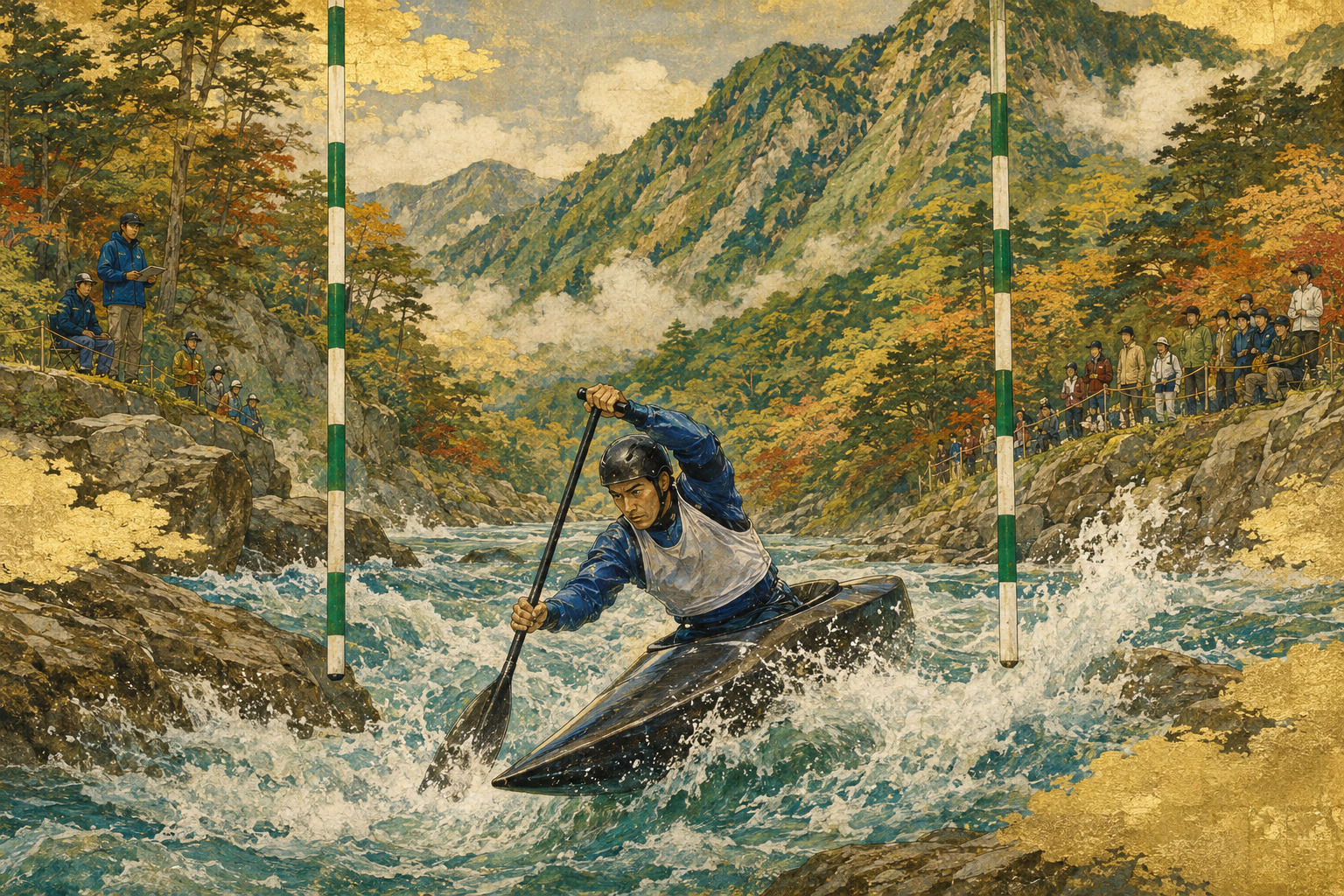
A canoe slalom final is a negotiation with water that will not repeat itself. The poles remain suspended over the same channel, but the eddy that releases one boat can hold the next. On Sunday, 55 paddlers on the published start lists will each be given two chances to solve that problem at the Meya Gorge Iwaki River Canoe Course in Nishimeya, Aomori Prefecture.
The September 6 program at the 80th National Sports Games—branded the Aono Kirameki Aomori Kokuspo—comprises four 15-gate medal events: women's and men's kayak single, or K-1, and women's and men's Canadian single, or C-1. The first run begins with women's K-1 at 9:10 a.m. A second series starts at 12:20 p.m., and the event awards ceremony is scheduled for 4:00 p.m.
Sunday is the second slalom medal day, following Saturday's 25-gate races. It is not the end of canoe competition in Nishimeya. Wildwater sprint finals follow Monday on the same river, while the broader Kokuspo canoe program resumes October 15–18 with sprint racing on a separate course at Tsugaru Shirakami Lake.
How a clean run becomes a winning score
Slalom combines speed with accuracy. Green-and-white gates are taken downstream; red-and-white gates require the athlete to turn into the current and pass upstream. The official Aomori program describes a Kokuspo course of 200 to 400 meters. A run score combines elapsed time with penalties, and the lower total wins.
Touching one or both poles at a gate adds two points, no matter how many contacts occur at that gate. Missing a gate or passing it incorrectly adds 50. Because one second of elapsed time is treated as one point, a single touch can erase a narrow speed advantage; a 50-point penalty will normally destroy a medal run.
Every athlete receives two runs, and only the better result is used for the final ranking. That format changes risk. A clean first run creates permission to attack the second. A damaged first run forces the athlete to find speed while protecting every gate. It is not an aggregate test of consistency: one exceptional solution can defeat one safe run and one failure.
| Event | Entrants | First run | Second run | Aomori entry |
|---|---|---|---|---|
| Women's K-1 | 15 | 9:10 a.m. | 12:20 p.m. | None on published list |
| Men's K-1 | 24 | 9:50 a.m. | 1:00 p.m. | Kazuki Yazawa |
| Women's C-1 | 6 | 10:40 a.m. | 1:50 p.m. | Chinami Okamura |
| Men's C-1 | 10 | 11:02 a.m. | 2:12 p.m. | Sosuke Kuzuhara |
Starts are scheduled at two-minute intervals. Those 55 names therefore represent 110 timed medal runs if every listed athlete starts twice. A published list is not a guarantee of participation: late withdrawals, non-starts, equipment checks or weather adjustments can alter the field.
Kayak and canoe ask different questions
K-1 and C-1 share a river and gate sequence but not a paddling method. A kayak athlete sits in the boat and uses a double-bladed paddle, alternating sides. A Canadian canoe athlete kneels and uses a single blade. The C-1 paddler must generate propulsion, turning force and balance from one-sided strokes and cross-bow corrections without a rudder.
That difference is most visible at upstream gates. A kayak can accelerate or correct from either side with the next blade. A canoeist must decide whether to hold the working side, cross the paddle or use the hull and current to complete the rotation. The quickest line is not simply the shortest; it is the line that lets the boat leave the gate with speed.
The 15-gate event is a Kokuspo format paired with the 25-gate competition. It should not be confused with an Olympic final or assumed to follow the same progression of heats, semifinals and one medal run. In Aomori, the entire published field contests two final runs, and the best score counts.
Three host-prefecture boats
Aomori has three athletes on Sunday's start lists. Kazuki Yazawa represents the prefecture in men's K-1. Chinami Okamura is entered in women's C-1, and Sosuke Kuzuhara in men's C-1. Their names and readings—Yazawa Kazuki, Okamura Chinami and Kuzuhara Sosuke—are printed in the official Japanese competition program.
Yazawa brings the most recognizable résumé. The Japanese Olympic Committee records appearances at Beijing 2008, London 2012 and Rio 2016, with ninth place in London his best Olympic finish. He is listed tenth in Sunday's first-run order, scheduled for 10:08 a.m., then 13:18 in the second round.
For Nishimeya, Yazawa is the most prominent host-prefecture entry. The official start list records him for Aomori. Familiarity with a home river can help, but moving water cannot be memorized: level, speed and even the wave left by the previous boat can change. Local knowledge is not an answer so much as a vocabulary for reading change.
Okamura opens the six-boat women's C-1 list at 10:40 a.m.; Kuzuhara starts second in men's C-1 at 11:04. Home water offers knowledge, but also attention. A pole touch carries the same penalty for the local entry as for everyone else.
Champions return, but the course is new
The program's historical tables identify two 2025 winners who are entered again in their 15-gate events: Momoka Nagasu of Chiba in women's K-1 and Kosuke Saito of Mie in men's K-1. Nagasu is last in the women's first-run order at 9:38; Saito is 21st among the men at 10:30.
“Defending champion” is useful context, not a forecast. Gate positions are approved for this competition, water changes through the day and the shorter course magnifies the cost of a small hesitation. Experience can improve recognition of patterns, but nobody repeats last year's run.
The C-1 fields are smaller—six women and ten men—yet not necessarily simpler. With fewer boats, there is less time to read how the course is evolving between one's own runs. The athlete and coach must separate a competitor's error from a genuine change in the water.
A river course, not an arena built around one weekend
The Meya Gorge course sits on the upper Iwaki River in Nishimeya, at the edge of a landscape shaped by the Shirakami mountain system. The official address is Tashiro-Natsubotaira 65. The host program describes views toward Mount Iwaki and a course surrounded by deciduous forest; the village calls itself the “source-stream village” and has explicitly pursued community development through canoeing.
This is not a temporary course appearing only for the Kokuspo. The official program records Japan Cup and Shirakami Cup competition here. The repetition matters: a major event can leave expensive infrastructure behind, but a venue becomes part of a place only when it supports training, local work, smaller competitions and stewardship between ceremonies.
The course is also operationally exposed to nature. The implementation outline requires approved electronic timing at the start and finish, using photoelectric and video systems, but technology cannot standardize current, rain or debris. Organizers retain authority to alter the schedule for weather. Whitewater sport sells the drama of natural force; safe administration depends on respecting its limits.
What spectators are watching
- Entry angle: whether the bow arrives aligned before an upstream turn.
- Boat speed: not just into a gate, but out of it.
- Pole clearance: one touch adds two points to the score.
- Recovery: whether an error remains local or disrupts the next sequence.
- Second-run choices: attack after a safe score, or rebuild after a costly penalty.
From transport craft to Japanese medal sport
Canoes began as working vessels for transport, hunting and survival long before they became timed sport. The Aomori competition program traces modern recreational canoeing to 19th-century Britain, notes its demonstration appearance at the 1924 Paris Olympics and its inclusion as a medal sport at Berlin in 1936. Japan first entered Olympic canoe competition at Tokyo 1964.
Canoe became a formal event in the National Sports Festival in 1982, at the 37th edition in Shimane. Women's C-1 was added to the national-meet slalom program at the 2017 Ehime event, putting all four current individual slalom combinations—women and men, kayak and canoe—on Sunday's Aomori schedule.
Japan's international breakthrough came in a canoe, not a kayak. Takuya Haneda won men's C-1 bronze at Rio 2016, the first Olympic canoe-slalom medal by an Asian athlete, according to the JOC. That medal made the discipline visible far beyond its river communities. The domestic system, however, is sustained by a wider map of prefectural associations, block qualifying and courses such as Nishimeya's.
1936 — Canoe becomes an Olympic medal sport in Berlin.
1964 — Japan first competes in Olympic canoeing at the Tokyo Games.
1977 — Aomori hosts the 32nd National Sports Festival, the Asunaro Kokutai.
1982 — Canoe enters the National Sports Festival as a formal sport.
2016 — Takuya Haneda wins Rio C-1 bronze, Asia's first Olympic slalom medal.
2024 — The National Sports Festival is renamed the National Sports Games, or Kokuspo.
2026 — Aomori stages the 80th Games, 49 years after its previous hosting.
A national event measured by prefecture
The Kokuspo is not merely a collection of individual national championships. Athletes represent prefectures, and placings feed a points system. In canoe, individual events award eight points for first place, seven for second, down to one for eighth. Participation points also contribute to the overall prefectural totals. The Emperor's Cup recognizes the leading combined prefecture; the Empress's Cup the leading women's total.
That structure explains the start-list geography: 24 prefectures in men's K-1, only six in women's C-1. Entry limits are tied to qualifying routes, and the program warns that totals can change with the number of teams advancing through regional blocks. A small field may carry the same medal status while revealing a narrower national participation base.
The institution itself changed names in 2024, from Kokumin Taiiku Taikai—National Sports Festival—to Kokumin Sports Taikai, shortened to Kokuspo and branded in English as JAPAN GAMES. The annual prefectural competition dates to the immediate postwar period. Aomori organizers describe 2026 as the prefecture's first “complete Kokuspo” since the renamed system began, and its first comprehensive hosting since the 1977 Asunaro Kokutai.
What a successful Sunday would leave
The visible outcome will be four rankings. A broader measure begins after the awards: whether local children see a path into the sport; whether Nishimeya can keep attracting training and national races; whether access, river safety and environmental care improve; and whether the separate October sprint program converts a four-day whitewater audience into sustained interest.
There is a productive tension in presenting a river as a national stage. The course must be fair enough to rank athletes, yet alive enough to reward reading water. The village wants visitors and sporting identity, yet the river's ecological and safety limits must remain stronger than promotion. The Games can bring attention; the local institution must decide what that attention becomes.
At 9:10 on Sunday, the first boat will leave the start and the abstraction will end. Two runs, 15 gates, four titles. The smallest penalty can survive on the scoreboard long after the splash disappears. For one day, the upper Iwaki River is not scenery behind the competition. It is the competition.
Primary sources and references
- Aono Kirameki Aomori Kokuspo, canoe slalom and wildwater official program — Start lists and readings, detailed timetable, format, penalties, venue history and past medalists.
- 80th National Sports Games canoe implementation outline — Dates, disciplines, entry limits, rules, equipment and safety provisions.
- Official canoe slalom and wildwater competition timetable — September 6 run order and scheduled times.
- Aomori Kokuspo official canoe page — Discipline descriptions, venues and addresses.
- Nishimeya Village, slalom and wildwater guide — Japanese terminology, course explanation, dates and spectator access.
- Aomori Kokuspo official canoe results service — Result-status check at the reporting cutoff.
- Japan Sports Association Kokuspo Channel, September 6 canoe listing — Livestream page and scheduled start.
- Japan Canoe Federation, canoe slalom — Official Japanese explanation of K-1, C-1 and slalom technique.
- Japanese Olympic Committee, Kazuki Yazawa profile — Name, Olympic appearances and results.
- Japanese Olympic Committee, Takuya Haneda profile — Reading, career and the significance of his Rio bronze medal.
- Japan Sports Association, overview of the National Sports Games — Governance, prefectural structure and 2024 name change.
- Japan Sports Association, past Games — Edition sequence and host history.
Reporting note: This report was prepared from official material available by 6:00 p.m. JST on September 5, 2026. The entrant count of 55 is calculated from the four published September 6 start lists; it is not a confirmed number of starters. The official results service did not yet display verified September 5 slalom results when checked, so this report does not name Saturday's champions. Sunday starters, non-starts, course design, water level, weather decisions, run scores, penalties, medalists and attendance remained unresolved at the cutoff. The official competition program and host-village guide call Sunday's event “15 gates”; the Kokuspo Channel listing used “16 gates,” an unresolved naming discrepancy not used to rewrite the competition title. No athlete quotation was attributed without a Japanese primary record. The Japanese and English editions were structured and written independently.
Image rights: © 2026 Japan.co.jp. AI-assisted editorial illustration. No unauthorized reproduction or reuse. For licensing, see the contact page.