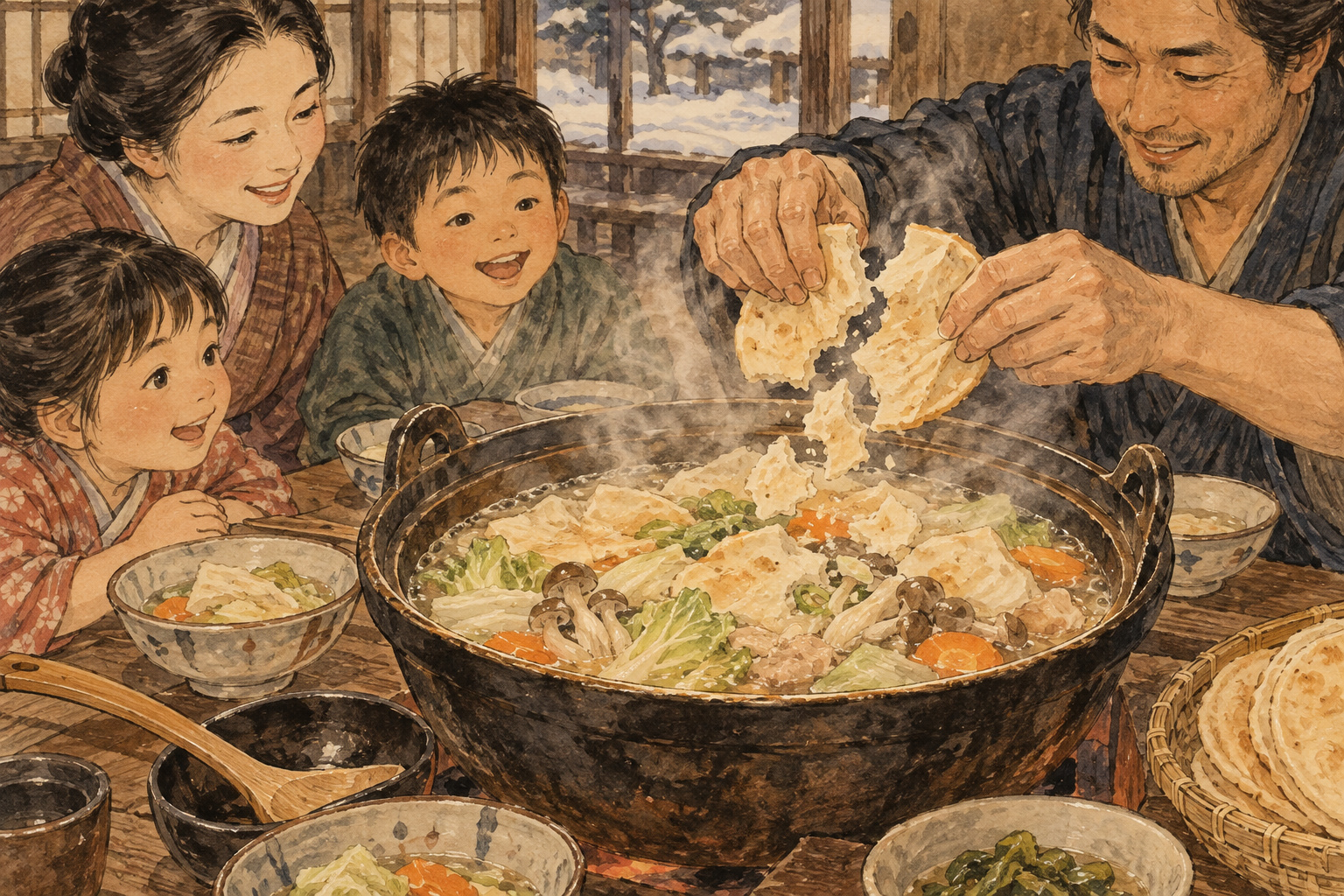
The crackers go into the pot. In Hachinohe senbei-jiru, pieces of purpose-made senbei simmer alongside ingredients such as chicken, vegetables and mushrooms, becoming part of the meal as they take up the broth. Aomori Prefecture’s account of the dish identifies that cooked texture as a defining feature.[1]
A cracker made for cooking
Nanbu senbei are traditionally made from wheat flour, salt and water, with the dough baked in round moulds. They belong to the food culture of the Hachinohe area and northern Iwate. The regional tourism organization, VISIT HACHINOHE, explains that the soup uses a special variety, otsuyu senbei, made to resist breaking down during simmering.[2]
That distinction matters when shopping for ingredients. “Senbei” is often rendered in English as “rice cracker,” but wheat is the starting point here. Look for crackers labelled for soup rather than assuming any snack cracker will produce the same result.
Broth with room for variation
Japan’s agriculture ministry describes chicken stock seasoned with soy sauce as a common base, with vegetables and shredded konnyaku among the additions. It also records salt-seasoned versions using cod or grilled mackerel, and a miso-seasoned horsemeat variation. There is room for different household traditions within the name.[3]
VISIT HACHINOHE compares the preferred texture to al dente pasta: broth has soaked into the cracker, but some firmness remains. The comparison helps explain why the cracker is an ingredient worth paying attention to in its own right.[4]
Regional ingenuity in a bowl
The agriculture ministry places Nanbu senbei in a region where cold-weather crop damage made rice difficult to grow and the crackers served as a preserved food. It also describes manufacturers developing soup crackers after the war. The precise origin of the soup has several accounts, rather than one securely established invention story.[3]
The result brings together two kinds of work: making a baked wheat food and preparing a broth that changes it. A dish with a simple name carries that practical relationship between the baker and the cook.
From home cooking to a regional introduction
VISIT HACHINOHE traces the Hachinohe Senbei-jiru Institute to a citizens’ volunteer group formed in 2003. Despite its English name, it is a community promotion group. The tourism organization also describes a packaged soup product developed with the group, offering another route from discovering the dish to preparing it at home.[5]
For home cooking, follow the chosen product’s instructions for ingredients, timing and simmering. There is pleasure in noticing how the crackers take up the flavour and in deciding how much firmness to keep. The bowl offers an introduction to Hachinohe through something made to be cooked, shared and cooked again.
Sources and further reading
- Aomori Prefecture: Regional dishes, Hachinohe senbei-jiru (Japanese)
- VISIT HACHINOHE: Nanbu senbei explained (Japanese)
- Ministry of Agriculture, Forestry and Fisheries: Senbei-jiru, Aomori (Japanese)
- VISIT HACHINOHE: Foods shaped by Hachinohe’s climate (Japanese)
- VISIT HACHINOHE: Hachinohe senbei-jiru and its community promoters (Japanese)
