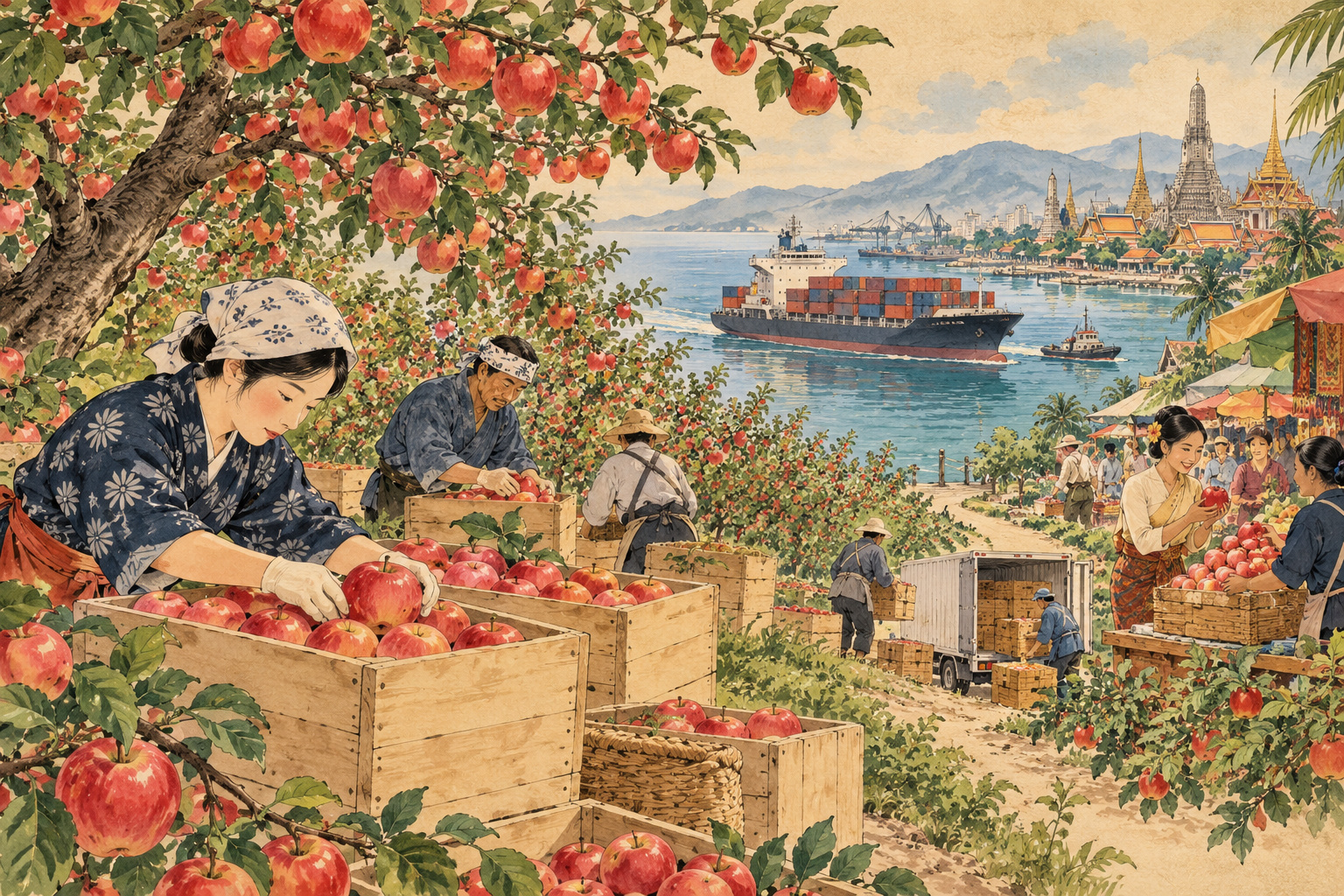
An apple’s journey from an Aomori orchard to a Thai shop begins well before it enters an export carton. It requires a buyer, a reliable supply chain and fruit that earns another purchase. A September announcement from Aomori Prefecture places that commercial relationship at the center of a new effort to develop the Thai market.
The prefecture said on September 16 that the Aomori apple industry council had invited Thai distribution businesses to visit apple-related facilities and support export expansion. A courtesy call at the prefectural government was scheduled for September 18. The notice describes a market-development initiative; it does not announce signed orders or additional export volumes.[1]
A visit is a beginning, not a sales result
For overseas distributors, a visit can provide a setting in which to discuss what a producing region can supply. For an orchard business, the useful outcome would be a clearer route to customers. Those are the potential commercial benefits of such exchanges, rather than verified results of this particular invitation.
The distinction matters. A promotional announcement can establish the purpose of a delegation without demonstrating that it generated new business. The available notice does not provide a completed itinerary or a post-visit account of negotiations.[1]
The export story also starts with harvest timing
A separate prefectural bulletin published on September 17 offers a revealing counterpoint to the marketing effort. It warned growers against harvesting the yellow Toki apple too early, reporting that prematurely picked fruit with inferior eating quality had caused problems in exports the previous year. It did not identify Thailand as the destination.[2]
The bulletin forecast the beginning of the Toki harvest around September 29 in Kuroishi and advised selective picking as fruit matures. That is a location-specific forecast, not a single harvest date for every orchard in Aomori.[2]
The practical lesson is straightforward: finding customers and satisfying them are connected tasks. An attractive appearance cannot substitute for eating quality. For the reader following regional business, the harvesting decisions behind a shipment deserve as much attention as the promotional activity ahead of it.
An export supply chain needs more than a buyer
Aomori’s 2026 guidance for Thailand-bound fruit sets out annual applications covering production sites and sorting-and-packing facilities, alongside standard operating procedures. These requirements connect orchard work with the businesses that prepare fruit for shipment.[3]
This is an overview of the production and distribution framework, not a finding that any named business meets every export requirement. The commercial point is that an overseas sale depends on coordinated work across several stages, rather than on a grower or distributor acting alone.
Why the regional stakes extend beyond one delegation
The prefecture’s apple strategy, adopted in September 2025, identifies fewer producers, labor shortages and weakening domestic consumption as challenges. It sets goals of maintaining production of at least 400,000 tonnes and sales of at least ¥180 billion. These are strategic targets, not results of the Thai initiative.[4]
Seen in that context, the invitation is one step in a longer effort to sustain a producing region. The next useful evidence would concern continuing trade and sales, rather than the visit alone. Aomori’s challenge is to connect the care taken in its orchards with customers who want to buy the fruit again.
Sources and further reading
- Aomori Prefecture: Thai distributor invitation and scheduled courtesy call, September 16, 2026 (Japanese)
- Aomori Prefecture: Apple Production Bulletin No. 11, September 17, 2026 (Japanese)
- Aomori Prefecture: 2026 guidance on production-site and packing-facility registration for Thailand-bound fruit (Japanese)
- Aomori Prefecture: Apple industry strategy, September 13, 2025 (Japanese)
