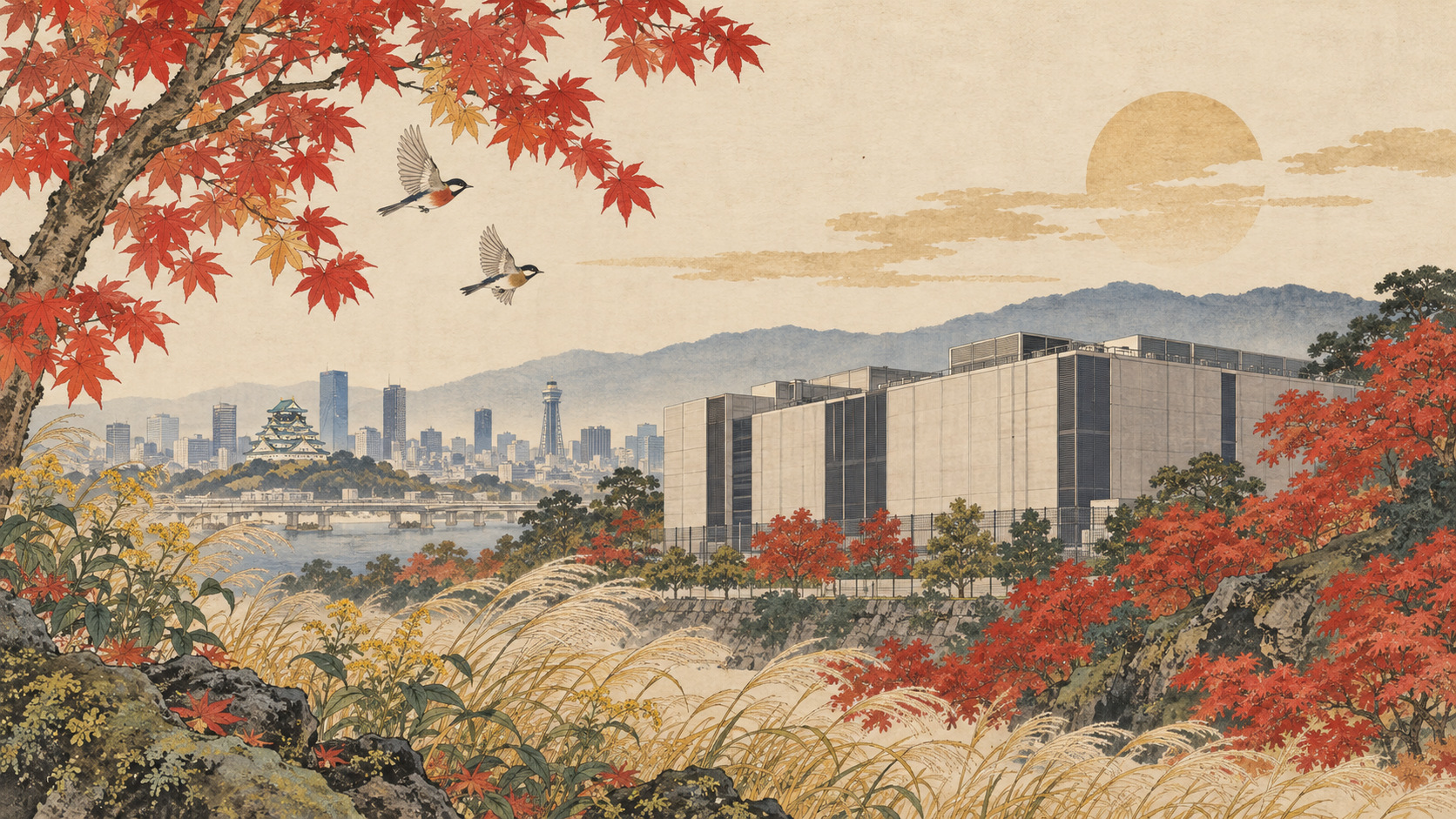
Negotiations are not construction approvals. Reported projections must not be confused with confirmed facility specifications.
A new geography for artificial intelligence
The next chapter of the AI race may be written less in software than in concrete, transformers, cooling plants and fiber-optic links. Osaka, Japan’s commercial heartland, is emerging as a possible site for infrastructure of unusual scale.
On October 13, Reuters reported, citing the Nikkei newspaper and its sources, that NTT DATA Group was in the final stages of negotiations to build a data center in Osaka for Anthropic, the US company behind Claude. According to that reporting, the project could cost as much as ¥1 trillion, have incoming power capacity of up to 500 megawatts, and begin partial operations as early as 2028. The parties were said to be seeking an agreement by the close of Japan’s fiscal year in March 2027.
None of those numbers is a signed contract. The project’s exact site, ownership structure, financial commitments and engineering design have not been publicly established. Reuters reported that NTT declined comment. This distinction matters: a proposal of enormous scale can alter expectations long before anyone pours concrete.
What 500 megawatts does—and does not—tell us
Five hundred megawatts is an eye-catching number in a business increasingly constrained by electricity. Running at that rate around the clock for a full year would imply 4.38 terawatt-hours of energy. That is arithmetic illustrating the magnitude of the figure, not a forecast of the facility’s actual electricity consumption.
More importantly, power intake capacity is not the same as IT load. A data center also needs cooling, electrical conversion, backup systems and other supporting infrastructure. Nor can the reported intake figure be translated into a precise GPU count. The utilization rate, design overheads and hardware configuration are unknown.
The reported ¥1 trillion ceiling deserves the same caution. It is not clear whether it includes land, building works, electrical infrastructure, cooling, networking or computing hardware. Until the investment allocation and contracts become public, estimates of profits, subsidies, regional jobs or electricity costs would be speculative.
Why Kansai is no longer merely Tokyo’s backup
For decades, the Tokyo metropolitan region has dominated Japan’s data-center geography. It concentrates corporate headquarters, major financial institutions and network connections. Kansai developed an important complementary role, including disaster recovery and business continuity operations outside the capital region.
That logic is changing. Modern cloud services and AI workloads require enormous, reliable capacity distributed across multiple locations. Osaka offers one of Japan’s deepest business ecosystems, while the surrounding Kansai region provides alternative sites, connectivity and geographic diversity.
In April 2026, NTT DATA itself described Kansai as evolving from a secondary recovery hub into a core market for hyperscale and enterprise facilities. The question for prospective operators is not which city makes the best promotional slogan. It is where suitable land, high-capacity electricity, cooling, redundant networks and workable delivery timetables can converge.
A decade of groundwork—before Anthropic entered the picture
This potential deal did not emerge from nowhere. In 2019, NTT Communications announced its Osaka 7 Data Center in Ibaraki, Osaka Prefecture, serving demand for resilient and connected facilities in western Japan. In September 2022, NTT announced a roughly ¥40 billion investment in a new Keihanna data center in Kyoto Prefecture.
NTT DATA Group officially opened Keihanna OSK11 in April 2026, describing a facility with 10,900 square meters of server rooms and 30 MW of IT load capacity. Separately, in May 2025, the group announced plans for a North Osaka facility in Ibaraki, with a projected 36 MW of IT power capacity at completion.
These projects provide essential history, but they must not be conflated with the reported Anthropic negotiations. OSK11 is in Kyoto, not Osaka Prefecture. The announced North Osaka campus is not confirmed as the site of the proposed Anthropic facility. The 30 MW and 36 MW numbers refer to their respective projects; they are not components of a verified 500 MW contract.
Anthropic’s Japanese trajectory
Anthropic’s Japanese ambitions have developed alongside its global infrastructure partnerships. The company announced a relationship with Google Cloud in 2023 and expanded collaboration with Amazon Web Services in 2024, naming AWS its primary cloud and training partner. These arrangements illustrate how frontier AI companies depend on access to sophisticated computing systems rather than relying solely on their own real estate.
In August 2025 Anthropic appointed Hidetoshi Tojo to lead its Japanese business. That October, it formally opened its Tokyo office—its first office in the Asia-Pacific region—and announced a memorandum of cooperation with Japan’s AI Safety Institute. The company’s leadership also engaged with Japanese policymakers and enterprise customers.
A Tokyo office and a large Osaka computing facility would represent different stages of market commitment. An office can build customer relationships and coordinate policy work; a dedicated data center, if agreed and delivered, could anchor much more of the physical machinery on which AI services depend. But the company has not publicly specified whether the proposed site would host training, inference or both.
The data-sovereignty question is more complicated than a postal address
Some customers will inevitably interpret a Japanese data-center proposal as a step toward greater control over data location. Domestic infrastructure can make lower-latency access, operational resilience and particular compliance arrangements easier to pursue. It does not automatically establish where every prompt, file, log or backup is processed and stored.
For a bank, hospital, manufacturer or public agency, the consequential details are service-specific: contractual data residency, retention policies, processing regions, subcontractors, incident response and audits. An operator can own a building in Japan while a customer service still uses multiple regions or third-party clouds.
Nor does a domestic facility mean Anthropic’s AI intellectual property will reside in Japan, that all Claude users in the country will be routed through Osaka, or that Japanese enterprises will obtain preferential access. Those claims would require product and contract announcements that do not yet exist.
An electricity project as much as a technology project
A high-density AI computing campus is also an industrial energy project. Reliable power delivery, substation upgrades, network redundancy and heat removal can determine its schedule as decisively as the availability of processors. The International Energy Agency estimated in its 2025 Energy and AI report that global data-center electricity demand could roughly double by 2030 to about 945 terawatt-hours in its base case. This is a worldwide scenario, not an estimate for Osaka.
Large facilities can generate work for builders, electrical contractors, specialist engineers and long-term maintenance providers. They can also raise difficult public questions: who pays for grid upgrades; what energy is contracted; how cooling is designed; whether water supplies are affected; what emergency generation entails; and how residents learn about plans before they are finalized.
Japan’s industrial competitiveness is implicated on both sides of the ledger. Affordable, reliable infrastructure can attract international customers. Expensive or poorly coordinated development could place costs on other electricity users or become mired in construction delays. Neither outcome can be assumed at this stage.
The lesson for Japan’s AI strategy
Japan’s ambitions in advanced chips and manufacturing are important, but an AI economy needs more than semiconductor fabrication. It requires power networks, secure digital connectivity, practical software adoption, technicians, land-use decisions and credible governance.
The putative Anthropic project would not, by itself, prove that Japan has captured the most valuable parts of AI research. Model ownership, cloud contracts and economic value chains are separate questions. But it could deepen a cluster of capabilities around the infrastructure that makes industrial AI possible: power engineering, construction, controls, cooling, disaster resilience and operations.
For executives and investors, the story is therefore larger than a potential tenancy agreement. It is a test of whether Japan can turn demand for computation into durable industrial expertise while confronting the costs and public responsibilities of hosting it.
Five answers still missing
The next reporting milestones are precise. First, whether NTT DATA and Anthropic confirm and sign an agreement. Second, the site, schedule and phasing. Third, the meaning of the reported 500 MW maximum and the actual IT capacity. Fourth, ownership, financing and the division of capital costs between the parties. Fifth, the proposed power sources, cooling method, environmental measures and contractual data-handling arrangements.
As of the October 13 reporting, the established record shows two companies with major Japanese commercial interests and a substantial history of regional infrastructure investment—plus a report of talks that could produce something far larger.
If a deal is completed, Osaka may become more than a place where companies use frontier AI. It could become an important place where the global AI industry obtains the physical conditions to operate. For now, the distance between the two is measured in unsigned contracts, megawatts that must actually be delivered and questions that deserve answers.
Sources and further reading
- Reuters/日本経済新聞(2026年10月13日)
- NTTデータグループ:大阪府での新たなデータセンターの建設(2025年5月27日)
- NTTデータグループ:京阪奈OSK11データセンター開設(2026年4月9日)
- NTT:関西圏における新データセンター建設(2022年9月29日)
- NTT Communications:Osaka 7 Data Center(2019年)
- Anthropic:日本・東京オフィス開設(2025年10月29日)
- Anthropic:AWSとの協業拡大(2024年11月22日)
- Anthropic:Google Cloudとの提携(2023年2月3日)
- IEA:Energy and AI — Energy demand from AI(2025年)
- NTT DATA:大阪OSK12計画
Reporting cutoff: October 13, 2026. Prepared for the October 15 edition; no later agreement or final project approval is implied.