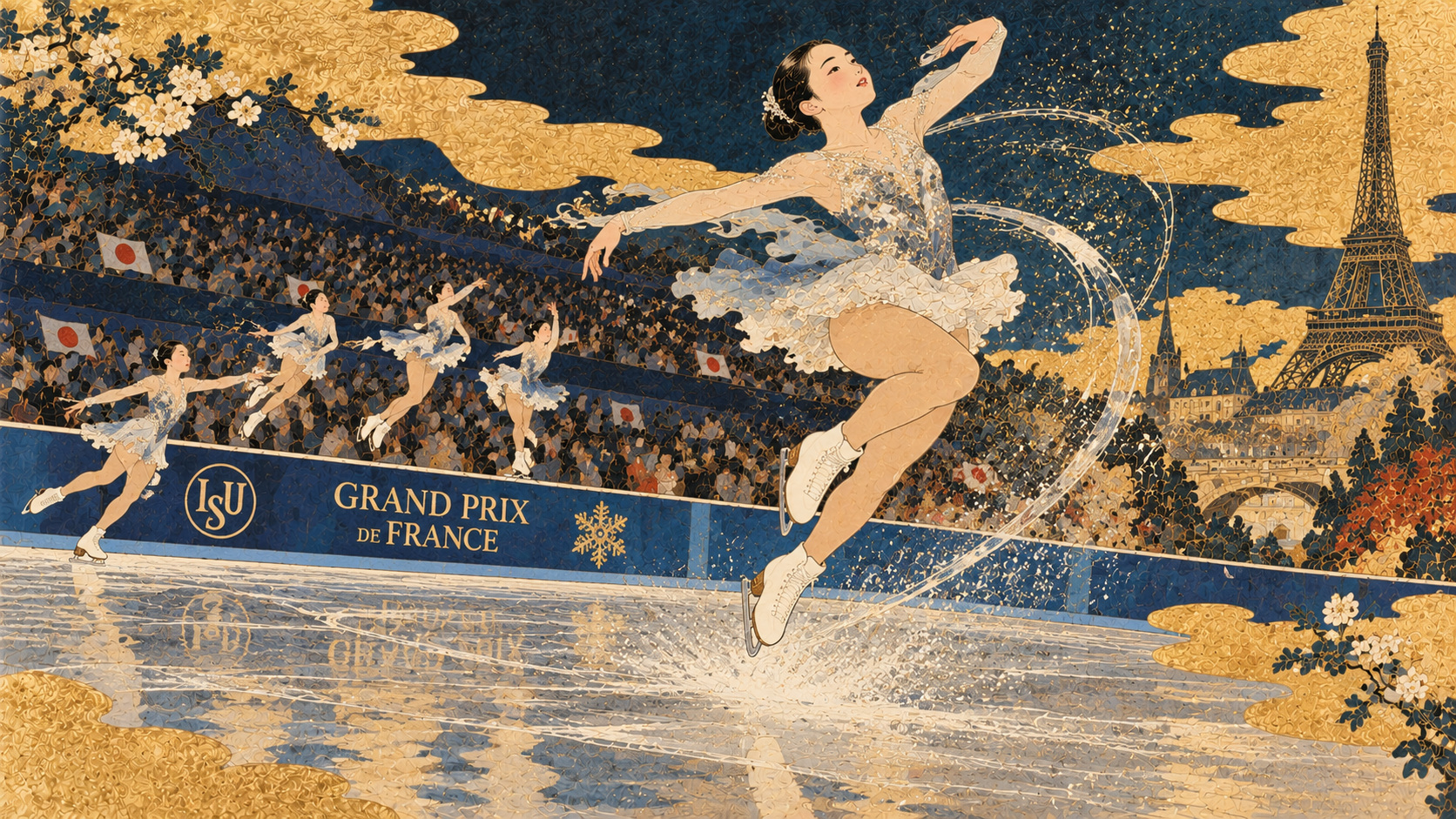
She did not erase Friday’s failed triple Axel. She returned to it on Saturday—and gave the French Grand Prix a different ending.
The same French rink, a different kind of victory
Ami Nakai returned to Angers as the defending Grand Prix de France champion and an Olympic bronze medalist. On October 24, the 18-year-old gave herself an ending that had looked uncertain a day earlier: a first-place free skate worth 149.08 points, lifting her from third after the short program to a winning 219.74 total. Anastasiia Gubanova of Georgia finished second at 202.82, 16.92 points behind. Last October, Nakai won this event in her senior Grand Prix debut. This time she had to defend a reputation as well as an advantage on the ice.
A jump she would not abandon
The triple Axel had betrayed Nakai in Friday’s short program, leaving her on 70.66 points while Japan’s Yuna Aoki led with 76.31. The difference was 5.65 points—substantial but not insurmountable over a free skate. In Saturday’s program, Nakai opened with another triple Axel attempt and landed it. Reporting from Angers describes her completing the subsequent jumping elements and performing with greater confidence after that first decisive moment. A single jump did not mathematically guarantee victory; it made possible the performance that followed.
The numbers behind the comeback
Nakai received 149.08 in the free skate and 219.74 overall. Gubanova finished at 202.82 and Italy’s Lara Naki Gutmann at 202.37. Aoki, the short-program leader, had a difficult free skate and finished fourth at 200.62; Japan’s Rion Sumiyoshi climbed from eighth after the short program to sixth overall on 190.70. A precision point matters: Nakai’s 149.08 was equal to her previous personal-best free-skate score, set at the 2025 Grand Prix de France. It was not a newly established personal best.
Gershwin, skating, and a French audience
Nakai’s 2026–27 free skate uses music from George Gershwin’s An American in Paris, including selections listed by the International Skating Union under that title. David Wilson is credited as the program choreographer. Its contrasting orchestral colors and jazz-inflected rhythm create space for performance beyond athletic checkpoints. A high-scoring program demands not only rotational control but edges, transitions, music interpretation and a readable dramatic arc. Angers, not Paris, hosted the competition; the Gershwin reference is to the score, not the city in which Nakai competed.
Why winning again felt harder
In an interview reported by Nikkan Sports after the competition, Nakai described facing a level of pressure she had not felt as the fresh challenger a year earlier. She said she could finally believe in herself as she heard the audience supporting her before skating. That change of perspective is credible context for the tears and relief described by rink-side reporters, though an athlete’s interior experience cannot be known beyond her own account. The defending champion was also a medalist at the Milan-Cortina Olympics; expectations followed her to France.
From Niigata to the international circuit
The Japan Skating Federation lists Nakai’s date of birth as April 27, 2008, and her birthplace as Niigata Prefecture. Her club affiliation is TOKIO INKARAMI. The ISU biography says she began skating in 2013. Her career did not begin with one spectacular French weekend: she won bronze at the 2024 Junior Grand Prix Final and finished fourth at the 2025 World Junior Championships. The technical ambition seen in Angers emerged from years of competition and development.
The extraordinary year between French titles
Her first Grand Prix de France win in October 2025 was followed by bronze at Skate Canada and silver at the 2025 Grand Prix Final. She then claimed bronze in women’s singles at the February 2026 Milan-Cortina Winter Olympics, before finishing ninth at the 2026 World Championships. The Olympic medal ensured that the next season would be interpreted differently: Nakai was no longer an intriguing prospect but an accomplished contender against whom others—and she herself—could measure performance.
Why the triple Axel still matters
The Axel takes off facing forward and lands backward, adding an extra half-rotation compared with other jumps named for three revolutions. A triple Axel therefore demands three and a half turns in the air. For women’s skating, it has long been a signature high-risk element, with a technical value that can transform a result but with execution judgments capable of eroding that benefit. Landing a jump and receiving maximum execution credit are not the same thing; the formal element calls and grades belong to the ISU judges’ protocols.
A lineage of Japanese women taking technical risks
Japan’s history in women’s singles offers several ways to understand the moment. Midori Ito won the world championship in 1989 and Olympic silver in 1992, while becoming a seminal figure in the triple Axel’s competitive history. Shizuka Arakawa claimed Olympic gold in 2006; Mao Asada won Olympic silver in 2010 and made the Axel a central part of her skating identity. More recently Kaori Sakamoto helped sustain Japan’s prominence at world level. Different eras brought different judging systems, fields and strategic incentives, however, and a young skater should not be reduced to a carbon copy of an illustrious predecessor.
Aoki’s brilliant Friday—and difficult Saturday
There was another compelling Japanese storyline. Yuna Aoki, 24, led the short program on a 76.31 score, according to the Japanese Olympic Committee’s October 24 account. But her free skate was scored 124.31, leaving her fourth overall. Rion Sumiyoshi’s improvement from eighth after the short program to sixth provides another reminder that skating championships are built across two distinct performances. The win belongs to Nakai, yet a fuller picture of the competition includes both the opportunities and the disappointments of the other Japanese competitors.
What a figure-skating score actually measures
Fans often identify the winning jump, but judges do not score a program as a single acrobatic feat. Technical evaluation comprises jump and spin base values, steps and their execution grades. Program components evaluate composition, presentation and skating skills, and deductions can alter the total. Without consulting the detailed judging sheets, a journalist cannot responsibly reconstruct every grade from a final headline score. The ISU results page and judges’ scores are the relevant primary record.
The road to a second consecutive Final
The Grand Prix series awards qualification points based on placements across assigned events. After finishing second in the 2025 Final, Nakai has opened this season with a win. Japanese reporting lists Skate America in Everett, Washington, November 13–15, as her next Grand Prix assignment, with the series Final scheduled for Chongqing, China, December 10–12. The France result strengthens her position; it does not by itself settle the Final lineup. Her next task is to turn one emphatic weekend into consistency across a season.
A comeback measured in courage as well as points
The lasting image from Angers may be more modest than a medal ceremony: an athlete who missed a demanding jump on Friday and chose to try it again on Saturday. Nakai did not erase the short-program error. She carried it into the next performance, landed the jump, and skated the rest of the program. For audiences discovering her after the Olympics, that story offers a better introduction than a label such as “teenage sensation.” The 219.74 points document the result. The second attempt explains why people watched.
Sources and verification
Based on ISU results, Japan Skating Federation/JOC biographical records and attributed rink-side reporting. The free skate took place Oct. 24 in France and was reported in Japan Oct. 25. No original interview was conducted. The 149.08 free-skate score equalled her 2025 personal best.
- ISU: Grand Prix de France 2026 official results and judges’ reports
- Japan Skating Federation: Ami Nakai official biography
- ISU: Nakai’s biography, program music and personal bests
- Japanese Olympic Committee: Nakai’s Grand Prix de France win
- JOC: short-program results
- Nikkan Sports: rink-side reporting and post-event remarks
- JOC: Nakai’s Olympic results
- Kyodo via Daily Sports: free-skate results and Japanese field