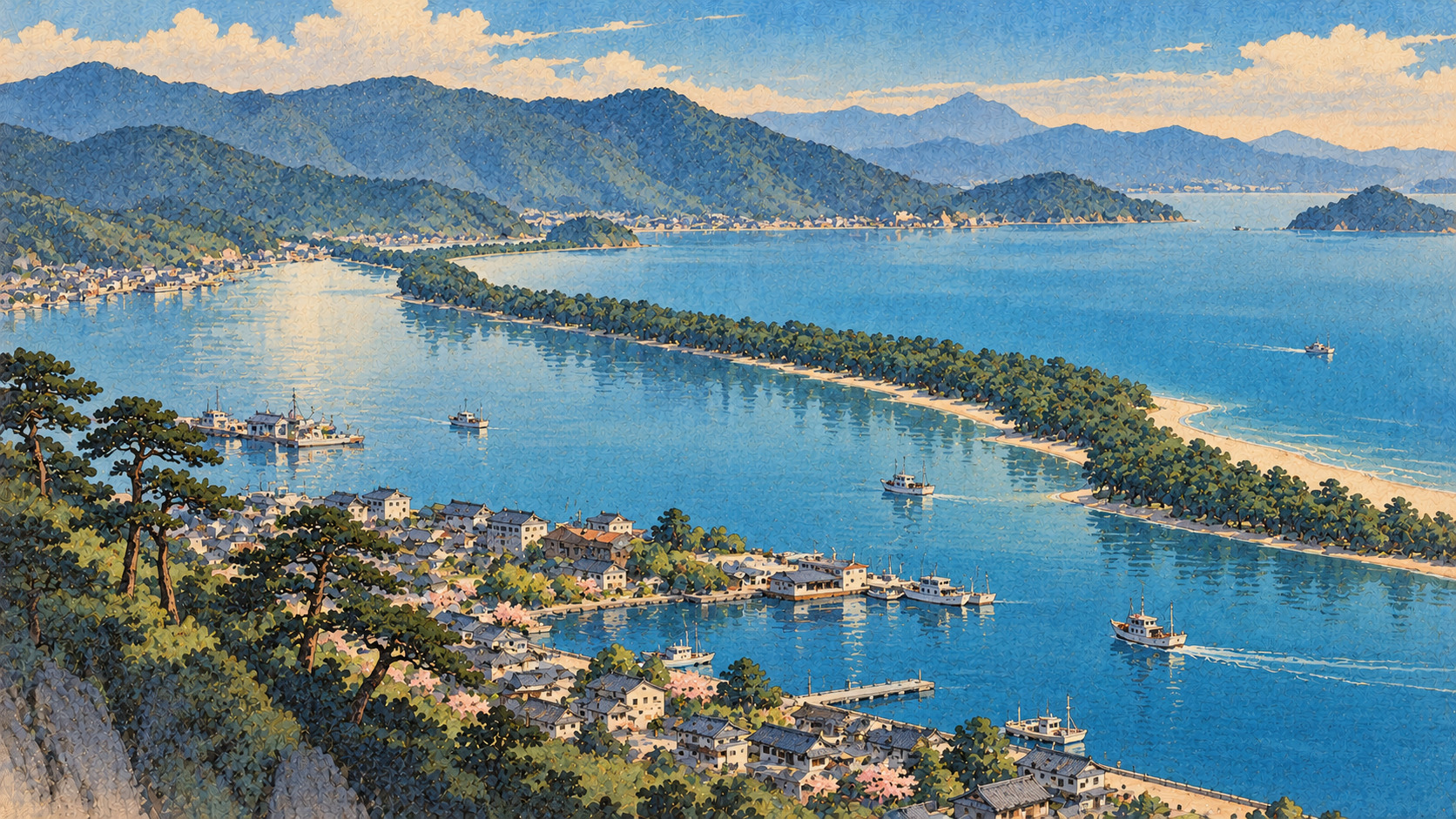
The test is not whether tourists can photograph the sandbar. It is whether they can discover—and support—the harbor community beyond it.
A new identity for an old maritime landscape
On November 15, Miyazu, a harbor city on Kyoto Prefecture’s Sea of Japan coast, is scheduled to take a significant administrative step: an existing waterfront revitalization designation will be enlarged to cover the whole of Miyazu Port and renamed Minato Oasis Miyazu Amanohashidate. The Ministry of Land, Infrastructure, Transport and Tourism (MLIT) announced the move on October 30. The change does not inaugurate a new seaport or promise a new rail line. Instead, it seeks to make a dispersed group of waterfront, tourism, cultural and transport destinations function more coherently as a region.
What the designation actually changes
The predecessor, Minato Oasis Tai Miyazu, will be re-registered with a broader area encompassing the Tai coastal district, the Shimazaki–Hamamachi waterfront and Amanohashidate. Japan’s Minato Oasis initiative recognizes sites where local participation supports continuing port-centered community activities. It is a mechanism for coordination and promotion, not a certification that every listed facility is newly constructed or that the national government has guaranteed a particular amount of new development spending. That distinction matters when evaluating what visitors and residents can expect.
A station, a park, a museum and three boat stops
The revised network adds Amanohashidate Station, Shimazaki Park, the Miyazu Historical Hall, the Tango Folk Museum and Old Nagashima Residence, and three sightseeing-boat landing facilities. Its representative hub is the Miyazu Machinaka Regional Promotion Base, known to travelers as Roadside Station Umi no Kyoto Miyazu. It sells local produce and seafood, offers tourism information and rents bicycles. The idea is to connect destinations that already have distinct roles—arriving, shopping, learning, strolling and boarding a boat—rather than to treat the harbor as an isolated photo stop.
Ejiri pier gives the plan a practical test
Miyazu City says the Ejiri pier in the Fuchu area will enter service and be presented alongside the November 15 registration ceremony. The pier provides a tangible sign that links across the bay are more than a branding exercise. But the announcement does not, by itself, establish a new year-round timetable, a guaranteed number of sailings, ticket prices or the volumes of people who will transfer between ferries and trains. The ease of using those connections will depend on operating arrangements that deserve subsequent scrutiny.
Why Japan created “port oases”
Ports are commonly discussed in terms of cargo, dredging, breakwaters and logistics. Yet smaller ports also define the social and economic life of the towns around them. Under Japan’s Minato Oasis system, qualifying facilities are registered as places supporting sustained, resident-involved regional revitalization around ports. The Kinki Regional Development Bureau put the tally at 16 in its jurisdiction and 171 nationwide in its October 30 notice. That is useful context, but a registration count says nothing by itself about visitor satisfaction, local income or environmental quality.
Amanohashidate is a landscape made by moving water
The pine-covered sandbar of Amanohashidate, long celebrated as one of Japan’s three great scenic views, separates Miyazu Bay from the sheltered Aso Sea. The city’s own historical explanation notes that currents and sediment supplied by rivers shaped the landform over time. Its familiar outline is relatively recent: the southern part developed toward its modern form in the late Edo period, while an older water passage at the Monju end was once roughly 100 meters wide. The celebrated historic image by Sesshū therefore captures a coastline different from today’s. This is not scenery outside history; the shoreline itself records change.
When Miyazu was a trading port, not a tourist postcard
The city’s past was built on maritime commerce. During the Edo and Meiji periods, kitamaebune merchant vessels connected the Sea of Japan coast with Osaka and other trading centers, buying and reselling cargo at ports along the route. Miyazu received goods as varied as kelp, salt and regional crafts, while local products entered wider trading circuits. The Mikami merchant family operated ships as well as other businesses. Their preserved residence and records offer a concrete reminder that the harbor once moved money, ideas and materials—not just sightseeing passengers.
From castle town to railway gateway
Miyazu developed as a castle town and maritime commercial center before modern infrastructure reshaped the journey. City historical materials describe a railway opening in 1924 that stimulated visits to Amanohashidate. Over subsequent decades, rail and road networks transformed access to northern Kyoto. Adding the railway station and sightseeing-boat docks to one coordinated waterfront designation revives an older practical question: how can people arriving by different modes of transport discover more of the city beyond its most famous view?
A festival weekend will offer an early glimpse
The city has separately scheduled the Miyazu Amanohashidate Seaside Festival for November 14–15. Programs around the bay include illuminated autumn foliage at Nariaiji Temple, a Tai-area coastal festival and a Miyazu food event; sightseeing boats are intended to connect activities. The overlap with the November 15 registration ceremony gives the waterfront initiative a natural public showcase. These events have their own organizers and may be affected by weather or operational changes. They should not be confused with permanent services promised by the new designation.
The difference between foot traffic and prosperity
Local revitalization is often narrated through attractive aerial photographs and festival crowds. But the measures that matter are less photogenic. Do visitors spend more time in town? Do independent fishers, merchants and restaurants benefit? Are routes accessible to older residents and families? Can regular services be maintained outside peak tourist weekends? The October announcement states what officials hope the wider designation will encourage. It does not provide post-registration employment numbers, additional business revenue or an independently established return on public investment.
Conservation is part of the waterfront economy
Miyazu’s competitive advantage includes more than convenient piers. The landscape’s pine-covered sandbar, enclosed waters and mountainous setting are the reason visitors travel here at all. Expansion of tourism connections brings questions about beach maintenance, environmental pressure, flooding and the needs of people living beside the waterfront. The announcement contains no comprehensive quantified forecast of ecological effects. Successful port planning would therefore be judged not only by how many visitors move through the area but by whether the place retains the qualities they came to see.
What to watch after November 15
The certificate presentation is scheduled for 9 a.m. on November 15 at the lawn of Shimazaki Park, Hamamachi, Miyazu. The significance of the change will emerge afterward: clearer wayfinding, practical connections among rail, cycling and boat services, repeat visits beyond the sandbar and evidence that more of the local economy shares in tourism. Miyazu’s history offers a useful lens. For centuries, this port linked communities through movement. The new challenge is to make that movement valuable to both travelers and residents without treating the harbor’s celebrated landscape as an inexhaustible resource.
Sources and verification
Based on October 30 ministry and municipal announcements and Miyazu City historical materials. Future commercial impacts, service frequencies and environmental outcomes are not established by these releases.
- 国土交通省港湾局・2026年10月30日発表 / MLIT port authority release
- 近畿地方整備局・登録変更・式典 / Kinki regional bureau details
- 宮津市・江尻桟橋の供用開始 / Miyazu City and Ejiri pier
- 宮津市・天橋立の成り立ち / Formation of Amanohashidate
- 宮津市・北前船の歴史 / Kitamaebune history
- 宮津市・城下町と近代化の歩み / Municipal historical landscape study
- 宮津天橋立シーサイドフェスティバル / Seaside Festival notice
- 宮津市・三上家と北前船 / Mikami shipping records