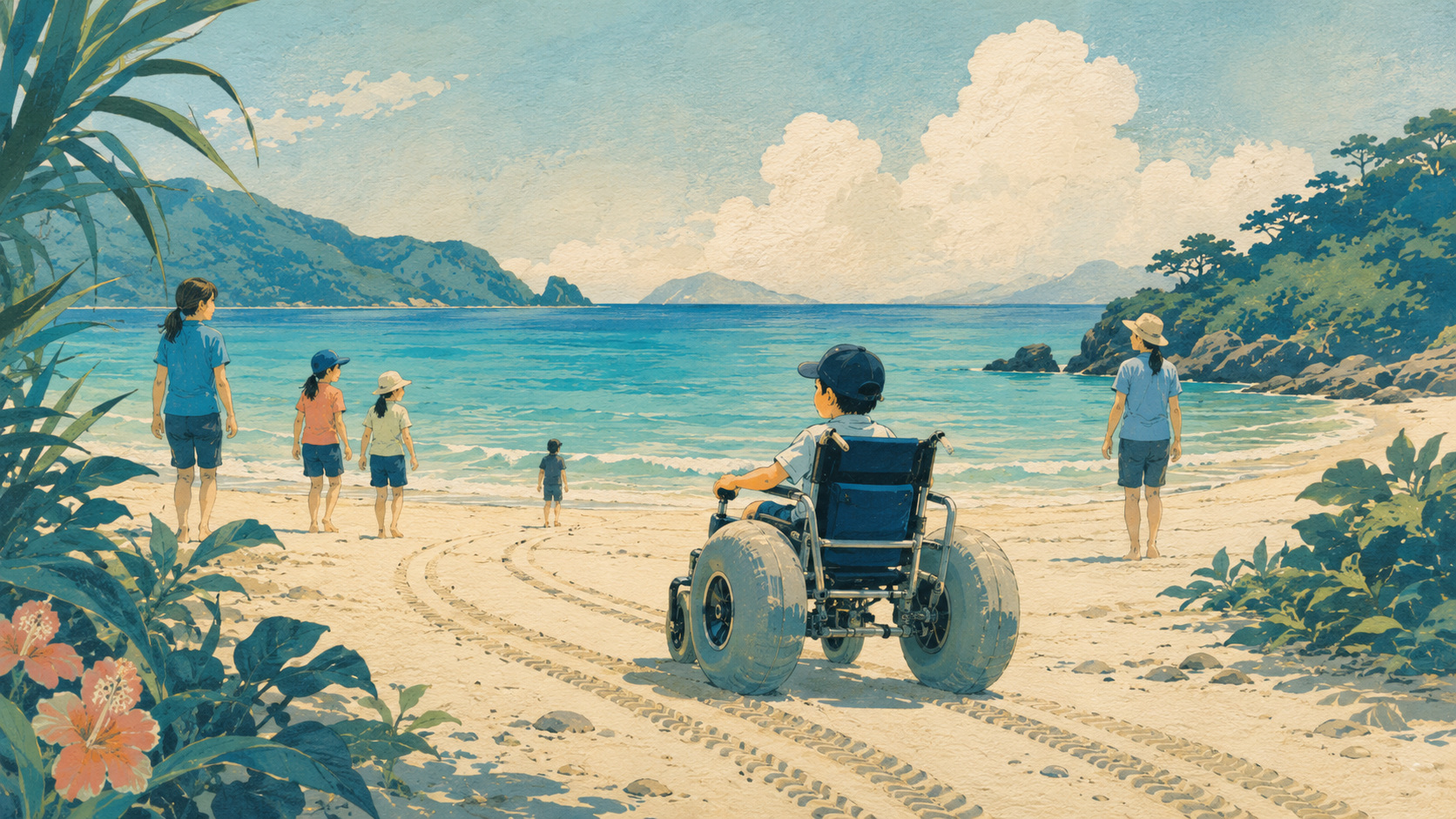
Sand is soft enough to accept a footprint and firm enough to stop a wheelchair.
A conventional front caster concentrates weight on a narrow contact patch. On pavement it turns lightly; on dry sand it digs in. The person pushing leans harder, the small wheel plows deeper, and a beach that appears open in every direction becomes a surface with no usable direction at all.
The usual adaptation is a beach wheelchair with broad, low-pressure tires. By spreading weight over more sand, the chair is less likely to sink. That can move a person from the promenade toward the water—but most common beach chairs are pushed by a companion. The destination becomes accessible while the decision about speed and direction remains in somebody else’s hands.
The electric chair introduced for an August camp in Amami Oshima changes that relationship. According to organizer D-SHiPS32, a child can operate a joystick, turn across the sand and choose a route toward the water’s edge. The important verb is not simply reach. It is steer.
A camp organized around control, not transportation
The program’s Japanese name is Shukkō! Kodomo Senchō—“Set Sail! Children Captains.” It was designed by certified nonprofit D-SHiPS32, locally operated by the Zero Gravity association and supported by a Nippon Foundation grant. The location is Setouchi, at the southern end of Amami Oshima in Kagoshima Prefecture.
The planned activities repeat one idea in several forms. On land, children use a joystick to direct the electric beach wheelchair. On the boat, they are scheduled to enter the wheelhouse and steer under an instructor’s supervision. Before snorkeling in open water, they practice with full-face masks in a pool. During the three-night stay, visiting children join local children and high-school volunteers for meals, bathing, a summer festival and shared daily routines.
This is not a program in which independence is confused with the absence of help. Instructors remain responsible for maritime safety. Staff prepare equipment, assess needs and provide assistance. The difference is that support is arranged around the participant’s action rather than replacing it. A child makes a movement; the environment is engineered so that movement can have a result.
| Experience | Barrier | Adaptation | Choice returned to the child |
|---|---|---|---|
| Crossing dry sand | Narrow wheelchair tires sink and caster wheels plow | Wide sand tires, electric drive and joystick control | Direction, pace, stopping and turning |
| Entering marine activity | Unfamiliar water, breathing equipment and transfer risk | Pool practice, full-face mask and trained support | Time to learn, signal comfort and participate safely |
| Operating a boat | Controls and wheelhouse may be inaccessible | Barrier-free vessel and instructor supervision | Experience being at the helm rather than only a passenger |
| Living at camp | Travel routines can be organized entirely by adults | Accessible lodging, peer group and planned assistance | Social decisions, new relationships and everyday responsibility |
The organizer has not identified the electric chair’s manufacturer or specifications, and its release says children will travel to the water’s edge—not that the powered chair itself will enter the sea. That distinction matters. Sand mobility equipment, floating beach chairs and submersible marine devices are not interchangeable. Safe use depends on the particular equipment, slope, tide, battery system and supervision.
The invisible wall at the edge of the pavement
Modern accessibility is often represented by concrete: a curb cut, a ramp, an elevator, a wide toilet door. A natural landscape exposes the limit of that image. There may be no architectural step on a beach, yet the change from pavement to loose sand can function as a wall.
Beach wheelchairs address the mechanics with large, wide wheels. California’s Coastal Commission, which maintains a public lending map, explains that most such chairs still require another person to push them, although some beaches provide motorized models. That sentence captures the difference between two generations of access. The first makes presence possible. The second can make self-directed movement possible.
Neither is universally better. A powered chair may be heavier, more expensive, harder to transport and dependent on battery maintenance. A manual floating chair may be better suited for supported entry into water. Some users cannot or do not want to operate a joystick. Universal design is not one device imposed on everyone; it is a choice of devices and assistance based on the person, activity and environment.
But for a child who can use the control, powered mobility changes the social choreography. The adult does not have to ask, “Where should I push you?” before every movement. The child can explore, change course, follow a friend, stop to look at something, or decide that the water is close enough. Small choices accumulate into ownership of the day.
Why “wait” can be a form of support
D-SHiPS32 chairman Daisuke Uehara has spent years turning this distinction into a method. Born with spina bifida, he became a para ice hockey player, represented Japan at the 2006 Turin, 2010 Vancouver and 2018 PyeongChang Paralympics, and helped the national team win silver in Vancouver.
His path into children’s programs began before the medal. Uehara has said that seeing disabled children play hockey energetically in North America in 2004 made him want to build the same ordinary opportunity in Japan. A later period training in the United States deepened the idea. He established D-SHiPS32 in December 2014.
In a 2021 interview, Uehara described an approach that can feel counterintuitive to parents and volunteers: wait. Adults who see a child struggling often intervene before the child has time to test a method, make a mistake or request specific help. The intervention is loving, but if it arrives too early, nobody learns what the child could have done independently or what precise adaptation was needed.
Waiting does not mean abandoning safety. It means leaving enough time for the child’s intention to appear. At a hockey session, that might mean allowing a player to work out how to turn. On an Amami beach, it means placing the joystick under the child’s hand and not substituting an adult’s route before the child chooses one.
- Remove the environmental barrier where possible.
- Provide the equipment and information needed to act.
- Ask what assistance the person wants instead of assuming it.
- Allow time for experimentation, refusal and changed decisions.
- Intervene immediately when safety requires it—but do not define every difficulty as danger.
A history written in mud, ice and travel
D-SHiPS32’s Amami project did not begin at the shoreline. Its earlier programs used sports, travel and camps to give disabled and nondisabled children experiences in common.
At a 2019 summer camp in Tomi, Nagano Prefecture, seven wheelchair-using children, nine siblings and family members and volunteers formed a group of 49. Children harvested vegetables and entered a rice paddy. During a game of tag, according to the Nippon Foundation’s report, the children themselves changed the route so everyone could play. The adaptation did not descend from a manual. It emerged from play.
The organization has also arranged trips intended to separate children, temporarily and carefully, from the adults who normally solve every logistical problem. Uehara’s “Kids Challenge Trip” took children abroad, echoing the public transport and sporting independence he had witnessed overseas. Other projects lend para-sports wheelchairs because specialized equipment is costly and children outgrow it quickly.
Across these programs, the activity is almost secondary. Ice, mud, a train platform and beach sand are different materials performing the same test: does the environment allow the child’s decision to become action?
2004 — Uehara sees disabled children playing hockey in North America and imagines comparable opportunities in Japan.
2010 — Japan wins para ice hockey silver in Vancouver, with Uehara on the team.
2014 — D-SHiPS32 is established.
2016 — Zero Gravity completes its barrier-free marine facility in Setouchi, Amami Oshima.
2019 — A D-SHiPS32 camp in Nagano brings wheelchair users, siblings, families and volunteers into shared outdoor play.
2026 — The Amami camp adds a powered beach wheelchair to a program of steering, snorkeling and community life.
Why Amami could carry the idea all the way to the water
The electric chair solves only the final strip of sand. An accessible seaside experience also requires transportation, sleeping space, bathrooms, practice facilities, a boat, trained staff and reliable information. If any link is missing, the journey can end before the beach.
Zero Gravity was built around that chain. Its founder traces the idea to a dive off Hachijojima more than 25 years ago, when the feeling of floating underwater suggested that wheelchair users should be able to experience the same freedom. In spring 2016, the organization completed a barrier-free marine facility at Seisui in Setouchi.
The Seisui Villa combines lodging with an accessible training pool and a purpose-built boat. Zero Gravity says the lodging, vessel and pool are designed for wheelchair access and that staff can provide wheelchair-accessible transport from Amami Airport. A 2026 case study describes six guest rooms with capacity for 13 people, a roughly nine-meter pool with a ramp, and a stable catamaran equipped with an accessible toilet, shower and stern lift for entering the water.
Equipment is selected around function rather than diagnosis alone. A full-face mask can help someone who cannot maintain a seal on a standard mouthpiece. Adapted wetsuits can reduce the difficulty of dressing. A water scooter can let a person with limited leg movement choose a direction underwater. Before arrival, staff discuss what a guest can do, what support is needed and where risk lies.
That is why Amami is more than a beautiful backdrop. The island’s southern facility makes it possible to connect land mobility, pool rehearsal, a barrier-free vessel and open water without repeatedly rebuilding the system from scratch.
An island region learning to describe access honestly
Kagoshima Prefecture has been developing universal tourism across the Amami archipelago since fiscal 2020. The Oshima branch surveys and publishes accessibility information for lodging, restaurants and attractions; trains tourism workers; produces model itineraries; and helps facilities apply for the Japan Tourism Agency’s “barrier-free mindset” certification.
Information is as important as a ramp. A traveler needs to know the width of a door, the position of rails, whether transport can take a particular chair, how a transfer will be handled and what assistance staff can actually provide. “Accessible” without measurements or operational detail can be another barrier because a family must gamble an expensive journey on an adjective.
The Tourism Agency now tells businesses to publish both barriers and adaptations clearly. Its universal-tourism resources cover product design, hospitality training and information disclosure. Amami’s work gives the policy a difficult landscape in which to prove itself: separate islands, long travel chains, tropical weather, beaches, boats and activities that cannot be made safe by a building code alone.
The 2026 camp brings children into that regional learning process. Six local children and three high-school volunteers are scheduled to participate alongside three visiting children. Inclusion is not framed as disabled guests receiving a service while everyone else watches. It is a mixed group sharing a place, an activity and the small negotiations of living together.
From ramps to rights
Japan’s legal understanding of accessibility has broadened over a generation. The 2000 Transport Barrier-Free Law addressed public transportation. In 2006, Japan combined and expanded transport and building rules into the Barrier-Free Act, adding a more continuous view of stations, roads, buildings, parking and urban parks.
Japan ratified the United Nations Convention on the Rights of Persons with Disabilities in 2014. Article 30 is unusually relevant at a beach: it calls for equal access to recreation, leisure, sport and tourism venues and services, and specifically says disabled children should have equal access to play and recreational activity. Recreation is not decorative—a reward granted after education, health care and transport are solved. It is part of participation in society.
The Disability Discrimination Elimination Act took effect in 2016. An amendment effective April 1, 2024 changed reasonable accommodation by private businesses from an effort to a legal duty, provided the measure does not impose a disproportionate burden. The Cabinet Office emphasizes constructive dialogue and the individual nature of accommodation.
No law requires every beach to own the same powered chair, and an electric wheelchair does not by itself prove compliance. The historical movement is nevertheless clear. The question has shifted from whether a person can be carried through a space to whether institutions and businesses have examined the barrier, discussed what is needed and made participation genuinely possible.
| Year | Step in Japan’s accessibility framework | What it adds to the Amami story |
|---|---|---|
| 2000 | Transport Barrier-Free Law | Travel begins before an attraction; vehicles and stations matter. |
| 2006 | Integrated Barrier-Free Act | Access is a continuous route across transport, buildings, roads, parks and parking. |
| 2014 | Japan ratifies the CRPD | Play, recreation, sport and tourism are treated as rights of participation. |
| 2016 | Disability Discrimination Elimination Act takes effect | Social barriers and unequal treatment become an explicit institutional responsibility. |
| 2021 | Tourism Agency begins barrier-free-mindset certification | Training, information and willingness to adapt join physical facilities. |
| 2024 | Private-sector reasonable accommodation becomes mandatory | Businesses must engage with individual needs, within the law’s burden limit. |
The environment can create—or reduce—disability
The World Health Organization describes disability as an interaction between a health condition and personal and environmental factors. That formulation is visible on the sand. A child’s body does not change when a wheelchair leaves concrete. The environment changes, the ordinary chair loses function, and participation contracts. Change the tires, drive system and support plan, and the field of possible action expands again.
This does not erase impairment, fatigue, pain or risk. The social model is not a claim that every limitation is caused by architecture. It is a demand to stop attributing the entire outcome to the person when an avoidable barrier is doing part of the work.
Research on disabled children’s recreation similarly emphasizes the interaction between child and environment, not attendance alone. Frequency matters, but so do preference, enjoyment, social connection and control. A child who is present at the beach but cannot initiate any movement may be included in a photograph while remaining excluded from exploration.
Uehara’s account of trying a powered beach chair for the first time captures the distinction. He had been to beaches before. What was new was directing himself to the water’s edge. The machine did not create his desire to go there. It allowed that desire to control motion.
Safety is not the opposite of autonomy
Marine programs carry real responsibilities. Sand slopes can tip equipment. Salt and water can damage electronics. Heat affects users and batteries. Tides move the safe boundary. Transfers can injure participants and helpers. A full-face snorkeling mask requires correct fit, training and supervision. Weather can cancel a carefully planned day.
The answer is not to promise that everyone can do everything. It is to replace a categorical “no” with an individual process: understand the person’s movement and communication, inspect the activity, select equipment, practice in a controlled setting, agree on signals and limits, and preserve the participant’s ability to stop.
Zero Gravity’s pool-before-sea sequence embodies that process. The pool is not merely a smaller ocean. It is a place where equipment and communication can be tested without waves, where a child can become familiar with breathing and where staff can observe what support is useful. Competence is built rather than presumed, and risk is managed without making passivity the price of safety.
One chair is an experiment; a system makes access ordinary
D-SHiPS32 says the new electric beach wheelchair is intended for use beyond this camp, including other beaches and terrain ordinary wheelchairs cannot cross. That promise is where the harder work begins.
For the chair to become public capacity rather than a memorable demonstration, people will need clear answers. Where will it be stored? Who can reserve it, at what price and with what eligibility? Can controls be adapted? What are the slope, weight, weather and water limits? Who charges and inspects the battery, washes away salt and sand, and repairs a failure on an island? What training is required, and can families find the information before buying airfare?
The August 6 release does not answer those operational questions. It also does not identify the chair model, count wheelchair-using children in the camp or provide participant outcomes. Those are not reasons to dismiss the initiative. They are the next reporting and design questions—especially if the aim is replication.
- A public reservation point with exact equipment specifications and eligibility.
- Maintenance, charging, cleaning and salt-corrosion procedures with named responsibility.
- Several seating and control options rather than one assumed body or ability.
- Trained staff who ask before touching a person or wheelchair.
- Outcome reporting led by participating children, including what they disliked or would change.
- A route map covering airport, transport, lodging, bathroom, beach, vessel and emergency plans.
The right to choose a crooked line
Adults tend to imagine accessible travel as a straight route: parking space, ramp, reception desk, approved activity, return. Children rarely move through a place so efficiently. They turn toward a friend, stop for a shell, retreat from a wave, circle back, race, hesitate and change their minds.
That apparently inefficient motion is the point. A child who can choose only the destination selected by an adult has gained transportation. A child who can change direction has gained a piece of childhood.
Amami’s electric beach chair is modest beside a barrier-free boat or a national law. It does not solve the cost of accessible travel, create equipment at every beach or remove the need for skilled assistance. The camp itself still needs a field report from the children before its results can be judged.
Yet the machine clarifies the standard by which the larger system should be measured. Not whether a child was carried to the sea. Not whether a brochure could print a wheelchair symbol. Whether the child could point the chair somewhere unexpected—and the world allowed it to go.
Reporting notes and principal sources
This article reviews public information available through August 16, 2026 at 6:00 AM JST. The event schedule, participant breakdown, planned activities and equipment description come from the organizer’s August 6 release. The release does not identify the electric-chair model, disclose the number or diagnoses of wheelchair users, or report participant outcomes. No child has been assigned a fictional quotation or observed action in this article.
- D-SHiPS32: August 2026 “Set Sail! Children Captains” camp announcement
- D-SHiPS32: mission and organizational history
- Nippon Foundation CANPAN: D-SHiPS32 registration, programs and founding history
- Nippon Foundation: D-SHiPS32 Summer Camp 2019
- TORCH: interview with Daisuke Uehara on para-sports, children and waiting before helping
- Zero Gravity: barrier-free marine facility, vessel, pool, lodging and access
- Yamatogokoro: July 2026 case study of Zero Gravity’s inclusive marine operations
- Kagoshima Prefecture: Amami archipelago universal-tourism program
- Japan Tourism Agency: universal-tourism policy, training and information guidance
- Ministry of Land, Infrastructure, Transport and Tourism: 2006 Barrier-Free Act
- Cabinet Office: mandatory reasonable accommodation by businesses from April 2024
- Ministry of Foreign Affairs: Convention on the Rights of Persons with Disabilities
- United Nations: CRPD Article 30 on recreation, leisure, sport and tourism
- World Health Organization: disability as an interaction with environmental factors
- California Coastal Commission: beach-wheelchair mechanics and public lending programs
- Ross and colleagues: physical-activity participation of disabled children