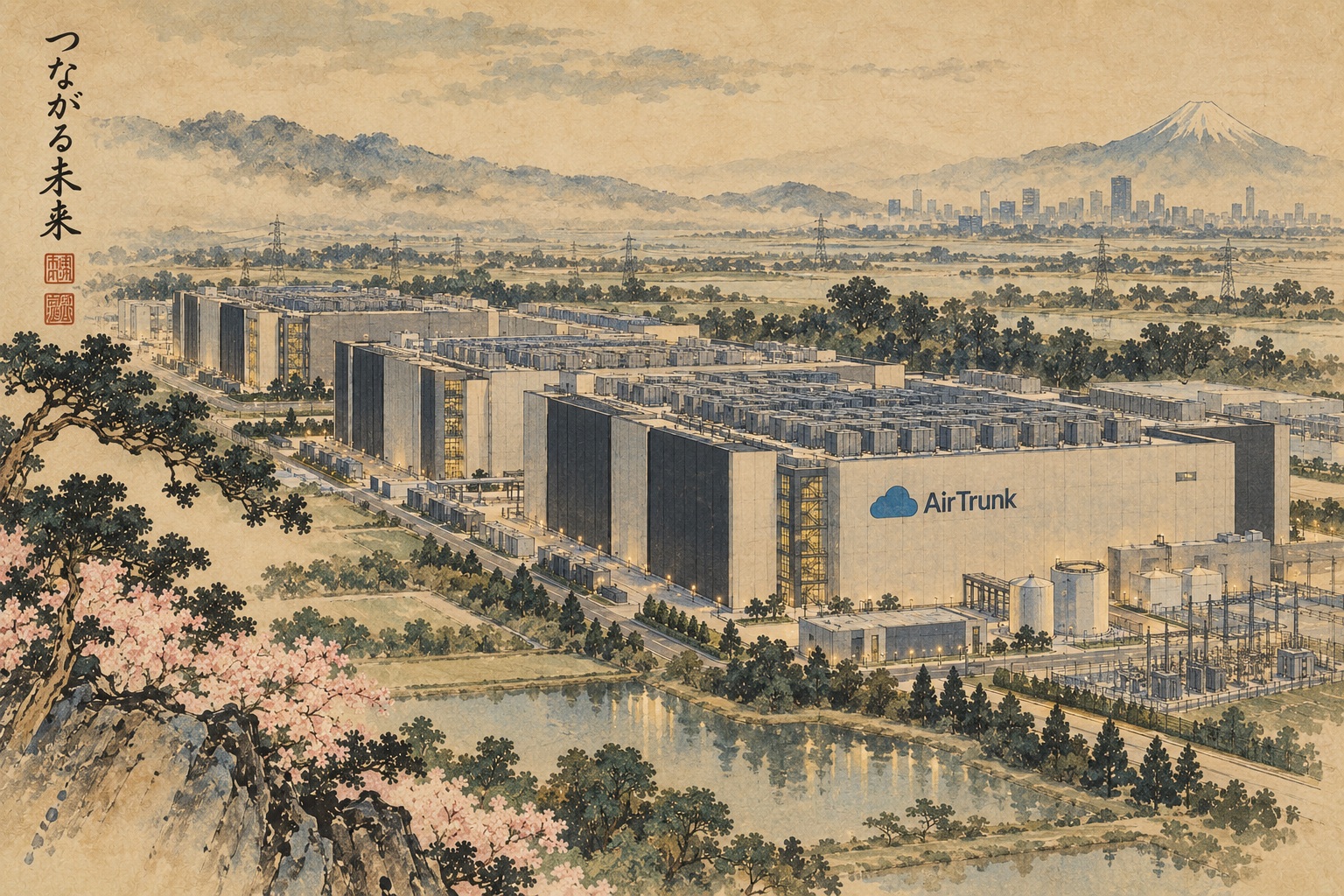
The cloud has a physical address in Japan, and one of its most important addresses is Inzai, Chiba. On October 7, Blackstone-backed AirTrunk said it would commit another $1 billion to its TOK1 hyperscale data-center campus there, extending a project already designed to scale beyond 300 megawatts as demand for cloud and artificial-intelligence computing accelerates.[1]
The number sounds like a real-estate investment. It is better understood as an infrastructure investment. A hyperscale data center requires not only buildings but high-voltage electricity, cooling systems, fiber routes, backup power, financing and enough land to add capacity years before customers need it. AI is turning the data center from an invisible back-office facility into something closer to a power-intensive industrial utility.
The new $1 billion is being layered onto an already enormous buildout
The October investment is not the beginning of TOK1. AirTrunk has been expanding the campus in phases for years. In March 2026 it secured a ¥191.6 billion — about $1.24 billion — green loan to refinance existing facilities and fund further development. The company described it as the largest data-center financing completed in Japan.[2]
At the same time, AirTrunk said it had started work to add more than 100MW of IT load to meet near-term customer demand. In data-center economics, megawatts matter at least as much as square meters. A facility can only support as much computing equipment as its electrical and cooling systems can sustain.
Why Inzai became one of Japan’s data-center capitals
Inzai sits outside central Tokyo, but for data centers that is a feature rather than a weakness. It remains close enough to the capital’s financial, corporate and network infrastructure to keep latency low, while offering larger parcels of land and more room for power infrastructure than central Tokyo.
AirTrunk itself describes TOK1 as strategically positioned in Inzai’s established data-center hub, with access to Tokyo’s central business district, airports and ports. The campus is carrier-neutral, supports multiple fiber paths and uses dedicated 66kV high-voltage power feeds.[3]
In AI infrastructure, electricity is the critical asset
AI computing is changing the electrical profile of data centers. Large GPU clusters can consume far more power per rack than conventional enterprise servers and produce much more heat. Cooling, substations and grid connections therefore become first-order constraints.
That is why the power architecture at TOK1 matters. AirTrunk has emphasized dedicated high-voltage substations and adjacent utility infrastructure since the campus was first developed. The AI boom is increasing demand not only for chips but for substations, transformers, cooling equipment and long-term power availability.
AirTrunk grew around one idea: build at hyperscale
Founded in 2015, AirTrunk expanded from Australia by targeting the requirements of hyperscale cloud customers — companies that often need tens or even hundreds of megawatts rather than a few server rooms. Its model is campus-based: secure large sites, power and connectivity, then add buildings as customers grow.
In September 2024, Blackstone and the Canada Pension Plan Investment Board agreed to acquire AirTrunk at an enterprise value above A$24 billion. Blackstone described the deal as its largest investment in Asia-Pacific. At the time, AirTrunk had more than 800MW of capacity committed to customers and land capable of supporting more than 1GW of future growth.[4]
Blackstone was buying scarce AI infrastructure, not just property
Blackstone has framed data centers as one of its highest-conviction digital-infrastructure themes. The logic is straightforward: AI demand may grow quickly, but sites with sufficient power, network access, land and development approvals cannot be created instantly.
That scarcity makes expansion rights valuable. Inzai’s appeal is not simply that TOK1 exists today; it is that the campus can continue to absorb new buildings and new electrical load. As AI customers plan several years ahead, the ability to promise future capacity becomes part of the product.
AirTrunk already operates more than 430MW in Japan
AirTrunk says its Japanese platform now provides more than 430MW of capacity across TOK1, TOK2 in western Tokyo and Osaka facilities. TOK2 alone can scale beyond 110MW, giving customers geographic diversity inside the broader Japanese market.[5][6]
That diversity matters in a country exposed to earthquakes, typhoons and other natural hazards. Large cloud customers generally design around multiple availability zones and redundant locations rather than relying on one campus.
Tokyo still attracts the gravity
Japan has long discussed moving data-center capacity beyond the Tokyo and Osaka regions. But data centers benefit from network effects. Tokyo concentrates financial institutions, corporate users, cloud availability zones, telecom carriers and technical talent. New infrastructure therefore continues to cluster around the capital even as policymakers promote geographic diversification.
Inzai is a compromise between those forces. It participates in Tokyo’s network ecosystem while offering more land and electrical infrastructure than a central-city site.
What PUE 1.15 does — and does not — mean
AirTrunk gives TOK1 a design PUE of 1.15. Power Usage Effectiveness measures total facility electricity divided by electricity used by IT equipment. A value closer to 1 indicates less overhead for cooling, lighting and other non-compute systems.[3]
But a low PUE does not mean low total energy consumption. A highly efficient 300MW campus still represents extraordinary absolute demand. The sustainability question in the AI era is therefore moving from “how efficient is this building?” to “what generation, transmission and storage system will supply the next hundreds of megawatts?”
The ¥191.6 billion loan shows how finance is changing
AirTrunk’s March financing was coordinated by Sumitomo Mitsui Banking Corporation, MUFG Bank, Crédit Agricole and Société Générale, with a broader group of domestic and international banks participating.[2]
That financing structure illustrates the maturation of data centers as long-duration infrastructure assets. Lenders are underwriting not only property but multi-year customer contracts, power access, operating efficiency and expansion rights. The AI boom is therefore affecting bank balance sheets and infrastructure funds as much as technology-company capital budgets.
The Japanese construction supply chain matters too
AirTrunk works with Daiwa House Industry on TOK1 and TOK2, citing the Japanese builder’s local construction experience, relationships and execution capability.[5]
That relationship highlights the domestic spillover from foreign-backed digital infrastructure. Hyperscale campuses create demand for civil construction, electrical systems, chillers, backup generators, substations, fiber, security and long-term maintenance. The $1 billion commitment is therefore not confined to one company’s balance sheet.
Can a giant data center remain a good neighbor?
Data centers are often less visibly industrial than factories, but they still affect communities through land use, visual impact, power demand, water use, construction traffic and emergency-generation systems.
AirTrunk points to biodiversity and community programs in Inzai, including woodland cleanup and ecological-restoration work.[5] Those efforts will become more important as campuses grow. Around the world, local opposition to data-center development is increasingly focused on electricity, water and transparency. Japan is unlikely to be exempt from that debate.
The physical reality behind Japan’s AI ambitions
Governments can promote AI adoption, but compute capacity does not appear automatically in “the cloud.” It requires GPU racks, land, grid connections and cooling capacity.
Japan is now seeing multiple projects on that scale. On October 1, JERA, Dell Technologies and RHAELM announced plans for a 400MW AI data-center project in Chiba. Reuters reported an estimated investment of $15 billion, with phased operations targeted from 2028.[7]
AirTrunk’s expansion belongs to the same structural shift. AI infrastructure is becoming a competition for power and sites as much as for software and semiconductors.
The next bottleneck may be supply, not demand
AI demand is not guaranteed to rise in a straight line. Yet for developers, the immediate constraint appears to be how quickly they can secure power, land, equipment and construction capacity. A hyperscale data center can take years to bring online because the project includes utility interconnection, substations, fiber, customer fit-out and commissioning.
That is why capacity is built ahead of confirmed future usage. If developers wait until every customer requirement is visible, they are already too late.
The significance of AirTrunk’s new $1 billion commitment is therefore larger than one campus. In Inzai, Japan is building the physical layer beneath its digital economy: the substations, financing, construction capability and high-density compute infrastructure that will determine how much AI the country can actually run.
Sources and references
- Reuters, “Blackstone-backed AirTrunk to invest $1 billion in Japan data centre campus,” October 7, 2026.
- AirTrunk, TOK1 green financing, March 10, 2026.
- AirTrunk, TOK1 Tokyo East campus specifications.
- Blackstone, AirTrunk acquisition agreement, September 4, 2024.
- AirTrunk, Japan operations.
- AirTrunk, TOK2 opening and Japan capacity.
- Reuters, “JERA teams up with Dell, RHAELM on Japan's AI infrastructure,” October 1, 2026.
Reporting and verification cutoff: October 7, 2026. The detailed phasing of the new $1 billion investment, ultimate live capacity, customer identities and full power-supply arrangements have not been publicly disclosed. Capacity figures are based on AirTrunk’s published specifications.