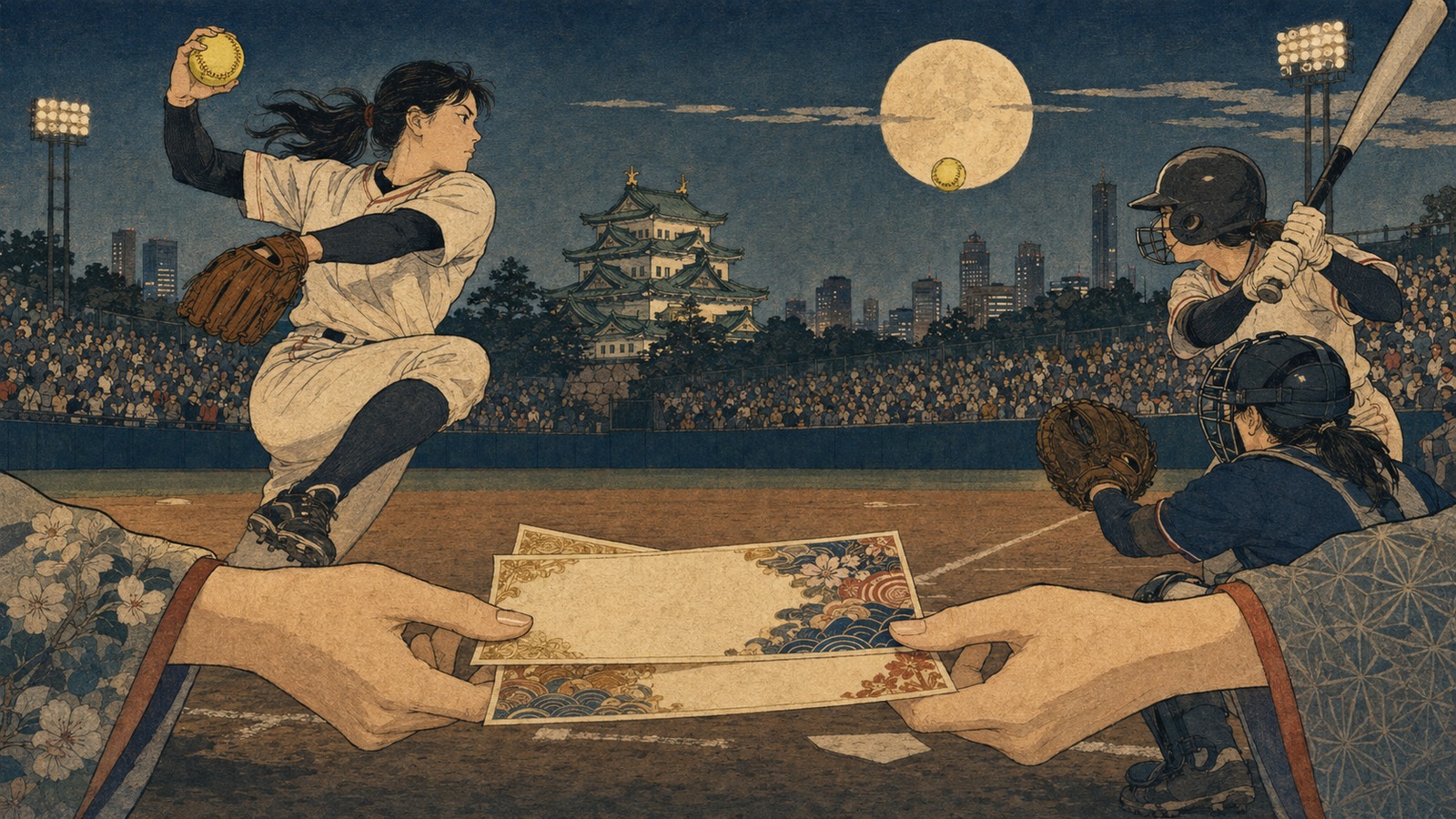
A ticket changes character when a schedule acquires names.
Before the draw, “softball” was a box on the Aichi–Nagoya 2026 sales site. After it, a seat in Anjo became Japan against the Philippines on the opening afternoon, Japan against Chinese Taipei near the end of the week, or perhaps the final in which the host nation could chase a seventh consecutive Asian Games gold medal.
The organizing committee’s two early-August notices therefore solve opposite sides of the same problem. One fixes the sporting uncertainty: who plays whom, where and when. The other gives a spectator whose plans have changed an authorized route to release an eligible ticket. Between them, the 20th Asian Games—an immense 16-day program of 43 sports and 53 venues—becomes a set of decisions ordinary people can make.
What the official exchange actually does
The service is not an invitation to speculate on scarce tickets. It is the organizer-approved channel for holders who can no longer attend to offer certain electronic tickets to another buyer within the event’s controlled system. That distinction matters in Japan, where the Ticket Unauthorized Resale Prohibition Act took effect in June 2019. The law targets commercial, unauthorized resale of specified event tickets above their sale price; government guidance directs consumers to organizer-authorized exchanges and warns that tickets bought through unofficial channels may be invalid or never arrive.
For Aichi–Nagoya 2026, resale submissions opened at 5:00 p.m. on August 4. The ordinary deadline is 11:59 p.m. three days before the relevant session. Ceremony deadlines will be announced separately. A listing is not the same as a completed sale, and the live official site—not a screenshot or social-media post—should be checked for current availability, settlement terms and any service charge.
| Generally eligible | Not eligible or temporarily excluded |
|---|---|
| Electronic tickets bought through the official ticket information and sales site using credit card, debit card or Google Pay | Hospitality packages, Ouen Plus and Premium Plus products |
| General, child, disability-discount, wheelchair and Heartful ticket types | Tickets obtained outside the official sales route, subject to the announced Ticket Pia exception |
| Opening and closing ceremonies and competition sessions, unless a specific exclusion applies | Tickets from the additional sale for supporter-ID registrants |
| Softball sessions were not on the temporary-exclusion list published August 3 | Sessions whose competition schedule may change; the initial list included certain football sessions and all handball, weightlifting, water polo and cricket sessions |
The exclusions reveal the logic of the system. A resale platform can only promise clarity when the underlying product is stable. If a session time may move, transferring it too early could simply pass the same problem to a new spectator. Premium packages also combine more than a seat—hospitality, benefits or bundled services—so they cannot automatically be treated like a standard admission ticket.
- Enter through the official Aichi–Nagoya 2026 ticket information and sales site.
- Confirm that the ticket type, payment method and session are eligible.
- Check the exact deadline; the normal three-day rule does not govern every product.
- Do not assume a ticket is sold merely because it has been submitted.
- Avoid person-to-person offers that bypass the official route, even if a QR-code image is shown.
This is more than consumer housekeeping. An empty seat can coexist with a sold-out notice when the original holder cannot attend. A functioning exchange converts that stranded entitlement back into potential attendance. At Anjo Softball Ground, whose planned capacity is about 2,500—roughly 1,000 infield and 1,500 outfield places—hundreds of reclaimed seats would materially change the sound and feel of a session.
An eight-team week in which every game counts
The women’s tournament uses a pure round robin. Japan, Chinese Taipei, China, the Philippines, Singapore, South Korea, Hong Kong, China, and Thailand each play the other seven once. That produces 28 preliminary games from September 26 through October 2. There are no semifinals: first and second advance directly to the October 3 final, while third and fourth meet for bronze.
This format turns every early result into part of the medal calculation. A favored team cannot treat the first half of the week merely as warm-up, because one upset may determine whether it reaches the final or falls into the bronze game. Organizers list the teams in World Baseball Softball Confederation ranking order, but the standings will be written on the field.
| Date | Japan’s preliminary game | Why it matters |
|---|---|---|
| Sept. 26 · 3:15 p.m. | Philippines | Opening game for the host and the first test of tournament rhythm |
| Sept. 27 · 3:15 p.m. | Thailand | Second game in as many days; pitching management begins to matter |
| Sept. 28 · 3:15 p.m. | Hong Kong, China | Completes the opening three-day block |
| Sept. 29 · 3:15 p.m. | Singapore | Midpoint of the seven-game round robin |
| Sept. 30 · 3:15 p.m. | South Korea | Starts the decisive East Asian closing sequence |
| Oct. 1 · 3:15 p.m. | Chinese Taipei | Perennial medal contender immediately before the finale |
| Oct. 2 · 3:15 p.m. | China | Final preliminary game against the tournament’s original dynasty |
| Oct. 3 | Bronze, 10:00 a.m.; final, 2:00 p.m. | Third vs. fourth, then second vs. first |
Japan’s seven preliminary games all begin at 3:15 p.m., a rare simplicity for supporters planning rail travel or work leave. Yet the calendar grows harder as it advances. The host closes against Chinese Taipei and China—the two programs most closely tied to the tournament’s medal history. If the standings are tight, the last 48 hours may function like semifinals even though the bracket contains none.
The dynasty China began and Japan inherited
Women’s softball entered the Asian Games at Beijing in 1990. China won that first tournament, then repeated at Hiroshima in 1994 and Bangkok in 1998. The early history belonged to one power: three editions, three Chinese gold medals.
Japan broke the sequence at Busan in 2002. It has not surrendered the title since—winning at Doha in 2006, Guangzhou in 2010, Incheon in 2014, Jakarta–Palembang in 2018 and the postponed Hangzhou Games, staged in 2023. Six consecutive golds are not one generation’s achievement; they are an institutional relay across changing rosters, coaches and Olympic cycles.
1990 · Beijing: Women’s softball debuts; China wins gold.
1994 · Hiroshima: China retains the title on Japanese soil.
1998 · Bangkok: China completes a three-title opening dynasty.
2002 · Busan: Japan wins its first Asian Games softball gold.
2006–2018: Japan adds four more consecutive championships.
2023 · Hangzhou: Japan defeats China in the final for a sixth straight gold.
2026 · Anjo: The host seeks an unprecedented seventh consecutive title.
The candidate roster announced by the Japan Softball Association makes that continuity visible, but it must not be mistaken for a final entry list. It includes Yukiko Ueno, whose career has stretched from Sydney 2000 to the present; left-hander Miu Goto, born in Aichi and already an Olympic champion; and players from many of the corporate clubs that sustain Japan’s domestic game. Selection can change before accreditation, and confirmed starters cannot be inferred from a candidate list.
Ueno, 413 pitches, and an Olympic sport that disappeared
Softball’s modern Japanese mythology was written in Beijing in 2008. Ueno threw 413 pitches across three games in two days, including the gold-medal victory over the United States. Japan had finished fourth at the sport’s 1996 Olympic debut, won silver at Sydney 2000 and bronze at Athens 2004. Beijing completed the climb.
Then the sport vanished from the Olympic program. Softball and baseball had been voted out for London 2012 and did not return at Rio 2016. The Asian Games became more than a continental medal event: it was one of the few recurring multisport stages on which national programs could preserve visibility, public funding and a story of international consequence.
Tokyo restored softball as a host-proposed additional sport for the Games held in 2021. In an almost empty Yokohama Stadium, Japan beat the United States 2–0 for another gold. Ueno started, Goto relieved, and Ueno returned to close—a handoff between eras performed inside one game. Softball was omitted at Paris 2024 but is approved for Los Angeles 2028, where its deep North American roots make its return fitting.
Why Anjo is the right place
Anjo sits in the industrial belt southeast of Nagoya, a landscape shaped by rail lines, supplier plants and the automotive economy. Japanese women’s softball grew inside this corporate geography. Company teams offered training, employment, coaching and durable leagues at times when a fully professional market did not exist. The modern JD.LEAGUE is a more public, competitive version of that inheritance.
Aichi is one of its densest strongholds. Toyota Red Terriers are based in Toyota, Toyota Industries Shining Vega in Kariya, Denso Bright Pegasus in Anjo and Tokai Rika Cherry Blossoms in Oguchi. Anjo regularly hosts league rounds and is Denso’s home city. Several candidate national-team players compete for Aichi clubs; Goto grew up in the prefecture. The Asian Games are therefore arriving in a community that already understands the speed of a rise ball and the tactical value of a one-run lead.
The venue is the existing Anjo Softball Ground at the city’s sports park, not a new monumental stadium. The Games master plan lists a capacity of about 2,500. That modest scale fits both the event’s strategy of using existing facilities and softball’s intimacy: the snap of a pitch into the catcher’s glove, dugout calls and infield communication remain audible.
It also raises the stakes of ticket circulation. In a 50,000-seat arena, one unused ticket disappears into the architecture. In Anjo, each occupied row contributes to the atmosphere. An official exchange can connect a supporter who can no longer travel with another who has just discovered that Japan–China is scheduled for Friday afternoon.
A third Japanese Asian Games
The Asian Games began in New Delhi in 1951, six years after the Second World War. The founding idea, associated with Indian Prime Minister Jawaharlal Nehru, was that sport might rebuild bonds among Asian countries torn apart by war. Eleven countries, including Japan, attended the first edition. The event now brings together 45 national and regional Olympic committees and a program that mixes global Olympic sports with Asian disciplines such as kabaddi, sepak takraw and wushu.
Japan hosted in Tokyo in 1958 and Hiroshima in 1994. Aichi–Nagoya 2026 is the country’s third Asian Games and its first in 32 years. The opening ceremony is scheduled for September 19 and the closing ceremony for October 4. Softball begins a week into the Games and ends the day before the closing ceremony, making its medal games part of the final surge.
The organizing challenge is distributed. Rather than concentrate everything behind one gate, Aichi–Nagoya uses venues across cities and, for some sports, other prefectures. That reduces the need for new construction but transfers complexity to transport, digital ticketing, session changes and communication. A resale policy is a small administrative feature measured against a continental festival, yet it is precisely where a mega-event touches an individual: Can I attend? Is this ticket genuine? What happens if my plans change?
What remains unknown
Important details are still moving. The resale announcement defines eligibility and timing, but users should confirm the live platform’s current price, fee, refund and settlement rules before transacting. A submitted ticket may not find a buyer. Sessions can be added to or removed from the temporary-exclusion list if schedules change.
The softball matchups are confirmed, but the final team rosters, probable pitchers and medal-game participants are not. The Japan Softball Association’s published list is a pool of candidate players. Seven round-robin games must decide who reaches the final, and weather or operational needs can still affect match-day information. Spectators should recheck official notices before travel.
Those cautions do not diminish the significance of August’s announcements. They make it legible. Japan’s long dynasty now has seven dates and seven opponents. China’s first dynasty waits at the end of the preliminary calendar. Chinese Taipei stands the day before. Around them are five national programs with their own ambitions and a format that rewards consistency, not reputation.
And somewhere outside Anjo, a ticket holder may learn that work, illness or travel has made attendance impossible. The official exchange offers a narrow bridge from that disappointment to another person’s day at the ballpark. If the seat is filled on October 3, the buyer will not see a transaction. They will see a pitch, a swing and perhaps the next line in a 36-year Asian Games story.
Reporting notes and primary sources
This report distinguishes the official resale submission window from a guaranteed sale, and the Japanese candidate-player pool from a final roster. Price, fee and settlement terms should be confirmed in the live official ticket service.
- Aichi–Nagoya 2026 Organizing Committee: official ticket resale service announcement, Aug. 3, 2026
- Official Asian Games ticket information and sales site
- Organizing Committee: women’s softball match schedule, Aug. 3, 2026
- Aichi–Nagoya 2026 Games Master Plan: venue and capacity
- Japan Softball Association: 20th Asian Games overview and candidate players
- Japan Softball Association: women’s national-team history
- WBSC: Japan’s sixth consecutive Asian Games gold
- Organizing Committee: history of the Asian Games
- Government of Japan: Ticket Unauthorized Resale Prohibition Act guidance