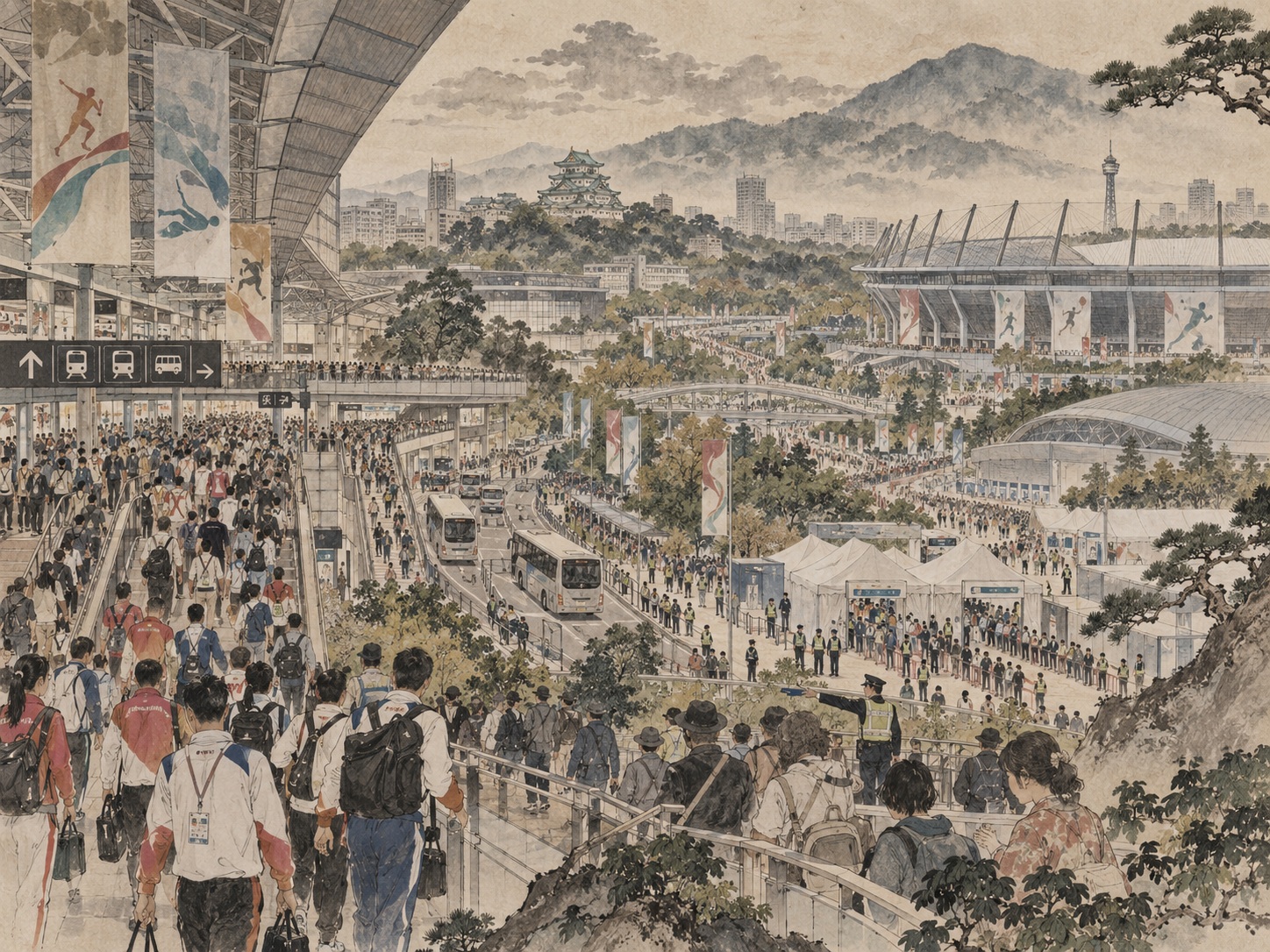
Aichi-Nagoya 2026 produced world records, teenage champions and a huge medal program. But one of the most consequential legacies of the Games may come from something less glamorous: where athletes slept, how they reached training, and whether a lower-cost mega-event can remain reliable when participation exceeds the plan.
On October 3, Japanese Olympic Committee President Seiko Hashimoto said organizers needed to reflect on and learn from the operational problems that affected accommodation and transportation. According to Reuters, planners had expected about 15,000 athletes and officials; participation eventually reached roughly 17,000, placing significant strain on a lodging and transport system built around a distributed model rather than a conventional athletes’ village.[1]
The key decision was not to build a traditional village
To understand the operational problems, it is necessary to understand the hosting model.
Aichi Prefectural Assembly materials describe a policy of making the Games as compact and sustainable as possible by maximizing existing facilities. Rising material and labor costs, inflation and the political legacy of Tokyo 2020 made large new construction increasingly difficult to justify. Plans for the original athletes’ village were abandoned in favor of hotels and other temporary solutions.[3]
That choice had real advantages. A conventional village can create major post-Games redevelopment risk, long-term maintenance obligations and a large upfront capital bill.
Accommodation was split across several systems
Organizers created a major lodging cluster around Nagoya Port.
Plans called for temporary modular accommodation at Garden Pier for roughly 2,000 participants and a cruise ship at Kinjo Pier for roughly 4,000, linked by shuttle buses. Other athletes and officials were distributed across hotels and additional facilities.[4]
The modular units were also promoted as potentially reusable for disaster-response purposes after the Games. The cruise ship avoided permanent construction altogether. From a legacy and capital-cost perspective, the approach was innovative.
The problem was bigger than the number of beds
The late increase of about 2,000 participants mattered, but reports showed that the difficulties were not simply a shortage of rooms.
Teams reported room-assignment problems, cramped accommodation, beds considered too small for some athletes, long waits after arrival and bus delays or failures that interfered with training schedules. Organizing officials publicly apologized for mistakes involving accommodation and transportation and said they were identifying causes and trying to prevent repetition.[1][5]
A distributed model trades construction risk for coordination risk
A traditional athletes’ village concentrates dining, transport staging, team headquarters, medical support, security, baggage handling and athlete services in one place.
Aichi-Nagoya reduced permanent construction by spreading participants across hotels, temporary lodging and a ship. That increased the number of operating nodes, each with different travel times, meal systems, staffing and links to competition venues.
If participant numbers match the model, that flexibility can work. When numbers rise, complexity increases sharply. Two thousand extra people do not require only two thousand extra beds. They also require meals, buses, accreditation, baggage handling, cleaning, team services and training transport.
Transport risk was recognized before the Games
Transport was not an entirely unforeseen problem. In June 2026, Aichi Prefectural Assembly discussions specifically raised concerns that Games buses, spectator vehicles and normal traffic would create congestion.
The prefecture said roadworks would be suppressed on designated Games routes during the main competition period, generally from early morning until late evening, to protect athlete and official transport.[6]
The issue, therefore, was not failure to recognize transport as a risk. It was whether the operating system had enough resilience to absorb actual participant numbers and the complexity of multiple lodging and competition sites.
Missing practice transport becomes a sporting-equity issue
Transport failures are not merely hospitality failures. Reuters video captured a Mongolia women’s basketball coach saying a team had to cancel planned shooting practice because the bus did not arrive.[7]
At that point, logistics begins to affect competitive preparation. A delayed airport transfer is inconvenient; a missed training session can influence performance.
Were the cruise ship and modular rooms themselves a failure?
The evidence is mixed.
Some athletes and staff gave positive assessments of the temporary accommodation and dining. Reuters footage included a Philippines women’s basketball coach saying the Garden Pier lodging was well thought out and provided what the team needed.[5]
Others complained about room size and bed dimensions. The same physical model therefore produced different experiences depending on sport, athlete size, team composition and length of stay.
The Olympic Council of Asia still called the Games a success
Despite the operational criticism, the Olympic Council of Asia described the Games overall as successful. Reuters reported that organizers saw revenue around 20% above projections, strong viewing figures and dozens of world and continental records.[8]
OCA officials also argued that avoiding a permanent athletes’ village reduced the risk of costly post-Games infrastructure.
That makes Aichi-Nagoya difficult to classify simply as a success or failure. The sporting output and legacy-light capital model had strengths; the consistency of athlete services did not always match them.
The comparison with Hiroshima 1994 matters
Japan previously hosted the Asian Games in Tokyo in 1958 and Hiroshima in 1994. Hiroshima is often remembered for community exchange programs and a more compact metropolitan footprint.
Aichi-Nagoya was larger and more geographically dispersed, with events extending beyond the immediate host area. The operating challenge therefore resembled a network of venues rather than a single-city Games.[2]
Tokyo 2020 taught Japan not to overbuild
The policy environment after Tokyo 2020 strongly shaped Aichi-Nagoya.
Japan emerged from the Olympics with intense scrutiny of costs, construction, corruption cases and pandemic-related expenditure. Aichi’s own policy discussions explicitly referenced that environment, along with inflation and higher building costs, in explaining the emphasis on existing venues and reduced permanent construction.[3]
In that sense, “no conventional village” was not reckless. It was a direct response to the political and financial lessons of the previous mega-event.
But a low-build Games requires more operational capability
Reducing hard infrastructure increases the importance of soft infrastructure.
A distributed accommodation model requires integrated dispatch, real-time vehicle tracking, backup buses, multilingual communication, consolidated lodging inventory, baggage systems, security coordination and strong links with national Olympic committees.
The infrastructure has not disappeared. It has moved from concrete into management systems.
How much contingency should a mega-event carry?
Organizers have said late growth in participation created major pressure. Reuters reported the increase from around 15,000 expected participants to roughly 17,000.[1]
That is a legitimate explanation, but mega-events are inherently volatile. Team sizes, qualification, delegation structures and scheduling can move late in the planning cycle.
The deeper question is how much spare capacity — beds, buses, staff, dispatch capability — a host should carry for conditions that may never occur.
Efficiency and redundancy pull in opposite directions
Unused hotel rooms, spare buses and extra staff look inefficient when nothing goes wrong. Yet those same resources become resilience when participation rises or traffic disruptions occur.
The Aichi-Nagoya experience suggests that aggressive cost optimization can weaken the buffer that protects service quality.
Doha 2030 is emphasizing compactness
The next Asian Games host, Doha, has emphasized a compact model using clusters of existing venues built for recent international events. Reuters reported that Doha organizers intend to use existing infrastructure and tight geographic clustering to simplify logistics.[9]
That is an important contrast. Two hosts can both avoid major new construction, but the one with more compact lodging and venues may face a very different operational burden.
The lesson matters for Japan’s future bids
Countries and cities are already considering bids for the 2036 Olympics and other major sports events. If Japan eventually seeks another global mega-event, it will need a model that answers both sets of domestic concerns: Tokyo 2020’s cost and governance controversies, and Aichi-Nagoya 2026’s distributed-operations problems.
Using existing facilities and minimizing permanent construction will probably remain the right direction. But it cannot be the entire strategy.
The real legacy may be operational resilience
The most useful legacy from a modern mega-event may not be another stadium.
Integrated transport management, multilingual operations, shared lodging systems, real-time incident response, volunteer deployment, medical coordination and national-team communication can all become capabilities useful for tourism, disasters and future events.
Aichi-Nagoya 2026 showed that a “no new village” Games is not necessarily a simpler Games. The less a host builds, the more precisely it must coordinate what already exists.
The competitions ended after 16 days. Whether the operational lessons are formally captured and institutionalized will determine whether the logistics problems become merely an embarrassment — or one of the most valuable legacies of the Games.
Sources and references
- Reuters, “Japan Olympics chief says Asian Games organisers must reflect after operational problems,” October 3, 2026.
- Japanese Olympic Committee, 20th Asian Games Aichi-Nagoya 2026.
- Aichi Prefectural Assembly, Asian and Asian Para Games special committee materials.
- Aichi-Nagoya organisers / Nagoya City, athlete accommodation hub plan.
- Reuters Connect, athlete accommodation reactions, September 25, 2026.
- Aichi Prefectural Assembly, transport and roadwork planning, June 25, 2026.
- Reuters Connect, transport problems and organiser apology, September 25, 2026.
- Reuters, “Despite logistical problems, OCA says Aichi-Nagoya Asian Games are a success,” October 4, 2026.
- Reuters, Doha 2030 organising plans, October 1, 2026.
Reporting and verification cutoff: October 7, 2026. A full official post-Games review has not yet been published. This article distinguishes between documented pre-Games operating plans, reported problems during the event and interpretations about future hosting policy.